
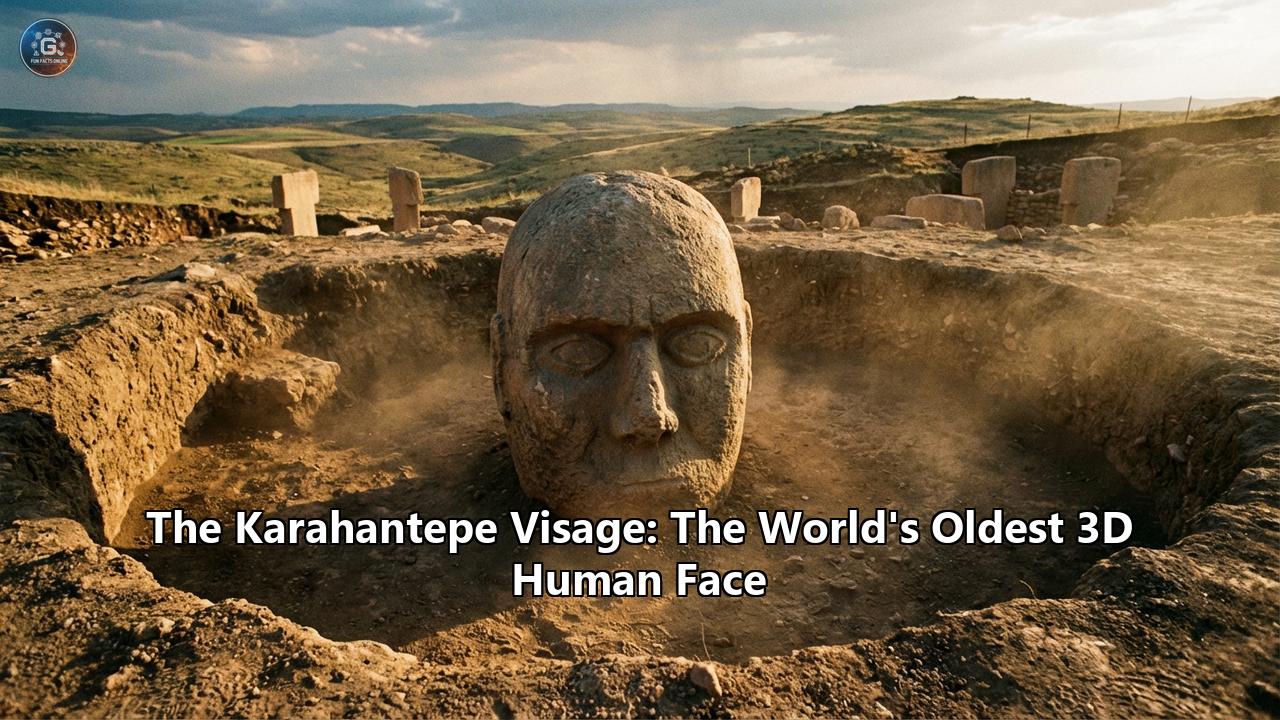
The dust of eleven millennia has been brushed away, and from the limestone bedrock of southeastern Turkey, a face has emerged to stare directly into the eyes of the modern world. It is a gaze that defies the abstract, a visage of haunting realism that shatters our previous understanding of the prehistoric mind. This is the Karahantepe Visage.
In the rolling "Stone Hills" (Taş Tepeler) of the Şanlıurfa province, roughly 35 kilometers from the world-renowned Göbekli Tepe, a discovery was made in the autumn of 2023 that has sent shockwaves through the archaeological community. It is a find that does not merely add a footnote to history; it rewrites the opening chapters of the human narrative. While Göbekli Tepe introduced us to the monumental architecture of the hunter-gatherers, Karahantepe has introduced us to the people themselves—not as stylized symbols or faceless figures, but as three-dimensional, anatomically detailed, and psychologically complex human beings.
This article explores the depths of this discovery, the anatomy of the "Visage," and the mysterious culture that carved it, shedding light on the dawn of human self-awareness.
Part I: The Awakening in the Stone
For decades, the standard narrative of the Neolithic Revolution—the critical transition from nomadic hunting and gathering to settled agriculture—was one of economic necessity. We believed that people settled down to farm, and only then did they have the resources to build temples, create complex art, and develop religion. The discoveries in Upper Mesopotamia have inverted this pyramid. We now know that the impulse for the sacred, for ritual, and for artistic expression likely preceded and perhaps even drove the transition to sedentary life.
The excavations at Karahantepe, led by Professor Necmi Karul and his team as part of the Taş Tepeler project, have been unearthing a site that is in many ways more enigmatic than its sister site, Göbekli Tepe. While Göbekli Tepe is famous for its circular enclosures and T-shaped pillars adorned with wild animals—scorpions, vultures, boars, and lions—Karahantepe presents a shift in focus. Here, the lens turns inward. The "beast" is no longer just the animal outside; the focus is the human within.
The pinnacle of this shift was revealed with the unearthing of two specific artifacts that compete for the title of the "World's Oldest 3D Human Face." The first is a colossal, 2.3-meter-tall statue of a seated man, and the second is a T-shaped pillar carved with a distinct, realistic human face. Together, they form the "Karahantepe Visage," a dual revelation of how our ancestors saw themselves.
The Seated Giant: The "Ribbed Man"
The most striking figure is the 2.3-meter (7.5 foot) high statue found in the enclosure known as Structure AD. Unlike the "Urfa Man"—the famous life-sized statue found near Balıklıgöl which dates to a similar period but is stiff and lacks a mouth—the Karahantepe statue is a masterclass in expressive dynamism.
Carved from limestone, the figure is seated on a stone bench. His posture is rigid yet alive. The most arresting feature is the realism of his anatomy. The ribs are prominently carved, protruding against the skin in a way that suggests emaciation or perhaps the state of a corpse, earning him the nickname "The Corpse Statue" or "The Ribbed Man" among some circles. The spine is detailed, the shoulders broad.
But it is the face that captivates. The facial expression is not blank. It possesses a heavy, perhaps somber brow, deep-set eyes, and a mouth that seems poised to speak or grimace. It is a specific face, possibly a portrait of a real individual—a shaman, a chief, or a revered ancestor—rather than a generic symbol.
In a gesture of profound symbolic weight, the figure holds his phallus with both hands. This is not the crude graffiti of later eras but a potent symbol of vitality, lineage, or perhaps the duality of life and death. The contrast between the skeletal ribs (death) and the phallus (life) suggests a complex theological narrative about regeneration and the cycle of existence.
The Face in the Pillar
Simultaneous to the discovery of the seated giant, archaeologists uncovered another face that broke a 12,000-year-old rule. At Göbekli Tepe and other sites, the T-shaped pillars are understood to be abstract human forms—the horizontal bar representing the head, the vertical shaft the body. They have arms and belts, but never faces. They are faceless watchers, perhaps gods too terrible or too abstract to depict.
At Karahantepe, that rule was broken. On one of the T-pillars in a domestic-ritual structure, a three-dimensional human face was found carved directly out of the stone. It has a prominent nose, a strong jaw, and deep eyes. It emerges from the stone as if the human spirit is fighting to free itself from the abstract geometry of the pillar. This represents a cognitive leap: the moment the "gods" or "spirits" gained a human face.
Part II: The Stage of the Ancestors
To understand the Visage, we must understand the stage upon which it sits. Karahantepe is not a city in the modern sense; it is a sanctuary, a gathering place, and perhaps a theater of the macabre.
The site is dominated by "Structure AD," a large chamber carved directly into the living bedrock. This structure is often described as resembling an amphitheater. One side features a long bench carved from the rock, where the seated giant was found. The other side features a series of pillars.
Adjacent to this is the "Phallus Pit" (Structure AB), one of the most baffling architectural features of the Neolithic world. It is a rock-cut chamber containing eleven T-shaped pillars carved directly from the floor, resembling phalluses, alongside a protruding human head carved from the rock wall. The head, with a serpentine neck, gazes out over the pillars. This room was not entered by a door; it was likely accessed by a small window or opening, suggesting it was a space for looking into, or for specific, restricted rituals.
The architecture of Karahantepe creates a controlled experience. The interplay of light and shadow, the subterranean nature of the rooms (many were roofed and semi-underground), and the staring faces of stone would have created an atmosphere of intense psychological power.
Part III: The "Winter" of Karahantepe
Archaeologists have begun to draw fascinating contrasts between Göbekli Tepe and Karahantepe. While they overlap in time (Pre-Pottery Neolithic A and B, roughly 9600–8200 BCE), their artistic "vibe" differs.
Göbekli Tepe is often associated with the summer. Its carvings are teeming with life: spiders, snakes, scorpions, vultures, foxes. It is an externalized celebration (or fear) of the natural world.
Karahantepe, by contrast, has been described by some scholars as representing the "Winter." The art is more solemn, more focused on the human form, and perhaps more connected to death and initiation rituals. The "Ribbed Man" with his skeletal features reinforces this. If Göbekli Tepe was a cathedral of life and nature, Karahantepe might have been the cathedral of the ancestors and the underworld.
The location itself supports this. Situated in the Tek Tek Mountains, it is a rugged, harsh landscape. The builders of Karahantepe were hunter-gatherers, but they were not wandering aimlessly. They were complex, sedentary foragers who returned to these "Stone Hills" seasonally or lived there permanently to construct these monuments.
Part IV: The Meaning of the 3D Face
Why is the "3D" aspect so important?
In the history of art, the move from 2D incision (drawing on a wall) to high relief (shapes sticking out) to fully freestanding 3D sculpture (statues) represents a massive leap in technical skill and cognitive representation.
To carve the Karahantepe Visage, the artist had to:
- Conceptualize the human head in the round: Understanding volume, depth, and proportion from all angles.
- Master the Material: They were working with limestone, using tools made of flint and obsidian. They had no metal chisels. To achieve the smooth cheeks, the ridge of the nose, and the hollows of the eyes required immense patience and a technology of abrasion and chipping that was state-of-the-art for 9400 BCE.
- Assert the Ego: The creation of a realistic human face suggests a new level of self-importance. In the Paleolithic (Ice Age), humans were rarely depicted; animals ruled the cave walls of Lascaux and Altamira. Humans were stick figures, insignificant in the face of the bison and the mammoth. At Karahantepe, the human is the central subject. The human has become the "master" of the stone.
This marks the "Human Turn" in iconography. It suggests that these people were beginning to see themselves as distinct from the animal kingdom, perhaps even superior to it. It is the genesis of the anthropocentric worldview that defines civilization.
Part V: The Great Burial
One of the most haunting facts about Karahantepe is how it ended.
Like Göbekli Tepe, the structures at Karahantepe were not destroyed by war or natural disaster. They were deliberately buried. The people who built these magnificent halls and carved these staring faces spent immense effort to fill them in with rubble, earth, and stone chips.
The "Ribbed Man" was not toppled by an enemy. He was likely covered in the very earth from which he was hewn, sealed in a time capsule by his own creators.
Why?
Theories abound. Was it a ritual closure? Did the "power" of the site become too dangerous? Did the culture change, moving away from these intense rituals as they adopted agriculture more fully? Or was the act of building and burying the ritual itself—a cycle of creation and destruction mimicking the seasons?
The deliberate burial preserved the limestone faces in pristine condition, saving them from 11,000 years of erosion, allowing them to stare at us today with the same intensity as the day they were covered.
Part VI: The Taş Tepeler Project and the Future
Karahantepe is just one of twelve sites identified in the "Taş Tepeler" (Stone Hills) project. The region around Şanlıurfa is proving to be a megalopolis of the Neolithic. Sites like Sayburç, Sefertepe, and Harbetsuvan are yielding their own treasures. At Sayburç, a relief was found of a man holding his phallus while surrounded by leopards—a thematic cousin to the Karahantepe giant.
As excavation continues, we can expect more faces to emerge. The "Karahantepe Visage" is likely not alone. It is the ambassador of a lost people, a silent witness to the moment when humanity looked in the mirror and decided to carve what it saw.
Conclusion: The Gaze that Spans Millennia
The Karahantepe Visage is more than a statue. It is a psychological event. When you look at the photos of the "Ribbed Man," you are not looking at a primitive artifact. You are looking at a person. You see the tension in the neck, the shadow of the brow, the specific shape of the nose.
It forces us to abandon the idea of "primitive" man. The people of 9400 BCE were emotionally and intellectually modern. They felt the weight of mortality (the ribs), the drive of life (the phallus), and the need to be remembered (the stone).
In the silent, stony stare of the Karahantepe giant, we find a reflection of ourselves—an ancient selfie carved in limestone, reminding us that the search for meaning, for identity, and for permanence is as old as the first sunrise over the Stone Hills. The face has returned from the dark, and it has a lot to tell us.
Reference:
- https://www.karahantepe.net/news/karahan-tepe-human-statue
- https://en.wikipedia.org/wiki/Urfa_Man
- https://www.researchgate.net/publication/354865014_Buried_Buildings_at_Pre-Pottery_Neolithic_Karahantepe_Karahantepe_Canak_Comleksiz_Neolitik_Donem_Gomulu_Yapilari_2021
- https://arkeonews.net/new-discoveries-in-gobeklitepe-and-karahantepe-a-human-sculpture-with-a-realistic-facial-expression-found-in-karahantepe/
- https://www.theartnewspaper.com/2025/10/09/discovery-of-11000-year-old-carved-face-in-turkey-offers-new-insight-into-early-human-expression
- https://www.karahantepe.net/news/gobeklitepevskarahantepe
- https://bianet.org/haber/neolithic-amphitheater-uncovered-at-karahantepe-archaeological-site-313926
- https://www.youtube.com/watch?v=RDpEPpjb4-U
- https://hispanatolia.com/en/archaeology-faces-found-at-karahantepe-support-gobeklitepe-human-theory/
- https://www.smithsonianmag.com/smart-news/a-human-face-was-carved-into-this-stone-pillar-in-turkey-11000-years-ago-180987489/
- https://www.ancient-origins.net/news-history-archaeology/neolithic-amphitheater-karahantepe-00102343
- https://dergipark.org.tr/en/download/article-file/1683122
- https://tastepeler.org/en/yerlesmeler/karahantepe
- https://www.easternturkeytour.org/urfa-man/
- https://www.ancient-origins.net/news-history-archaeology/karahan-tepe-0019457
- https://newseu.cgtn.com/news/2025-12-07/In-T-rkiye-ancient-carved-faces-shed-new-light-on-Neolithic-society-1IRzubkiLtK/p.html
- https://www.iflscience.com/karahan-tepe-the-stunning-sister-of-g-bekli-tepe-is-just-as-mysterious-67279
- https://en.wikipedia.org/wiki/Karahan_Tepe
- https://trendsmena.com/investigations/excavations-in-turkey-provide-vital-clues-about-human-history/