
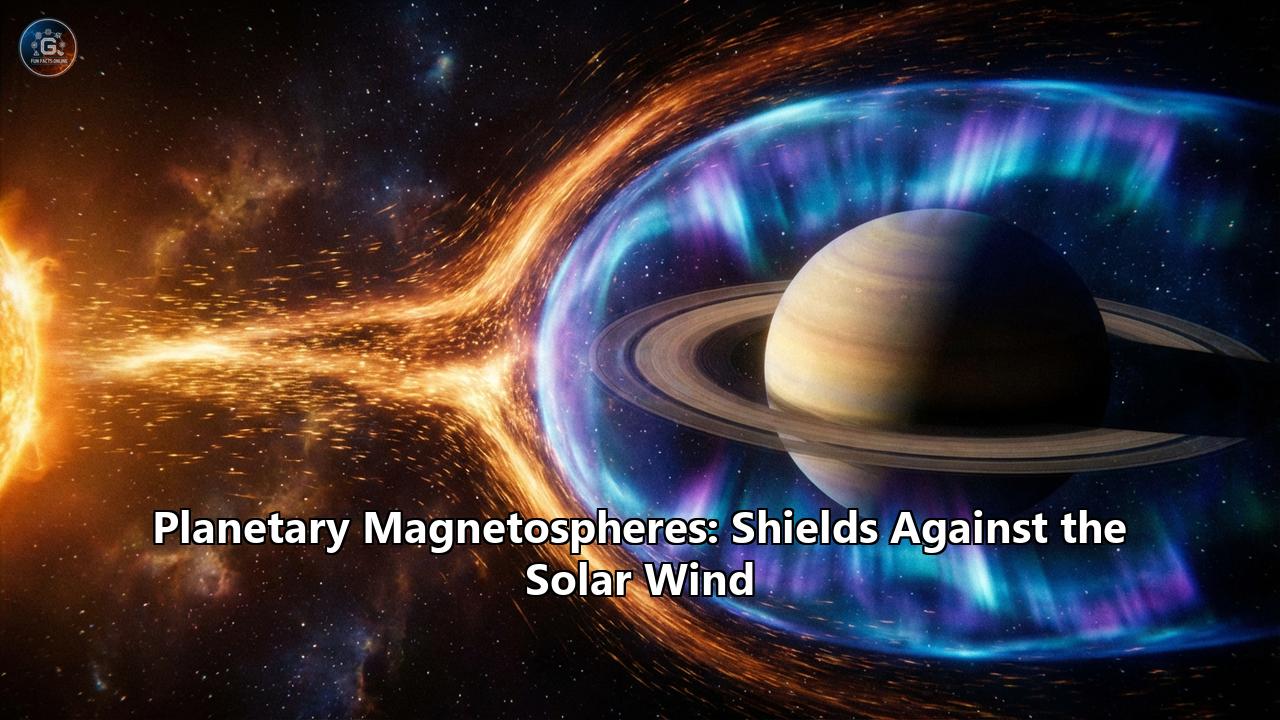
Planetary magnetospheres are among the most complex, dynamic, and vital structures in the solar system, serving as the invisible bastions that stand between planetary atmospheres and the relentless onslaught of the solar wind. They are vast, comet-shaped bubbles of magnetism that extend thousands to millions of kilometers into space, governed by the intricate laws of plasma physics and magnetohydrodynamics. From the roaring, radiation-filled belts of Jupiter to the lopsided, corkscrew fields of Uranus, and the protective cocoon of our own Earth, these magnetic shields define the boundaries where a planet's influence ends and the dominion of the star begins.
I. The Solar Wind: The Relentless Sieger
To understand the shield, one must first understand the weapon it defends against. The Sun is not a tranquil ball of light; it is a chaotic fusion reactor that perpetually exhales a stream of superheated plasma known as the solar wind. This wind consists primarily of protons and electrons, ejected from the Sun’s upper atmosphere, the corona, at supersonic speeds ranging from 250 to 750 kilometers per second.
This flow is not merely a gentle breeze; it carries with it the Interplanetary Magnetic Field (IMF), an extension of the Sun’s own magnetic field frozen into the plasma. When this magnetized plasma stream encounters a planet, it does not simply blow past. It interacts violently with any obstacle in its path. For planets without a magnetic field, the solar wind can strip away lighter atmospheric gases, desiccating the planet over billions of years—a fate believed to have befallen Mars. However, for a planet with an internal magnetic dynamo, the interaction creates a magnetosphere, a dynamic cavity in the solar wind flow that deflects the vast majority of these energetic particles.
II. The Physics of the Shield: Anatomy of a Magnetosphere
A magnetosphere is not a static bubble; it is a living, breathing structure that compresses and expands in response to the fury of the Sun. Its architecture is defined by several distinct boundaries and regions, each governed by specific physical processes.
1. The Bow ShockThe first line of defense is the bow shock, a standing shock wave located upstream of the planet. Because the solar wind travels at supersonic speeds relative to the planet, it cannot "sense" the obstacle ahead. When it finally encounters the planet's magnetic influence, it must abruptly decelerate to subsonic speeds. This transition creates a turbulent, heated region of plasma similar to the sonic boom created by a supersonic jet. The position of the bow shock is not fixed; it moves in and out depending on the pressure of the incoming solar wind.
2. The Magnetosheath and MagnetopauseBehind the bow shock lies the magnetosheath, a region of turbulent, heated, and slowed solar wind plasma that has passed through the shock. This plasma flows around the magnetosphere like water around a rock. The true boundary of the magnetosphere is the magnetopause, the surface where the outward pressure of the planet’s magnetic field exactly balances the inward dynamic pressure of the solar wind. Inside this boundary, the planet’s magnetic field dominates; outside, the solar wind rules.
3. The MagnetotailOn the side of the planet facing away from the Sun (the nightside), the magnetic field lines are stretched out by the solar wind into a long, cylinder-like structure called the magnetotail. This tail can extend for millions of kilometers—Earth’s magnetotail reaches well beyond the orbit of the Moon. It is within this tail that magnetic energy is stored and often explosively released, driving auroral displays.
4. Plasma Physics: The Engine of DynamicsThe behavior of the magnetosphere is governed by complex plasma processes. One of the most critical is Magnetic Reconnection. This occurs when magnetic field lines from the solar wind (the IMF) and the planet’s magnetic field, pointing in opposite directions, break and reconnect. This process essentially "opens" the shield, allowing solar wind particles to flood into the magnetosphere. Reconnection converts magnetic energy into kinetic energy, accelerating particles to near-relativistic speeds and heating the plasma. This is the primary driver of geomagnetic storms.
Inside the magnetosphere, Wave-Particle Interactions play a crucial role. Electromagnetic waves, such as "chorus waves" (which sound like chirping birds when converted to audio) and "hiss," interact with electrons. Chorus waves can accelerate electrons to dangerous energy levels, creating "killer electrons" that threaten satellites, while hiss waves can scatter electrons, causing them to rain down into the atmosphere and be lost.
III. Earth: The Standard Candle
Earth’s magnetosphere is the most studied and best understood. It is generated by a geodynamo—the convective motion of molten iron in the planet's outer core. This motion acts like a massive electrical generator, creating a dipolar magnetic field tilted about 11 degrees from the spin axis.
The Van Allen Radiation BeltsDiscovered in 1958 by Explorer 1, the Van Allen belts are two donut-shaped zones of high-energy particles trapped by Earth's magnetic field. The inner belt, located roughly 1,000 to 6,000 kilometers above the surface, is dominated by high-energy protons. The outer belt, extending from about 13,000 to 60,000 kilometers, is populated chiefly by high-energy electrons. These belts are a hazard for spacecraft and astronauts; traversing them requires shielding and careful trajectory planning. The region between the belts, the "slot region," is usually relatively empty, but during intense solar storms, it can fill with radiation.
Auroras: The Visual ManifestationThe most visible sign of the magnetosphere at work is the aurora (Borealis in the north, Australis in the south). When magnetic reconnection occurs in the magnetotail, charged particles are injected back toward Earth. They spiral down magnetic field lines and slam into the upper atmosphere, exciting oxygen and nitrogen atoms. As these atoms relax back to their ground state, they emit light—green and red for oxygen, blue and purple for nitrogen.
IV. The Giant Guardians: Jupiter and Saturn
The gas giants possess magnetospheres that dwarf Earth's in both size and energy, powered not just by the solar wind, but by rapid planetary rotation and internal volcanic moons.
Jupiter: The King of MagnetospheresJupiter’s magnetosphere is the largest continuous structure in the solar system. If it were visible to the naked eye, it would appear larger than the full moon in the sky. It extends up to 7 million kilometers toward the Sun and almost to the orbit of Saturn on the nightside.
- The Internal Dynamo: Jupiter’s field is generated by a churning layer of metallic hydrogen deep within the planet, creating a magnetic moment 20,000 times stronger than Earth’s.
- The Io Plasma Torus: Unlike Earth, whose magnetosphere is largely driven by the solar wind, Jupiter’s is driven internally. Its volcanic moon, Io, spews a ton of sulfur and oxygen dioxide per second into space. This material is ionized and trapped by Jupiter’s magnetic field, forming a doughnut-shaped "plasma torus." As Jupiter rotates (once every 10 hours), its magnetic field whips this plasma around, creating tremendous centrifugal forces that stretch the magnetic field into a disk shape.
- Ganymede’s Unique Status: Jupiter’s moon Ganymede is the only moon in the solar system with its own intrinsic magnetosphere. It carves out a "mini-magnetosphere" within Jupiter’s giant one. The interaction creates bright auroral "footprints" on Jupiter’s poles, connected to Ganymede by massive flux tubes of electric current.
Saturn’s magnetosphere is similar to Jupiter’s but has a unique quirk: its magnetic axis is almost perfectly aligned with its rotation axis. This symmetry puzzled scientists for decades because standard dynamo theory suggests a tilt is needed to maintain the field.
- Enceladus as a Source: Just as Io feeds Jupiter, the icy moon Enceladus feeds Saturn. Geysers of water vapor erupt from Enceladus’s south pole, populating the magnetosphere with neutral water molecules and plasma. This creates a "neutral torus" of water vapor.
- Variable Rotation: Because the magnetic field is symmetric, it’s difficult to determine Saturn’s true rotation rate. Radio emissions (Kilometric Radiation) used to track rotation have been found to slip and vary over time, controlled more by the solar wind and plasma load than the planet's deep interior.
V. The Ice Giant Oddities: Uranus and Neptune
The Voyager 2 flybys in the 1980s revealed that the ice giants, Uranus and Neptune, possess magnetospheres that are radically different from the dipole-like fields of Earth, Jupiter, and Saturn.
Uranus: The Toppled MagnetosphereUranus spins on its side, with its rotation axis tilted 98 degrees to the ecliptic. However, its magnetic axis is tilted an additional 60 degrees away from the rotation axis and is offset from the planet’s center by one-third of the planetary radius. This creates a chaotic "tumbling" magnetosphere. As Uranus rotates, its magnetotail twists into a corkscrew shape. The magnetosphere opens and closes to the solar wind on a daily basis (a Uranian day is about 17 hours), causing wild fluctuations in plasma density.
Neptune: The Tilted TwinDespite its normal rotation axis, Neptune’s magnetic field is also tilted (47 degrees) and offset (by about half a radius) from the center. This suggests that for both ice giants, the dynamo is not generated in the core, but in a slushy, convective mantle of salty water and ammonia. Neptune's magnetosphere also undergoes rapid reconfiguration as the planet rotates, shifting from an "Earth-like" configuration to a "pole-on" configuration with every turn.
VI. The Small and the Induced: Mercury, Venus, and Mars
Not all planets have giant protective bubbles. The inner solar system offers a study in contrasts.
Mercury: The Miniature DynamoMercury, despite its small size and slow rotation, possesses a weak intrinsic magnetic field (about 1% of Earth's). Its magnetosphere is tiny, barely holding off the solar wind above the surface. During strong solar events, the magnetosphere can be crushed completely, allowing solar wind ions to impact the surface directly, sputtering atoms into space to form a tenuous exosphere.
Venus and Mars: The Induced MagnetospheresVenus and Mars lack global intrinsic magnetic fields, likely due to the lack of a convective core dynamo (Mars' dynamo died billions of years ago; Venus may lack the temperature gradient). However, they are not entirely defenseless.
- Induced Magnetospheres: When the solar wind hits the conductive ionospheres of Venus and Mars, it induces electric currents. These currents generate a magnetic field that drapes around the planet, creating an "induced magnetosphere."
- Atmospheric Loss: While this induced field offers some protection, it is porous. Solar wind scavenging is a significant loss process. Mars, with its low gravity, has lost much of its atmosphere to this stripping. Venus, conversely, has retained a massive atmosphere. This "Venus Paradox" highlights that while a magnetic field is a shield, gravity is the ultimate anchor. Venus's immense mass holds its atmosphere despite the solar wind, whereas Mars's weak gravity allowed its air to escape once its dynamo failed.
VII. Space Weather: The Technological Hazard
The interaction between the solar wind and Earth’s magnetosphere is not just a scientific curiosity; it is a matter of technological survival. "Space weather" refers to the environmental conditions in Earth's magnetosphere.
Geomagnetic Storms and GICsWhen a Coronal Mass Ejection (CME)—a massive cloud of solar plasma—slams into Earth, it compresses the magnetosphere and triggers a geomagnetic storm. Rapidly changing magnetic fields induce electric currents in the ground, known as Geomagnetically Induced Currents (GICs). These currents seek the path of least resistance, which often includes high-voltage power lines and long pipelines.
- The Quebec Blackout: On March 13, 1989, a massive geomagnetic storm induced currents in the Hydro-Québec power grid. The currents saturated transformers, causing protective relays to trip. In less than 90 seconds, the entire province of Quebec lost power, leaving 6 million people in the dark for 9 hours.
- Pipeline Corrosion: GICs flowing through pipelines can disrupt cathodic protection systems (designed to prevent rust), leading to accelerated corrosion and potential leaks over time.
- Surface Charging: High-energy electrons can accumulate on satellite surfaces, causing electrostatic discharges (mini-lightning) that fry electronics.
- Single Event Upsets: High-energy protons can penetrate satellite shielding and flip bits in computer memory, causing software crashes or phantom commands.
- GPS Disruption: Turbulence in the ionosphere, driven by magnetospheric storms, can scintillate GPS signals, causing errors of tens of meters or complete loss of lock, affecting aviation, military operations, and precision agriculture.
VIII. Exploration: From Explorer to Clipper
The mapping of these invisible realms is a triumph of the Space Age.
The Pioneers:- Explorer 1 (1958): James Van Allen’s Geiger counters revealed the radiation belts, the first major discovery of the Space Age.
- Mariner & Pioneer: These early probes confirmed the solar wind (Mariner 2) and made the first flybys of Jupiter and Saturn, detecting their massive bow shocks.
Voyager 1 and 2 provided the grand tour. Voyager 1 confirmed the Io torus and the complexity of Jupiter’s disk. Voyager 2 remains the only spacecraft to have visited Uranus and Neptune, revealing their bizarre, offset magnetic fields.
The Orbiters:- Galileo (Jupiter) & Cassini (Saturn): These long-term orbiters mapped the dynamics of the giant planets. Cassini discovered the water-vapor connection between Enceladus and Saturn’s magnetosphere.
- Juno (Jupiter): Currently in orbit, Juno is revolutionizing our understanding. It flies closer to Jupiter than any previous mission, mapping the polar magnetic field and discovering that the "Great Blue Spot" is an anomaly in the field. It has also provided the first direct measurements of reconnection at Ganymede.
- MMS (Earth): NASA's Magnetospheric Multiscale Mission uses four spacecraft flying in tight formation to study the micro-physics of magnetic reconnection in Earth's magnetotail, confirming it as the driver of particle acceleration.
The next decade will be the golden age of magnetospheric exploration.
- ESA's JUICE (Jupiter Icy Moons Explorer): Launched in 2023, it will arrive in 2031. It will be the first spacecraft to orbit a moon (Ganymede) other than our own. Its primary goal is to study Ganymede’s intrinsic magnetosphere and its interaction with Jupiter’s plasma environment in unprecedented detail.
- NASA's Europa Clipper: Scheduled for the late 2020s, it will study the interaction of Europa's induced magnetic field (caused by its salty subsurface ocean) with Jupiter. Detecting changes in this induced field is one of the primary ways scientists confirmed the ocean's existence.
IX. Conclusion: The Universal Shield
Planetary magnetospheres are more than just magnetic bubbles; they are the distinct signatures of a planet's interior life. A strong magnetosphere tells us of a churning, hot core; a tilted, offset one speaks of a complex, slushy mantle; a missing one hints at a geologically dead world. They are the gatekeepers of habitability, shielding atmospheres from erosion and surfaces from sterilizing radiation.
As we look to exoplanets orbiting active red dwarf stars—stars known for violent flares and intense stellar winds—the question of whether those distant worlds possess magnetospheres becomes a question of whether they can host life. The study of the magnetic shields in our own solar system, from the stable dipole of Earth to the chaotic corkscrew of Uranus, provides the Rosetta Stone for decoding the magnetic universe. We live in a galaxy of stars that bite; magnetospheres allow the planets to bite back.
Reference:
- https://www.ebsco.com/research-starters/astronomy-and-astrophysics/planetary-magnetospheres
- https://www.annualreviews.org/doi/pdf/10.1146/annurev.ea.15.050187.001131
- https://www.cosmos.esa.int/web/juice/all-meetings
- https://astronomy.stackexchange.com/questions/28328/mars-vs-venus-the-retention-of-atmospheres-in-relationship-to-earth
- https://en.wikipedia.org/wiki/Europa_Clipper
- https://meetingorganizer.copernicus.org/EPSC-DPS2011/EPSC-DPS2011-1270.pdf
- https://svs.gsfc.nasa.gov/4144/
- https://www.researchgate.net/figure/Schematic-of-the-formation-of-geomagnetically-induced-currents-GICs-and-of-how-they_fig1_286876880
- https://en.wikipedia.org/wiki/Geomagnetically_induced_current
- https://www.sws.bom.gov.au/Category/Educational/Pamphlets/Overview%20of%20space%20weather%20and%20potential%20impacts%20and%20mitigation%20for%20the%20energy%20and%20resource%20sector.pdf
- https://space.fmi.fi/MAGN/GIC/home_of_GIC.html
- https://www.spaceweather.gc.ca/tech/index-en.php
- https://www.mdpi.com/2673-8724/3/2/11
- https://arxiv.org/pdf/2306.16380
- https://www.astronomy.com/space-exploration/juice-and-europa-clipper-will-target-jupiters-mysterious-moons/