
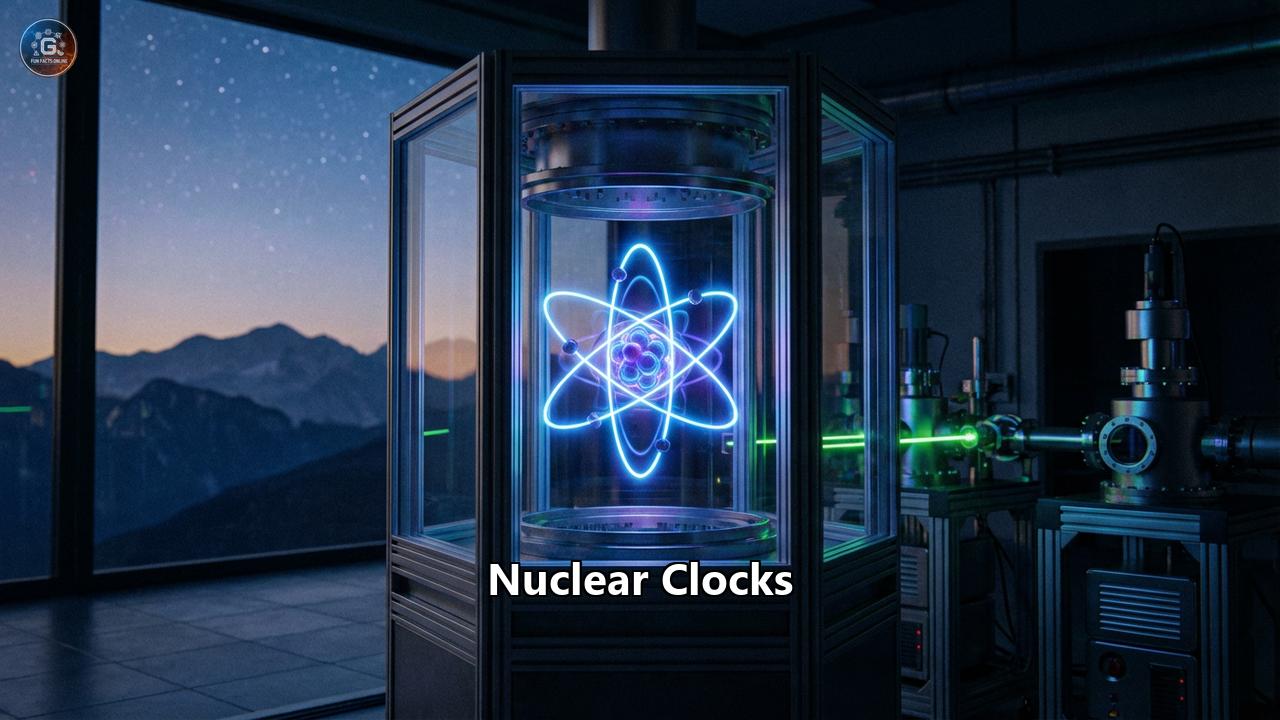
I. The Sentinel of Time
Time is the invisible scaffolding of our reality. It is the dimension in which we live, the river in which we swim, and the tyrant that dictates the decay of all things. Since the dawn of consciousness, humanity has been obsessed with measuring it. We began with the shadow of a stick, tracing the sun’s arc across the dust. We moved to the rhythmic swing of the pendulum, dividing the day into hours, minutes, and seconds. In the 20th century, we harnessed the vibration of quartz crystals, and finally, the oscillation of atoms themselves.
For the last sixty years, the "second" has been defined by the behavior of electrons orbiting a cesium atom. This atomic timekeeping has given us the modern world: the Global Positioning System (GPS), the synchronization of the internet, financial markets, and deep-space navigation. We thought we had reached the pinnacle of precision. We were wrong.
A new revolution is underway—one that makes the atomic clock look like a sundial in comparison. We are moving from the electron to the nucleus. We are descending into the heart of the atom, where the forces are millions of times stronger and the "ticks" of the clock are immune to the noise of the outside world.
Welcome to the era of the Nuclear Clock.
This is not science fiction. As of late 2024 and 2025, the first prototypes have been built. The "impossible" clock is now a reality ticking in laboratories in Boulder, Colorado, and Vienna, Austria. This device promises to be so accurate that it will not lose a single second over the entire age of the universe. But its purpose goes far beyond telling time. It is a quantum sensor of such exquisite sensitivity that it may finally reveal the nature of dark matter, detect the shifting of the earth's crust in real-time, and answer whether the fundamental constants of nature are actually constant.
II. The Atomic Limit: Why We Need a Better Clock
To understand the magnitude of the nuclear clock, we must first understand the limitations of our current master: the atomic clock.
All clocks work on the same principle: resonance. You need something that oscillates (ticks) at a steady, unchanging frequency, and you need a counter to track those ticks. In a grandfather clock, the oscillator is a pendulum swinging at 1 Hz (one tick per second). In a quartz watch, it is a crystal vibrating at 32,768 Hz.
In a standard atomic clock, the "pendulum" is an electron orbiting the nucleus of an atom—typically Cesium-133 or Strontium-87. According to quantum mechanics, electrons live in specific energy levels. If you hit an electron with exactly the right frequency of microwave or laser light, it will jump from a lower energy state to a higher one. This "jump" frequency is nature's perfect tuning fork. For Cesium, this frequency is exactly 9,192,631,770 Hz. This number is the definition of one second.
Modern optical lattice clocks (using Strontium or Ytterbium) use visible light lasers rather than microwaves. These light waves oscillate roughly 100,000 times faster than microwaves, providing a "finer" ruler with which to measure time. These clocks are accurate to about 1 part in $10^{18}$—meaning they would lose less than a second if they ran for the entire 13.8 billion years the universe has existed.
So, why isn't this enough?
The problem lies in the electron itself. Electrons are flighty, lightweight particles that live on the outskirts of the atom. They are exposed to the world. A stray magnetic field from a nearby power cable, a slight fluctuation in temperature, or even the collision with a stray gas molecule can disturb the electron's orbit. This shifts the frequency slightly—a phenomenon known as "systematic uncertainty."
To keep atomic clocks accurate, physicists build complex vacuum chambers, magnetic shields, and laser-cooling traps to freeze the atoms to near absolute zero. But no matter how good the shielding, the electron remains vulnerable. It is a leaf blowing in the electromagnetic wind.
To beat this limit, we need a pendulum that is heavier, stiffer, and protected behind an impregnable wall. We need the atomic nucleus.
III. The Nuclear Option: Into the Heart of Matter
The nucleus is the dense core of the atom, composed of protons and neutrons bound together by the Strong Nuclear Force. This force is the most powerful interaction in nature—137 times stronger than the electromagnetic force that holds electrons in orbit.
Because the protons and neutrons are held so tightly, they oscillate at incredibly high frequencies—typically in the X-ray or Gamma-ray range of the electromagnetic spectrum (billions of times faster than visible light). Furthermore, the nucleus is tiny—about 100,000 times smaller than the electron cloud. This small size, combined with the shielding provided by the surrounding electron cloud, makes the nucleus virtually immune to external disturbances.
A nuclear clock works on the same principle as an atomic clock: you excite a particle from a low energy state to a higher one. But instead of moving an electron, you are rearranging the protons and neutrons inside the nucleus.
If you could build a clock based on a nuclear transition, it would be:
- Immune to Noise: External magnetic and electric fields would have almost no effect on the ticking rate.
- Solid State: Because the nucleus is shielded by its own electrons, you wouldn't necessarily need to trap single atoms in a vacuum. You could embed the atoms in a solid crystal lattice—a "nuclear diamond"—making the clock portable and robust.
- Insanely Accurate: The "Q-factor" (a measure of how "pure" the tone of the tick is) would be orders of magnitude higher than the best atomic clocks.
There was just one massive problem that stumped physicists for fifty years.
In almost every known element, the energy required to excite the nucleus is enormous. It requires X-rays or Gamma rays. We simply do not have lasers that can produce coherent X-rays or Gamma rays to "tickle" the nucleus. We have no way to start the pendulum swinging.
For decades, the nuclear clock was a beautiful theory with no way to build it. Until we found the anomaly.
IV. The Thorium Anomaly: Nature’s Gift to Timekeeping
Among the 3,000+ known isotopes in the universe, there is exactly one that acts as a backdoor to the nuclear world: Thorium-229.
Thorium is a heavy, slightly radioactive metal (atomic number 90). Usually, nuclear transitions involve Mega-electronvolts (MeV) of energy. But in 1976, nuclear physicists noticed something bizarre about the isotope Thorium-229. It seemed to have an excited state (an isomer) that was tantalizingly close to the ground state.
While most nuclear states are millions of electronvolts apart, the first excited state of Thorium-229 (denoted as $^{229m}\text{Th}$) is only about 8.35 electronvolts (eV) above the ground state.
This number is shocking. 8.35 eV is not an X-ray energy; it is in the range of Vacuum Ultraviolet (VUV) light. This is the only nuclear transition in the entire chart of nuclides that can be reached using lasers.
It is a cosmic accident. The strong nuclear force and the electromagnetic force inside the Thorium nucleus just happen to cancel each other out in a way that leaves two states nearly identical in energy. It is as if nature left a key under the doormat specifically for humanity to find.
However, finding the key was one thing; putting it in the lock was another. For 40 years, scientists knew the transition existed, but they didn't know the exact frequency. It was like trying to tune a radio to a specific station when you don't know the station's number, and the dial spans the entire length of the universe.
V. The Breakthroughs of 2024-2025: Building the Machine
The race to build the nuclear clock accelerated dramatically in the 2020s, culminating in a series of historic papers published in Nature and Physical Review Letters between 2024 and 2025.
1. The Hunt for the Frequency (2023-2024)
Before they could build a clock, they had to see the tick. Researchers at CERN (Geneva), LMU Munich, and JILA (Boulder, Colorado) spent years refining the search.
In early 2024, a team led by Thorsten Schumm at TU Wien (Vienna) and collaborators successfully utilized a "frequency comb" to pinpoint the transition. They embedded Thorium-229 ions into calcium fluoride (CaF2) crystals. By blasting these crystals with a specialized VUV laser, they finally observed the fluorescence: the nucleus absorbed the light and re-emitted it. They had found the station. The frequency was approximately 2,020 Terahertz (corresponding to a wavelength of roughly 148 nanometers).
2. The First Prototype (September 2024)
The monumental moment arrived in September 2024. A team at JILA, led by the renowned physicist Jun Ye, in collaboration with the Vienna team, built the first fully functioning nuclear clock prototype.
They achieved what was previously considered impossible:
- The Laser: They developed a custom VUV laser system capable of hitting the 148 nm target with extreme precision.
- The Frequency Comb: They used a "frequency comb"—a Nobel Prize-winning technology that acts as a gear reduction mechanism for light—to link the incredibly fast ticking of the Thorium nucleus (in the VUV range) to the ticks of a Strontium optical atomic clock.
- The Comparison: For the first time, they measured the ratio between the nuclear tick and the atomic tick.
The result was a measurement with 12 digits of precision. While this prototype was not yet more accurate than the best atomic clock (because it was tied to one), it proved the technology worked. The "gearbox" between the nucleus and the outside world had been built.
3. The Crystal Lattice (2025 Refinements)
In 2025, the focus shifted to stability. Unlike atomic clocks that require trapping individual atoms in a vacuum using lasers (a fragile and complex setup), the nuclear clock teams doubled down on the solid-state approach.
They demonstrated that billions of Thorium-229 atoms could be doped into a transparent crystal about the size of a grain of rice. Because the nuclear transition is shielded, the crystal lattice structure—despite vibrating with heat and phonons—did not disturb the nuclear ticks. This paved the way for a device that is not a room-sized laboratory experiment, but a chip-sized sensor.
VI. How it Works: A Technical Deep Dive
Let us look under the hood of this machine. How exactly does one count the ticks of a nucleus?
The Crystal Core:The heart of the device is a crystal of Calcium Fluoride ($CaF_2$) doped with Thorium-229. The crystal must be transparent to VUV light, which is difficult because VUV light is absorbed by almost everything (including air, which is why the entire clock must operate in a vacuum).
The VUV Laser Drive:Generating coherent light at 148 nm is notoriously difficult. Standard lasers don't go that low. The teams use a process called High-Harmonic Generation (HHG). They take a powerful infrared laser and blast a jet of Xenon gas. The electrons in the Xenon gas get ripped away and slammed back into their parent atoms, releasing bursts of high-energy photons (VUV light). This light is then filtered and directed at the Thorium crystal.
The Isomer Switch:When the laser hits the Thorium-229 nucleus, it flips a "nuclear spin switch." One of the neutrons in the nucleus changes its orbit. The nucleus expands slightly (by a femtometer) and changes its shape from a pear-like distribution to a slightly different deformation. This is the "tick."
The Readout:To know if the laser is on the right frequency, the scientists monitor the crystal for a signal. In the prototype, they look for the "decay" signal—when the nucleus relaxes back to its ground state, it emits an electron or a photon. By locking the laser to the point where this signal is strongest, the laser becomes synchronized with the nucleus.
The Gearbox (Frequency Comb):The nuclear frequency is roughly 2 Petahertz (2 quadrillion ticks per second). No electronic counter can count that fast. A frequency comb is a laser that emits hundreds of thousands of frequencies simultaneously, spaced perfectly apart like the teeth of a comb. It acts as a bridge, converting the unreadable Petahertz nuclear frequency down to a readable Gigahertz microwave frequency that a computer can count.
VII. Unlocking the Universe: Applications in Fundamental Physics
The invention of the nuclear clock is not just about better timekeeping; it is about breaking the code of the universe. The extreme sensitivity of the Thorium-229 nucleus makes it a sensor for "New Physics."
1. Are the Constants Constant?
Physics relies on fundamental constants, such as $\alpha$ (the fine-structure constant), which dictates the strength of the electromagnetic force, and the strong coupling constant.
Standard atomic clocks are sensitive to $\alpha$. However, because of the unique cancellation of forces inside the Thorium-229 nucleus, the nuclear clock is estimated to be 10,000 to 100,000 times more sensitive to changes in $\alpha$ than atomic clocks.
If $\alpha$ drifts by even a tiny fraction over time—as some string theories suggest—the nuclear clock will see it. If we detect a drift, it would rewrite the Standard Model of particle physics, proving that the laws of nature are not immutable but evolving.
2. The Dark Matter Detector
We know Dark Matter exists because of its gravity, but we have never seen it. Some theories suggest Dark Matter is an "ultralight field" that permeates the universe (like axions). If this is true, this field would interact very weakly with normal matter, causing the fundamental constants to oscillate slightly.
Because the nuclear clock is so sensitive to the coupling constants, a wave of Dark Matter passing through Earth would cause the clock to speed up and slow down rhythmically. A network of nuclear clocks could act as a Dark Matter Telescope, "listening" for the hum of the invisible universe.
VIII. Reshaping the World: Practical Applications
Beyond the esoteric realm of theoretical physics, nuclear clocks will revolutionize technology on Earth.
1. Relativistic Geodesy (Measuring the Earth)
Einstein’s Theory of General Relativity tells us that time moves slower closer to a massive object (gravity). This is called gravitational time dilation.
Current atomic clocks are precise enough to detect the difference in time passing at an altitude difference of about 1 centimeter. A nuclear clock, with its potential $10^{-19}$ or $10^{-20}$ accuracy, could detect time differences caused by millimeter or even sub-millimeter changes in height.
This transforms the clock into the ultimate gravity sensor. We could map the Geoid (the shape of the Earth) with perfect precision. We could detect:
- Magma moving underground before a volcanic eruption.
- Tectonic plates shifting before an earthquake.
- Rising sea levels at a localized scale.
- New oil or mineral deposits by their gravitational density signature.
2. Next-Gen Navigation (GPS III)
GPS relies on satellites carrying atomic clocks. The accuracy of the GPS location (currently meters to centimeters) depends on the accuracy of these clocks.
While putting a nuclear clock in space is a challenge for the future, the robustness of the solid-state crystal design makes it far more feasible than launching a room-sized optical lattice clock. A nuclear-based GPS could provide millimeter-level accuracy anywhere on Earth.
More importantly, it allows for autonomous navigation. A spacecraft traveling to Mars or Europa cannot rely on GPS signals from Earth (the delay is too long). A nuclear clock on board would allow the spacecraft to navigate by the stars and pulsars with perfect timing, enabling autonomous landing and maneuvering in deep space.
3. The Synchronized Internet
High-frequency trading, telecommunications, and the power grid all rely on synchronization. As data transfer speeds increase, the window for synchronization shrinks. Nuclear clocks would provide a "heartbeat" for a future quantum internet, ensuring that data packets entangled across continents remain perfectly synchronized.
IX. The Road Ahead: From Lab to Chip
We are currently at the "Wright Flyer" stage of nuclear clocks. The prototype flies, but it is clunky, expensive, and requires a room full of PhDs to operate.
The Challenges:- The Laser: The current VUV lasers are massive and inefficient. Engineers need to develop compact, solid-state lasers that can emit at 148 nm.
- The Crystal Quality: The Thorium-doped crystals need to be grown with perfect purity. Any defects in the crystal lattice can broaden the signal and reduce accuracy.
- Cooling: While the nucleus is shielded, the crystal itself still suffers from thermal noise. Cryogenic cooling (liquid nitrogen or helium) helps, but adds bulk.
- 2026-2028: Improvement of precision to surpass the best Strontium atomic clocks. First dedicated experiments hunting for Dark Matter.
- 2030s: Miniaturization. Development of "chip-scale" nuclear frequency references.
- 2040s: Deployment in space missions and potentially next-generation GNSS (Global Navigation Satellite Systems).
X. Conclusion: The Eternal Tick
The history of timekeeping is the history of civilization. Every time we have improved our measurement of time, we have transformed society. The sundial gave us the calendar; the pendulum gave us the schedule; the atomic clock gave us the digital age.
The nuclear clock represents the final frontier. By locking our time to the dense, quiet, unshakeable heartbeat of the atomic nucleus, we are creating a ruler that will not bend. We are building a device that will outlast the stars.
In the silence of the vacuum chamber, inside a tiny crystal of calcium fluoride, a Thorium nucleus shudders. It is a movement smaller than an atom, faster than thought. But in that tiny shudder lies the future of navigation, the map of the invisible universe, and perhaps, the answer to the question of whether reality itself is stable.
The nuclear age of time has begun. Tick.
Addendum: Comparative Analysis (Narrative)
To fully appreciate the leap, consider the analogy of a pendulum.
An Atomic Clock (Microwave/Cesium) is like a pendulum swinging in a breeze. It keeps good time, but the air (electromagnetic interference) affects it.
An Optical Clock (Strontium/Laser) is like a pendulum swinging much faster, making it harder to disturb, but it is still exposed to the air.
A Nuclear Clock (Thorium) is like a heavy lead pendulum, swinging a million times faster, sealed inside a vacuum chamber, buried inside a concrete bunker. The breeze cannot touch it. The temperature cannot warp it. It ticks for itself, indifferent to the chaos of the world outside.
This is the promise of the nuclear clock: Time, purified.
Reference:
- https://newatlas.com/physics/nuclear-clock-prototype-atomic-clocks/
- https://jila.colorado.edu/news-events/articles/moving-nuclear-timekeeping-domain
- https://www.sciencefocus.com/future-technology/nuclear-clocks
- https://www.nist.gov/news-events/news/2024/09/major-leap-nuclear-clock-paves-way-ultraprecise-timekeeping
- https://newatlas.com/physics/nuclear-clocks-hunt-for-dark-matter/
- https://www.wam.ae/en/article/b518ox6-scientists-create-worlds-first-nuclear-clock
- https://www.med.physik.uni-muenchen.de/aktuelles/nuclear-clock-breakthough/index.html
- https://jila.colorado.edu/sites/default/files/group-files/The%20First%20Nuclear%20Clock%20Will%20Test%20if%20Fundamental%20Constants%20Change%20_%20Quanta%20Magazine.pdf
- https://www.sciencealert.com/breakthrough-scientists-create-worlds-first-nuclear-clock-prototype
- https://madhyamamonline.com/science/revolutionary-thorium-229-nuclear-clock-could-unveil-changes-in-fundamental-physics-1327791
- https://www.spacedaily.com/reports/Nuclear_Clock_Breakthrough_Measures_Fine_Structure_Constant_with_Unprecedented_Precision_999.html