
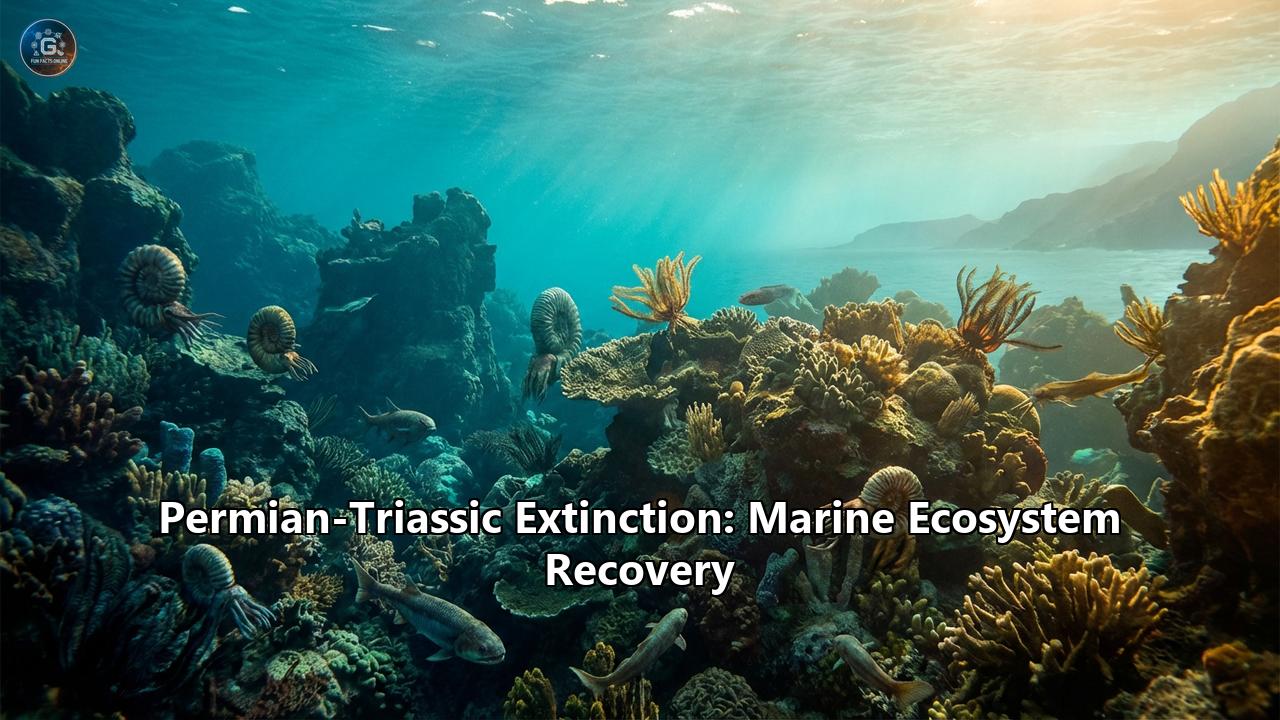
Picture an ocean where the vibrant hum of life has been suddenly, violently silenced. The coral reefs, once teeming with armored trilobites, delicate sea lilies, and spiraled nautiloids, are reduced to crumbling graveyards. The water is uncomfortably warm, unnervingly still, and tinged with the toxic green-purple hue of sulfur-metabolizing bacteria. This was the reality approximately 251.9 million years ago. Earth had just endured the Permian-Triassic mass extinction—an event so devastating it earned the grim moniker, "The Great Dying." It remains the most severe extinction event in our planet's history, wiping out roughly 81% of all marine species and drastically altering the trajectory of evolution on Earth.
For decades, paleontologists believed that the oceans remained a toxic, impoverished wasteland for up to 10 million years following the catastrophe. However, a wave of recent, groundbreaking fossil discoveries and cutting-edge geochemical analyses has completely upended this narrative. The story of marine ecosystem recovery after the Permian-Triassic boundary is no longer just a tale of prolonged death and stagnation; it is a profound testament to the resilience, adaptability, and rapid evolutionary innovation of life under the most extreme conditions imaginable.
The Ocean's Darkest Hour: The Anatomy of a Global Cataclysm
To understand the magnitude of the recovery, one must first understand the sheer scale of the destruction. The Permian-Triassic extinction was triggered by a catastrophic confluence of geological events, primarily driven by the eruption of the Siberian Traps. This massive volcanic province in modern-day Russia spewed millions of cubic kilometers of lava, but the true killers were the invisible gases released into the atmosphere. Gigatons of carbon dioxide and sulfur dioxide triggered a runaway greenhouse effect, causing global temperatures to skyrocket.
In the oceans, this translated into a multi-pronged assault on marine ecosystems. As the oceans absorbed massive amounts of CO2, the water became highly acidic, dissolving the calcium carbonate shells of countless marine invertebrates. Furthermore, the extreme heat disrupted ocean circulation, causing the oceans to become stagnant and largely devoid of oxygen—a condition known as global oceanic anoxia. The deep ocean became a dead zone, and toxic hydrogen sulfide generated by anaerobic bacteria likely bubbled up to the surface, poisoning what little life remained in the shallow waters.
Entire lineages that had dominated the Paleozoic Era vanished. The trilobites, which had survived hundreds of millions of years and two previous mass extinctions, were wiped off the face of the Earth. The rugose and tabulate corals went entirely extinct, leaving the oceans without reef-builders for millions of years.
The "Strangelove Ocean" and the Rule of Disaster Taxa
In the immediate aftermath of the extinction—during the earliest stages of the Triassic Period, known as the Griesbachian and Dienerian—the oceans resembled what scientists call a "Strangelove Ocean." This term, borrowed from the apocalyptic film Dr. Strangelove, describes an ocean where the biological pump has completely collapsed. With the vast majority of plankton and complex marine life gone, the carbon cycle was fundamentally altered.
The shallow sea floors, no longer churned by the burrowing and feeding activities of diverse benthic (bottom-dwelling) animals, became laminated and eerily pristine. In the absence of grazing animals, microbial mats and stromatolites—structures built by layers of cyanobacteria—made a sudden and dramatic return. Stromatolites had been largely pushed to the extreme margins of the world hundreds of millions of years earlier during the Precambrian and early Paleozoic, but in the post-apocalyptic Early Triassic, they thrived once again in the empty ecological real estate.
The few animals that did survive the Great Dying are often referred to as "disaster taxa." These were extreme generalists, capable of enduring low oxygen, high heat, and acidic waters. In the oceans, paper-thin bivalves like Claraia and opportunistic brachiopods like Lingula carpeted the seafloors. They required very little oxygen to survive and reproduced rapidly, taking over the globe in the absence of predators and competitors. However, despite their abundance, these ecosystems were incredibly simple, lacking the complex trophic levels and food webs that characterize a healthy ocean.
The Lilliput Effect: A World of Miniatures
One of the most fascinating evolutionary phenomena observed in the aftermath of the Permian-Triassic extinction is the "Lilliput Effect." Named by paleontologist Adam Urbanek in 1993 after the island of miniature people in Jonathan Swift’s Gulliver's Travels, this effect describes a quantifiable, temporary decrease in the body size of surviving taxa.
During the earliest Triassic, marine organisms were comically small compared to their Permian ancestors. Gastropods (snails), bivalves, brachiopods, and foraminifera all exhibited dramatic size reductions. This ubiquitous dwarfing was the result of two primary factors: the selective extinction of larger species, and within-lineage evolution toward smaller body sizes among the survivors.
Why did life shrink? The answer lies in the intersection of temperature and oxygen. The Early Triassic oceans were incredibly hot, with equatorial sea surface temperatures potentially reaching a lethal 40°C (104°F). According to biological principles, higher temperatures increase an animal's metabolic rate, requiring more oxygen. However, warm water inherently holds less dissolved oxygen than cold water. Faced with a high metabolic demand but a suffocatingly low oxygen supply, marine animals were forced to adapt. A smaller body provides a higher surface-area-to-volume ratio, making the diffusion of oxygen much more efficient. Furthermore, in highly stressful, unpredictable environments, evolutionary pressures favor organisms that grow quickly, reproduce early, and die young—a life strategy that inherently limits maximum body size.
The Old Paradigm: A Ten-Million-Year Coma
For a long time, the scientific consensus held that this impoverished, miniature, and biologically simple state persisted for an incredibly long time. Paleontologists theorized that complex ecosystems required 5 to 10 million years to evolve after such an absolute annihilation.
Studies utilizing uranium and carbon isotopes from ancient seabed rocks in places like modern-day China and Turkey painted a dire portrait of the Early Triassic. Researchers found that chronically low levels of oxygen hampered the recovery of life on a global scale. The Earth’s climate remained wildly unstable, plagued by resurgent pulses of volcanic activity, severe global warming, and oceanic anoxia that essentially acted as secondary extinction events, repeatedly beating back any fragile ecosystems attempting to recover.
Certain groups of organisms, known as "Dead Clades Walking," barely squeaked through the Permian-Triassic boundary only to succumb to these harsh Early Triassic conditions. For example, dozens of foraminifera genera and several families of gastropods survived the initial cataclysm but eventually went extinct before the Middle Triassic, unable to cope with the ongoing environmental whiplash.
Shattering the Timeline: The Guiyang and Paris Biotas
While the 10-million-year delay in benthic recovery holds true for many parts of the globe, recent fossil discoveries have completely shattered the idea that the entire ocean remained a wasteland. In highly specific locations—perhaps oceanographic refugia where temperatures were slightly cooler or oxygen levels slightly higher—life was rebounding with astonishing speed. Two monumental discoveries in the last decade have forced scientists to rewrite the timeline of marine ecosystem recovery: the Guiyang Biota and the Paris Biota.
The Guiyang Biota: Discovered in the Daye Formation of South China and officially detailed in the journal Science in 2023, the Guiyang Biota provides an unprecedented snapshot of a highly complex marine ecosystem. Using high-precision U-Pb (uranium-lead) radiometric dating on volcanic ash layers surrounding the fossils, researchers pinpointed the age of the assemblage to 250.83 million years ago. This is barely one million years after the extinction event.Despite the short timeframe, the Guiyang Biota was not a simple ecosystem of disaster taxa. It comprised at least 12 classes and 19 orders of organisms, representing a fully functioning, trophically complex food web. Paleontologists unearthed an array of predatory bony fishes, coelacanths, ammonoids, bivalves, and malacostracan arthropods, including the early ancestors of modern shrimp and lobsters. The presence of vertebrate apex predators and complex crustacean scavengers definitively proves that in some parts of the ocean, the biological puzzle pieces reassembled incredibly fast, laying the groundwork for modern marine ecosystems almost immediately after the crisis.
The Paris Biota: Half a world away, in the western USA basin (modern-day Idaho, Nevada, and Utah), another spectacular fossil assemblage tells a similar story of defiance. Discovered in 2017 within the Thaynes Group, the Paris Biota dates to the earliest Spathian substage of the Early Triassic, approximately 249 million years ago (about 3 million years post-extinction).The phyletic diversity of the Paris Biota is staggering. It contains fossils from at least seven phyla and 20 distinct metazoan orders. Alongside the expected ammonoids and bivalves, scientists discovered a treasure trove of unexpected organisms: leptomitid sponges (previously thought to be largely absent from this era), epizoan brachiopods, crinoids, gladius-bearing coleoids (squid-like cephalopods), and an extraordinarily rich array of arthropods.
Particularly notable are the decapod crustaceans of the Paris Biota. The assemblage includes glyphidean lobsters and early penaeid shrimps, pushing the evolutionary origins of several major arthropod families—like the Aegeridae—five million years further back in time than previously recorded. The Paris Biota even yielded the teeth of cartilaginous fishes (chondrichthyans), proving that sharks were actively prowling these early Triassic seas.
Cutting-Edge Science: Deciphering the Invisible
The revelation of these complex biotas has been made possible not just by physical excavation, but by leaps in analytical technology. Often, fossils from the Early Triassic are flattened, distorted, or poorly preserved due to their taphonomic history.
In a groundbreaking 2025 study published in PLOS One, researchers investigating the Paris Biota utilized non-destructive synchrotron micro-X-ray fluorescence (µXRF) to map the major-to-trace elemental composition of the fossils. They discovered that different clades of marine animals left behind distinct, clade-specific geochemical signatures. By analyzing the elemental spectra, scientists can now identify unrecognizable or highly distorted fossil smudges, distinguishing a flattened piece of algae from a crushed shrimp based purely on its atomic makeup. This technological marvel is allowing paleontologists to uncover hidden biodiversity that traditional visual morphology would have completely missed, further proving the robust nature of the Early Triassic recovery.
The Blueprint of the Modern Ocean: An Evolutionary Arms Race
The Permian-Triassic extinction did not just temporarily empty the oceans; it fundamentally changed what lived in them. The recovery period marked the beginning of a massive ecological shift from the "Paleozoic Evolutionary Fauna" to the "Modern Evolutionary Fauna."
Before the Great Dying, the ocean floor was dominated by sessile (stationary), epifaunal (surface-dwelling) suspension feeders. Brachiopods, crinoids (sea lilies), and bryozoans formed expansive "meadows" on the sea floor. These organisms were heavily armored but entirely immobile, making them highly vulnerable to sudden environmental changes and ocean acidification.
When these populations were decimated, the ecological slate was wiped clean. The organisms that filled the void in the Early and Middle Triassic were vastly different. The new marine world favored motile (moving), infaunal (burrowing) organisms, and active predators. Bivalves (clams and oysters) rapidly overtook brachiopods as the dominant shell-builders. Gastropods evolved new shapes and behaviors, while decapod crustaceans became vital scavengers and ecosystem engineers, churning up the sediment and revitalizing the biological pump.
This shift ignited a profound evolutionary arms race—a precursor to the broader Mesozoic Marine Revolution. As the oceans became crowded with fast-swimming predatory fishes, ammonoids, and newly evolved sharks, prey species had to adapt. They could no longer just sit on the sea floor; they had to burrow deep into the mud or develop drastically thicker, more complex shells to survive the crushing claws of lobsters and the jaws of fish.
The most dramatic evolutionary innovation of this recovery, however, was the return of the tetrapods to the sea. During the Early Triassic, the abundance of fast-recovering pelagic life—such as schooling fish and swarms of ammonoids—created a massive, unexploited food source at the top of the food chain. Terrestrial reptiles, surviving the harsh conditions on land, ventured back into the water to capitalize on this bounty. Over the course of a few million years, these land-dwelling reptiles rapidly evolved into fully aquatic apex predators. This period saw the birth of the ichthyosaurs (dolphin-like marine reptiles) and the sauropterygians (the ancestors of the long-necked plesiosaurs), which would go on to rule the Mesozoic oceans alongside the dinosaurs on land.
Echoes from the Abyss: Lessons for a Modern Earth
By the Middle Triassic, roughly 10 to 15 million years after the Great Dying, the marine biosphere had fully stabilized. Large carbonate platforms re-emerged, and massive reef networks built by newly evolved scleractinian corals (the ancestors of all modern reef-building corals) spanned the shallow tropical seas. The ocean was alive again, but it was forever changed—a dynamic, predator-heavy, rapidly moving ecosystem that directly laid the biological blueprint for the oceans we navigate today.
The story of the Permian-Triassic marine recovery is deeply paradoxical. It is a story of unfathomable death and profound environmental collapse, yet it is also a story of extraordinary biological resilience and explosive evolutionary creativity. Life, when pushed to the absolute brink, did not just endure; it reinvented itself. Small, marginal survivors like the tiny ancestors of decapods and fishes seized the empty oceans and built an entirely new ecological world.
However, the Great Dying also serves as a haunting cautionary tale. The primary kill mechanisms of the end-Permian extinction—massive greenhouse gas emissions, rapid global warming, widespread ocean acidification, and severe marine deoxygenation—are not just relics of deep time. They mirror, with terrifying precision, the anthropogenic pressures currently being placed on modern marine ecosystems. The geologic record clearly shows that while life itself will inevitably recover from such cataclysms, the biological cost is a near-total erasure of the existing world. The Permian-Triassic extinction teaches us that the oceans are capable of miraculous rebirth, but the timeframe of that recovery is measured in millions of years—a scale that underscores the urgent need to protect the fragile marine biodiversity we have today.
Reference:
- https://en.wikipedia.org/wiki/Permian%E2%80%93Triassic_extinction_event
- https://www.ebsco.com/research-starters/geology/permian-triassic-extinction-event-great-dying
- https://www.sci.news/paleontology/guiyang-biota-11644.html
- https://news.stanford.edu/stories/2016/02/anoxia-ocean-life-021716
- https://homepages.uc.edu/~algeot/Algeo-etal-Palaeo3-2011-tele.pdf
- https://www.researchgate.net/publication/224042749_Gastropod_evidence_against_the_Early_Triassic_Lilliput_effect_COMMENT
- https://pubs.geoscienceworld.org/gsa/geology/article/39/1/e232/130453/Gastropod-evidence-against-the-Early-Triassic
- https://www.cambridge.org/core/journals/paleobiology/article/abs/comparative-size-evolution-of-marine-clades-from-the-late-permian-through-middle-triassic/3A8328936CE34262BCE7A5E1E3AE7462
- https://peerj.com/articles/11654/
- https://en.cug.edu.cn/info/1228/3283.htm
- https://www.researchgate.net/publication/368393669_A_Mesozoic_fossil_lagerstatte_from_2508_million_years_ago_shows_a_modern-type_marine_ecosystem
- https://sciworthy.com/how-quickly-can-life-recover-from-a-mass-extinction/
- https://en.wikipedia.org/wiki/Paris_biota
- https://pmc.ncbi.nlm.nih.gov/articles/PMC5310825/
- https://journals.plos.org/plosone/article?id=10.1371/journal.pone.0329498
- https://www.cambridge.org/core/journals/journal-of-paleontology/article/abs/paris-biota-decapod-arthropoda-fauna-and-the-diversity-of-triassic-decapods/64A4305D6B79BC4C25B754E1A41FE549
- https://www.zora.uzh.ch/entities/publication/7d096932-4359-4709-a364-663b6bbe41cf