
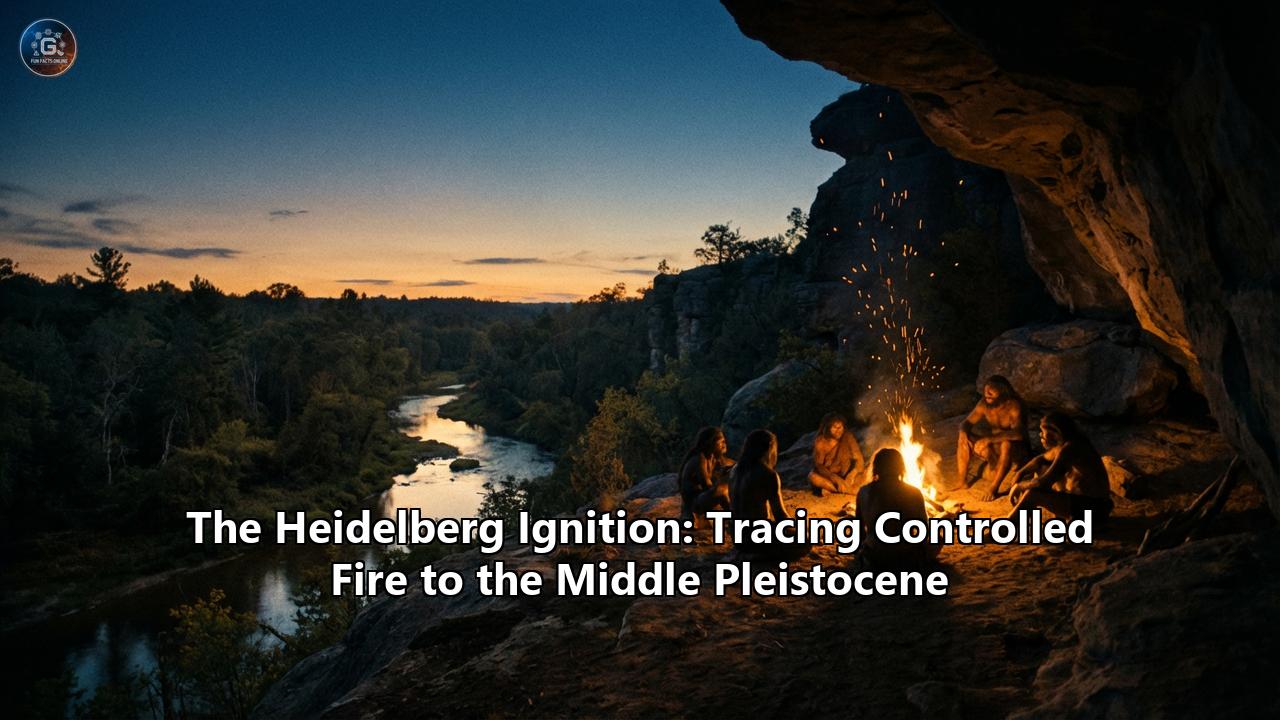
In the vast, silent theater of human evolution, there is a moment when the stage lights were suddenly thrown on. For over a million years, our ancestors had lived in a world illuminated only by the sun and the terrifying, sporadic glare of wildfires. They were creatures of the daylight, retreating to the safety of trees or cliffs when the sun dipped below the horizon, shivering against the encroaching cold of the Pleistocene nights.
Then, something changed. Around 400,000 years ago, a new behavior ignited across the Old World. It wasn't just the opportunistic use of a burning bush struck by lightning; it was the deliberate, technological mastery of flame. This pivotal threshold, often overshadowed by the earlier invention of stone tools or the later emergence of art, marks the true separation of human from animal. This is the Heidelberg Ignition—the era when Homo heidelbergensis and their contemporaries tamed the chemical reaction that would eventually power civilizations, digest our food, and reshape our very biology.
This article traces the forensic evidence of this revolution, moving from the ash layers of Israeli caves to the muddy banks of ancient English rivers, to understand how the Middle Pleistocene became the crucible of humanity.
Part I: The Smoldering Ember – The Mystery of the Early Burn
To understand the magnitude of the Heidelberg Ignition, we must first navigate the shadowy era that preceded it. The relationship between hominins and fire is ancient, but for a long time, it was an abusive, one-sided affair.
The "Cooking Hypothesis" and the Missing Hearth
The most famous theory regarding early fire is the "Cooking Hypothesis," championed by biological anthropologist Richard Wrangham. Wrangham argues that Homo erectus, a direct ancestor who lived 1.8 million years ago, must have used fire. His reasoning is biological rather than archaeological: H. erectus had smaller teeth, a smaller gut, and a significantly larger brain than its predecessors. To fuel such an expensive metabolic engine while reducing digestive tissue, they needed high-quality, easily digestible calories. Cooked meat and tubers fit this bill perfectly.
If Wrangham is right, fire use is nearly 2 million years old. However, the archaeological record refuses to cooperate.
- Koobi Fora (Kenya) & Chesowanja: There are patches of baked earth dated to 1.5 million years ago, but they are indistinguishable from the remnants of natural brush fires.
- Wonderwerk Cave (South Africa): Microscopic traces of wood ash and burnt bone deep inside this cave date to 1 million years ago, suggesting Homo erectus might have brought burning branches inside.
But these instances are sporadic. They are "smoldering embers"—isolated moments where an ancestor might have captured a wildfire’s gift and kept it alive for a night or two. There were no structured hearths, no regular patterns of burning. For a million years, fire was a visitor, not a resident.
The Problem of "Fire at Will"
The distinction between using fire and making fire is the difference between scavenging and hunting. A creature that relies on lightning strikes to obtain fire is a slave to chance. If the fire goes out, the darkness returns for weeks, years, or decades. This opportunistic use likely characterized the Early Pleistocene. Homo erectus may have chased wildfires to collect roasted animals, or carried smoldering brands, but they likely lacked the technology to spark a flame from cold stone.
The "Ignition" required a technological leap: the ability to command fire at will. And that leap appears in the archaeological record with startling synchronicity roughly 400,000 years ago.
Part II: The Spark – The Technology of the Middle Pleistocene
The Middle Pleistocene (770,000 to 126,000 years ago) was once considered the "muddle in the middle"—a confusing period of lineage splitting between Homo erectus, Homo heidelbergensis, and the ancestors of Neanderthals and Sapiens. We now know it was the most dynamic period of technological innovation in prehistory.
The Smoking Gun: Barnham and the Pyrite Revelation
For decades, archaeologists assumed that the ability to create fire (pyrotechnology) was an invention of modern humans, perhaps only 40,000 years old. But a discovery at Barnham (East Farm) in Suffolk, United Kingdom, shattered this timeline in 2025-era research updates.
Excavations at Barnham, a site dated to roughly 400,000 years ago (during the warm Marine Isotope Stage 11), revealed the holy grail of fire archaeology: Strike-a-lights.
Researchers found fragments of iron pyrite (fool's gold) in association with heat-shattered flint handaxes. Pyrite is not native to the site; it had to be collected and brought there. When a piece of pyrite is struck significantly against a sharp piece of flint, it shaves off tiny particles of iron that spontaneously combust in the air—sparks.
The evidence at Barnham was forensic:
- Use-Wear Analysis: The flint tools showed microscopic scarring and rounding characteristic of repeated striking against mineral surfaces, not meat or wood.
- Spatial Context: The pyrite was found alongside reddened sediments and "pot-lid" fractured flints (stones that have exploded due to thermal shock).
This discovery proved that Middle Pleistocene hominins—likely Homo heidelbergensis or very early Neanderthals—carried "lighters." They possessed a fire kit. This implies a level of cognitive foresight previously denied to them. They weren't just waiting for lightning; they were carrying the potential for fire in their pockets, mastering the physics of percussion to create energy.
Beeches Pit: The Architecture of Warmth
Just a few miles from Barnham lies Beeches Pit, another site of the same age. Here, the evidence shifts from the mechanism of ignition to the structure of living.
At Beeches Pit, archaeologists uncovered one of the earliest indisputable hearths in Europe. This wasn't just a pile of ash; it was a designated place for fire. The sediment was baked red and black, indicating sustained heat of over 400°C.
- Fireside Knapping: Remarkably, archaeologists found a scatter of flint debris that refitted together to form a single core. These flakes fell in an arc around the hearth. We can ghost-line the image of a Homo heidelbergensis individual sitting by the fire 400,000 years ago, crafting a tool while enjoying the warmth, the flakes dropping around their crossed legs.
- The Error: Some of the flint tools had fallen into the fire and burned, useless. This "mistake" is a humanizing detail, a frozen moment of annoyance or carelessness preserved for eons.
Part III: The Hearth at the Center of the World – Qesem Cave
While the British sites show us the technology, Qesem Cave in Israel reveals the sociology. Dated between 420,000 and 200,000 years ago, Qesem is a treasure trove of the Acheulo-Yabrudian Cultural Complex.
The 4-Meter Inferno
At the center of Qesem Cave lies a massive hearth, spanning nearly 4 square meters. Micro-morphological analysis of the ash layers reveals that this fire was lit, extinguished, and relit repeatedly over centuries. It was the permanent anchor of the cave.
The spatial organization around this hearth is complex:
- Cooking Zones: Burned animal bones (fallow deer, aurochs) are concentrated near the fire, often showing cut marks that imply meat was roasted and then stripped.
- Clean Zones: The areas further from the fire were used for different tasks, suggesting a conceptual division of space—a "kitchen" versus a "workshop."
The Social Hub
The Qesem hearth fundamentally changed the social fabric. Before controlled fire, feeding was likely a solitary or competitive act, done quickly to avoid predators. With a central fire, feeding became communal.
The "camp," as a concept, was born here. The fire provided light, extending the day into the night. This extra time, the "social night," was likely when language evolved. Freed from the immediate pressure of hunting and gathering, these hominins could tell stories, plan tomorrow's hunt, or bond. The large hearth at Qesem suggests a group size that required social regulation, and the fire was the focal point of that order.
Part IV: The Northern Frontier – Surviving the Ice
The "Heidelberg Ignition" was not just a luxury; in Europe, it was a survival strategy. Homo heidelbergensis was the first human species to permanently colonize the northern latitudes. While they arrived during warm interglacials, they stayed as the climate cooled.
Schöningen: The Hunters of the Lake
In Germany, the site of Schöningen (approx. 300,000 years ago) offers a different perspective. Famous for the preservation of eight exquisite wooden spears, Schöningen also presents a debate about fire.
While the presence of distinct hearths at Schöningen has been debated (some arguing the reddened earth is from natural decay), the wooden spears themselves hint at fire technology. To harden the tip of a spruce spear without making it brittle requires careful heating—a technique known as fire-hardening.
Furthermore, the sheer quantity of butchered horse remains suggests these people were apex predators. It is inconceivable that they could process and consume such vast quantities of meat in a predator-rich environment without the protection of fire. Fire allowed them to defend their kill from the scimitar-toothed cats (Homotherium) that prowled the lakeside.
The Thermal Barrier
Physiologically, H. heidelbergensis was robust and muscular, generating significant body heat. But without fire, winters in Northern Europe would have been a death sentence. Fire allowed them to create micro-climates. A shelter with a hearth can raise the ambient temperature by 10-15 degrees Celsius. This "technological warmth" allowed humans to break the thermal barrier that confined other primates to the tropics.
Part V: The Alchemist – How Fire Changed Us
The habitual use of fire did more than change our surroundings; it changed us. The period of the Heidelberg Ignition correlates with the final sprint in human brain size increase.
The External Stomach
Cooking is essentially external digestion. Heat breaks down the complex collagen in meat and the tough cellulose in starches (like tubers).
- Energy Efficiency: A raw steak takes immense energy to chew and digest. A cooked steak yields more calories for less work.
- The Brain-Gut Trade-off: As we cooked, our guts shrank. The energy savings were redirected to the brain. Homo heidelbergensis had a cranial capacity overlapping with modern humans (1100–1400cc). This expensive tissue was paid for by the hearth.
The Detoxification of the World
Fire also unlocked new food sources. Many root vegetables and seeds are toxic or indigestible when raw. Cooking neutralizes toxins, effectively widening the menu. This dietary flexibility made H. heidelbergensis and later Neanderthals resilient to climate change, as they could switch food sources when specific prey or plants vanished.
The Sleep Revolution
Primates sleep in trees to avoid leopards. This sleep is often light and interrupted. Humans sleep on the ground. A study on the "sleep intensity" of primates vs. humans suggests that fire's protection allowed our ancestors to enter deeper REM sleep. REM sleep is crucial for memory consolidation and complex cognitive processing. By keeping the monsters at bay, the fire allowed us to dream, and perhaps, to become smarter.
Part VI: The Torchbearers – Who Were They?
We call this the "Heidelberg Ignition," but the taxonomy is complex. The users of this fire at Barnham, Beeches Pit, and Qesem were the ancestors of Neanderthals and Homo sapiens.
- In Europe: These fire-wielders evolved into the Neanderthals. Far from the brutish stereotype, Neanderthals were masters of fire. They produced birch tar (the first industrial glue) which requires dry distillation of bark at precise temperatures (~340°C)—a feat impossible without total control of fire.
- In Africa: The Heidelbergensis populations (sometimes called Homo rhodesiensis) evolved into Homo sapiens. We carried the fire obsession with us. By the time our species left Africa, we were dependent on it. We are the "obligate fire users"—the only animal that dies without cooked food and artificial warmth.
The Cognitive Leap
The ability to make fire with pyrite suggests a sophisticated "operational sequence" (chaîne opératoire).
- Planning: You must carry pyrite and flint, even when you don't need fire right now.
- Knowledge: You must know that this specific shiny rock (pyrite) contains hidden fire, unlike other rocks.
- Skill: You must strike at the correct angle to cast the spark into the tinder, which must be dry and prepared.
This is not instinct; it is culture. It is knowledge passed from parent to child. The Heidelberg Ignition represents the solidification of cultural transmission.
Conclusion: The Legacy of the Flame
The "Heidelberg Ignition" was not a singular event, but a cascading revolution that occurred roughly 400,000 years ago across the Old World. It was the moment humanity stepped out of the ecological niche of a clever primate and into the role of a planetary shaper.
When you strike a match today, or turn the dial on a gas stove, you are reenacting a ritual born in the muddy clays of Beeches Pit and the limestone vaults of Qesem Cave. Homo heidelbergensis gave us the night. They gave us the cooked meal. They gave us the social circle. But most importantly, they handed us the spark that would eventually light the engines of the modern world. We are the children of that ignition, still gathered around the fire, telling stories against the dark.
Reference:
- https://www.nationalgeographic.com/science/article/oldest-fire-making-neanderthals-ancient-humans
- https://www.sci.news/archaeology/earliest-evidence-fire-making-14416.html
- https://en.wikipedia.org/wiki/Beeches_Pit
- https://www.researchgate.net/publication/284246535_Spatial_aspects_as_seen_from_a_density_analysis_of_lithics_at_Middle_Pleistocene_Qesem_Cave_Preliminary_results_and_observations
- https://www.journals.uchicago.edu/doi/10.1086/691211
- https://weizmann.elsevierpure.com/en/publications/evidence-for-the-repeated-use-of-a-central-hearth-at-middle-pleis/
- https://evrimagaci.org/gpt/ancient-firemaking-discovery-rewrites-human-history-519631
- https://en.wikipedia.org/wiki/Sch%C3%B6ningen_spears
- https://globalpalaeonews.wordpress.com/2013/12/12/a-quest-for-palaeolithic-fire-starters-a-new-methodological-framework-to-identify-strike-a-lights/