
1. Introduction: The Invisible Cloud Beneath the Surface
For decades, the global narrative around plastic pollution has focused on the visible scars: the strangled sea turtles, the whales with stomachs full of bags, and the unsightly garbage patches swirling in our ocean gyres. We have treated plastic primarily as a physical pollutant—a choking hazard that persists for centuries. However, a silent, invisible transformation is taking place on the surface of our waters, one that changes the equation entirely.
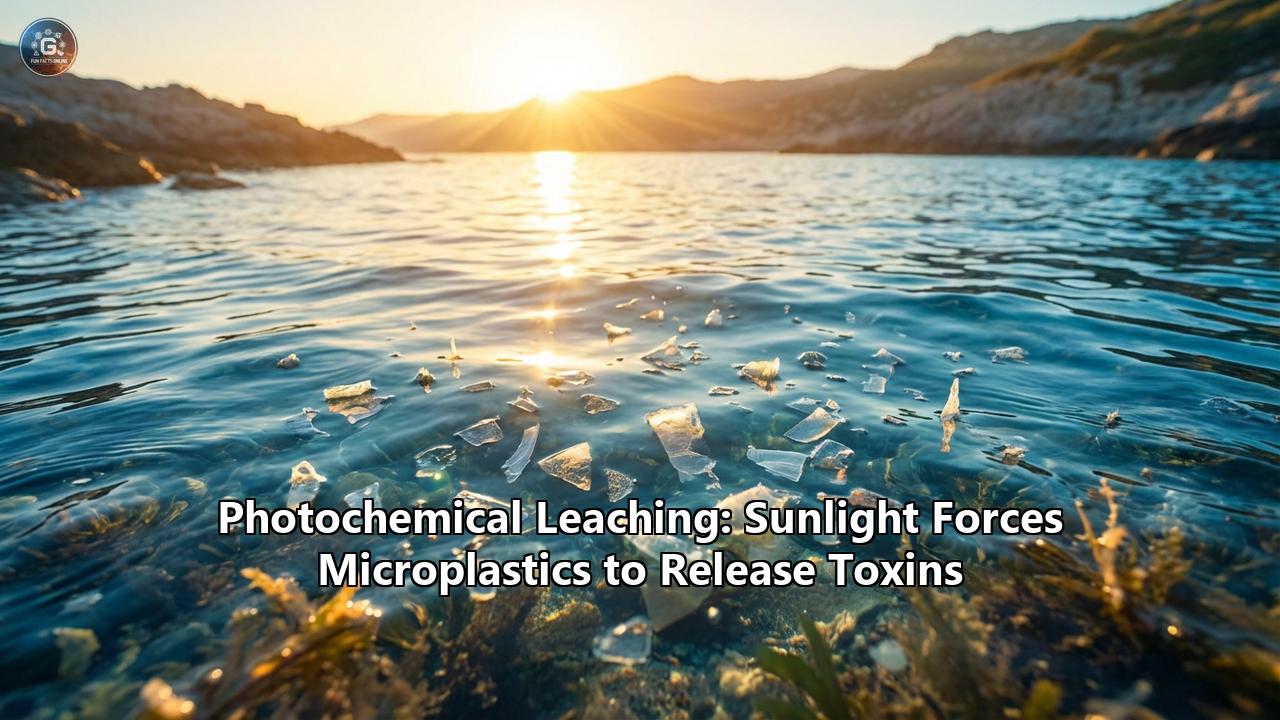
Recent scientific breakthroughs have revealed that microplastics are not merely inert debris floating in the waves. Under the relentless glare of the sun, they are chemically active time bombs. Through a process known as photochemical leaching, sunlight is forcing these particles to "sweat" out a complex cocktail of additives and degradation products. This process creates a halo of dissolved toxicity around floating plastics—an invisible cloud that is chemically distinct from the natural ocean environment and far more dangerous than the plastic particle itself.
This article explores the cutting-edge science of photochemical leaching, detailing how UV radiation acts as a catalyst for chemical release, the specific toxins entering our marine food webs, and the profound implications for planetary health.
2. The Engine of Decay: How Photochemical Leaching Works
To understand the threat, we must first understand the mechanism. Plastics are rarely pure polymers; they are chemical formulations containing a base resin (like polyethylene or PVC) mixed with thousands of additives designed to provide flexibility, color, and durability. When these plastics fragment into microplastics (particles smaller than 5mm), their surface area increases exponentially, turning them into highly efficient chemical delivery systems.
The Sunlight Trigger
The primary driver of this process is ultraviolet (UV) radiation from the sun. When microplastics float in the upper layers of the water column, they are exposed to intense UV energy. This energy excites the electrons within the polymer matrix, causing photo-oxidation. The polymer chains begin to break (chain scission), and the plastic surface becomes brittle and cracked.
But the chemical reaction goes deeper. The UV energy acts as a "key," unlocking the chemical bonds that hold additives within the plastic matrix. It accelerates the migration of these chemicals from the core of the particle to the surface.
The "Blooming" Effect
Scientists describe one phase of this release as "blooming." Just as oil rises to the top of water, additives like plasticizers and antioxidants migrate to the surface of the microplastic under heat and UV stress. Once at the surface, they are easily washed away by the surrounding water. This is not a slow, geological process; recent studies indicate that sunlight can accelerate this leaching rate by over 100-fold compared to dark conditions.
From Solid to Soup: The Creation of Microplastic DOM
Perhaps the most disturbing discovery is the transformation of solid plastic into Dissolved Organic Matter (DOM). We used to think plastic just broke into smaller solids. We now know that sunlight dissolves a portion of the plastic into liquid form.
This "Microplastic-DOM" is chemically unique. Unlike natural organic matter (like decaying leaves or algae), which is heavy and humic, Microplastic-DOM is often lower in molecular weight and highly oxidized. It creates a "chemical cloud" around the particle that bacteria and plankton cannot avoid. It is a synthetic nutrient source that effectively rewrites the chemistry of the water immediately surrounding the plastic.
3. The Toxic Cocktail: What Is Being Released?
The substances leaching from these particles read like a catalog of industrial hazards. Researchers have identified thousands of unique compounds releasing from weathering plastics, but three categories stand out for their toxicity and prevalence.
Phthalates and the Endocrine Disruption Nightmare
Polyvinyl chloride (PVC) is one of the most common plastics used in construction and piping, and it is notoriously unstable under UV light. A landmark 2024 study published in Communications Chemistry highlighted that photoaging reduces the half-life of DEHP (a common phthalate plasticizer) from centuries to mere decades, dumping massive quantities into the water in a short burst.
DEHP and its relatives are potent endocrine disruptors. They mimic hormones like estrogen, potentially causing reproductive failures, developmental deformities, and population collapses in marine species. When sunlight hits a PVC microplastic, it essentially squeezes these hormone-mimicking chemicals out into the water.
The "Forever Chemicals" and Flame Retardants
Many plastics are treated with flame retardants (PBDEs) and surface treatments involving PFAS ("forever chemicals"). These substances are hydrophobic, meaning they hate water and love fat. When leached, they don't just dilute; they seek out fatty tissues. The microscopic zooplankton that form the base of the food web are essentially floating fat droplets, making them the perfect sponge for these leached toxins.
Transformation Products: The Unknown Dangers
The sun doesn't just release chemicals; it cooks them. Photochemical reactions can alter the molecular structure of leached additives, creating transformation products. For example, when DEHP degrades, it can form MEHP (Mono(2-ethylhexyl) phthalate) and phthalic acid.
These byproducts are often more toxic and more water-soluble than the parent chemical. They can penetrate cell membranes more easily and travel further in the water column. We are effectively conducting an uncontrolled chemistry experiment in the open ocean, creating novel compounds that have never existed in nature before.
4. Ecological Impact: Poisoning the Base of the Food Web
The "leaching cloud" has devastating consequences for the organisms living in the surface microlayer—the exact zone where microplastics accumulate.
The Bacterial Dead Zone
In a pivotal study led by researcher Lixin Zhu, scientists exposed marine bacteria to the leachates from photodegraded polyethylene (PE). The results were stark: the leachate inhibited microbial growth.
This contradicts the assumption that bacteria will simply "eat" the plastic carbon. Instead, the cocktail of additives and oxidized oligomers acted as an antibiotic, creating a dead zone around the particles. Since marine bacteria are the engines of nutrient cycling in the ocean, poisoning them disrupts the very foundation of ocean chemistry.
Choking the Algae: A Threat to Oxygen Production
Microalgae like Chlorella vulgaris and Microcystis aeruginosa are responsible for a significant portion of the planet's oxygen production. When exposed to microplastic leachates, these algae show signs of severe stress. The toxins interfere with their photosynthesis, reducing their growth rates and causing oxidative stress within their cells.
If the "lungs of the ocean" are compromised by chemical leaching, the implications extend far beyond the marine ecosystem to the global atmosphere.
The Mariculture Crisis: Seafood Contamination
In coastal aquaculture zones, such as the Maowei Sea in China, high densities of microplastics have been found in oyster nurseries and fish farms. The concern here is trophic transfer. Filter feeders like oysters ingest the microplastics, but they also absorb the dissolved leachate through their gills and tissues.
We are seeing a double-hit mechanism: physical blockage from the particle and chemical poisoning from the leachate. For humans consuming this seafood, it means we are potentially ingesting not just the plastic, but the concentrated residue of its chemical payload.
5. A New Branch of the Carbon Cycle
One of the most profound shifts in our understanding comes from the work of researchers like Alice (Xia) Zhu, who propose that plastic pollution is now a distinct branch of the global carbon cycle.
Historically, the carbon cycle involved the exchange of carbon between the atmosphere, biosphere, and oceans. Now, we must account for the Plastic Carbon Cycle.
- Extraction: Fossil fuels are extracted to make plastic.
- Emission: Plastic enters the ocean.
- Dissolution: Sunlight converts solid plastic carbon into Dissolved Organic Carbon (DOC).
- Integration: This synthetic DOC enters the microbial food web or oxidizes into CO2.
This "new" carbon is altering the chemistry of the surface ocean. Estimates suggest that in heavily polluted areas, microplastic-derived DOC could account for a measurable fraction of the total dissolved organic carbon pool. We are essentially injecting a synthetic carbon source into the ocean's metabolism, with unknown long-term consequences for climate regulation.
6. Case Studies and Recent Breakthroughs (2024-2025)
The science is moving fast. Here are two critical developments that have reshaped our view in the last few years.
The PVC Leaching Acceleration Study (2024)
A critical study released in late 2024 focused on the kinetics of leaching. Researchers found that previous models vastly underestimated how quickly toxins leave plastic. They discovered that aqueous boundary layer diffusion was the bottleneck. Essentially, the water right next to the plastic gets saturated with toxins, slowing down further release. However, in the turbulent, wave-churned ocean, this boundary layer is constantly stripped away, allowing the plastic to pump out toxins at a maximum rate. This suggests that lab experiments (often done in still water) have historically underestimated the toxicity of ocean plastics.
The North Pacific Gyre Experiments
In situ experiments involving water collected from the North Pacific Gyre have shown that "buoyant" plastics (like PE and PP) are the most photo-resistant, meaning they stay on the surface the longest. This persistence allows them to travel thousands of miles while continuously leaching. The study confirmed that even "clean" fragments collected from the middle of the ocean were surrounded by a unique signature of dissolved organic compounds, proving that the leaching process continues for years, or even decades, after the plastic enters the water.
7. Conclusion: Rethinking the "Inert" Pollutant
The phrase "single-use plastic" is a dangerous myth. A bottle may be used once, but chemically, it is active for centuries. The phenomenon of photochemical leaching proves that microplastics are not just passive trash; they are active chemical agents.
Sunlight, the very force that we hopewill "break down" the plastic, is actually weaponizing it, forcing it to release its toxic stores into the water column. As we look toward the future, our mitigation strategies cannot just be about skimming solids off the surface. We must address the chemical complexity of the materials we produce.
If we continue to treat the ocean as a chemical sink, we risk altering the microbial foundations of life itself. The cloud beneath the surface is growing, and it is time we made it visible.
Reference:
- https://pubmed.ncbi.nlm.nih.gov/39333700/
- https://www.researchgate.net/publication/384407773_Photoaging_enhances_the_leaching_of_di2-ethylhexyl_phthalate_and_transformation_products_from_polyvinyl_chloride_microplastics_into_aquatic_environments
- https://pmc.ncbi.nlm.nih.gov/articles/PMC8704590/
- https://www.researchgate.net/publication/335414207_Photochemical_dissolution_of_buoyant_microplastics_to_dissolved_organic_carbon_Rates_and_microbial_impacts
- https://www.researchgate.net/publication/367065648_Photochemical_weathering_of_polyurethane_microplastics_produced_complex_and_dynamic_mixtures_of_dissolved_organic_chemicals
- https://pubs.acs.org/doi/10.1021/acs.est.3c07161
- https://www.researchgate.net/publication/397157755_Leaching_behavior_and_toxic_effect_of_plastic_additives_as_influenced_by_aging_process_of_microplastics