
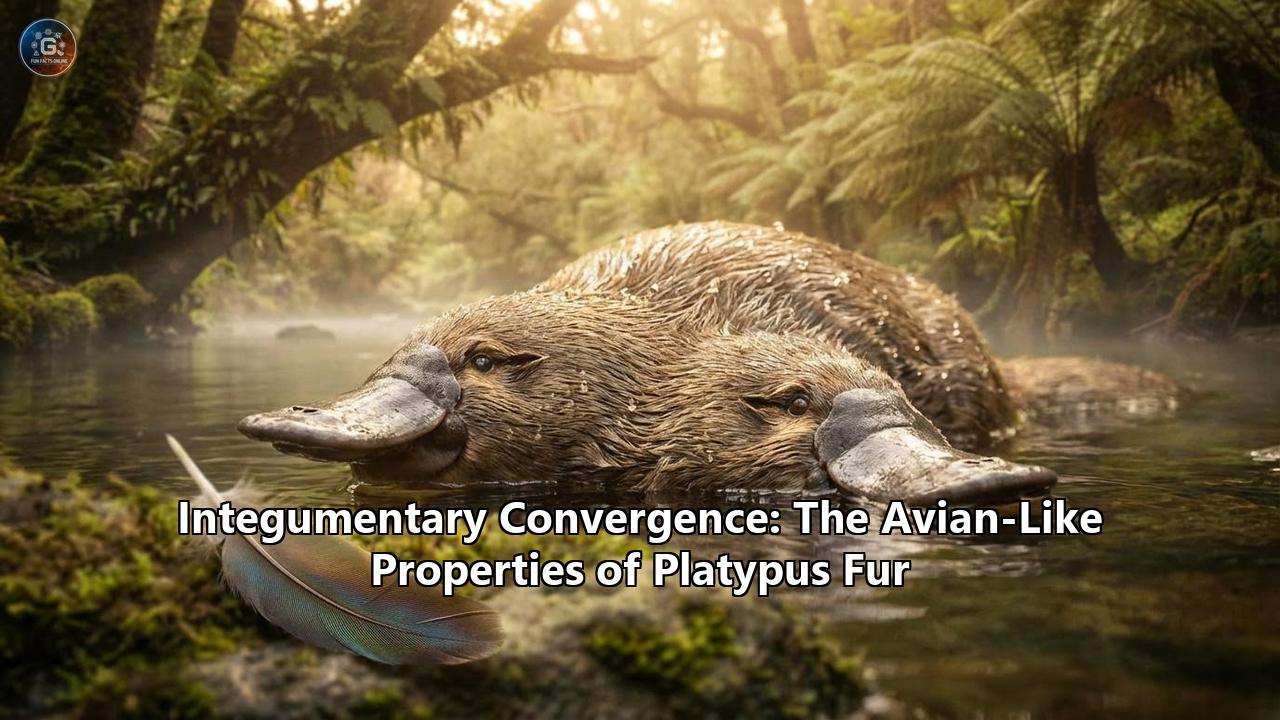
When European naturalists first laid eyes on the preserved pelt of a platypus (Ornithorhynchus anatinus) at the close of the 18th century, the scientific community was famously overcome with skepticism. Believing it to be an elaborate hoax concocted by mischievous taxidermists, some even took scissors to the specimen, desperately searching for the stitches that supposedly bound a duck’s beak to a mammal’s body. Today, the platypus is recognized not as a taxidermist’s joke, but as an evolutionary marvel—a living relic of early mammalian history that possesses a baffling mosaic of traits.
However, beneath the leathery bill, venomous spurs, and egg-laying reproductive system lies another, deeply fascinating layer of biological wizardry: the animal's fur. Far from being standard mammalian hair, the integument of the platypus exhibits astounding convergent evolution with the world of birds. From microscopic, hollow pigment structures to astonishing optical illusions under ultraviolet light, platypus fur behaves in ways that defy traditional mammalian biology. The integumentary convergence between the platypus and its avian counterparts offers a stunning masterclass in how nature’s most effective blueprints are recycled and refined across vast evolutionary divides.
The Microscopic Masterpiece: Hollow Melanosomes
To understand the avian-like properties of platypus fur, we must first look at it through the lens of an electron microscope. For centuries, biologists understood a fundamental rule about the coloration of animal integument: in mammals, the microscopic packets that hold pigment—called melanosomes—are solid structures. In contrast, birds frequently possess hollow melanosomes. This microscopic hollowness in avian feathers is largely responsible for structural coloration, giving birds like peacocks, hummingbirds, and starlings their brilliant, iridescent sheen.
Yet, recent microscopic analyses have completely upended this binary understanding. Researchers from Ghent University made a groundbreaking discovery: platypus hair contains hollow melanosomes. This marks the very first time hollow pigment structures have been found in the fur of any mammal.
When researchers compared the melanosomes of the platypus against those of 126 other mammalian species—including marsupials and the platypus’s closest living relative, the echidna—the platypus stood entirely alone. While avian hollow melanosomes are typically rod-like and contribute to flashy iridescence, the platypus’s hollow melanosomes are completely unique: they are spherical, and rather than creating a rainbow sheen, they simply produce the drab, dark brown colors of the animal's coat.
Why would a mammal evolve a complex, bird-like microscopic structure just to remain brown? While the exact evolutionary advantage remains a tantalizing mystery, scientists hypothesize that the hollow structure may play a hidden role in the animal's highly specialized aquatic lifestyle. Regardless of its ecological function, the presence of hollow melanosomes is a profound example of convergent evolution—a phenomenon where wildly different branches of the tree of life independently arrive at the exact same biological engineering solution.
A Luminescent Cloak: Biofluorescence in the Dark
The visual similarities between platypus fur and bird feathers extend beyond daylight. When the sun goes down and different wavelengths of light are introduced, the platypus reveals a secret straight out of a science fiction novel.
In 2020, researchers were using blacklights to study biofluorescence in flying squirrels at the Field Museum in Chicago. Out of sheer serendipity and curiosity, they decided to shine their ultraviolet (UV) torches onto the museum's preserved platypus specimens. To their astonishment, the drab, brown fur of the platypuses instantly erupted into a brilliant, neon blue-green and cyan glow.
This phenomenon, known as biofluorescence, occurs when an organism absorbs short, high-energy wavelengths of light (in this case, UV light between 200 and 400 nanometers) and re-emits them as longer, lower-energy wavelengths of visible light (between 500 and 600 nanometers). While bioluminescence involves an internal chemical reaction (like a firefly), biofluorescence is purely optical, dependent on the physical properties of the fur or feathers.
Biofluorescence is incredibly widespread in the avian world—puffins, owls, and parrots utilize glowing feathers for visual communication and mate selection. In mammals, however, it is exceedingly rare. The discovery that platypuses glow green confirmed that biofluorescence exists across all three major mammalian lineages: placentals (flying squirrels), marsupials (opossums), and monotremes (the platypus). Further studies on recently deceased wild platypuses confirmed that this is not an artifact of museum preservation; living platypuses truly glow.
The evolutionary purpose of this avian-like optical trick in the platypus is still debated. Because the platypus hunts at night and closes its eyes entirely while swimming—relying instead on the tens of thousands of electroreceptors on its bill—it is unlikely that the glow is used for communication with other platypuses. Instead, researchers suggest it acts as a high-tech invisibility cloak. Many of the platypus's natural predators, such as large nocturnal birds of prey, can see in the UV spectrum. By absorbing UV light and shifting it into the blue-green visible spectrum, the platypus's fur may effectively camouflage the animal, allowing it to vanish into the murky, low-light waters of its habitat.
The Ultimate Dry Suit: Feather-Like Insulation
The physical structure of platypus fur mimics the thermodynamic perfection of a duck's plumage. As a warm-blooded mammal that spends up to twelve hours a day foraging in near-freezing Australian freshwater streams, the platypus faces a severe physical challenge: water strips heat from a body roughly 25 times faster than air. To survive, the platypus has evolved an integumentary system that functions exactly like the down feathers of waterfowl.
Platypus fur is incredibly dense, boasting an astonishing 300,000 hairs per square inch, making it the most densely furred animal on Earth behind only the sea otter. But density alone does not prevent hypothermia; it is the specific architecture of the hairs that keeps the animal alive.
The coat is composed of two distinct layers: a layer of flattened, broad guard hairs that interlock tightly, and an ultra-dense layer of curvy, kinked underfur. When the platypus dives, the interlocking guard hairs form an impenetrable, waterproof shield, while the curvy underfur acts as a sponge for atmospheric air. This traps a thick layer of insulating air right against the platypus's skin. Much like a penguin diving into the Antarctic ocean or a duck paddling in a frozen lake, the platypus's skin never actually touches the water.
This trapped air provides overwhelming buoyancy and thermal insulation, turning the platypus into a living thermos. It is an extraordinary convergence of form and function; mammal hair has evolved to replicate the aerodynamic and hydrodynamic properties of bird down, allowing the platypus to maintain a core body temperature of 32°C (90°F) even in the icy alpine streams of Tasmania.
Deep Time and Developmental Blueprints: Placodes and Cornification
To fully appreciate the avian-like properties of platypus fur, we must look beyond the fully grown animal and delve into embryonic development. Feathers, reptilian scales, and mammalian hair might look completely different to the naked eye, but they share a deep, common evolutionary origin. All of these integumentary structures begin as "placodes"—tiny thickenings of the epidermis in the developing embryo.
Because the platypus represents a lineage that diverged from the rest of the mammalian family tree over 150 million years ago, its hair development offers a unique window into the past. Studies into the fine structure and immunocytochemistry of monotreme hair reveal fascinating transitional traits. For instance, the inner root sheath of platypus hair utilizes a trichohyalin-based cornification process, bridging the gap between ancient reptilian skin structures and modern mammalian hair.
Furthermore, the very way a platypus begins its life mirrors avian development. Most mammalian zygotes undergo "holoblastic" cleavage, where the entire egg cell divides. However, the platypus—like birds and reptiles—undergoes "meroblastic" division, where only a small disc of cytoplasm atop a massive yolk undergoes division. This deep-seated developmental biology underscores the fact that the platypus is not "trying" to be a bird; rather, both birds and platypuses have conserved, adapted, and utilized the highly successful biological blueprints of their distant, shared amniote ancestors.
Genomic Chimerism: The Avian Threads in Platypus DNA
The morphological convergence between platypus fur and bird feathers is deeply reflected in the animal's DNA. When the draft sequence of the platypus genome was published in 2008 (and updated in 2021), it confirmed what naturalists had long suspected: the platypus genome is a bizarre and elegant amalgamation of mammalian, reptilian, and avian genetic elements.
While most mammals possess two sex chromosomes (XX for females, XY for males), the platypus possesses a staggering ten sex chromosomes. A male platypus has an X1Y1X2Y2X3Y3X4Y4X5Y5 configuration. Even more astounding to geneticists was the revelation that the platypus's X chromosomes share a close sequence homology with the "Z" sex chromosome found in birds. The genetic instructions that dictate the platypus's development sit at the precise evolutionary crossroads where the lineages of modern birds, reptiles, and mammals diverge.
Nature’s Ultimate Recycler
For over two centuries, the platypus has been unfairly characterized as a biological hodgepodge—an animal made from the spare parts of other creatures. However, modern scientific discoveries surrounding its integumentary system paint a vastly different picture. The platypus is a masterclass in highly specialized, convergent bioengineering.
From the hollow melanosomes that mirror the iridescent feathers of a starling, to the neon biofluorescent glow that mimics the plumage of a parrot, to the interlocking waterproof fur that rivals the down of a duck, the platypus demonstrates that evolution is nature’s ultimate recycler. When natural selection stumbles upon a superior mechanism for trapping heat, hiding from predators, or structuring pigment, it does not hesitate to cross taxonomic lines to use it again.
The avian-like properties of platypus fur remind us that the boundaries we draw between "mammal," "bird," and "reptile" are human constructs, often blurred by the relentless creativity of evolution. As we continue to uncover the microscopic, genetic, and optical secrets of the platypus, this ancient, egg-laying swimmer continues to do what it has done since the 18th century: challenge everything we thought we knew about the rules of the natural world.
Reference:
- https://australian.museum/learn/species-identification/ask-an-expert/what-is-a-monotreme/
- https://crev.info/2021/05/platypus-origins-the-mystery-deepens/
- https://www.sciencenews.org/article/platypus-fur-hollow-like-bird-feather
- https://www.reddit.com/r/science/comments/1rx2sbp/platypuses_just_got_even_weirder_researchers_have/
- https://redaksiya.az/en/platypus-tuklerinde-quslara-xas-sirr-askarlandi
- https://gizmodo.com/as-if-the-platypus-couldn-t-get-any-weirder-1845529134
- https://www.livescience.com/platypuses-glow-uv-light.html
- https://www.iflscience.com/platypuses-glow-green-under-ultraviolet-light-57661
- https://www.nationalgeographic.com/animals/article/glowing-platypus
- https://en.wikipedia.org/wiki/Platypus
- https://www.britannica.com/science/Do-Platypuses-Glow-Under-UV-Light
- https://www.vice.com/en/article/scientists-just-discovered-that-platypus-fur-glows-green-under-uv-light/
- https://www.researchgate.net/publication/13565634_The_sensory_world_of_the_platypus
- https://pubmed.ncbi.nlm.nih.gov/15281062/
- https://en.wikipedia.org/wiki/Monotreme