
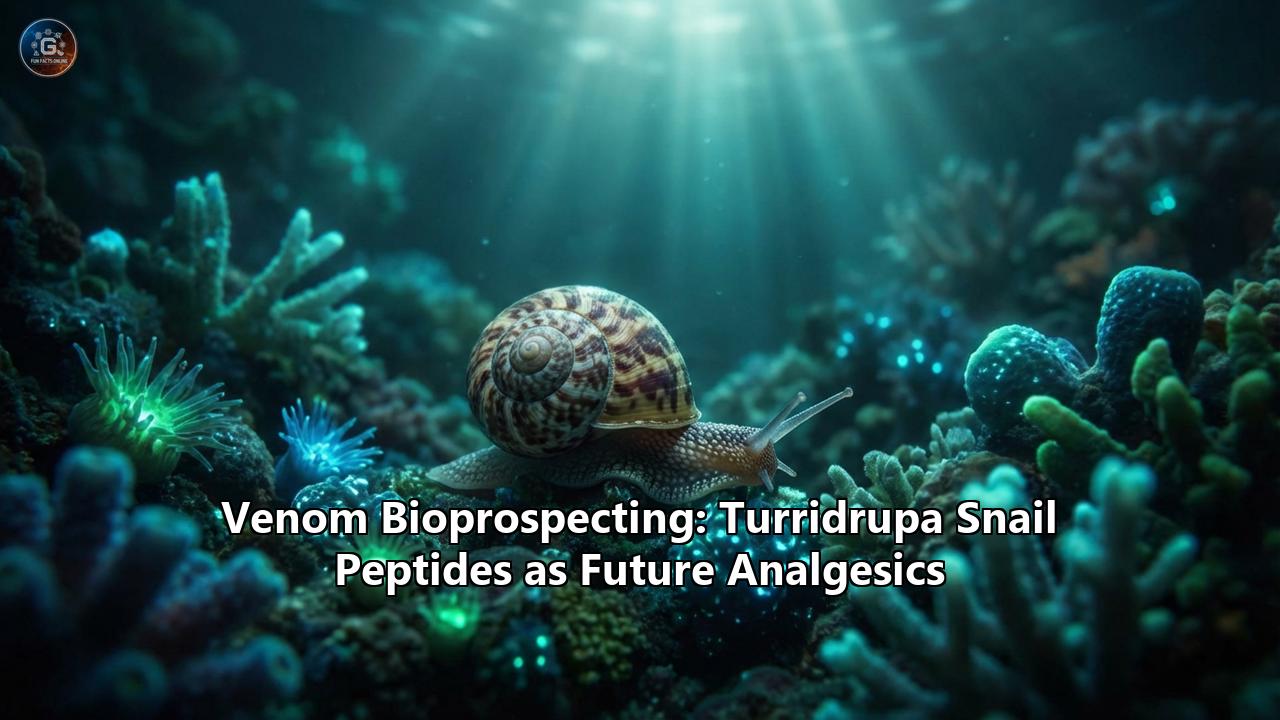
1. Introduction: The Silent Chemists of the Deep
In the shadowy recesses of the world’s tropical oceans, a silent chemical warfare has been raging for millions of years. It is a war fought not with claws or teeth, but with some of the most sophisticated molecular cocktails known to science. For decades, pharmaceutical researchers have looked to the rainforests for the next generation of medicines, but a paradigm shift is currently underway. The future of pain management—specifically the holy grail of non-addictive analgesics—may lie hidden in the venom ducts of marine snails.
While the famous Cone Snail (Conus) has long hogged the spotlight, producing the FDA-approved chronic pain drug Ziconotide (Prialt), it represents only a fraction of the ocean’s venomous diversity. Emerging from the shadows is a less understood, yet potentially more chemically diverse group: the Turrids, and specifically, the genus Turridrupa.
As the global medical community scrambles for alternatives to opioids, which carry devastating risks of addiction and respiratory depression, "venom bioprospecting" has moved from a niche biological curiosity to a billion-dollar frontier. The Turridrupa snail, a small, unassuming predator of marine worms, has evolved a venom arsenal capable of hijacking the nervous systems of its prey with surgical precision. These toxins, designed by evolution to paralyze without causing the prey to flinch, are now being decoded as the potential blueprints for the future of human analgesics.
2. Beyond the Cone Snail: Enter the Turridrupa
To understand the significance of Turridrupa, one must first understand the family tree of venomous mollusks. The superfamily Conoidea includes three main groups: cone snails, auger snails, and turrids.
Cone snails are the "celebrities" of this world. They are large, easy to collect, and their venom is packed with "conotoxins"—small, disulfide-rich peptides that are exceptionally stable and potent. However, science has arguably picked the "low-hanging fruit" of cone snail venom. We have cataloged thousands of conotoxins, but many of them hit the same biological targets.
Turrids, on the other hand, are the "dark matter" of conoidean biodiversity. They comprise over 10,000 species—more than 10 times the number of cone snail species—yet less than 1% of their venom peptides have been sequenced.Taxonomic Detective Work: The Crassispira Connection
A critical point of clarification for any enthusiast or researcher diving into this topic is the taxonomy. The genus Turridrupa has undergone significant scientific revision. Through modern molecular analysis, several species historically classified under Turridrupa (such as the prominent Turridrupa cerithina) have been reclassified into the genus ---Crassispira---.
This distinction is vital because much of the groundbreaking research on "Turridrupa peptides" is technically published under the name Crassispira. For instance, the peptide cce9a, one of the most promising leads discussed later in this article, was isolated from Crassispira cerithina (formerly Turridrupa cerithina). For the purpose of this article, we will refer to them by their biological heritage and the common research context of "turrid venoms," but identifying this shift is crucial for following the scientific trail.
The "Neglected" Majority
Why were they ignored for so long? Size and habitat. Turrids are often tiny (some less than 5mm) and live in deep, inaccessible waters or cryptic coral reef environments. Getting enough venom from a Turridrupa snail to analyze used to be impossible. A single cone snail could provide enough venom for a basic analysis; a turrid might yield nanoliters.
However, the revolution in "Venomics"—specifically high-sensitivity mass spectrometry and transcriptomics—has changed the game. Researchers no longer need to "milk" thousands of tiny snails. They can now sequence the DNA and RNA from a single venom duct to predict the library of toxins the snail can produce. This technological leap has blown the door open on Turridrupa bioprospecting.
3. The Science of Sting: Turritoxins vs. Conotoxins
If cone snails are the "heavy artillery" of the snail world, blasting prey with massive doses of paralytics, turrids are the "snipers." Their venom composition is strikingly different, offering a new chemical palette for drug designers.
Structural Innovation: Breaking the Disulfide Mold
Conotoxins are famous for their rigidity. They are held together by "disulfide bridges"—strong chemical bonds between sulfur atoms that act like staples, keeping the peptide molecule in a specific shape. This shape allows them to fit into receptors in the human body like a key in a lock.
Turritoxins (peptides from turrids like Turridrupa) often break this rule. Recent studies, including work by researchers at the University of the Philippines and the University of Utah, have revealed that many turrid peptides lack these extensive disulfide frameworks. Instead, they rely on other structural motifs, such as alpha-helices, to maintain their shape.Why does this matter for medicine?
- Easier Synthesis: Disulfide bonds are difficult and expensive to reproduce in a lab. Peptides that don't rely on complex bridging patterns are often cheaper and easier to manufacture as drugs.
- Novel Binding: A different shape means they bind to receptors differently. If a conotoxin blocks a pain receptor by "plugging the hole," a turritoxin might work by "jamming the hinge," offering a new way to shut down pain signals that the body hasn't developed a tolerance to.
The Methionine Mystery
One of the most peculiar findings in Turridrupa and related turrid venoms is the high prevalence of methionine, tyrosine, and arginine residues. In typical protein biology, methionine is often just a "start" signal or a structural filler. In turritoxins, it appears to play a functional role in stabilizing the toxin's active "coiled-coil" structure.
This unique "methionine-rich" architecture represents a novel structural class of neurotoxins. In the world of pharmacology, "novel" translates to "opportunity." It means these molecules might evade the immune system, cross biological barriers (like the blood-brain barrier) more effectively, or exhibit fewer side effects than traditional drugs.
4. The Star Candidate: Crassipeptide cce9a
The theoretical potential of Turridrupa venom became concrete reality with the isolation of a specific peptide known as Crassipeptide cce9a (from Crassispira cerithina, formerly Turridrupa cerithina).
Discovery and Isolation
Isolated by researchers investigating the "neglected" turrid families, cce9a is a 29-amino acid peptide. Unlike the chaotic mixture of hundreds of toxins found in crude venom, cce9a was purified to test its specific biological effects.
Behavioral Modulation in Mice
When introduced to mouse models, cce9a produced a fascinating result. It didn't just paralyze the mice (which would indicate a simple, lethal toxin). Instead, it caused a phenotypic shift from lethargy to hyperactivity depending on the age of the mouse and the dosage.
While "hyperactivity" sounds like the opposite of "pain relief" (analgesia), in neuropharmacology, this is a gold standard signal. It proves the peptide is psychoactive—it is successfully crossing into the nervous system and modulating the firing rates of neurons. It isn't just destroying tissue; it is flipping switches in the brain.
Mechanism of Action: Rewiring the Nervous System
The specific target of cce9a and related turritoxins appears to be the Nicotinic Acetylcholine Receptor (nAChR). These receptors are the primary communication gates between nerves and muscles, and crucially, they regulate pain pathways in the central nervous system.
Opioids work by dampening the signal after it arrives. Turridrupa peptides, by targeting nAChRs, essentially stop the "pain message" from ever being written. This mechanism is similar to how nicotine can have mild analgesic effects, but these snail peptides are thousands of times more potent and specific, targeting only the receptor subtypes involved in pain sensation without affecting the ones that control heart rate or breathing.
5. From Neurotoxin to Analgesic: The Medical Logic
The leap from a snail killing a marine worm to a human taking a pill for chronic back pain relies on "homology"—the shared biology between species. The ion channels that a worm uses to wiggle are remarkably similar to the ion channels humans use to signal chronic neuropathic pain.
Targeting the nAChRs: The Non-Opioid Pathway
The search for non-opioid analgesics is largely a search for voltage-gated ion channel blockers.
- Ziconotide (Prialt) proved this works by blocking N-type calcium channels. However, Ziconotide has a major flaw: it cannot cross the blood-brain barrier effectively and must be injected directly into the spinal fluid (intrathecally).
- Turrid peptides offer a second chance. Because they are structurally distinct (often smaller or helical), there is hope that they can be engineered into "peptidomimetics"—drugs that mimic the peptide but can be taken orally or intravenously.
Specific turritoxins have shown affinity for the alpha-9-alpha-10 (α9α10) subtype of nicotinic receptors. This specific receptor is a prime target for breast cancer pain and chemotherapy-induced neuropathy. If a Turridrupa peptide can selectively block α9α10 without blocking the α7 receptor (which is needed for cognitive function), we could have a painkiller that doesn't cause drowsiness, addiction, or brain fog.
Synergy in the Venom Cocktail
Recent papers (Carpio et al., 2025) have highlighted that turrid venoms rely on "Synergistic Cabals." This means the snail doesn't just shoot one bullet; it fires a team.
- Toxin A might open a hole in the cell membrane.
- Toxin B (the analgesic) slips through that hole to block the pain receptor.
- Toxin C prevents the enzyme that would normally break down Toxin B.
Bioprospecting is now looking at using these "helper" peptides to improve drug delivery. Even if the analgesic peptide itself is hard to deliver to a human nerve, the Turridrupa snail might have already evolved a "delivery vehicle" peptide that we can borrow.
6. The Bioprospecting Pipeline: Challenges and Breakthroughs
If these peptides are so promising, why aren't they in pharmacies yet? The journey from "Venom Duct" to "Vial" is fraught with the "Glass Ceiling" of peptide drug development.
The Glass Ceiling
Peptides are fragile. If you swallow a peptide, your stomach acid treats it like a piece of steak—it digests it. This is why insulin (a peptide) must be injected.
- Challenge: Making Turridrupa peptides stable enough to survive the human body.
- Solution: Cyclization. Chemists are learning to "tie the ends" of these linear snail peptides, turning them into loops (cyclic peptides) that enzymes cannot easily chew up. The unique, non-disulfide structure of some turritoxins makes them excellent candidates for this chemical hardening.
Synthesis and Stability
Because turrids are too small to farm, we cannot harvest the venom naturally. We must synthesize it.
- Advantage: The Turridrupa peptides characterized so far (like cce9a) are relatively short (29 residues). This falls into the "sweet spot" for solid-phase peptide synthesis (SPPS). They are small enough to be made cheaply in a machine but large enough to be highly specific to their target receptors.
7. Future Outlook: The Next Decade of Marine Pharmacology
The next decade will likely see the "Conoidea" field expand massively beyond Conus.
- 2025-2027: We can expect the publication of the first comprehensive Turridrupa and Crassispira "Venomes"—libraries mapping thousands of peptide sequences from these snails.
- Pre-Clinical Trials: Specific focus will be on neuropathic pain (phantom limb pain, diabetic neuropathy, sciatica). These are conditions where opioids are notoriously ineffective, but where channel-blockers (like those in snail venom) shine.
- Conservation: This research provides a powerful economic argument for conserving coral reefs. A single extinct species of Turridrupa could mean the loss of a cure for cancer pain. The biodiversity of the Philippines and Indo-Pacific, where these snails thrive, is now viewed not just as an ecological treasure, but a pharmaceutical vault.
8. Conclusion
Venom bioprospecting is rewriting the rulebook of pain management. For too long, we have relied on the poppy flower (opium) to numb human suffering, at great cost to society. The Turridrupa snail offers a different path.
Its venom, honed by millions of years of evolution to subdue swift prey, contains molecular keys that fit the locks of our own nervous system. By studying peptides like cce9a, scientists are uncovering a new class of analgesics—drugs that are potent, non-addictive, and structurally novel.
The Turridrupa snail may be small, and it may have been neglected by science for a century, but its time has come. In the war against chronic pain, this tiny marine predator is emerging as one of humanity’s most promising allies. The future of analgesia is not synthetic; it is oceanic.
Reference:
- https://www.researchgate.net/publication/51663201_Characterization_of_a_Venom_Peptide_from_a_Crassispirid_Gastropod
- https://pmc.ncbi.nlm.nih.gov/articles/PMC8899473/
- https://www.frontiersin.org/journals/molecular-biosciences/articles/10.3389/fmolb.2022.784419/full
- https://pubmed.ncbi.nlm.nih.gov/15051399/