
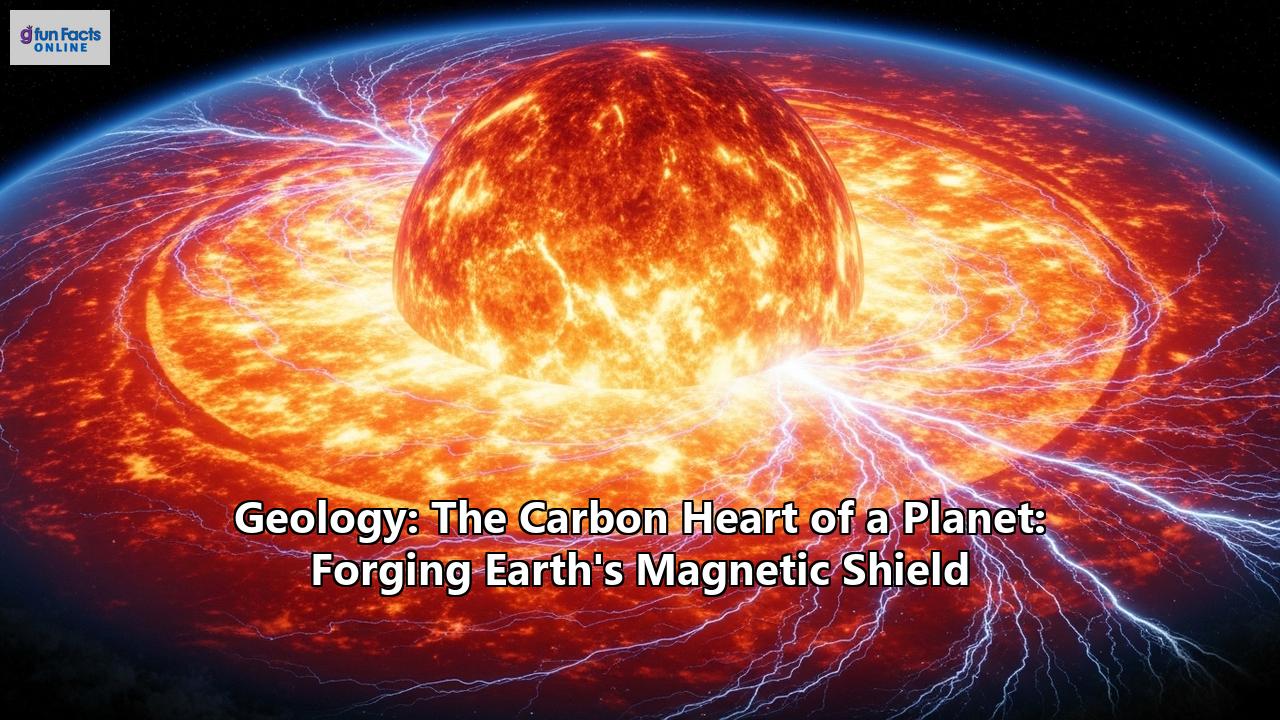
A Journey to the Heart of Our Planet: How Carbon Forged Earth's Vital Magnetic Shield
Our planet is a unique haven for life in the vast, unforgiving expanse of the cosmos. This is made possible by an invisible, yet powerful, force field known as the magnetosphere. This magnetic shield, generated deep within the Earth, deflects harmful solar winds and cosmic radiation that would otherwise strip away our atmosphere and make life impossible. For decades, scientists have understood the basics of how this shield is generated, but a fundamental paradox about the very heart of our planet has puzzled them: how did the Earth's solid inner core—the engine of our magnetic field—come into being? Recent groundbreaking research has unveiled a surprising hero in this geological drama: carbon. This element, the very basis of life on the surface, appears to be the key ingredient that allowed our planet's heart to solidify, thereby forging the magnetic shield that protects us all.
A Glimpse into the Earth's Fiery Depths
To understand the significance of this discovery, we must first journey to the center of the Earth, a realm of unimaginable pressure and temperature. Our planet is structured in layers, much like an onion. We live on the crust, a thin, solid outer layer. Beneath it lies the mantle, a thick layer of hot, dense rock that constitutes most of the Earth's volume. Deeper still, we find the core, the planet's innermost structure, divided into two distinct parts.
The outer core is a vast, swirling ocean of molten iron and nickel, beginning at a depth of about 2,890 kilometers (1,790 miles). Here, temperatures can soar to between 4,000 and 5,000 degrees Celsius (7,200–9,000 degrees Fahrenheit). It is the ceaseless motion within this liquid metal sea that generates Earth's magnetic field.
At the very center of our planet, starting at a depth of 5,150 kilometers (3,160 miles), lies the inner core. It is a solid ball of primarily iron and nickel, about 70% the size of the Moon. Despite being as hot as the surface of the Sun, the immense pressure at the center of the Earth prevents the inner core from melting. The existence of this solid inner core, distinct from the liquid outer core, was first discovered in 1936 by Danish seismologist Inge Lehmann through the study of seismic waves from earthquakes.
The Geodynamo: Earth's Magnetic Engine
The Earth's magnetic field is not static; it is a dynamic and continuously generated phenomenon. The prevailing theory explaining its origin is the "geodynamo" theory. This theory posits that the movement of the electrically conductive molten iron in the outer core, driven by convection currents, creates powerful electrical currents. These currents, in turn, generate the magnetic field, which extends far out into space, forming the protective magnetosphere.
This process is self-sustaining. The motion of the molten metal generates the magnetic field, and the magnetic field, in turn, influences the motion of the molten metal. This intricate dance is powered by the Earth's internal heat. As the planet gradually cools, the inner core grows, with molten iron from the outer core crystallizing onto its surface. This process releases heat and lighter elements into the outer core, creating convection currents that churn the liquid metal and drive the geodynamo. Therefore, the formation and growth of the solid inner core are absolutely critical for sustaining the magnetic shield that is so vital to life on Earth.
The Inner Core Nucleation Paradox: A Scientific Conundrum
For many years, a significant paradox has clouded our understanding of the Earth's core. Scientists have struggled to explain how the inner core first began to form. For a liquid to solidify, it either needs a seed particle to crystallize around or it must be "supercooled"—cooled to a temperature below its freezing point.
Previous calculations suggested that for a core of pure iron, or even an iron-nickel alloy, an immense amount of supercooling would have been necessary to spontaneously start the crystallization process—somewhere between 800 and 1000 degrees Celsius. This presented a major problem. If the core had supercooled to such an extent, it would have led to a rapid and massive growth of the inner core, and a catastrophic failure of the Earth's magnetic field in the past. However, geological evidence from ancient, magnetized rocks tells us that the magnetic field has existed for billions of years, and seismic observations of the inner core do not support such a rapid growth scenario. This discrepancy is known as the "inner core nucleation paradox."
Carbon: The Unexpected Architect of Earth's Core
Recent research, published in September 2025, has provided a compelling solution to this long-standing paradox. A team of researchers from the University of Oxford, University of Leeds, and University College London used sophisticated computer simulations to investigate how the presence of other, lighter elements might affect the freezing of the core. They looked at silicon, sulfur, oxygen, and carbon, all of which are known to exist in the mantle and could have dissolved into the core during Earth's history.
Their findings were surprising. The simulations revealed that some of the elements previously thought to be significant components of the core, like silicon and sulfur, actually inhibit the freezing process, meaning even more supercooling would be required. In stark contrast, carbon was found to accelerate the freezing process.
The researchers ran simulations with varying amounts of carbon. With 2.4% carbon, the required supercooling was about 420°C, still too high to be plausible. But when they increased the carbon concentration to 3.8% of the core's mass, the required supercooling dropped to a much more feasible 266°C. This is the only known composition that can explain both the initial formation (nucleation) of the inner core and its currently observed size.
This suggests that carbon, in a much higher abundance in the core than previously thought, played a critical role in the Earth's geological history. Without this specific carbon-rich chemistry, the formation of a solid inner core may have never happened, and our planet might look very different today. These experiments indicate that with the right amount of carbon, the core didn't need a massive, improbable supercooling event to begin solidifying; it could freeze spontaneously under more realistic conditions.
Forging the Shield: The Carbon-Core-Magnetosphere Connection
The discovery of carbon's crucial role in the solidification of the inner core has profound implications for our understanding of the Earth's magnetic shield. The crystallization of the iron-carbon alloy at the inner-outer core boundary is the very engine that drives the geodynamo. As the inner core grows, the crystallizing iron leaves behind a liquid in the outer core that is enriched in lighter elements, including carbon. This less dense, buoyant liquid rises, driving the powerful convection currents needed to generate the magnetic field.
Therefore, carbon's role is twofold. Firstly, it allowed the inner core to form in the first place by reducing the amount of supercooling required for crystallization. Secondly, the ongoing process of this carbon-rich iron solidifying at the inner core boundary continuously fuels the convection in the outer core, sustaining the geodynamo over geological timescales. This elegant mechanism, kick-started by the presence of carbon, has maintained our protective magnetic shield for billions of years.
A Shield for Life
The importance of this carbon-forged magnetic shield cannot be overstated. The magnetosphere acts as a protective bubble, deflecting the constant stream of charged particles from the sun, known as the solar wind. Without this shield, the solar wind would gradually strip away our atmosphere, as it is thought to have happened on Mars. The magnetosphere also protects us from cosmic rays and energetic particles from solar storms, which can be harmful to life and damage our technological infrastructure.
In essence, the presence of a precise amount of carbon deep within our planet's core set in motion a chain of events that ultimately made life on the surface possible. It allowed for the formation of a solid inner core, which in turn drives the geodynamo that sustains our magnetic field, which protects our atmosphere and allows life to flourish.
An Evolving Shield and Future Mysteries
Our magnetic shield is not static. There are regions where it is weaker, such as the South Atlantic Anomaly, a vast area stretching over South America and the South Atlantic Ocean where the magnetic field is significantly diminished. This "dent" in the magnetic field allows the inner Van Allen radiation belt to dip closer to the Earth's surface, posing a risk to satellites and spacecraft that pass through it. The anomaly is also observed to be growing and moving, highlighting the dynamic nature of the geodynamo.
The debate over the exact composition of the core is also ongoing. While the recent findings highlight the critical role of carbon in core nucleation, other research points to the presence of other light elements like silicon, oxygen, and sulfur, which are also necessary to explain the core's observed density. Some studies have even explored the possibility of carbon itself exhibiting magnetic properties under extreme conditions. Further research will undoubtedly continue to refine our understanding of this hidden realm. The age of the inner core is another area of active debate, with estimates ranging from less than half a billion to over two billion years old. The new evidence pointing to carbon's crucial role may help to resolve this long-standing question.
The Carbon Heart of a Habitable Planet
The story of carbon in the Earth's core is a powerful testament to the intricate and often surprising connections within our planet's systems. An element that we associate with the delicate biosphere on the surface appears to be the linchpin in a colossal geological process deep within the Earth's metallic heart. This process, the carbon-facilitated formation of the inner core, was the crucial step in forging the magnetic shield that has protected our world for eons, allowing it to become the vibrant, living planet we call home. The journey to the center of the Earth has revealed that our planet's very habitability is written in the language of geology, with carbon as one of its most essential words.
Reference:
- https://scied.ucar.edu/learning-zone/sun-space-weather/earth-magnetosphere
- https://www.youtube.com/watch?v=lZKx8MRIDes&pp=0gcJCfwAo7VqN5tD
- https://science.nasa.gov/science-research/earth-science/earths-magnetosphere-protecting-our-planet-from-harmful-space-energy/
- https://www.sciencedaily.com/releases/2025/09/250904103920.htm
- https://www.eurekalert.org/news-releases/1096602
- https://www.gsi.ie/en-ie/education/our-planet-earth/Pages/The-Earth-structure.aspx
- https://www.calacademy.org/explore-science/from-core-to-crust-defining-earths-layers
- https://www.britannica.com/science/Earths-core
- https://www.ebsco.com/research-starters/earth-and-atmospheric-sciences/earths-core
- https://newspaceeconomy.ca/2025/09/01/the-south-atlantic-anomaly-earths-quietly-shifting-magnetic-enigma/
- https://en.wikipedia.org/wiki/Earth%27s_inner_core
- https://www.earth.ox.ac.uk/article/hidden-chemistry-earths-core-revealed-how-it-froze
- https://geologyglasgow.org.uk/headlines/carbon-may-have-helped-earths-iron-core-solidify/
- https://thedebrief.org/it-could-change-in-the-future-simulations-of-earths-mysterious-core-just-revealed-something-unexpected/
- https://www.techexplorist.com/hidden-chemistry-earth-core/100880/
- http://www2.ess.ucla.edu/~nimmo/website/ptrsl.pdf
- https://www.sustainability-times.com/research/earths-shield-is-breaking-apart-massive-magnetic-field-hole-above-south-america-now-splitting-into-two-dangerous-zones/
- https://www.pnas.org/doi/10.1073/pnas.1919930117
- https://www.sciencedaily.com/releases/2020/07/200706140856.htm