
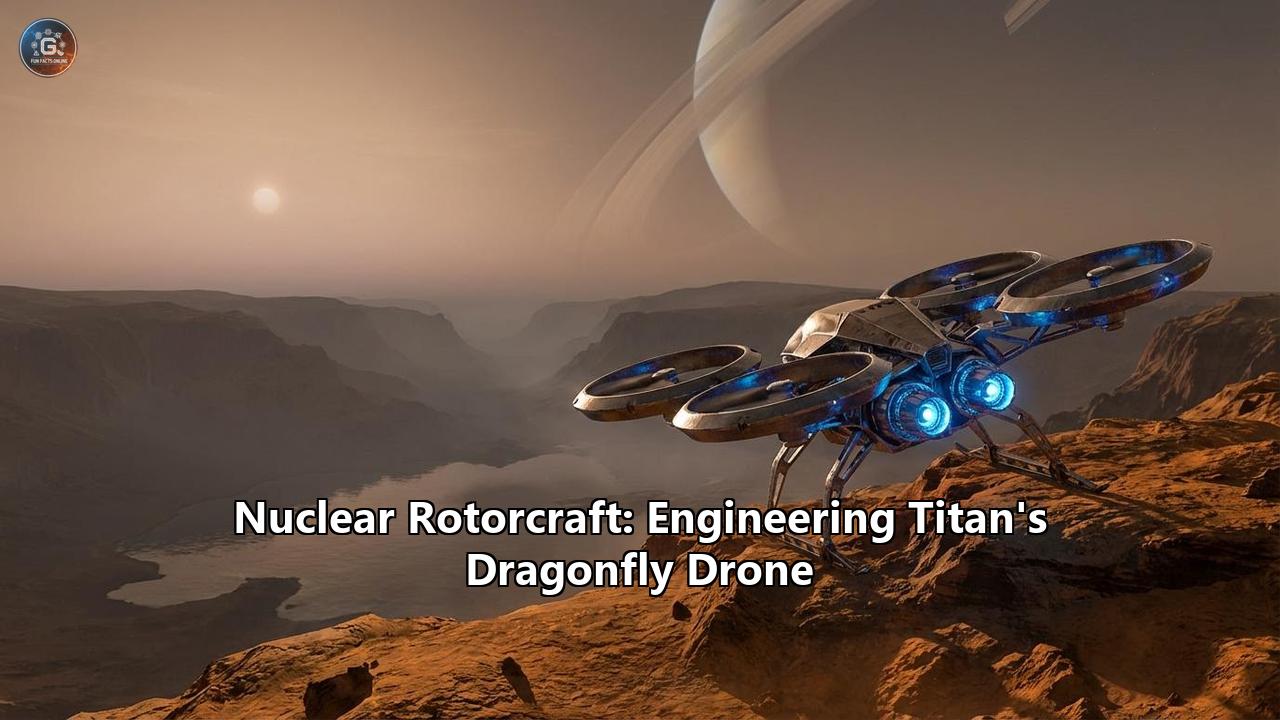
Imagine standing on the surface of a world nearly a billion miles from the Sun. The sky above you is a thick, opaque amber. The temperature is a staggering minus 290 degrees Fahrenheit (minus 179 degrees Celsius). Methane rain drizzles down from hydrocarbon clouds, cutting river valleys into a crust of solid water-ice, before pooling into vast, dark seas. Suddenly, a low, mechanical hum breaks the ancient silence of the landscape. Out of the golden smog descends a vehicle the size of an SUV, powered by the radioactive decay of plutonium, and kept aloft by eight massive spinning rotors.
This is not a scene ripped from the pages of a science fiction novel. It is the very near future of human space exploration. It is NASA’s Dragonfly.
Scheduled to launch in July 2028, Dragonfly represents a fundamental paradigm shift in planetary science. Moving away from the methodical, painstaking crawl of wheeled rovers that have dominated Martian exploration for the past three decades, engineers have designed a nuclear-powered rotorcraft built to conquer the skies of Saturn’s largest moon, Titan. With an estimated price tag of $3.35 billion, this is not a mere technology demonstrator, but a fully-fledged, flagship-tier scientific laboratory. Over the course of its primary three-year mission, starting with its arrival in 2034, this aerial explorer will leapfrog across dozens of locations, analyzing the complex chemistry of an environment that closely mirrors the primordial, pre-biological Earth,.
To understand how and why such a magnificent machine is being built, one must first understand the bizarre and captivating world it is destined to explore, and the immense engineering hurdles required to build a flying drone for a cryogenic, alien atmosphere.
Titan: A World of Hydrocarbon Haze
Saturn’s moon Titan is a planetary anomaly. It is the second-largest moon in the solar system (larger even than the planet Mercury), but its true claim to fame is its atmosphere. Titan is the only moon in our solar system with a dense, substantial atmosphere. In fact, the atmospheric pressure at Titan's surface is about 1.5 times that of Earth, and because of the extreme cold, the air is roughly four times denser than the air we breathe.
This atmosphere is composed primarily of nitrogen (about 95%) and methane (about 5%), sprinkled with traces of hydrogen and a rich brew of complex organic molecules. High in the atmosphere, ultraviolet light from the Sun and magnetic radiation from Saturn break apart nitrogen and methane molecules. These fragments recombine to form a diverse array of complex hydrocarbons, which gradually clump together to form the moon’s signature opaque orange haze. Eventually, these heavy organic molecules settle onto the surface, forming vast, dark dune fields made not of silicate sand, but of literal organic plastic.
For astrobiologists, Titan is a cosmic goldmine. It is a planetary-scale laboratory where the exact prebiotic chemical reactions that preceded the origin of life on Earth have been playing out in a deep freeze for billions of years. Beneath its icy crust, Titan is also believed to harbor a global liquid water ocean, making it a prime candidate in the search for extraterrestrial habitability.
But how do you explore a world with a surface hidden beneath a thick smog, covered in organic dunes, and carved by liquid methane rivers? A wheeled rover would easily become bogged down in the soft, unpredictable hydrocarbon sands.
The answer lies in Titan's unique physics. The combination of an atmosphere four times denser than Earth's and a gravitational pull that is only one-seventh of Earth's (about 14% of terrestrial gravity) makes Titan the easiest place in the solar system to fly. On Titan, strapping on a pair of artificial wings and flapping them would generate enough lift for a human being to take flight. For a machine, it means rotor-driven flight is vastly more efficient than rolling over treacherous, unknown terrain.
Anatomy of an Interplanetary Octocopter
Dragonfly is a marvel of aerospace and robotic engineering, primarily designed and built by the Johns Hopkins Applied Physics Laboratory (APL) in Laurel, Maryland. At first glance, it resembles a massively scaled-up version of the commercially available quadcopters used by photographers on Earth. However, the similarities end entirely at the basic aerodynamic shape.
Dragonfly is massive. It weighs roughly 1,900 pounds (875 kilograms) and measures 12.5 feet (3.85 meters) long, 12.5 feet wide, and 5.5 feet (1.75 meters) tall. It is the size of a small car. To generate lift, the drone utilizes an octocopter configuration—specifically, eight sets of 53-inch (1.35-meter) coaxial composite blades arranged in pairs at the end of four outriggers. This coaxial design provides immense redundancy; if one motor or rotor encounters an anomaly, the vehicle can still maintain controlled flight and land safely.
Because Titan is unimaginably cold, standard materials behave very differently than they do on Earth. Plastics become as brittle as glass, and metals shrink and warp. Therefore, Dragonfly is being subjected to rigorous durability trials. Its fuselage and vital internal components are wrapped in a specialized foam coating designed to insulate the rotorcraft's sensitive electronics from the frigid ambient temperatures.
At the Johns Hopkins APL, the vehicle's integrated electronics module—the "brain" responsible for guidance, navigation, and data handling—was recently put through power and functional tests. Because the drone will operate 746 million miles away, the communication delay with Earth is over an hour each way. Remote piloting by a human operator is physically impossible. Dragonfly must be entirely autonomous. It will use advanced optical sensors and LiDAR to map the terrain below it in real-time, identifying hazards like boulders or deep crevices, and independently selecting safe landing zones.
The Nuclear Heartbeat
Solar power is useless on Titan. The moon's distance from the Sun, combined with its thick, smoggy atmosphere, means the surface receives only about 0.1% of the sunlight that reaches Earth. Chemical batteries would quickly freeze and die. Therefore, Dragonfly relies on a technology that has a proven track record in deep space: a nuclear battery.
The drone is powered by a Multi-Mission Radioisotope Thermoelectric Generator (MMRTG), supplied by the U.S. Department of Energy. This is the exact same type of power system that drives NASA's Curiosity and Perseverance rovers currently exploring Mars. The MMRTG does not use nuclear fission like a power plant; rather, it harnesses the natural radioactive decay of Plutonium-238. As the plutonium decays, it releases a steady, predictable amount of heat. Thermocouples convert this heat into electrical energy.
However, the MMRTG only produces a continuous output of about 70 watts—roughly enough to power a standard incandescent lightbulb. Flying a 1,900-pound drone requires significantly more power than 70 watts. To solve this, Dragonfly utilizes a hybrid power system. The steady trickle of electricity from the MMRTG is used to slowly charge a massive 134 ampere-hour lithium-ion battery.
Dragonfly will spend the vast majority of its time—about 99%—sitting on the surface of Titan. During these long periods (a Titan day, or "Tsol," lasts 16 Earth days), the drone will perform scientific experiments, communicate with Earth, and quietly charge its battery. When the battery is full, the drone will have enough stored energy to perform a high-power flight lasting up to an hour, covering distances of up to 5 miles (8 kilometers) at speeds of roughly 20 miles per hour,. Furthermore, the excess waste heat generated by the plutonium decay is ingeniously routed through the spacecraft's interior—a space engineers affectionately call the "attic"—to keep the delicate scientific instruments and lubricants from freezing solid.
The Astrobiology Arsenal
Dragonfly is not just a flying machine; it is a world-class chemistry laboratory designed to search for the chemical precursors to life. To accomplish this, the vehicle carries a suite of highly specialized scientific instruments, each adapted to operate in Titan's extreme environment.
DrACO (Drill for Acquisition of Complex Organics):Before you can analyze a sample, you have to collect it. Developed by Honeybee Robotics, DrACO is the sample acquisition system. Mounted on the drone's landing skids, DrACO features a rotary-percussive drill capable of penetrating the incredibly tough, water-ice-cemented regolith of Titan, which has a compressive strength of around 80 MPa.
Traditional rovers scoop up dirt and drop it into an oven, but Titan's low gravity and thick atmosphere make handling powdery samples difficult. Instead, DrACO uses a brilliant pneumatic transport system. It essentially acts as a vacuum cleaner, suctioning the drill cuttings using a fast-moving stream of Titan's own ambient, freezing air. This prevents the sample from heating up during transport, which could alter or destroy the delicate organic molecules before they can be studied.
DraMS (Dragonfly Mass Spectrometer):Once DrACO collects a sample, it is pneumatically delivered to DraMS, the undisputed heart of the science payload. Developed in part by NASA's Goddard Space Flight Center and the French space agency (CNES), DraMS is built on the heritage of the Sample Analysis at Mars (SAM) instrument on the Curiosity rover,.
DraMS is designed to identify chemical components and processes that produce biologically relevant compounds. It operates in two distinct modes. In the Laser Desorption Mass Spectrometry (LDMS) mode, the sample is irradiated with an onboard ultraviolet laser, ionizing the molecules so their mass-to-charge ratio can be measured,. In the Gas Chromatograph Mass Spectrometry (GCMS) mode, the sample is baked in an oven to vaporize the organics, separating them for incredibly precise chemical fingerprinting,. Together, these methods will allow astrobiologists to detect molecular biosignatures and understand how far prebiotic chemistry has progressed on Titan.
DraGNS (Dragonfly Gamma-ray and Neutron Spectrometer):While DraMS looks for complex organics, DraGNS looks at the fundamental building blocks of the terrain. Developed by APL and the Lawrence Livermore National Laboratory, this instrument fires a pulse of neutrons into the ground beneath the lander. By measuring the gamma rays that bounce back, DraGNS can instantly determine the elemental surface composition—identifying carbon, nitrogen, hydrogen, and oxygen—without ever needing to drill a hole.
DragonCam:You cannot send a spacecraft to another world without taking pictures. Developed by Malin Space Science Systems (the same team behind the spectacular cameras on NASA's Mars rovers), DragonCam is a suite of microscopic and panoramic cameras. It will characterize landforms, image the surface at microscopic scales to understand the sand grains, and capture breathtaking aerial photography as Dragonfly cruises above the alien dunes.
DraGMet (Dragonfly Geophysics and Meteorology Package):Titan has weather, and Dragonfly will be the first permanent weather station on another moon. DraGMet includes a dozen different sensor types to measure wind speed, atmospheric pressure, temperature, and methane humidity. Because the aerodynamic wake of the lander could disrupt readings, DraGMet's thermal wind sensors are mounted on small masts extending from the rotor hubs to ensure pristine environmental data. These specific sensors have been rigorously tested at the NASA Langley Research Center’s Transonic Dynamics Tunnel, using heavy R-134a gas to simulate Titan's dense aerodynamics.
DraGMet doesn't just look up; it looks down. It includes a seismometer to detect "Titanquakes." By measuring how seismic waves travel through the moon, scientists hope to calculate the exact depth and thickness of Titan’s subsurface liquid water ocean. Furthermore, DraGMet features an incredible instrument called EFIELD—two electrodes designed to detect the alternating current (AC) electric fields generated by wind-blown charged sand grains,. On Earth, rubbing a balloon creates static electricity; on Titan, hydrocarbon sand blowing across the dunes generates static charges. EFIELD will help scientists finally understand how Titan's massive dunes are formed and shaped,.
Phoning Home: The Deep Space Network
Gathering all this ground-breaking data is useless if it cannot be transmitted back to scientists on Earth. Dragonfly handles communication via a High-Gain Antenna designed to point directly at Earth, establishing a link with NASA's Deep Space Network (DSN).
Because Titan is on average 8 to 11 Astronomical Units (up to a billion miles) away, the sheer physics of radio communication becomes a massive hurdle. Dragonfly relies on an X-band radio system, powered by a 100-watt traveling-wave tube amplifier and an APL-designed "Frontier" radio. Given the immense distance, the constraints of a 1-meter antenna dish, and the power limitations of the MMRTG, the maximum data transmission rate is severely bottlenecked. Engineers estimate that Dragonfly will downlink its data to Earth at a rate of approximately 2 Kilobits per second (2K bps).
By modern terrestrial standards, 2 Kbps is incredibly slow—slower than a 1990s dial-up modem. This limitation requires Dragonfly to be exceptionally smart about what it transmits. The drone's onboard computers will compress data, prioritize the most important scientific findings, and transmit during specific windows when Saturn and Titan are favorably aligned with Earth's massive 34-meter and 70-meter DSN listening dishes.
The Flight Plan and the Road to 2034
Getting to Titan is an odyssey in itself. Fabrication of the spacecraft is fully underway. Recently, Lockheed Martin engineers completed the fabrication and thermal cycle testing of Dragonfly’s aeroshell and heat shield, a critical milestone to ensure the drone survives atmospheric entry. The official integration and testing phase is accelerating through 2026 and early 2027 at the APL facilities in Maryland,.
In July 2028, Dragonfly will be packed atop a massive SpaceX Falcon Heavy rocket at NASA's Kennedy Space Center in Florida and blasted into the void,. Because the rocket cannot push the heavy spacecraft directly to Saturn fast enough, Dragonfly will take a looping, six-year trajectory, performing a gravity-assist maneuver around Earth to slingshot itself toward the outer solar system.
Arrival is scheduled for 2034. The dramatic entry sequence will begin as the aeroshell slams into Titan's upper atmosphere at hypersonic speeds, enduring temperatures of up to 1,650 degrees Celsius (3,000 degrees Fahrenheit). After the fiery friction of atmospheric entry bleeds off most of the spacecraft's velocity, a sequence of parachutes will deploy in the thick air.
Then comes the moment of truth. Unlike the Mars rovers that used airbags or the "Sky Crane" lowering mechanism, Dragonfly will simply drop out of its protective aeroshell mid-air. Its eight rotors will spin up, biting into the freezing, dense nitrogen atmosphere. It will stabilize itself in powered flight, scan the ground below, and gently touch down in the Shangri-La dune fields.
From there, the true mission begins. Over three years, Dragonfly will repeatedly take to the skies. It will explore a variety of geologic settings, eventually making its way toward Selk Crater. This impact crater is of massive scientific interest because the heat from the ancient asteroid impact briefly melted Titan's water-ice crust, creating a localized environment where liquid water mixed with the moon's abundant surface organics. It is the perfect crucible to search for the chemical fingerprints of life.
By bounding from dunes to impact craters, Dragonfly will cover approximately 70 miles (115 kilometers) of territory—vastly farther than the combined distance driven by all Mars rovers in history.
NASA’s Dragonfly is a testament to human ingenuity. It marries the cutting-edge technology of autonomous drone flight with the rugged, tested reliability of nuclear power. As it prepares to embark on its voyage to the Saturnian system, it carries with it the profound hopes of the scientific community. It is not a mission designed to find currently living, breathing biology, but rather a mission to unlock the secrets of our own origins. By exploring the frozen, smoggy, and weirdly familiar landscape of Titan, this robotic dragonfly may finally show us the exact chemical spark that ignites a barren world into a living one.
Reference:
- https://www.jhuapl.edu/destinations/instruments/dragmet
- https://www.hou.usra.edu/meetings/lpsc2026/pdf/1726.pdf
- https://arxiv.org/abs/2211.01502
- https://astrobiology.com/2022/11/detection-and-characterization-of-wind-blown-charged-sand-grains-on-titan-with-the-dragmet-efield-experiment-on-dragonfly.html
- https://www.jhuapl.edu/destinations/missions/dragonfly
- https://forum.nasaspaceflight.com/index.php?topic=55869.20
- https://assets.science.nasa.gov/content/dam/science/cds/researchers/nac/pac/2023/Day2_1010_2023-11-14_SCaN_Presentation_to_Planetary_Science_Advisory_Committee_TAGGED.pdf
- https://deepspace.jpl.nasa.gov/dsndocs/810-005/201/201F.pdf
- https://space.stackexchange.com/questions/36504/deep-space-networks-transmitter-power-versus-frequency
- https://space.stackexchange.com/questions/41909/x-band-range-and-data