
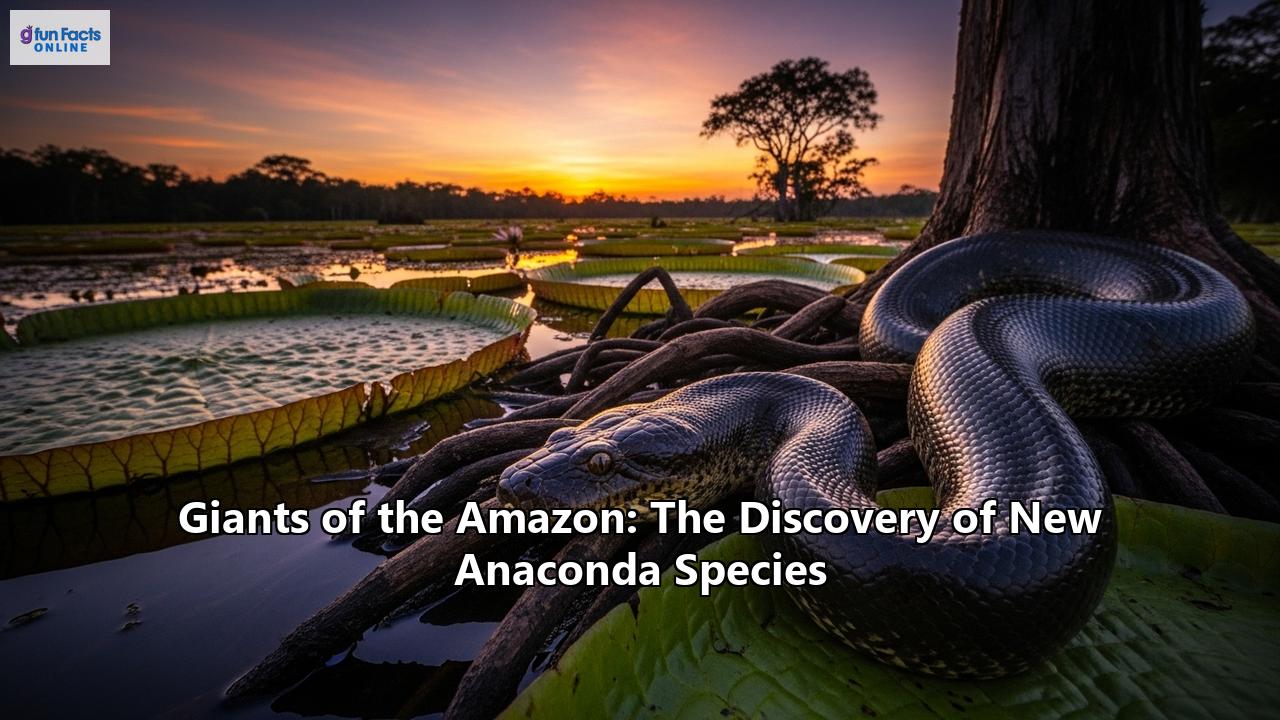
A New Titan Emerges from the Amazon's Depths: The Discovery of the Northern Green Anaconda
Deep within the labyrinthine waterways of the Amazon, a discovery of colossal proportions has sent ripples through the scientific community, rewriting our understanding of one of the world's most formidable predators. In a revelation that underscores the vast, untapped mysteries of our planet, researchers have identified a new species of giant anaconda, a serpent of mythic proportions that has been hiding in plain sight. This is the story of the northern green anaconda, Eunectes akayima, a cryptic giant whose existence was brought to light through a remarkable collaboration between indigenous wisdom, cutting-edge science, and a touch of Hollywood glamour.
A Quest for Giants in Waorani Territory
For nearly two decades, a team of international researchers, led by Professor Bryan Fry from the University of Queensland and Dr. Jesus Rivas, a world-renowned anaconda expert from New Mexico Highlands University, has been meticulously studying the anacondas of South America. Their work, spanning nine countries, aimed to unravel the complex evolutionary history of these aquatic giants. A pivotal moment in their research came in 2022, with an expedition to a remote corner of the Ecuadorian Amazon, the Bameno region of the Baihuaeri Waorani Territory. This journey was made possible by a rare invitation from the Waorani people, who have long spoken of anacondas larger than any officially recorded by science.
The expedition, which was also joined by a National Geographic film crew for the Disney+ series "Pole to Pole with Will Smith," was a true cross-cultural endeavor. Waorani leader Penti Baihua and his son, Marcelo Tepeña Baihua, guided the scientists through the dense jungle, their ancestral knowledge of the forest and its inhabitants proving indispensable. For ten days, the team navigated the winding river systems by canoe, searching for these sacred serpents in the shallows where they lie in wait for their prey. The Waorani's intimate understanding of the anacondas' behavior and habitat led the researchers to several of these magnificent creatures. The collaboration was so integral to the discovery that the Waorani guides were rightfully recognized as co-authors on the scientific paper that would announce the new species to the world.
The sheer size of the anacondas they encountered was astounding. One female specimen measured a staggering 6.3 meters (20.7 feet) in length. However, according to the anecdotal reports of the Waorani people, even larger individuals exist, with some said to surpass 7.5 meters (24.6 feet) and weigh around 500 kilograms (1,100 pounds). These accounts, once relegated to the realm of local legend, were now being given serious scientific consideration.
Unraveling the Genetic Code: A Tale of Two Anacondas
What truly distinguished these northern anacondas, however, was not just their size, but their genetic makeup. For years, only one species of green anaconda, Eunectes murinus, was officially recognized. The researchers, through detailed genetic analysis, uncovered a startling revelation: the green anaconda is, in fact, two distinct species.
The newly identified northern green anaconda, Eunectes akayima, is genetically divergent from its southern counterpart, Eunectes murinus, by a remarkable 5.5%. To put this into perspective, the genetic difference between humans and chimpanzees is only about 2%. This significant genetic split indicates that the two species diverged almost 10 million years ago, a testament to the long and complex evolutionary history of the Amazon basin.
Despite their profound genetic differences, the northern and southern green anacondas are what is known as "cryptic species," meaning they are morphologically almost identical. There are no obvious physical characteristics to easily distinguish them. However, a follow-up paper by Rivas and his team, published in July 2024, highlighted a notable difference in sexual size dimorphism (SSD) intensity between the two species. In Eunectes murinus, only a few females grow larger than the longest males, whereas in Eunectes akayima, most females are longer than the longest males, suggesting a more pronounced size difference between the sexes in the northern species.
The name akayima was chosen to honor the indigenous people who were so crucial to this discovery. It is derived from the Carib language and translates to "The Great Snake."
The Anaconda Family Tree: A Broader Perspective
The genus Eunectes comprises a group of large, semi-aquatic snakes that are perfectly adapted to life in the lowland rivers and wetlands of South America. Their eyes and nostrils are positioned on top of their heads, allowing them to see and breathe while the rest of their body remains submerged, a perfect camouflage for an ambush predator.
Prior to this discovery, four anaconda species were recognized:
- *The Green Anaconda (Eunectes murinus): Now referred to as the southern green anaconda, it is found in the Amazon and Orinoco river basins and is one of the largest snakes in the world.
- The Yellow Anaconda (Eunectes notaeus): A smaller species, typically reaching up to 4.6 meters (15 feet), found in the wetlands of the Paraguay River basin.
- The Dark-Spotted Anaconda (Eunectes deschauenseei): Found in northeastern South America, including Brazil, French Guiana, and possibly Suriname.
- The Beni Anaconda (Eunectes beniensis): As its name suggests, this species is restricted to the Beni region of Bolivia.
The same study that identified the northern green anaconda also proposed a reclassification of the yellow anacondas. The researchers suggested that Eunectes deschauenseei and Eunectes beniensis should be unified with Eunectes notaeus into a single species due to their close genetic relationship. This proposal, if accepted, would further reshape our understanding of anaconda taxonomy.
A Storm in the Scientific Community: The Controversy
The announcement of a new anaconda species, especially one of such a grand scale, did not come without its share of controversy. Shortly after the initial publication in February 2024, two separate teams of scientists, Dubois et al. and Vásquez-Restrepo et al., published critiques questioning the validity of the new species' naming and the methods used by Rivas and his team.
The main points of contention were:
- Nomenclatural Issues: The critics argued that the name Eunectes akayima was a "nomen nudum," a term used in zoological nomenclature for a name that has not been formally published with an adequate description, rendering it invalid. They also pointed out that the original paper failed to adequately review previously existing names that could have been applied to the northern green anaconda.
- Species Delimitation: The critics questioned whether the 5.5% mitochondrial DNA divergence was, on its own, sufficient to declare a new species, especially in the absence of clear morphological differences. They argued that more comprehensive genetic analysis, including nuclear DNA, was needed.
- Type Locality of Eunectes murinus---: There was disagreement over the original location of the type specimen for Eunectes murinus, which could impact which of the two green anaconda populations should retain the original name.
In July 2024, Rivas and his team published a follow-up paper to address these criticisms. They acknowledged that the initial description could have been more explicit and formally described Eunectes akayima again to comply with the International Code of Zoological Nomenclature. They also presented further evidence for the distinction between the two species, including the aforementioned differences in sexual size dimorphism and other morphological subtleties. Furthermore, they designated a neotype for E. murinus to stabilize the nomenclature. This scientific debate, while contentious, highlights the rigorous and self-correcting nature of the scientific process.
The Sacred Serpent and its Keepers: The Waorani Connection
The Waorani people's relationship with the anaconda goes far beyond that of a mere inhabitant of their ancestral lands. For them, the anaconda is a sacred animal, a figure of power and reverence, and an integral part of their cultural and spiritual landscape. They hold a deep respect for these giants, and their traditional knowledge has been passed down through generations.
The Waorani do not fear the anacondas but coexist with them. They understand their movements, their hunting patterns, and their significance within the ecosystem. This profound connection is a key reason why the Waorani territory has remained a refuge for these magnificent creatures. The invitation extended to the scientists was an act of trust, a sharing of their world in the hope that it would lead to a greater understanding and, ultimately, the protection of their sacred animal and their home.
An Apex Predator in a Fragile World
Anacondas are apex predators, playing a crucial role in maintaining the delicate balance of the Amazonian ecosystem. Their diet consists of a wide range of prey, including fish, caimans, deer, and capybaras. By controlling the populations of these animals, they help to ensure the health and diversity of the entire food web.
The discovery of the northern green anaconda comes at a critical time for the Amazon. The region is facing unprecedented threats from human activity, including:
- Deforestation: The clearing of forests for agriculture and cattle ranching is destroying the anacondas' habitat at an alarming rate. The Ecuadorian Amazon has lost hundreds of thousands of hectares of pristine rainforest in recent decades.
- Oil Exploration and Spills: The Yasuni National Park, a part of the northern green anaconda's range, is a hotspot of biodiversity that is tragically also rich in oil reserves. The construction of roads for oil exploration fragments the forest, and oil spills have devastating consequences for the aquatic environment that anacondas depend on.
- Pollution: Heavy metal pollution from mining and agricultural runoff also poses a significant threat to the health and reproductive ability of anacondas and other aquatic life.
Professor Fry has highlighted the urgent need for further research into how these environmental threats are impacting the newly discovered species. The anaconda, as a top predator, is an indicator species, meaning its health reflects the overall health of its ecosystem. The threats they face are a stark warning about the precarious state of the Amazon.
A Giant Awakens Our Wonder
The discovery of the northern green anaconda is more than just the addition of a new name to the list of known species. It is a powerful reminder that our planet still holds wonders that are yet to be revealed. It is a story of the enduring power of nature, the importance of indigenous knowledge, and the dedication of scientists who venture into the world's most remote corners to expand the frontiers of our understanding.
This newfound giant of the Amazon has emerged from the depths, not as a monster to be feared, but as a symbol of the incredible biodiversity that is at risk of being lost. Its discovery is a call to action, urging us to redouble our efforts to protect the Amazon, a vital organ of our planet, and the magnificent creatures that call it home. The tale of Eunectes akayima is a testament to the fact that there are still giants in the world, and it is our responsibility to ensure that they have a future.
Reference:
- http://novataxa.blogspot.com/2024/02/akayima.html
- https://academic.oup.com/zoolinnean/article/201/4/zlae099/7735800
- https://www.mdpi.com/1424-2818/16/7/418
- https://en.wikipedia.org/wiki/Northern_green_anaconda
- https://espace.library.uq.edu.au/view/UQ:2ce8286
- https://www.rightsofnaturetribunal.org/cases/yasuni-itt-case/
- https://www.researchgate.net/publication/378971440_Nomenclatural_problems_raised_by_the_recent_description_of_a_new_anaconda_species_Squamata_Serpentes_Boidae_with_a_nomenclatural_review_of_the_genus_Eunectes
- https://ouci.dntb.gov.ua/en/works/4knXx8K7/
- https://serpentresearch.com/2024/05/01/the-controversy-over-a-second-species-of-giant-anaconda/
- https://www.researchgate.net/figure/A-comparison-of-SSD-between-both-species-of-green-anaconda-Notice-that-only-a-few_fig6_382340282
- https://www.mdpi.com/1424-2818/16/2/127
- https://www.audubon.org/magazine/oil-companies-dig-yasuni-national-park-ecuadorians-are-fighting-back
- https://multimedia20stg.blob.core.windows.net/publicaciones/519183Vsquez-Restrepo_et_al_2024.pdf
- https://latinamericanpost.com/americas/new-giant-anaconda-species-discovered-in-ecuadorian-amazon-is-among-the-worlds-largest/
- https://bioone.org/journals/journal-of-vertebrate-biology/volume-72/issue-E2303/jvb.E2303/Special-Issue-a-few-steps-back-several-steps-forward/10.25225/jvb.E2303.pdf
- https://villagevoicenews.com/2025/05/06/scientists-discover-the-largest-anaconda-ever-found-in-the-amazon-during-will-smiths-show-set/
- https://news.mongabay.com/2023/08/oil-palm-and-balsa-plantations-trigger-deforestation-in-ecuadorian-amazon/
- https://www.tandfonline.com/doi/full/10.1080/00222933.2025.2479875
- https://amazonfrontlines.org/chronicles/deforestation-ecuador-amazon/
- https://amazonaid.org/ecuadors-jaguars-threatened-oil-drilling/
- https://news.mongabay.com/2015/10/oil-roads-to-ecological-ruin-ecuadors-bushmeat-and-wildlife-trade/