
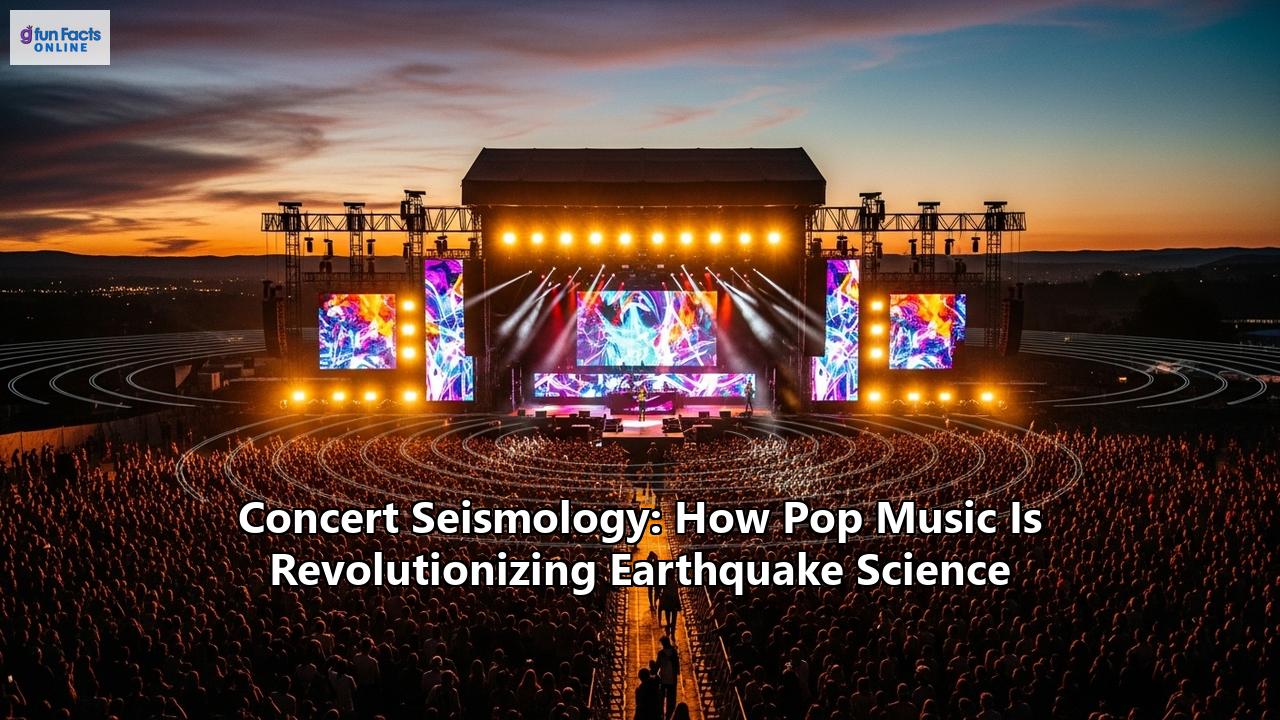
The Unlikely Rockstars of Earthquake Science: How Pop Concerts Are Shaking Up Seismology
An entirely new category of seismic event is capturing the attention of geoscientists. Coined "concert tremors," these human-made earthquakes, generated by tens of thousands of synchronized fans, are providing a novel and invaluable data source for understanding ground motion, testing the structural integrity of massive venues, and even offering a unique window into the Earth's subsurface.It’s a phenomenon that has seen pop music, rock anthems, and country ballads find an unexpected place in the annals of geophysical research. From the global pop icon Taylor Swift to the thunderous rock of the Foo Fighters and the high-energy rap of Travis Scott, the collective energy of their fan bases is creating a seismic symphony that is being eagerly studied by scientists around the world. These "concert quakes" are not just a quirky headline; they represent a burgeoning field of study that is revolutionizing how we think about and monitor the ground beneath our feet.
When the Fans Become the Fault Line: The Science of Concert Seismology
For decades, seismology, the scientific study of earthquakes and the propagation of elastic waves through the Earth, has primarily focused on natural tectonic events and, to a lesser extent, human activities like mining and reservoir construction. However, the turn of the 21st century has seen a surge in a new form of induced seismicity—the kind generated by the rhythmic, collective movement of massive crowds.
The fundamental principle behind concert seismology is surprisingly simple. When a large number of people—often exceeding 50,000—jump and dance in unison to the beat of a song, they exert a significant and rhythmic force on the ground. This synchronized movement generates seismic waves that propagate outwards from the stadium, much like the ripples from a stone dropped in a pond. These waves, though generally of a low magnitude, are powerful enough to be detected by sensitive instruments called seismometers placed miles away.
A key distinction between a natural earthquake and a concert tremor lies in their seismic signatures. Earthquakes typically release a sudden, sharp burst of energy that lasts for a few seconds. In contrast, a concert tremor is a more sustained, harmonic vibration that can last for the duration of a song, often several minutes long. Seismologists liken the difference to that between a firework explosion and the continuous roar of a jet engine; while the immediate impact might differ, the total energy released can be comparable.
One of the most crucial findings in this field is the confirmation that the primary source of these tremors is the crowd itself, not the powerful sound systems. In a study of a Taylor Swift concert in Los Angeles, researchers from the California Institute of Technology (Caltech) conducted experiments to differentiate between the two potential sources. They played music through a powerful PA system next to a seismometer and found that it did not produce the characteristic harmonic signals seen during the concert. It was only when a person jumped next to the sensor that the tremor-like vibrations were replicated. This definitively points to the collective foot-stomping and dancing of tens of thousands of fans as the engine driving these seismic events.
The "Swift Quake" and Other Seismic Superstars
The burgeoning field of concert seismology has been thrust into the global spotlight in recent years, largely thanks to the enormous and highly engaged fanbase of Taylor Swift. Her "Eras Tour" has not only broken box office records but has also set new benchmarks for concert-induced seismic activity.
In July 2023, during Swift's two-night stand at Seattle's Lumen Field, seismologist Jackie Caplan-Auerbach detected seismic activity equivalent to a magnitude 2.3 earthquake. The event, dubbed the "Swift Quake," garnered international media attention and highlighted the sheer power of 72,171 "Swifties" moving in unison. Caplan-Auerbach noted that the shaking was "twice as strong" as the infamous 2011 "Beast Quake," a tremor generated by the ecstatic reaction of Seattle Seahawks fans to a spectacular touchdown.
A month later, a study of Swift's concert at SoFi Stadium in Inglewood, California, provided even more detailed insights. Researchers from Caltech and UCLA deployed a network of sensors both inside and outside the stadium, allowing them to analyze the seismic signature of each song. They were able to identify 43 of the 45 songs performed, with "Shake It Off" registering the highest radiated energy, equivalent to a magnitude 0.85 earthquake.
But Taylor Swift is far from the only artist making the ground move. The phenomenon spans across various music genres, each with its own unique seismic footprint:
- Travis Scott: The rapper's high-energy performances are notorious for inciting frenzied crowd reactions. A 2023 concert at the historic Circus Maximus in Rome, with a crowd of 60,000, generated tremors equivalent to a 1.3 magnitude earthquake. This event sparked a debate among Italian officials and archaeologists about the appropriateness of hosting such high-impact events at ancient, fragile sites. Similar seismic activity was reported during his concerts in Milan and São Paulo, with some residents initially fearing an actual earthquake.
- Foo Fighters: The legendary rock band has a long history of generating seismic signals. A 2011 concert in Auckland, New Zealand, with 50,000 fans, produced what local geoscientists described as a "volcanic tremor." The ground was recorded shaking three times per second, in a steady rhythm that corresponded with the band's performance.
- Garth Brooks: The country music icon has also left his seismic mark. A 2022 concert at Louisiana State University's Tiger Stadium, with over 102,000 fans, registered as a small earthquake on a campus seismograph during the performance of his hit song "Callin' Baton Rouge." The event was affectionately nicknamed the "Garthquake."
- Bruce Springsteen: "The Boss" and his E Street Band are also known for their earth-shaking performances. A 2016 concert at Barcelona's Camp Nou stadium, attended by 65,000 people, was recorded by a seismometer located 500 meters from the venue. The seismic data was so detailed that researchers could identify individual songs in the setlist based on the changing frequencies of the vibrations.
- Metallica: Interestingly, not all high-energy concerts produce the same level of seismic activity. A study comparing different concerts at SoFi Stadium found that a Metallica concert generated weaker signals than Taylor Swift's. Researchers hypothesized that this could be due to the different ways fans engage with the music; while Swift's fans tend to jump and dance in a synchronized manner, Metallica's fans are more prone to headbanging, which creates less of a unified, ground-shaking force.
The Seismologist's Toolkit: From Sensors to Software
The study of concert tremors relies on a sophisticated array of instruments and analytical techniques. At the heart of the operation are seismometers, devices that detect and record ground motion. For concert seismology, scientists often employ a combination of permanent seismic network stations and temporary, portable sensors.
Strong-motion seismometers, or accelerographs, are particularly useful in this context. These instruments are designed to measure acceleration and are crucial for understanding how man-made structures respond to shaking. For the SoFi Stadium study, researchers even used inexpensive, custom-built accelerometers from the Community Seismic Network, demonstrating that valuable data can be collected with relatively accessible technology. These sensors can be deployed both inside and outside the stadium, providing a comprehensive picture of how the seismic waves are generated and how they propagate.
Once the data is collected, it is processed and analyzed using specialized software. A key tool in the concert seismologist's arsenal is the ObsPy Python toolbox. This open-source software package is specifically designed for seismological signal processing and allows researchers to perform a variety of tasks, including:
- Filtering: Isolating the specific frequency bands associated with the concert from the background noise of the city.
- Spectrogram Analysis: Creating visual representations of the seismic data called spectrograms. These graphs show the intensity of different frequencies over time, allowing scientists to see the distinct seismic signature of each song.
- Data Conversion: Converting the raw data into meaningful physical units.
By analyzing the spectrograms, researchers can identify the start and end times of songs, their dominant frequencies (which often correlate with the song's tempo), and the total radiated energy. This detailed analysis allows for a nuanced understanding of how different songs and different artists generate varying levels of seismic activity.
More Than Just a Good Vibration: The Potential Applications of Concert Seismology
While the idea of a "Swift Quake" is a fun and engaging curiosity, the scientific applications of concert seismology extend far beyond the realm of pop culture trivia. This emerging field holds significant potential for advancing our understanding of earthquakes and improving urban resilience.
Probing the Earth's Interior
One of the most exciting prospects of concert seismology is its potential to help us map the subsurface of our cities. The seismic waves generated by a concert travel through the ground, and their characteristics change depending on the materials they pass through. By studying how these waves are reflected, refracted, and attenuated, scientists can gain insights into the local geology. This includes identifying hidden faults, mapping sedimentary basins, and understanding how different soil types amplify ground shaking. This information is vital for creating accurate seismic hazard maps and informing building codes in earthquake-prone areas.
Monitoring Structural Health
Concerts also provide a unique opportunity to study the dynamic response of large structures like stadiums. The sustained, harmonic vibrations from a dancing crowd act as a sort of "stress test" for the building. By placing sensors throughout the stadium, engineers can measure how different parts of the structure move and resonate in response to the shaking. This data can be used to create a baseline of the building's "health." By comparing data from concerts over time, engineers can detect changes in the structure's response that might indicate damage or degradation, allowing for proactive maintenance and ensuring the safety of the venue. As Monica Kohler, a research professor at Caltech, explains, "We need that baseline response—to know how the structure is responding during times of good health—to know then how those responses might have changed after some large shaking event."
A Gateway to Science Communication
Perhaps one of the most immediate and impactful applications of concert seismology is its power to engage the public with science. The intersection of pop culture and geophysics creates a compelling narrative that can capture the imagination of people who might not otherwise be interested in earthquake science. Seismologist Jackie Caplan-Auerbach, who studied the Seattle "Swift Quake," has spoken about the flood of interest and data she received from Swift's fans. "I'm just really grateful to this community for their willingness to share their enthusiasm about doing science via Taylor Swift," she said. This enthusiasm can be harnessed for "citizen science" projects, where fans contribute videos and observations that can be correlated with the seismic data. By making science relatable and exciting, concert seismology can inspire a new generation of scientists and foster a greater public understanding of the world around us.
The Challenges and Future of a Noisy Science
Despite its immense potential, concert seismology is not without its challenges. One of the biggest hurdles is the "noisy" environment of a city. Urban areas are filled with a cacophony of vibrations from traffic, construction, and other human activities, and isolating the specific signal of a concert can be a complex task. Researchers must employ sophisticated filtering techniques to separate the signal from the noise.
Another challenge is accounting for the unique geological conditions of each stadium's location. The way seismic waves travel and the degree to which they are amplified can be significantly influenced by the local soil and rock types. For example, the ground in the Seattle area, which is built on soft, sedimentary deposits, is known to amplify shaking, which likely contributed to the strength of the "Swift Quake."
Looking to the future, seismologists are excited to continue exploring this new frontier. As technology advances and more data is collected from a wider variety of concerts and venues, our understanding of these human-made tremors will only grow. There is particular interest in comparing the seismic signatures of different musical genres and crowd behaviors to build a more comprehensive model of how human activity interacts with the solid earth.
The study of concert seismology is a testament to the fact that scientific discovery can be found in the most unexpected of places. It is a field where the infectious energy of a pop concert and the rigorous discipline of geophysical research come together to create a new and exciting harmony. As Gabrielle Tepp of Caltech notes, "Looking at these non-earthquake signals can be really helpful for evaluating the different tools that we have as seismologists and reevaluating our assumptions that go into those." So the next time you find yourself at a sold-out stadium show, surrounded by thousands of fellow fans, remember that you're not just part of a concert—you're part of a groundbreaking scientific experiment, and your dance moves are, quite literally, making the world a more understood place.
Reference:
- https://www.thenewstribune.com/news/state/washington/article277760603.html
- https://www.igne.com/services/specialist-drilling/advanced-drilling-and-installations/seismic-monitoring
- https://pubs.geoscienceworld.org/ssa/srl/article/95/4/2179/636176/Shake-to-the-Beat-Exploring-the-Seismic-Signals
- https://medium.com/@achemine.yasmine/reading-modifying-and-converting-seismic-event-data-using-obspy-cc94c00badc4
- https://www.geophysik.uni-muenchen.de/~megies/www_obsrise/
- https://www.cascadiadaily.com/2023/aug/09/viral-swift-quake-wwu-professor-aims-to-make-earth-science-popular/
- https://www.quest-itn.org/library/software/obspy.html
- https://news.wwu.edu/wwu-seismologist-captures-swift-quake-story-goes-global
- https://pubs.geoscienceworld.org/ssa/srl/article-abstract/95/4/2179/636176/Shake-to-the-Beat-Exploring-the-Seismic-Signals
- https://www.imseismology.org/xes/
- https://www.rnz.co.nz/news/world/494773/taylor-swift-seattle-concert-generates-seismic-activity
- https://www.foxweather.com/lifestyle/taylor-swift-eras-concert-quake-seattle
- https://www.cbsnews.com/news/taylor-swifts-eras-tour-earthquake-like-tremors/
- https://www.eurekalert.org/news-releases/1096708
- https://www.frontiersin.org/journals/earth-science/articles/10.3389/feart.2020.00009/full
- https://www.eurekalert.org/news-releases/1037503
- https://www.caltech.edu/about/news/swifities-shake-it-off-and-help-seismologists-solve-mystery-of-how-concertgoers-shake-things-up
- https://scholar.google.com/citations?user=Np1JIN8AAAAJ&hl=en
- https://en.wikipedia.org/wiki/Seismometer
- https://www.encardio.com/blog/seismograph-ground-movements-and-vibrations
- https://www.guinnessworldrecords.com/world-records/759394-greatest-seismic-activity-caused-by-a-music-concert
- https://www.researchgate.net/publication/258623566_ObsPy_A_Python_Toolbox_for_Seismologists_Seismological_Observatories_and_Data_Centers
- https://github.com/obspy/obspy
- https://pubs.geoscienceworld.org/ssa/srl/article/95/4/2280/635333/Imaging-Urban-Hidden-Faults-with-Ambient-Noise
- https://www.frontiersin.org/research-topics/26276/new-challenges-for-seismic-risk-mitigation-in-urban-areas/magazine
- https://central.scec.org/publication/14338
- https://www.researchgate.net/publication/320989416_Urban_Seismology_On_the_origin_of_earth_vibrations_within_a_city
- https://pubmed.ncbi.nlm.nih.gov/29127329/
- https://central.scec.org/meetings/2023/am/poster/050