
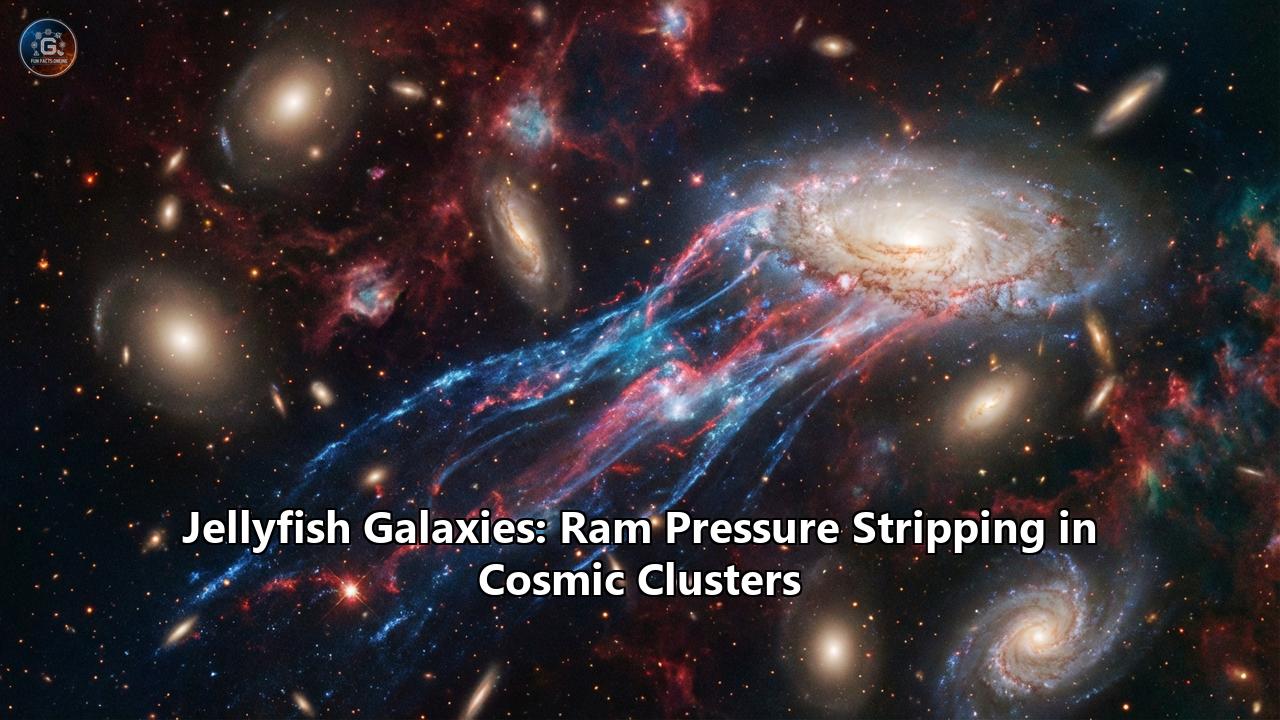
When we envision the cosmos, we often imagine galaxies as isolated islands of stars floating serenely through an empty, frictionless vacuum. However, the universe is far more dynamic and hostile than this quiet picture suggests. In the dense, chaotic environments of galaxy clusters, space is anything but empty. These colossal gravitational metropolises are filled with a superheated plasma known as the Intracluster Medium (ICM). When a gas-rich galaxy gets pulled into one of these clusters, it does not simply glide in; it plunges into a scorching, cosmic headwind. The resulting aerodynamic friction violently reshapes the galaxy, blowing its star-forming gas outward to create sweeping, luminescent tentacles. Astronomers call these extraordinary objects "jellyfish galaxies," and they are currently providing some of the most profound insights into how galaxies live, evolve, and ultimately die.
To understand the sheer scale of the violence occurring within a jellyfish galaxy, we must first look at the mechanism driving its transformation: Ram Pressure Stripping (RPS). First theorized in 1972 by astronomers James Gunn and J. Richard Gott, ram pressure is the drag force exerted on a body moving through a fluid medium.
While the gas of the Intracluster Medium is highly diffuse by human standards, the astronomical velocities at play make its impact devastating. When a spiral galaxy falls toward the center of a massive cluster, it can reach speeds of several million miles per hour. As it plows through the ICM—which is heated to staggering temperatures of up to 100 million Kelvin—the galaxy experiences an intense aerodynamic pressure. To visualize this, researchers often use the analogy of a dog sticking its head out of the window of a fast-moving car; the sheer force of the oncoming wind blows the dog's fur backward.
In the cosmic scenario, the "fur" is the galaxy's Interstellar Medium (ISM)—the vast reserves of cold hydrogen gas and dust that serve as the fuel for new stars. The ram pressure acts as a powerful headwind that overcomes the gravitational pull of the galaxy's disk, physically ripping the cold gas away and stretching it into trailing tails. Crucially, the stars already formed within the galaxy, along with its dark matter halo, are generally too compact and massive to be affected by this aerodynamic drag. The stars remain gravitationally bound to the disk, continuing their regular rotation as if nothing were wrong, even as the lifeblood of the galaxy is siphoned away into deep space.
The most famous and visually arresting archetype of this phenomenon is ESO 137-001, a barred spiral galaxy located approximately 220 million light-years away in the Norma Cluster (Abell 3627). Discovered in 2005 by astronomer Ming Sun, ESO 137-001 is hurtling toward the cluster's center at an astonishing speed of 1,900 kilometers per second (nearly 4.5 million miles per hour). As it crashes through the Norma Cluster's searing 180-million-degree Fahrenheit ICM, ram pressure stripping has drawn out a spectacular tail of gas that spans over 260,000 light-years—more than double the diameter of our own Milky Way.
Observations from the Hubble Space Telescope and the Chandra X-ray Observatory reveal ESO 137-001 as a cosmic dandelion caught in a hurricane, shedding its seeds into the void. The stripped gas does not simply vanish into the background heat of the cluster. Instead, it forms a multi-phase wake. Dense knots of cold molecular gas manage to survive within the sprawling tail, triggering intense bursts of "extraplanar" star formation. These stellar nurseries outside the galaxy produce brilliant clusters of young, massive blue stars, lending the galaxy its glowing, jellyfish-like tentacles.
The survival of this cold, star-forming gas in an environment surrounded by 100-million-degree plasma puzzled astrophysicists for years. How does the stripped interstellar medium avoid instantaneous evaporation? Recent multi-wavelength studies, utilizing arrays like ALMA (Atacama Large Millimeter/submillimeter Array) and the VLA (Karl G. Jansky Very Large Array), have pointed to a fascinating protective mechanism: magnetic draping. As the galaxy moves through the magnetized plasma of the ICM, the cluster's magnetic field lines catch and drape themselves over the galaxy's stripped tail. This magnetic sheath acts as an insulating barrier, suppressing thermal conduction and shielding the cold, dense clouds of molecular gas from the surrounding inferno. Within this protective cocoon, the gas can cool, condense, and collapse under its own gravity to birth new stars far beyond the galactic disk.
While ESO 137-001 serves as a local textbook example, modern observatories are continually pushing the boundaries of when and where these cosmic leviathans can exist. In February 2026, a groundbreaking discovery was announced using data from the James Webb Space Telescope (JWST) that fundamentally altered our timeline of galactic evolution. Deep within the COSMOS (Cosmic Evolution Survey) field, a team of researchers led by Dr. Ian Roberts from the University of Waterloo identified an undocumented jellyfish galaxy officially designated as COSMOS2020-635829.
What makes COSMOS2020-635829 extraordinary is its extreme distance and age. It possesses a redshift of z = 1.156, meaning its light traveled for 8.5 billion years to reach JWST's mirrors. We are seeing this galaxy as it existed when the universe was only about 5.3 billion years old. Prior to this JWST discovery, astrophysicists widely believed that the (proto)clusters of the early universe had not yet accumulated a sufficiently dense Intracluster Medium to trigger ram pressure stripping. It was assumed that jellyfish galaxies were a feature of a more mature, modern universe. The discovery of COSMOS2020-635829, complete with trailing tendrils of gas and extraplanar star formation, proves that severe environmental quenching and ram pressure stripping were already shaping the evolution of galaxies during the cosmos's turbulent adolescence.
To comprehensively map the intricate physics of these transformations, astronomers launched the GASP (GAs Stripping Phenomena in galaxies with MUSE) survey. Coordinated by Bianca Maria Poggianti of the National Institute for Astrophysics (INAF) in Italy, this ambitious project utilized the Multi Unit Spectroscopic Explorer (MUSE) instrument on the European Southern Observatory’s Very Large Telescope (VLT). By observing over a hundred jellyfish candidates across different cosmic environments, the GASP team has painted an incredibly detailed picture of the baryonic cycle—the continuous exchange of matter between a galaxy and its environment.
One of the most surprising revelations to emerge from the GASP survey is the unexpected link between ram pressure stripping and Active Galactic Nuclei (AGN). At the heart of nearly every large galaxy lies a supermassive black hole, but in most galaxies, these behemoths are dormant. However, the GASP team discovered that an unusually high number of jellyfish galaxies host highly active, feeding black holes. It turns out that while ram pressure acts primarily to push gas out of the galaxy's outer disk, the chaotic, asymmetric forces can also cause some gas to lose angular momentum and funnel inward toward the galactic core. This sudden influx of material awakens the supermassive black hole, which rapidly accretes the gas and unleashes massive amounts of energy. Galaxies like JW100, a prime subject of the GASP survey, represent a stunning laboratory of these concurrent extremes: while its outer edges are being stripped away to form spectacular X-ray-emitting tails, its core is ablaze with AGN activity.
The GASP survey also shed light on the kinematic strangeness of the stripped gas. MUSE observations revealed that the gas plumes swept out into space continue to rotate with the same velocity signature as the galaxy they left behind. This preservation of angular momentum far out into the intergalactic void serves as undeniable kinematic proof that aerodynamic drag from the cluster gas—not tidal gravitational forces from a passing galaxy—is the primary culprit behind the stripping.
Furthermore, advanced cosmological simulations like IllustrisTNG50 are helping astronomers understand the long-term fate of these galaxies through large-scale citizen science projects like "Fishing for Jellyfish". These hydrodynamic simulations trace the lifespan of satellite galaxies falling into massive halos. They reveal that the ram pressure stripping process is not instantaneous; it can be a protracted agony lasting anywhere from 1.5 to 8 billion years, with the most intense period of gas loss occurring within the first billion years of the galaxy's infall into the cluster. Remarkably, these simulations show that jellyfish galaxies are a massive source of cold gas accretion for the cluster itself, depositing billions of solar masses of cold gas into the host halo, enriching the intergalactic space with heavy elements forged in the galaxy's stellar furnaces.
Ultimately, the majestic tentacles of a jellyfish galaxy signal its impending doom. The spectacular bursts of star formation seen in the tails are a final, defiant fireworks display. As the ram pressure relentlessly removes the cold atomic and molecular gas, the galaxy is deprived of the raw materials needed to sustain its stellar populations. Once the gas is completely stripped, star formation within the galaxy's disk grinds to a permanent halt—a process known as "quenching". The galaxy transitions from a vibrant, blue, star-forming spiral into a "red and dead" lenticular galaxy, retaining its disk structure but lacking the spiral arms and the luminous blue glow of young stars. The GASP project has directly observed this morphological metamorphosis, noting how the stripping of gas can cause spiral arms to "unwind," leaving behind a barren, lenticular husk.
Jellyfish galaxies represent a critical, transitional phase in the grand story of cosmic evolution. They are astrophysical laboratories that allow us to witness the interplay of gravity, hydrodynamics, magnetic fields, and thermodynamics on a scale spanning millions of light-years. From the local universe's ESO 137-001 bleeding its gas into the Norma Cluster, to the JWST's ancient COSMOS2020-635829 challenging our timelines of the early cosmos, these remarkable objects demonstrate that galaxy clusters are not peaceful cosmic retirement homes. They are turbulent, unforgiving environments where galaxies are dramatically reshaped. Through the continued synthesis of deep-space observation and advanced simulation, the study of jellyfish galaxies promises to further unravel the complex, violent, and beautiful processes that dictate the life and death of galaxies in the cosmic ocean.
Reference:
- https://jgrps.sciencesconf.org/
- https://science.nasa.gov/asset/hubble/galaxy-eso-137-001/
- https://www.eso.org/public/news/eso1437/
- https://en.wikipedia.org/wiki/ESO_137-001
- https://scitechdaily.com/why-does-this-galaxy-have-tentacles-deep-space-mystery-stuns-astronomers/
- https://arxiv.org/abs/2212.03891
- https://academic.oup.com/mnras/article/476/4/4753/4904145
- https://www.mdpi.com/2075-4434/9/4/116
- https://www.space.com/astronomy/james-webb-space-telescope/james-webb-space-telescope-spots-a-stunning-cosmic-jellyfish-solve-the-mysteries-of-galactic-evolution-photo
- https://thedebrief.org/james-webb-space-telescope-discovers-an-8-5-billion-year-old-jellyfish-galaxy-never-seen-by-astronomers/
- https://www.universetoday.com/articles/another-early-universe-surprise-from-the-jwst-a-jellyfish-galaxy
- https://web.oapd.inaf.it/gasp/publications.html
- https://cordis.europa.eu/article/id/454273-how-cosmic-jellyfish-and-other-galaxies-evolve
- https://www.semanticscholar.org/paper/c6a26b92078eb9931e7987a439e5fa6f28ecdce4
- https://academic.oup.com/mnras/article/542/3/1901/8222502
- https://arxiv.org/abs/2304.09196