
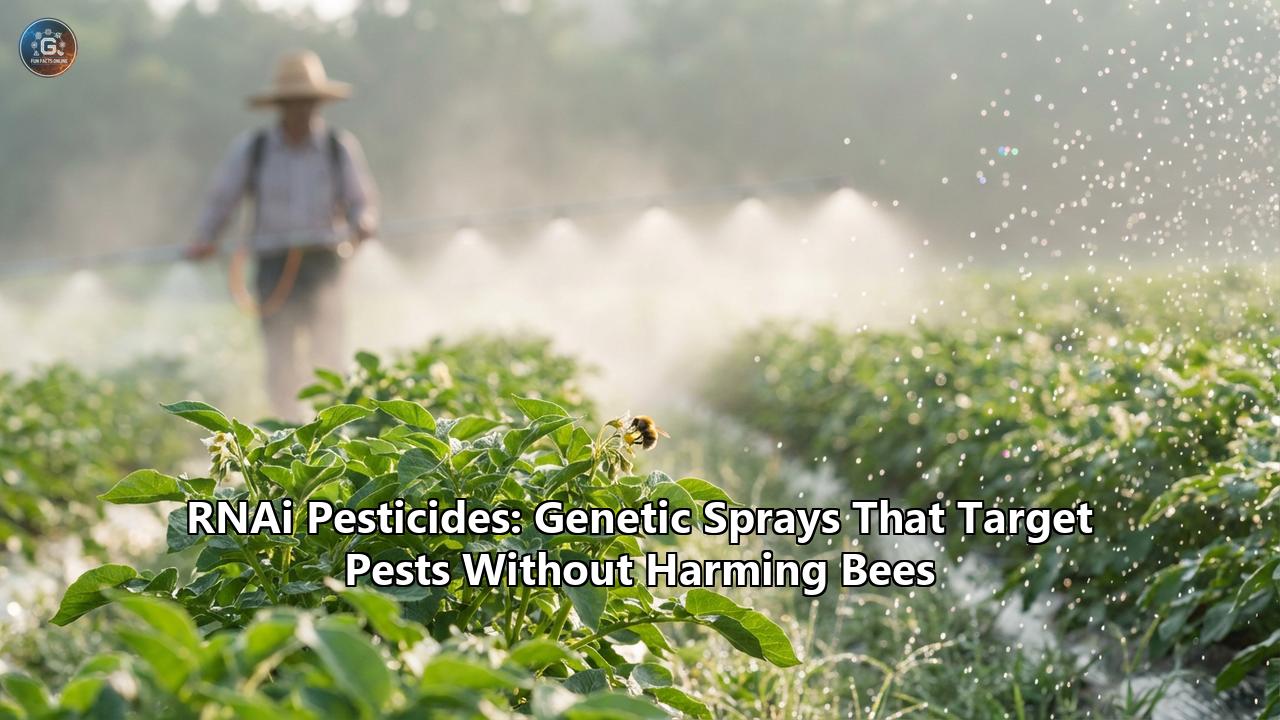
Imagine a sniper so precise it can find a single enemy soldier in a crowded stadium and neutralize them without disturbing a single spectator. Now, imagine a pesticide that works the same way: it can drift over a field of blooming flowers, coating the petals and leaves, and yet, when a honeybee lands to sip nectar, it is as harmless as morning dew. But when a destructive beetle takes a bite, it triggers a genetic "kill switch" that stops its heart.
This is not science fiction. It is the reality of RNA interference (RNAi), a revolutionary technology that is ending the century-long era of "chemical warfare" in agriculture and ushering in an age of "biological precision."
For decades, we have relied on neurotoxins and broad-spectrum poisons that kill pests but also decimate the beneficial insects that keep our world alive. We are now standing on the precipice of a change so fundamental it has been compared to the transition from the abacus to the computer. Welcome to the world of genetic sprays—where we don't just poison pests; we silence them.
The Crisis: Why We Need a "Smart Weapon"
To understand why RNAi is such a game-changer, we must first look at the battlefield. Modern agriculture is fighting a losing war.
- The Resistance Nightmare: Pests are winning. The Colorado potato beetle, a notorious destroyer of nightshade crops, has developed resistance to over 50 different classes of chemical insecticides. Farmers are forced to spray more often and with more toxic cocktails, yet the beetles keep eating.
- The Pollinator Collapse: We are losing our bees. Colony Collapse Disorder and general pollinator decline are driven by a "toxic soup" of stressors, with chemical pesticides being a primary culprit. Neonicotinoids, once hailed as safe, are now known to disorient bees, making them unable to find their way home.
- The Environmental Toll: Traditional chemicals persist. They leach into groundwater, linger in soil for years, and bioaccumulate in the food chain.
The world doesn't need stronger poisons; it needs smarter ones. Enter RNA interference.
The Science of Silence: How RNAi Works
RNAi is not a synthetic chemical invention; it is a natural biological process that already exists inside your cells, in plants, and in insects. It was discovered in 1998 by Andrew Fire and Craig Mello, a discovery so profound it earned them the Nobel Prize in Physiology or Medicine just eight years later.
The Mechanism: A Genetic "Kill Switch"
DNA is the blueprint of life, but messenger RNA (mRNA) is the contractor that reads the blueprint and tells the cell what proteins to build. If DNA is the cookbook, mRNA is the handwritten note telling the chef to "bake a cake."
RNAi pesticides work by introducing double-stranded RNA (dsRNA) that matches a specific sequence of the pest's mRNA. When the pest eats the crop coated with this dsRNA, its cells recognize the double-stranded structure as a viral invader. The cell’s defense system, an enzyme called Dicer, chops this dsRNA into small pieces. These pieces then guide a complex called RISC (RNA-induced Silencing Complex) to hunt down and destroy any mRNA that looks exactly like them.
In simple terms: The pesticide intercepts the note to the chef and shreds it.
- The Result: The pest's cells stop producing a vital protein—perhaps one needed to digest food or maintain cell structure.
- The Outcome: The pest stops eating and dies, often within days.
The "Genetic Barcode" Specificity
This is where the magic happens. Every species has a unique genetic code. The sequence of mRNA required to build a stomach enzyme in a Colorado potato beetle is different from the sequence in a honeybee, a ladybug, or a human.
Scientists design the RNAi spray to match only the pest’s unique sequence.
- For the Pest: It is a lethal instruction to shut down life support.
- For the Bee: It is just a string of nucleic acids—nutritional noise that is digested like food. It has no effect because the "password" doesn't match the bee's genetic system.
The Bee Savior: Defeating the Vampire Mite
Perhaps the most emotional and critical application of RNAi technology is in the fight to save the honeybee itself. For years, beekeepers have been battling the Varroa destructor mite, a parasitic arachnid that attaches to bees and sucks their fat bodies, weakening them and spreading deadly viruses.
Current treatments are harsh. Beekeepers have to put "miticides" (pesticides for mites) directly into the hive. These chemicals can harm the bees, contaminate the honey, and eventually, the mites develop resistance to them.
Enter GreenLight Biosciences and "Norroa"
GreenLight Biosciences, a leader in this field, developed an RNAi product (active ingredient Vadescana) specifically to target Varroa mites.
- How it Works: The product is a syrup placed in the hive. Bees eat the syrup and feed it to their brood and the mites. The bees possess enzymes that break down the RNA quickly, so it doesn't hurt them. However, the mites absorb the dsRNA, which targets a gene essential for their reproduction and survival.
- The Result: The mites die or become sterile, while the bees remain completely unharmed.
- Field Data: Trials have shown that this treatment can reduce mite populations significantly without the toxicity associated with chemical strips. It breaks the cycle of the "vampire" without poisoning the host.
This represents the first time we have used a pesticide inside a beehive that is biologically incapable of harming the bee.
The First Big Win: Calantha vs. The Potato Beetle
While saving bees is noble, the agricultural industry runs on crop yield. The proof of concept for RNAi as a commercially viable tool came with Calantha, the first foliar RNAi bioinsecticide approved by the US EPA (January 2024).
- The Target: Colorado Potato Beetle (CPB). This pest can strip a potato field to bare stems in days.
- The Product: Calantha (active ingredient Ledprona) is sprayed just like a normal pesticide.
- Performance: In field trials, it performed as well as leading chemical insecticides. However, unlike chemicals that might persist for months, Calantha degrades in the soil within 3 days.
- Safety: If a bird eats a beetle killed by Calantha, or if a farmer breathes in the spray, the RNA degrades harmlessly. It targets a gene sequence only found in the beetle family.
This product proved that RNAi could be affordable (costing less than $1 per gram to produce) and effective at an industrial scale.
Beyond Sprays: The "Vaccinated" Corn
While sprays are revolutionary, another approach is engineering the plant to produce the RNAi itself.
Bayer’s SmartStax PRO is a prime example. This genetically modified corn doesn't just produce the traditional Bt toxin (a bacterial protein toxic to pests); it also produces dsRNA targeting the corn rootworm.- The Mechanism: When the rootworm larva bites the corn root, it ingests the dsRNA produced by the plant. This turns off a gene essential for the worm's life (Snf7).
- Why it Matters: The corn rootworm is the "billion-dollar bug," costing US farmers immense sums annually. It had begun to develop resistance to Bt traits. The addition of RNAi provides a completely new "mode of action," effectively breaking the resistance cycle.
The Environmental Profile: A Green Revolution
The environmental benefits of RNAi pesticides are difficult to overstate.
- Biodegradability: Chemical pesticides often contain "forever chemicals" or heavy metals. RNA is a biological molecule. In the environment (soil, water), bacteria and UV light break it down into simple sugars and phosphates within days. It leaves no toxic residue.
- Soil Health: Earthworms, nematodes, and soil bacteria are vital for healthy crops. Broad-spectrum fumigants kill them all. RNAi targets only the pest, leaving the soil microbiome intact.
- Worker Safety: For farmworkers, the risk of acute poisoning from handling these products is virtually non-existent compared to organophosphates.
The Economic Landscape: From Lab to Field
Historically, making RNA was incredibly expensive—costing thousands of dollars per gram in the lab. This made it impossible to spray on a field.
Companies like GreenLight Biosciences solved this by developing cell-free manufacturing processes. They essentially created large fermentation vats (like brewing beer) where yeast or bacteria churn out massive quantities of dsRNA at a fraction of the cost.
- Cost Efficiency: Production costs have dropped to under $1 per gram, making it competitive with premium chemical pesticides.
- Market Growth: The market for RNAi pesticides is projected to grow from a niche sector to a multi-billion dollar industry by 2030, driven by European Green Deal mandates to reduce chemical pesticide use by 50%.
Future Frontiers: Weeds and Fungi
The revolution won't stop at insects.
- Weed Control: Weeds are harder to target because their cells are protected by thick waxy coatings that are hard for RNA to penetrate. However, companies are developing surfactants and "nanocarriers" to slip the RNA inside weed leaves. If successful, we could have a spray that kills Palmer Amaranth (a "superweed" resistant to Roundup) without harming the soybeans growing right next to it.
- Fungicides: RNAi sprays are being developed to target Fusarium and Botrytis (gray mold) on strawberries and grapes. These would replace copper and synthetic fungicides, ensuring our wine and fruit are free of chemical residues.
Challenges and The Road Ahead
No technology is perfect. RNAi faces its own set of hurdles:
- Public Perception: Because this involves "genes," there is a risk of consumer confusion with GMOs. However, sprayed RNAi does not modify the genome of the plant or the pest; it is a temporary "silencing" effect. Communicating this distinction is vital.
- Resistance: Just as pests evolved resistance to chemicals, they can theoretically evolve resistance to RNAi (e.g., by changing their gut chemistry to destroy RNA before it enters their cells). Integrated Pest Management (IPM) will still be necessary.
- Regulation: Regulatory bodies worldwide are still writing the rulebook. The US EPA is leading the way, but Europe's strict regulations could slow adoption there.
Conclusion
We are witnessing the end of the "sledgehammer" approach to farming and the beginning of the "scalpel." RNAi pesticides offer a vision of agriculture where we work with the biological code of nature rather than against it.
For the beekeeper, it means hives that thrive without fear of mite infestations. For the farmer, it means crops protected from super-pests without the fear of resistance. And for the consumer, it means food that is grown with intelligence, precision, and a profound respect for the ecosystem that sustains us.
The genetic sprays are here. The pests are silent. And the bees? They are buzzing louder than ever.
Reference:
- https://www.engineering.org.cn/engi/EN/10.1016/j.eng.2024.10.010
- https://www.greenlightbiosciences.com/articles/greenlight-biosciences-features-in-science-magazine-does-rna-make-the-perfect-pesticide
- https://www.cropscience.bayer.ca/traits/corn/smartstax-pro
- https://academic.oup.com/jee/article/116/2/456/7075013
- https://revistacultivar.com/news/USA-registers-RNA-based-product-against-Varroa-destructor-mite
- https://bisresearch.com/industry-report/rnai-pesticides-market.html
- https://www.openpr.com/news/4304399/rnai-pesticides-market-exclusive-report-on-the-latest-revenue
- https://www.greenlightbiosciences.com/articles/protecting-honey-bees-an-effective-and-long-lasting-new-mode-of-action-for-varroa-control
- https://www.slideshare.net/slideshow/rnai-pesticides-market-growth-2020-2030-techsci-research/276907833
- https://www.imarcgroup.com/rnai-pesticides-market
- https://foe.org/wp-content/uploads/2020/10/RNAi_FullReport.pdf
- https://www.engineering.org.cn/engi/EN/PDF/10.1016/j.eng.2024.10.010
- https://www.thepacker.com/news/industry/first-rna-based-treatment-launched-varroa-mites
- http://www.newaginternational.com/biocontrol/greenlight-biosciences-launches-norroa-for-varroa-mite-control/
- https://www.cropscience.bayer.us/traits/corn/smartstax-pro
- https://bayertraits.blob.core.windows.net/documents/corn/PR14176_SmartStax_PRO_with_RNAi_techsheet_Eng_Remediated.pdf
- https://www.cropscience.bayer.us/articles/traits/whats-the-truth-behind-smartstax-pro-with-rnai-technology
- https://pmc.ncbi.nlm.nih.gov/articles/PMC10332594/
- https://www.greenlightbiosciences.com/