
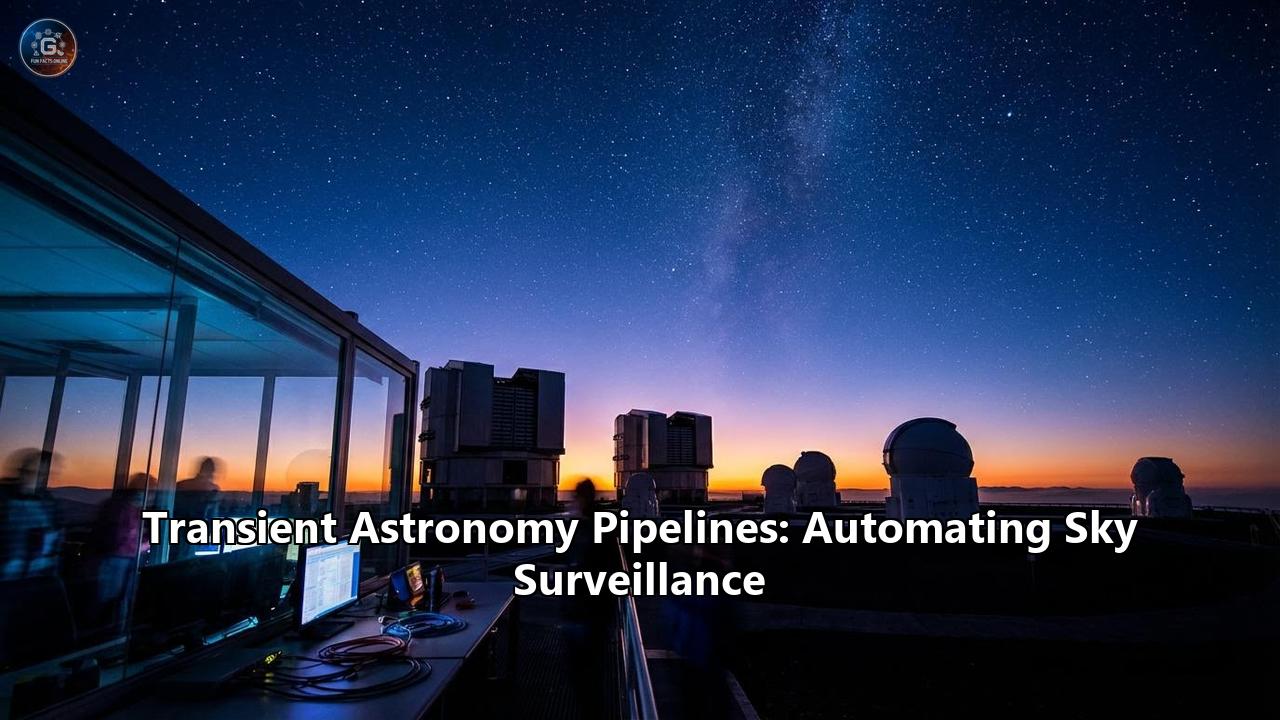
For millennia, humanity gazed at the night sky and saw a profound, comforting stillness. The stars were fixed, the constellations eternal, and the heavens represented an immutable perfection. Today, modern astrophysics has shattered that illusion. We now know that the universe is a chaotic, violent, and deeply dynamic arena. Stars explode with the brilliance of entire galaxies, supermassive black holes tear apart wandering suns, neutron stars collide to forge heavy elements, and invisible ripples in space-time wash over our planet. This is the realm of time-domain astronomy—the study of the restless, ever-changing sky.
But capturing this cosmic dynamism presents an unprecedented logistical nightmare. The universe does not wait for an astronomer to peer through an eyepiece. Transients—objects that change in brightness or position over time—can flash and fade in a matter of days, hours, or even minutes. To catch them, we must watch everywhere, all at once.
Welcome to the era of Transient Astronomy Pipelines: the colossal, automated, artificial intelligence-driven software ecosystems that act as the nervous system of modern astronomy. As we plunge deeper into the late 2020s, these pipelines are not just aiding human scientists; they are autonomously watching the sky, making split-second decisions, and orchestrating global networks of robotic telescopes.
The Data Tsunami and the Need for Automation
To understand why automated pipelines are strictly necessary, one must look at the sheer scale of modern observational infrastructure. In the early 2000s, finding a supernova was a labor-intensive process of manually comparing photographic plates or digital images. By the 2010s and early 2020s, facilities like the Zwicky Transient Facility (ZTF) began capturing the sky at an industrial scale, generating hundreds of thousands of alerts per night.
But in 2025 and 2026, the game fundamentally changed. The Vera C. Rubin Observatory, perched high in the Chilean Andes, has transitioned from its final commissioning phase into operations. The Rubin Observatory's defining mission, the Legacy Survey of Space and Time (LSST), is an endeavor of staggering proportions. Armed with an 8.4-meter primary mirror—crafted from a single piece of glass—and a record-breaking 3.2-gigapixel digital camera, it is capturing 10-square-degree images roughly every 40 seconds. Every three nights, it maps the entire visible southern sky, effectively creating a 10-year, high-definition cinematic movie of the evolving cosmos.
The result? The Rubin Observatory generates up to 10 million transient alerts every single night. No army of human astronomers could possibly sift through 10 million notifications a night to find the one needle in the cosmic haystack. If a neutron star merger is detected, telescopes around the world need to pivot and observe it within minutes before the faint optical glow—the kilonova—fades into obscurity.
This is where the automated transient pipeline takes over. It is a highly optimized, multi-stage relay race of data that operates entirely without human intervention, spanning from the cold mountaintops of Chile to cloud computing centers around the globe.
Stage 1: The First Pass – Difference Image Analysis (DIA)
The pipeline begins the moment the telescope's shutter closes. The raw data is immediately piped to local supercomputers where the first critical operation takes place: Difference Image Analysis (DIA).
To find out what has changed in the sky, you have to play a highly sophisticated game of "spot the difference." The pipeline takes the fresh, newly captured image of a patch of sky (the "science image") and aligns it perfectly with an older, deep reference image of that exact same patch (the "template image"). By subtracting the pixel values of the template from the science image, the static background—the billions of unchanging stars and galaxies—cancels out and vanishes.
What is left behind on the resulting "difference image" is only what has changed. If a star has exploded as a supernova, it will appear as a bright spot of light. If an asteroid has drifted across the field of view, it will show up as a streak or a dot.
However, DIA is notoriously messy. The Earth's atmosphere is turbulent, causing the stars to twinkle and blur. The camera sensors have bad pixels, cosmic rays strike the detectors, and mega-constellations of low-Earth orbit satellites regularly carve bright, blinding streaks across the images. Simply subtracting images leaves behind millions of artifacts that look exactly like real astrophysical transients. This creates the infamous "Real/Bogus" problem. For every one genuine cosmic event, the pipeline might generate a hundred bogus artifacts.
Stage 2: Artificial Intelligence at the Edge
To filter the cosmic trash from the treasure, pipelines rely heavily on advanced Artificial Intelligence (AI) and Machine Learning (ML). In the early days, rule-based algorithms (e.g., "if the object is perfectly round and matches a certain brightness profile, it is real") were used. But the volume and complexity of LSST data require something far more robust.
Today, Deep Learning models—specifically Convolutional Neural Networks (CNNs)—are deployed directly at the data source. These models are fed the image cutouts (often called "stamps") of the subtracted image, the science image, and the template image. In fractions of a second, the AI assigns a probability score indicating whether the detection is a genuine astrophysical object or a sensor artifact.
But the AI doesn't stop at simply labeling something as "real." It must immediately classify what the object is. Modern astronomical AI has evolved significantly, integrating time-series analysis and anomaly detection to understand the physics of the object:
Light Curve Analysis: As a transient is observed over multiple nights, its brightness rises and falls, creating a graph known as a light curve. Transformers and Recurrent Neural Networks (RNNs) are now used to analyze these light curves in real-time. By observing the steepness of a brightening curve, the AI can distinguish between the fast, violent flare of an M-dwarf star, the rhythmic pulsation of a Cepheid variable, or the weeks-long thermonuclear detonation of a Type Ia supernova. Few-Shot Learning and The Oxford Model: One of the most significant breakthroughs in late 2025 was the development of the "Oxford Model" in modern astronomy. Historically, deep learning required massive datasets of millions of labeled examples to learn. But what if we are looking for something incredibly rare, like a Fast Blue Optical Transient (FBOT) or a new type of stellar collision? The Oxford Model utilizes few-shot learning, mapping data into a shared feature space where instances of the same kind are grouped tightly together. This allows the AI to generalize from better-represented phenomena and correctly identify bizarre, rare cosmic events with only a handful of examples. Multi-Class Deep SVDD for Anomaly Detection: Finding the "unknown unknowns"—events that defy current astrophysical models—is the ultimate prize for astronomers. Recent models, such as Multi-Class Deep SVDD (Support Vector Data Description), have been designed specifically to handle different categories of "normal" data. By using neural networks to map standard astronomical objects into specific hyperspheres, anything that falls outside these defined geometric boundaries is instantly flagged as an anomaly, alerting scientists to potentially physics-breaking phenomena.Stage 3: The Traffic Cops of the Cosmos – Alert Brokers
Once an alert passes the Real/Bogus test and is annotated with machine learning classifications, it must be distributed to the global astronomical community. According to Rubin Observatory protocols, this entire process—from capturing the photon to issuing the alert—must happen within 60 seconds.
Distributing millions of complex data packets per night is impossible over standard web interfaces. Instead, the pipeline relies on Community Alert Brokers. These are massive software systems built on technologies like Apache Kafka, designed to ingest the firehose of survey data, process it, enrich it, and redistribute it in real-time.
For the LSST era, the Rubin Observatory selected seven "full-stream" brokers capable of handling the astronomical data avalanche: ALeRCE, AMPEL, ANTARES, Babamul, Fink, Lasair, and Pitt-Google. Each broker has a unique philosophy and architecture, catering to different subfields of astronomy:
- Fink: Conceived by a large interdisciplinary community, Fink goes beyond traditional cross-matching by providing real-time transient classification using state-of-the-art deep learning and adaptive learning techniques. If a user is looking specifically for kilonovae or microlensing events, Fink filters the Kafka streams according to these exact predicted physical classes.
- ALeRCE (Automatic Learning for the Rapid Classification of Events): ALeRCE employs a sophisticated two-level classification approach. First, its "top-level" light curve classifier sorts incoming alerts into broad categories: periodic, stochastic, or transient. Then, utilizing both image stamps and time-series data, it drills down into highly specific classifications, such as flagging candidates with an 80% confidence of being a supernova.
- ANTARES (Arizona-NOIRLab Temporal Analysis and Response to Events System): ANTARES specializes in contextual value. The moment an alert arrives, ANTARES cross-references it against vast multiwavelength catalogs (such as Gaia for stellar movements, Chandra for X-rays, or WISE for infrared) to tell astronomers not just what the object is doing now, but what its historical multiwavelength profile looks like.
- Lasair: Originating from ZTF heritage in the UK, Lasair empowers astronomers to build their own bespoke filters using standard SQL syntax. If a researcher wants to find "objects that have brightened by 2 magnitudes in the last 48 hours, are located near a known galaxy, and are not classified as moving asteroids," they can write a simple SQL query, and Lasair will push those specific alerts directly to their phone or computer.
Stage 4: Closing the Loop – Target and Observation Managers (TOMs)
An alert broker telling an astronomer that a star has exploded is only half the battle. To actually understand the physics of the explosion, scientists need spectroscopy—splitting the light into its component colors to reveal the chemical fingerprints and velocity of the expanding gas. But the Rubin Observatory does not take spectra; it only takes images.
Therefore, the pipeline must trigger other telescopes around the world to conduct follow-up observations. Enter the Target and Observation Managers (TOMs).
A TOM is essentially a central command dashboard for a scientific collaboration. Frameworks like the Automated Alert Streams to Real-Time Observations (AAS2RTO) connect directly to brokers like Fink and ALeRCE. When the broker flags a high-probability event (say, an optical glow matching a gravitational wave detection from LIGO), the TOM springs into action automatically.
Without a human ever pressing a button, the TOM evaluates the object's coordinates, checks the weather and availability of telescopes in global robotic networks (such as the Las Cumbres Observatory network, which spans multiple continents), and submits an observation request. A robotic telescope in Australia or Hawaii will autonomously interrupt its current schedule, slew its massive dome across the night sky, and point its spectrograph at the dying star. By the time the lead astronomer wakes up and checks their laptop, the pipeline has already discovered the transient, classified it, orchestrated a global robotic follow-up, and delivered the finalized spectral data to their inbox.
Transformational Science: What Are We Hunting For?
Why build this billion-dollar, multi-layered cybernetic infrastructure? Because the transient sky holds the answers to the most fundamental questions in astrophysics. The automated pipelines are actively hunting for:
- Multi-Messenger Astrophysics and Kilonovae: When two neutron stars collide, they send gravitational waves rippling through space-time. By connecting gravitational wave alerts with optical transient pipelines, we can pinpoint the exact origin of these mergers. These kilonovae are the cosmic foundries where the universe's heaviest elements—like gold, platinum, and uranium—are forged. Catching them in the first few hours is vital to understanding the origins of the periodic table.
- Cosmology and Dark Energy: Type Ia supernovae are the "standard candles" of the universe. Because they explode with a consistent, knowable intrinsic brightness, we can use them to measure the expansion rate of the universe. Automated pipelines ensure we catch thousands of these supernovae early in their explosion, allowing for incredibly precise measurements that help unravel the mystery of Dark Energy.
- Tidal Disruption Events (TDEs): Occasionally, an unlucky star wanders too close to a dormant supermassive black hole at the center of a galaxy. The immense gravity of the black hole stretches the star into a stream of gas—a process known as spaghettification. As this stellar debris falls into the black hole, it emits a brilliant flare of light. Transient pipelines allow us to watch black holes feed in real-time, mapping their mass and spin.
- Planetary Defense: Not all transients are deep-space explosions. Many are rocks in our own cosmic backyard. Pipelines are perfectly tuned to identify Near-Earth Objects (NEOs) and Potentially Hazardous Asteroids (PHAs). By linking multiple observations over consecutive nights, the pipeline calculates orbital trajectories, providing vital early warning systems for asteroids that might intersect Earth's orbit.
- Interstellar Interlopers: Following the discovery of 'Oumuamua and Comet Borisov, astronomers are desperate to find more objects entering our solar system from deep space. The incredibly wide and fast surveys orchestrated by LSST are expected to capture dozens of these interstellar visitors, allowing our automated follow-up networks to characterize the chemistry of other star systems.
The Sociological Shift in Astronomy
The rise of the automated transient pipeline has fundamentally altered what it means to be an astronomer. The romantic image of the lone scientist wrapped in a parka, peering through an eyepiece in a freezing mountaintop dome, is largely a relic of the past.
Modern time-domain astronomy is an exercise in massive, open-source software engineering, big data processing, and global collaboration. The challenge is no longer just optical engineering; it is a "true sociological problem" of connecting heterogeneous communities of users with petabytes of data. Summits and hackathons bring together experts in artificial intelligence, cloud architecture, and theoretical astrophysics to build interconnected, interoperable systems.
Furthermore, this automation democratizes the cosmos. Because the alert streams from observatories like Rubin and ZTF are world-public, a university student in a developing nation with a laptop and an internet connection has the exact same access to the universe's most cutting-edge discoveries as a tenured professor at a prestigious institute. They can write a Python script, hook into a broker like Lasair or Fink, and discover a supernova over their morning coffee.
The Golden Age of Time-Domain Astronomy
As we look to the horizon of the late 2020s and beyond, the automation of sky surveillance represents one of humanity's greatest scientific triumphs. We have constructed an artificial optic nerve for the planet Earth—a tireless, unsleeping system of glass, silicon, and code that processes the universe at the speed of light.
With AI models growing exponentially smarter, spotting rare cosmic events from simulated training data, and robotic telescope networks operating in seamless symphony, we are no longer just passive observers of the static heavens. We are actively engaged in a real-time dialogue with a living, breathing, exploding universe. The transient astronomy pipeline ensures that no matter where, no matter when, if the universe flashes, humanity will be watching.
Reference:
- https://www.institut-pascal.universite-paris-saclay.fr/en/scientific-programs/rbs-rubin-broker-summit
- https://magazine.unibo.it/en/articles/vera-rubin-observatory-a-new-era-for-astronomy
- https://rubinobservatory.org/news/sharpening-our-cosmic-focus
- https://www.space.com/astronomy/milky-way-dazzles-over-vera-rubin-observatory-space-photo-of-the-day-for-oct-24-2025
- https://rubinobservatory.org/for-scientists/data-products/alerts-and-brokers
- https://ceur-ws.org/Vol-4048/paper14.pdf
- https://trendsresearch.org/insight/the-oxford-model-in-modern-astronomy/
- https://icml.cc/virtual/2023/28161
- https://astron-soc.in/asi2026/ws3
- https://www.aanda.org/articles/aa/full_html/2025/06/aa52099-24/aa52099-24.html
- https://academic.oup.com/mnras/article/501/3/3272/5992334