
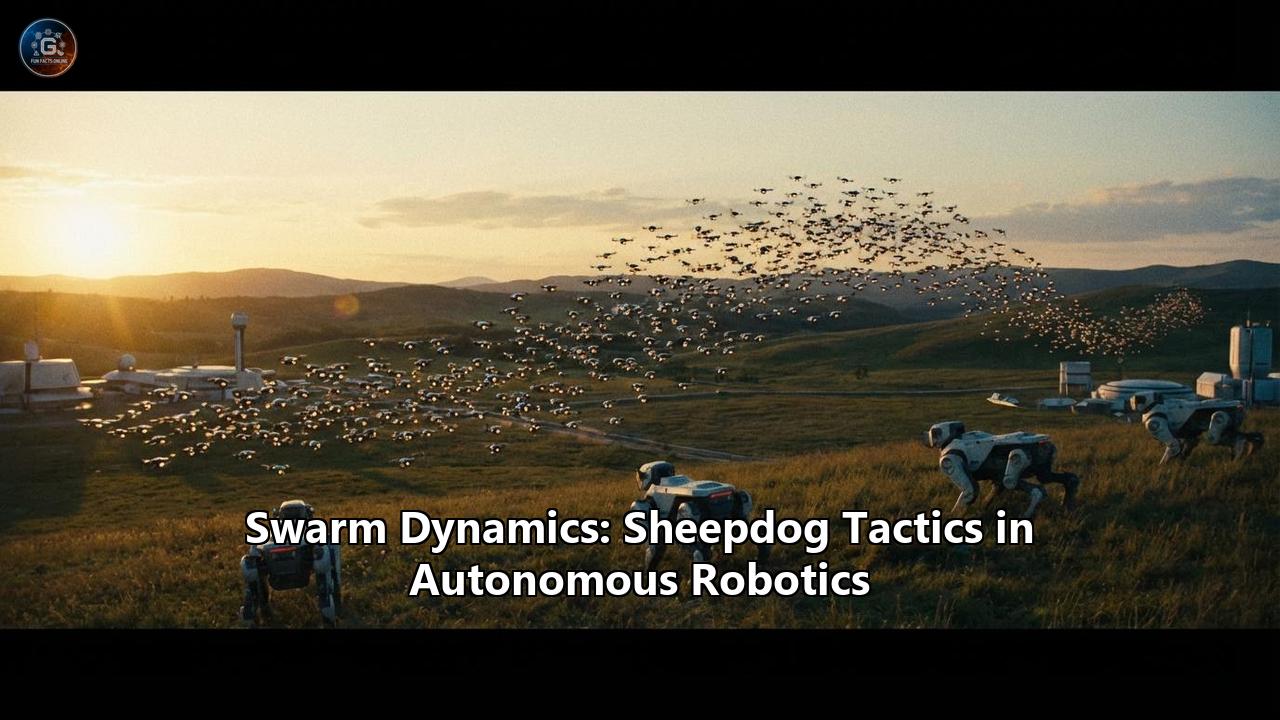
For millennia, humans have gazed at the natural world and marveled at the synchronized ballets of flocking birds, schooling fish, and swarming insects. These mesmerizing displays of collective behavior are not orchestrated by a central leader or a master conductor. Instead, they arise from decentralized, microscopic interactions among individuals following simple, local rules. In the modern era of robotics, engineers have sought to replicate this biological phenomenon to create "swarm robotics"—armadas of autonomous machines capable of achieving complex, macroscopic goals through decentralized cooperation.
However, a fundamental challenge has long plagued the field of multi-agent systems: How do you guide, contain, or redirect a massive, chaotic swarm when individual agents are non-cooperative, simplistic, or lacking sophisticated communication hardware?
The answer, it turns out, has been running across the grassy hills of the Scottish Borders for over a century. By studying the intricate, high-stakes interplay between sheepdogs and flocks of sheep, roboticists and computer scientists are unlocking revolutionary algorithms for autonomous control. This paradigm—often referred to as Swarm Shepherding or Sheepdog Tactics—represents a bleeding-edge fusion of ethology, complex systems physics, artificial intelligence, and autonomous robotics.
By employing a small number of highly capable "shepherd" agents to manipulate the environment and exploit the natural instincts of "sheep" agents, engineers are bypassing the need for computationally heavy, centralized control systems. From micro-drones corralling environmental pollutants to quadrupedal robots managing livestock, and from defense systems deflecting adversarial drone swarms to nanobots navigating the human bloodstream, sheepdog tactics are redefining the geometry of autonomous control.
The Biological Blueprint: Unlocking the Secrets of the Sheepdog
To comprehend how sheepdog tactics are applied to autonomous robotics, one must first deconstruct the biological and psychological mechanisms of actual herding. At its core, shepherding is an exercise in applied predator-prey dynamics and applied behavioral psychology.
Hamilton’s "Selfish Herd" Theory
In 1971, evolutionary biologist W.D. Hamilton proposed the "Selfish Herd" theory to explain why animals aggregate when threatened. The theory posits that individuals in a group do not flock together out of a cooperative desire to protect the whole; rather, each individual acts selfishly to minimize its own "domain of danger." When a predator approaches, animals on the periphery of the group will instinctively move toward the center, using their peers as living shields.
A sheepdog is essentially a domesticated predator. It does not want to eat the sheep, but it utilizes the sheep's deeply ingrained evolutionary fear of predators to trigger the selfish herd response. When the dog applies "pressure" by approaching, the sheep clump together into a cohesive mass. Once the sheep are aggregated, they behave more like a single, fluid entity than a collection of individuals, allowing the dog to steer the entire mass by applying directional pressure from the rear and the flanks.
The Paradox of the Small Flock and the Georgia Tech Breakthrough
Historically, roboticists assumed that controlling a small group of agents would be mathematically simpler than controlling a massive swarm. However, recent breakthroughs have flipped this assumption on its head. In a landmark March 2026 study published in Science Advances, researchers from the Georgia Institute of Technology analyzed hours of competitive sheepdog trial footage and uncovered a counterintuitive truth: larger groups are actually much easier to control than smaller ones.
In a large flock, the majority of the sheep are safely embedded in the center, experiencing a continuous sense of protection. This dampens the chaos of the group, leading to smooth, coherent motion. In contrast, in a small flock, every individual is dangerously close to the edge. As a result, the animals are trapped in a state of neurological indecision, rapidly and erratically switching between two conflicting instincts: follow the group (cohesion) and flee the dog (evasion).
"That switching behavior makes the group unpredictable," noted Tuhin Chakrabortty, co-lead author of the study.
By observing masterful human handlers and their dogs dealing with these erratic micro-flocks, the researchers identified a masterful two-step kinematic strategy:
- Subtle Alignment: The sheepdog approaches with minimal movement, applying just enough psychological pressure to force the sheep to align their physical orientations toward the target destination, without triggering a full-blown panic flight.
- Dynamic Pressure: Once alignment is achieved, the dog suddenly increases the pressure (through speed or aggressive posturing) to trigger coordinated, forward motion.
Because the alignment of a small, indecisive group decays rapidly due to internal behavioral "noise," the timing of this two-step transition is the absolute crux of successful shepherding. These biological observations have now become the foundational bedrock for a new generation of robotic algorithms.
Translating Instinct into Code: The Algorithms of Herding
The leap from the rolling pastures to the digital realm of autonomous robotics requires translating the nuanced dance of the sheepdog into rigorous mathematical frameworks and control algorithms. Traditional swarm robotics relied heavily on "averaging"—where each robot would assess the position and velocity of all its neighbors and calculate a mean vector to decide its next move. While effective in highly structured, cooperative environments, averaging breaks down disastrously in noisy, uncertain, or adversarial environments. If half the sensors are reading noise, the average becomes a corrupted instruction, and the swarm collapses.
The Indecisive Swarm Algorithm (ISA)
Inspired by the frantic "switching" behavior of small sheep flocks, the 2026 Georgia Tech team developed the Indecisive Swarm Algorithm (ISA). Instead of taking an average of all incoming data, an ISA-equipped autonomous agent pays attention to only one source of information at a time—either a guiding signal (the "dog") or a single neighboring robot.
Crucially, the agent dynamically and continuously switches its focus from one source to another from moment to moment. In simulations and physical tests involving high levels of environmental noise, this indecisive switching strategy dramatically outperformed traditional averaging methods. By not averaging the data, the true, uncorrupted signal is not diluted by surrounding noise. The ISA allows the swarm to maintain its trajectory with significantly less energy expenditure and computational overhead, proving that biological "indecision" can be engineered into a feature rather than a bug.
Adaptive Switching: Collecting vs. Driving
Another foundational pillar in algorithmic shepherding is the adaptive switching heuristic, famously conceptualized by researchers modeling the classic sheep-dog interaction. The shepherd algorithm operates on a simple but highly effective binary state machine based on the spatial distribution of the swarm: Collecting and Driving.
Let us define the swarm by its Global Center of Mass (GCM) and an acceptable radius of dispersion, $f(N)$, which scales with the number of agents.
- The Collecting Phase: The robotic shepherd continuously monitors the swarm. If it detects that a single "sheep" agent has drifted further than $f(N)$ from the GCM, the swarm is deemed fragmented. The shepherd aborts its current trajectory, rapidly navigates to a designated collecting position behind the straying agent, and sweeps it back toward the GCM.
- The Driving Phase: Once all agents are tightly packed within the $f(N)$ radius, the shepherd transitions to driving. It maneuvers to a driving position directly behind the GCM, diametrically opposed to the target destination, and pushes the consolidated mass forward.
This algorithm mathematically proves that a single, highly maneuverable shepherd can successfully herd massive groups of interacting agents by preventing the swarm from splitting, ensuring that the driving force is only applied when the "selfish herd" is fully formed.
The Farthest-Agent Targeting (FAT) Algorithm and Decentralization
As robotics scales up, relying on a central server to calculate the Global Center of Mass and beam instructions down to multiple shepherds becomes a critical bottleneck. Centralized communication is vulnerable to latency, jamming, and hardware failure. Thus, the frontier of shepherding involves communication-free decentralization.
In decentralized multi-shepherd systems, each robotic dog operates purely on its own local sensory data without talking to the other dogs. The Farthest-Agent Targeting (FAT) algorithm is a breakthrough in this domain. In the FAT model, each robotic shepherd independently identifies the "sheep" within its visual or LIDAR range that is farthest from the overall target destination. The shepherd then naturally maneuvers to push that specific outlier inward and forward.
When multiple shepherds follow this exact same localized rule simultaneously, they organically space themselves out around the flanks and rear of the swarm. The complex, coordinated behavior of a multi-dog team emerges spontaneously from simple, localized mathematics, completely eliminating the need for wireless communication grids.
The Rise of the Machine Shepherd: AI and Reinforcement Learning
While heuristic, rule-based algorithms (like the collecting/driving model) are elegantly simple, real-world environments are messy. Wind gusts disrupt drone flight paths, uneven terrain slows down ground robots, and target agents (whether animals, adversarial drones, or oil spills) behave with chaotic non-linearity. To handle this complexity, roboticists have turned to Artificial Intelligence, specifically Reinforcement Learning (RL).
Overcoming the Curse of Dimensionality
In classical control theory, guiding a multi-agent system requires computing the state-space of every single agent. If you have 1,000 agents, the mathematical state-space becomes so massive that even supercomputers struggle to solve the equations in real-time. This is known as the "curse of dimensionality". Standard numerical solvers trying to calculate optimal trajectories often fail to converge, breaking down into jagged, oscillatory paths as the system's high dimensionality and non-linearity violate basic assumptions of local linearization.
To bypass this, researchers utilize Mean-Field Models combined with reinforcement learning. Instead of tracking 1,000 individual agents, the AI tracks the probability distribution (the density) of the swarm over a given area. The AI "leader" (the shepherd) is trained using Temporal-Difference algorithms like SARSA or Q-Learning to compute control policies based entirely on this macro-level distribution rather than individual micro-level movements.
Curriculum-Based Reinforcement Learning
Training a robotic sheepdog from scratch in a simulated environment using standard RL is notoriously difficult. If the AI makes a random move and the flock scatters, the episode ends in failure, providing a very sparse "reward" signal for the AI to learn from.
To solve this, researchers employ Curriculum-Based Reinforcement Learning. Much like how a real sheepdog puppy is trained—starting with small, slow, docile sheep in a confined pen before graduating to massive flocks on open mountainsides—the AI is trained through a progressively escalating curriculum.
- Stage 1: The AI is tasked with simply approaching a stationary group of agents without scattering them.
- Stage 2: The AI must drive a pre-aggregated group in a straight line toward a nearby target.
- Stage 3: The AI is introduced to chaotic, dispersing agents and must learn the "collecting" maneuver.
- Stage 4: The AI is subjected to simulated wind shear, sensor noise, and obstacles, forcing it to combine collecting, driving, and alignment tactics dynamically.
The result is a neural network capable of adapting instantly to the unpredictable nature of biological or artificial swarms. Once trained in simulation, these "brain" models cross the sim-to-real gap, being downloaded into the hardware of physical drones and robotic quadrupeds.
Anatomy of an Autonomous Shepherding System
For a robot to successfully herd a swarm, it must be vastly superior to the agents it is controlling in three key domains: perception, computation, and actuation. This asymmetry is what allows one agent to dominate many.
1. Perception and Sensor Fusion:The robotic shepherd must continuously map the dynamic boundary of the swarm. Ground-based robots like Boston Dynamics' Spot (which has been successfully deployed as a robotic sheepdog in New Zealand via the cloud robotics firm Rocos) utilize a 360-degree suite of stereoscopic cameras, LIDAR, and infrared sensors to track the flock in real-time. Aerial shepherds (quadcopters) utilize downward-facing computer vision and semantic segmentation algorithms to differentiate the swarm agents from the background terrain.
2. Computation and Edge Processing:Because latency can mean the difference between a tightly corralled swarm and a scattered mess, the shepherd cannot rely on cloud computing. It must process complex AI models on the edge. High-performance onboard GPUs process the sensor data, feed it through the RL policy networks or the Indecisive Swarm Algorithm architectures, and generate kinematic outputs in milliseconds.
3. Actuation and Form Factor:The physical design of the shepherd dictates its influence over the swarm.
- Quadcopters: Unmatched in speed and omnidirectional movement, drone swarms are highly effective at herding ground-based livestock or other drones. For example, researchers at the University of Haifa developed an algorithm specifically for a swarm of quadcopters to herd cows. By devising rapid, swooping flight trajectories, the drones simulate aerial predators, causing the cows to run away in the desired direction, dynamically grouping them into intermediate sub-flocks before corralling them into a single massive herd.
- Quadrupeds (Robot Dogs): Legged robots excel in traversing the rugged, uneven terrain of agricultural fields or disaster zones where wheeled robots would get stuck. Their physical presence on the ground accurately mimics the terrestrial predators that herd animals are biologically hardwired to fear.
- Autonomous Surface Vehicles (ASVs): In aquatic environments, agile robotic boats use their wake, physical bumpers, or acoustic emitters to herd fish, corral oil spills, or direct floating debris.
Real-World Applications: Where Robot Sheepdogs Roam
The mathematics of shepherding is highly abstract—an interplay of repulsive forces, state spaces, and target distributions. But when deployed in the physical world, these algorithms are solving some of the most pressing challenges of the 21st century.
1. Precision Agriculture and Livestock Management
The most literal application of shepherding algorithms is in the agricultural sector. The global shortage of skilled agricultural labor has accelerated the adoption of robotics. Autonomous drones and robotic quadrupeds are now actively managing livestock. These robotic shepherds do not tire, they do not require food, and they can be guided via satellite to manage massive cattle stations spanning thousands of acres in places like the Australian Outback or the American Midwest.
Furthermore, because their behavior is governed by optimized algorithms, robotic shepherds can actually reduce the stress placed on the animals. An AI-driven robot can calculate the exact minimal amount of pressure required to move the herd, avoiding the chaotic, panic-inducing over-corrections that an untrained biological dog might make.
2. Environmental Cleanup and Containment
Perhaps the most critical engineering application of the shepherding problem is environmental remediation. When an oil tanker spills its payload into the ocean, the oil behaves like a massive, continuously dispersing swarm of non-cooperative agents spreading via wind and ocean currents.
Using swarm shepherding algorithms, a small fleet of highly maneuverable Autonomous Surface Vehicles (ASVs) can deploy floating booms. By treating the edge of the oil slick as the "sheep" and the ASVs as the "shepherds," the robots can dynamically adjust their positions to counter the changing currents. They execute the "collecting" algorithm to sweep in rogue tendrils of oil, and the "driving" algorithm to push the massive, consolidated slick toward a skimmer ship for extraction. Similar dynamics are being developed for fleets of micro-submersibles to herd suspended microplastics in the water column into collection zones.
3. Defense, Security, and Airspace Protection
As drone technology proliferates, the threat of adversarial drone swarms has become a premier concern for global security. Traditional kinetic defense systems (like shooting drones down) are dangerous in urban environments due to falling debris, and electronic jamming can disrupt civilian infrastructure.
Enter "StringNet Herding." In advanced defense applications, a fleet of defending autonomous drones acts as the sheepdogs, while the incoming adversarial swarm is treated as the sheep. Using sophisticated trajectory planning, the defender drones form a dynamic net, using repulsive forces (electronic, acoustic, or physical presence) to corral the attacking swarm. Without firing a single shot, the defender swarm steers the attacking drones away from a protected zone and guides them to a safe neutralization area.
4. Search and Rescue and Crowd Evacuation
In the chaos of a disaster—such as a burning building or a stadium evacuation—human crowds often exhibit the same fluid, panic-driven dynamics as a threatened herd of animals. In these scenarios, robotic "shepherds" (such as automated guidance lights, aerial drones with loudspeakers, or ground-based robots) can be deployed to gently manipulate the flow of the crowd. By applying the "Indecisive Swarm" findings, systems can avoid overwhelming panicked individuals with too much data. Instead, by providing clear, singular, switching signals, robots can efficiently guide crowds out of danger zones, preventing fatal crush dynamics.
5. Nanomedicine and Targeted Drug Delivery
At the microscopic scale, the physics of shepherding remain remarkably consistent. In targeted drug delivery, thousands of drug-carrying nanobots must be guided through the chaotic, turbulent environment of the human bloodstream to a specific tumor site. It is impossible to individually pilot thousands of nanobots.
Instead, utilizing the principles of indirect shepherding, doctors can use external magnetic fields or a few heavily actuated "shepherd" nanobots to emit repulsive or attractive biochemical signals. By manipulating the boundaries of the nanobot swarm, the shepherds herd the microscopic payload directly into the cancerous tissue, maximizing efficacy and eliminating the side effects of systemic chemotherapy.
The Mathematical Symphony of Swarm Dynamics
To truly appreciate the elegance of autonomous shepherding, one must look beneath the hood at the mathematics governing the swarm.
Vector Fields and Potential Functions
In a robotic shepherding system, the environment is often modeled as a gradient field, utilizing Artificial Potential Fields.
- The Target Destination is modeled as a massive "sink"—an area of low potential energy that mathematically attracts the agents.
- Obstacles are modeled as localized "peaks"—areas of high potential energy that emit a repulsive force, pushing the agents away.
- The Shepherd is a highly mobile, high-energy peak.
When the shepherd moves toward a "sheep," the sheep experiences an exponentially increasing repulsive vector. The sheep will naturally move along the gradient of steepest descent, sliding away from the shepherd. By carefully positioning itself, the shepherd manipulates the entire topological landscape of the sheep's world, forcing the sheep to "roll downhill" toward the target destination.
Sparse Indirect Control via PDE and ODE Coupling
When dealing with large-scale multi-agent systems (macro-swarms), the mathematics must evolve. Modern reinforcement learning frameworks utilize a coupled system of equations:
- Ordinary Differential Equations (ODEs) are used to model the exact, microscopic kinematics of the highly capable shepherds.
- Partial Differential Equations (PDEs) are used to model the continuous, macroscopic density and fluid-like flow of the uncontrolled target swarm.
By bridging the gap between ODEs and PDEs, the AI learns "sparse indirect control"—how the microscopic, discrete actions of a few agents (the dogs) can physically reshape the macroscopic continuum of the many (the flock). This allows the control system to be infinitely scalable; the algorithm does not care if it is herding 50 sheep or 50,000, because it interacts with the flock as a malleable fluid density rather than a discrete list of entities.
Challenges and Limitations on the Horizon
Despite rapid advancements, autonomous shepherding is not without its hurdles.
The Scalability Threshold:Shepherds have universally determined through history that there is a golden ratio for herding: $m \ll n$ (where $m$ is the number of dogs, and $n$ is the number of sheep). However, if the swarm size becomes vastly disproportionate to the speed and reach of the shepherds, the swarm achieves "escape velocity." The collecting algorithm fails because by the time the shepherd retrieves one outlier on the left flank, three more have escaped on the right flank. Finding the absolute mathematical limits of this ratio under varying friction and speed constraints remains an active area of optimal control research.
Environmental Noise:While the Indecisive Swarm Algorithm has drastically improved performance in noisy conditions, physical friction cannot be ignored. Visual occlusion (where the shepherd cannot see the far side of the flock), communication dropouts, and sudden environmental shocks (like a predator or an explosion) can instantaneously shatter the internal cohesion of the swarm, resetting the shepherding process to zero.
Ethical and Safety Guardrails:As with any autonomous system, the deployment of shepherding robots raises ethical questions, particularly regarding defense and crowd control. A system designed to physically coerce the movement of human beings using repulsive physical or acoustic force must be programmed with unbreakable safety constraints to ensure that the "driving" phase does not result in the injury of the targets.
The Future Horizon: Centaurs and Cosmic Swarms
As computational power grows and battery technologies improve, the future of sheepdog tactics in robotics is expanding in thrilling directions.
Heterogeneous Shepherding Swarms:Future systems will not rely on a single type of robot. A heterogeneous shepherding team might consist of high-altitude fixed-wing drones acting as the "eyes," computing the PDE density models of a forest fire or an oil spill. These overarching commanders will beam target coordinates to low-altitude quadcopters acting as the "flankers," which in turn coordinate with robust quadrupedal ground robots acting as the heavy "pushers."
Human-Swarm Interaction (The Centaur Model):Just as a human shepherd works in tandem with their dog via whistle commands, the ultimate multi-agent system will keep the human in the loop. In these "Centaur" models, a human operator provides the high-level cognitive intent ("Move the swarm to the valley over there"), and the autonomous shepherding algorithms handle the millions of micro-calculations required to execute the command. This abstracts the complexity of swarm control, allowing a single human to pilot an armada of thousands of machines as easily as playing a video game.
Beyond Terrestrial Boundaries:The final frontier for swarm shepherding is off-world. As humanity looks to explore the subterranean lava tubes of the Moon or the vast plains of Mars, deploying a single, expensive rover is a high-risk gamble. Instead, space agencies are looking toward swarms of cheap, expendable micro-rovers. To navigate the communication blackouts of deep space, an advanced, heavily shielded "Shepherd Rover" will act as the mothership, using local repulsive and attractive algorithms to herd a swarm of hundreds of mapping micro-bots through alien cave systems, ensuring the collective gathers maximum data without losing individuals to the Martian abyss.
Conclusion: Nature’s Oldest Algorithm, Tomorrow’s Greatest Technology
The integration of sheepdog tactics into autonomous robotics represents one of the most profound examples of biomimicry in modern science. By looking backward at an agricultural practice honed over centuries, engineers have found the key to unlocking the future of decentralized machine intelligence.
The transition from a biological Border Collie intensely staring down a stubborn ram to a quadcopter using reinforcement learning and the Indecisive Swarm Algorithm to herd a chaotic robotic collective is a testament to the universal laws of mathematics and physics. Whether the "sheep" are animals, oil spills, hostile drones, or nanobots, the dynamics of fear, cohesion, alignment, and pressure remain unchanged.
In the chaotic, unpredictable environments of the real world, rigid programming shatters. But by embracing the organic, adaptive, and sometimes indecisive nature of biological swarms, roboticists have created a new breed of autonomous systems—machines capable of bringing order to chaos, one calculated nudge at a time.
Reference:
- https://royalsocietypublishing.org/rsif/article/11/100/20140719/35292/Solving-the-shepherding-problem-heuristics-for
- https://research.gatech.edu/sheepdogs-reveal-better-way-guide-robot-swarms
- https://www.hackster.io/news/sheepdog-trials-provide-inspiration-for-a-new-autonomous-robotic-swarm-algorithm-5ead8ebdf0d5
- https://businessnewsthisweek.com/technology/sheepdogs-reveal-a-better-way-to-guide-robot-swarms/
- https://arxiv.org/pdf/2205.08155
- https://arxiv.org/pdf/2510.25115
- https://faculty.engineering.asu.edu/acs/wp-content/uploads/sites/33/2021/03/Kakish-DARS-2021-Using-Reinforcement-Learning-to-Herd-a-Robotic-Swarm-to-a-Target-Distribution.pdf
- https://arxiv.org/abs/2006.15807
- https://www.ifaamas.org/Proceedings/aamas2022/pdfs/p633.pdf
- https://aamas.csc.liv.ac.uk/Proceedings/aamas2022/pdfs/p633.pdf
- https://boingboing.net/2020/05/21/watch-this-robotic-sheepdog-ma.html
- https://cris.haifa.ac.il/en/publications/an-algorithm-for-herding-cows-by-a-swarm-of-quadcopters/
- https://www.frontiersin.org/journals/robotics-and-ai/articles/10.3389/frobt.2021.640446/full
- https://arxiv.org/pdf/2511.21304