
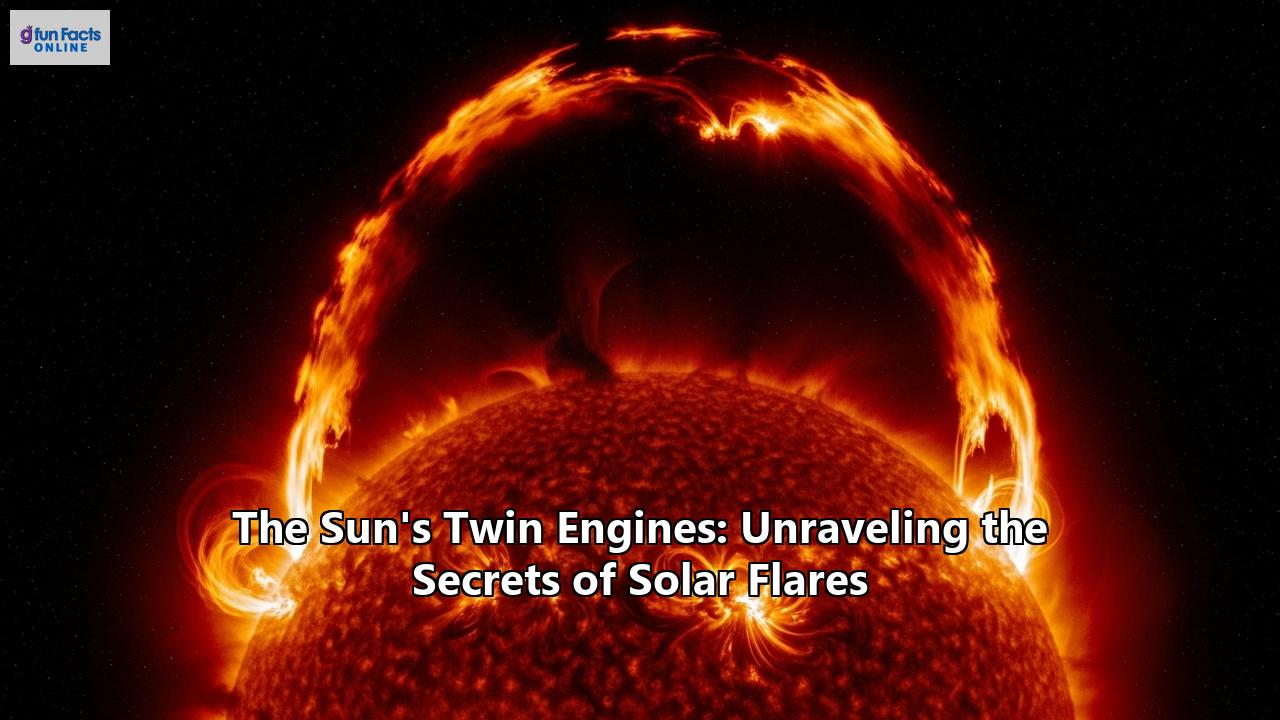
Our sun, the serene, life-giving star that anchors our solar system, harbors a tempestuous secret. It is a celestial furnace capable of unleashing explosions so powerful they dwarf humanity's entire nuclear arsenal. These cataclysmic events, known as solar flares, are not just distant astronomical curiosities; they are potent drivers of space weather that can reach across 93 million miles to touch our world in profound and disruptive ways. For decades, scientists have worked to understand the complex physics behind these outbursts. Now, thanks to pioneering missions that have flown closer to the sun than ever before, we are beginning to understand that the sun's eruptive fury is powered not by one, but by a pair of twin engines, each with its own distinct character and method of accelerating particles to nearly the speed of light.
This is the story of those engines: the sudden, violent crack of the solar flare and the vast, sweeping shockwave of the coronal mass ejection. It is a journey into the heart of our star, exploring the tangled magnetic fields that fuel its power. We will travel back in time to witness the first, startling discovery of a solar flare and recount the historic super-storms that revealed our technological society's vulnerability. Finally, we will explore the cutting-edge science and sophisticated network of sentinels we have placed in space and on Earth to monitor these twin engines, predict their behavior, and protect our interconnected world from the awesome and untamed power of the sun.
The Heart of the Storm: Anatomy of a Solar Flare
A solar flare is, in essence, an immense explosion in the sun's atmosphere. It is an intense, localized burst of radiation born from the sudden release of magnetic energy. These are the largest explosive events in our solar system, releasing energy equivalent to billions of hydrogen bombs in a matter of minutes. Flares manifest as sudden, brilliant brightenings in a region of the sun and can persist for minutes to hours. They unleash radiation across the entire electromagnetic spectrum, from radio waves to visible light, and all the way to high-energy X-rays and gamma rays.
These explosions occur in what are known as "active regions" on the sun, which are areas characterized by strong and complex magnetic fields. More often than not, these regions are associated with sunspots—cooler, darker patches on the solar surface where the magnetic fields are particularly intense, acting as anchors for vast magnetic structures that loop up into the sun's outer atmosphere, the corona.
The sun's surface is not static. It is a turbulent sea of electrically charged gas, or plasma, in constant motion. This motion perpetually stretches, twists, and shears the magnetic field lines that emerge from sunspots. Imagine an elastic rubber band being twisted tighter and tighter. At some point, the stored tension becomes too great, and the band snaps, releasing its energy in a flash. In a similar way, when the sun's magnetic field lines become too tangled and stressed, they can suddenly reconfigure into a simpler, lower-energy state. This process is the engine of a solar flare.
The Engine of Reconnection
The core physical mechanism driving this explosive energy release is a phenomenon known as magnetic reconnection. In the sun's plasma, magnetic field lines are typically "frozen-in," meaning the plasma and the magnetic field are bound together and move as one. However, under the extreme stress found in active regions, oppositely directed magnetic field lines can be forced together. When they meet, they can break and then reconnect in a new configuration.
The standard model of a solar flare, often called the CSHKP model (named after its developers Carmichael, Sturrock, Hirayama, and Kopp & Pneuman), provides a foundational picture of this process. It begins with a large, arching magnetic loop that is stretched upward by the sun's roiling motions. This stretching creates a thin, vertical sheet of electrical current where oppositely directed field lines are pressed together.
Reconnection acts like a cosmic short-circuit within this current sheet. The field lines snap and reconfigure into two new sets of loops. One is a lower, more stable arcade of loops that remains anchored to the sun. The other is a helical coil of magnetic field, a "plasmoid," that is no longer tied to the solar surface and is violently ejected into space. The energy that was stored in the original, complex magnetic field is abruptly converted into thermal energy, heating the surrounding plasma to tens of millions of degrees, and kinetic energy, which furiously accelerates charged particles like electrons and protons to near the speed of light.
These super-heated particles and intense radiation are the hallmarks of a solar flare. The accelerated electrons, guided by the newly formed lower magnetic loops, stream down toward the denser lower layer of the sun's atmosphere, the chromosphere. When they slam into the chromosphere, they release their energy, causing the material to heat up explosively and emit the brilliant light across the spectrum that we observe as a flare.
While this standard model has been successful in explaining the general features of flares, scientists now understand that the process is far more complex. Modern observations and high-resolution simulations suggest that reconnection doesn't happen in a single, neat sheet but in a turbulent, three-dimensional volume filled with a "fractal" or patchy network of current sheets and plasmoids. This complexity is key to explaining the rapid and bursty nature of the energy release seen in flares.
The Twin Engines: Flares and Coronal Mass Ejections
For years, a central question in solar physics was the precise relationship between solar flares and Coronal Mass Ejections (CMEs). CMEs are colossal bubbles of plasma and magnetic field that are flung from the sun's corona into space. While flares are defined by their intense burst of electromagnetic radiation (light), CMEs are defined by the actual expulsion of solar material. These two phenomena often occur together but can also happen independently, leaving their connection shrouded in mystery.
A groundbreaking discovery, facilitated by the European Space Agency's Solar Orbiter mission, has finally brought clarity to this relationship, revealing them as the "twin engines" responsible for accelerating the high-speed particles that populate the solar system. The mission's data has shown that solar flares and CMEs are two distinct, though related, mechanisms for creating streams of Solar Energetic Electrons (SEEs).
This landmark research, led by Alexander Warmuth of the Leibniz Institute for Astrophysics Potsdam, has definitively separated these particle events into two categories: "impulsive" and "gradual."
Engine 1: The Impulsive Accelerator (Solar Flares)The first engine is the solar flare itself. When magnetic reconnection occurs in the compact, turbulent region of a flare, it acts as an incredibly efficient, rapid-fire particle accelerator. It grabs electrons and protons from the surrounding plasma and, in a sharp, sudden burst, flings them outwards. These are the "impulsive" events. They are characterized by a rapid rise time, often just minutes, and are tightly linked to the X-ray and radio bursts emitted directly from the flare site.
The particles accelerated by this engine tend to be rich in specific elements and isotopes, such as Helium-3, and have charge states indicating they originated in the extremely hot plasma of the flare region, where temperatures exceed 10 million Kelvin. These particle streams are typically narrow, constrained to flow along the magnetic field lines that connect directly back to the site of the flare. An observer in space, like a satellite, will only detect these particles if it is in the right place at the right time to be on this direct magnetic highway.
Engine 2: The Gradual Accelerator (Coronal Mass Ejections)The second engine is the CME. As a CME plows through the solar corona and out into interplanetary space at speeds exceeding a million miles per hour, it creates a massive shockwave in front of it, much like a supersonic jet creates a sonic boom. This enormous, expanding shock front acts as a vast particle accelerator. It sweeps up the ambient particles of the solar wind in its path and energizes them over a much broader area and a longer period. These are the "gradual" events.
The particle acceleration mechanism at these shocks is a process known as diffusive shock acceleration (DSA) or first-order Fermi acceleration. In this process, particles are trapped near the shock front, repeatedly bouncing back and forth across it. Each time a particle crosses the shock, it gains a small amount of energy. Over many crossings, particles can be accelerated to incredibly high energies. Another related mechanism, shock drift acceleration (SDA), plays a crucial role when the magnetic field is nearly perpendicular to the shock front, using the electric field at the shock to give particles a quick and powerful boost.
Gradual events associated with CMEs produce a much wider spray of particles that are released over many hours. These events are responsible for the largest and most intense Solar Energetic Particle (SEP) events seen at Earth and pose a greater threat to astronauts and satellites because they contain more high-energy particles spread over a vast region of space.
The Solar Orbiter mission was uniquely equipped to unravel this dual-engine mystery. By flying closer to the sun than previous missions, its Energetic Particle Detector (EPD) could measure the particles in a "pristine" state, before their journey through space could obscure their origins. Simultaneously, its remote-sensing instruments, like the X-ray Spectrometer/Telescope (STIX), could pinpoint the exact location and timing of the flare on the sun. By combining these two perspectives—seeing the cause (the flare/CME) and the effect (the particles) at the same time—scientists were finally able to definitively link impulsive events to flares and gradual events to CME shocks.
This "twin engine" discovery is a monumental leap in our understanding of solar physics and has profound implications for our ability to forecast space weather. Knowing whether a solar event will produce a narrow, impulsive beam of particles or a broad, gradual storm is critical for protecting our assets in space and on Earth.
A History Forged in Light and Fury
Humanity's awareness of the sun's violent temper began not with advanced spacecraft, but with a patient eye, a telescope, and a stroke of luck.
The Carrington Event: A Moment of Discovery
On the morning of September 1, 1859, a British amateur astronomer named Richard Carrington was in his private observatory, projecting an image of the sun onto a screen and meticulously sketching a large group of sunspots. Suddenly, he witnessed "two patches of intensely bright and white light" erupt from the sunspot cluster. The entire event lasted only five minutes, but Carrington had become the first person in history to observe and record a white-light solar flare. Another English astronomer, Richard Hodgson, independently observed the same event, confirming its solar origin.
Carrington suspected a connection between the flash on the sun and some minor magnetic field disturbances recorded by ground-based magnetometers at the same time. But the true impact of what he had seen would not be felt for another 17 to 18 hours. In the early hours of September 2, the CME associated with that monster flare slammed into Earth.
The result was the most intense geomagnetic storm in recorded history, now known as the Carrington Event. The planet's magnetic field was overwhelmed. Telegraph systems across Europe and North America failed catastrophically. Sparks flew from telegraph machines, shocking operators and setting paper on fire. So much electrical current was induced in the wires that some operators were able to disconnect their batteries and continue sending messages using only the auroral-induced power.
The auroras themselves were a global spectacle. The Northern Lights were seen as far south as Cuba, Texas, and the Caribbean, while the Southern Lights were witnessed in the southern hemisphere reaching toward the equator. The light was so brilliant that people in the northeastern United States could read newspapers at night, and miners in the Rocky Mountains were woken up, believing it was dawn. The Carrington Event was a stunning demonstration of the sun's power and the first time a clear link was established between an event on the sun and major technological and geophysical effects on Earth.
Modern Wake-Up Calls: The Quebec Blackout and Halloween Storms
For over a century, the Carrington Event remained a historical curiosity. But as human society became increasingly dependent on electricity and technology, the threat of space weather loomed larger. That threat became a stark reality on March 13, 1989.
Following a series of powerful flares and a CME from a particularly active sunspot region, a severe geomagnetic storm hit Earth. The storm induced powerful geomagnetically induced currents (GICs)—low-frequency DC currents—that surged through the ground. In Quebec, Canada, the region's geology, a large shield of igneous rock, prevented these currents from easily flowing through the earth. Instead, the currents found a path of least resistance: the long, high-voltage transmission lines of the Hydro-Québec power grid.
At 2:44 a.m., the influx of GICs caused transformer saturation and tripped the grid's protective safety relays. In less than 90 seconds, the entire Québec power grid collapsed. Six million people were plunged into darkness for nine hours in the cold of a Canadian March. The event was a critical wake-up call, proving that solar storms were not just a historical footnote but a tangible, modern threat to our critical infrastructure.
Another dramatic demonstration of our vulnerability came in late October and early November 2003 with the "Halloween Solar Storms." An extremely active sunspot region, one of which was 13 times the size of Earth, unleashed a barrage of at least 17 major flares. The most powerful of these, on November 4, was so intense it saturated the X-ray sensors on the GOES satellites. Its power was later estimated to be a staggering X45, the most powerful flare ever recorded by instruments.
The effects were widespread.
- Satellites: Over half of all Earth-orbiting spacecraft were affected. Systems were put into safe mode, communications were disrupted, and Japan's ADEOS-2 satellite was permanently damaged and lost. Astronauts on the International Space Station were forced to take shelter in the most heavily shielded portion of the station to protect against the high radiation levels.
- Aviation: Dozens of flights were rerouted from high-latitude polar routes to avoid communication blackouts and high radiation doses for passengers and crew.
- GPS: The accuracy of the Global Positioning System was significantly degraded, affecting surveyors, drilling operations, and other high-precision users.
- Power Grids: While North America avoided a major blackout, the Swedish power grid experienced a one-hour outage, and twelve transformers in South Africa were damaged and had to be replaced.
Like the Carrington Event, the Halloween Storms produced stunning auroras seen as far south as Florida and Texas, a beautiful but ominous reminder of the immense energies at play. These historical events, from Carrington's simple sketch to the grid collapse in Quebec and the satellite failures of 2003, form the foundation of our modern understanding of space weather risk. They are the benchmarks against which we measure our preparedness and the motivation for the vast scientific enterprise dedicated to watching the sun.
A Planet on Alert: Monitoring, Prediction, and Mitigation
In the face of the sun's twin engines of fury, humanity has not stood idle. A global network of sentinels, both in space and on the ground, now keeps a constant vigil, while engineers and policymakers develop sophisticated strategies to harden our technology and mitigate the risks. This effort is spearheaded by organizations like the NOAA Space Weather Prediction Center (SWPC) in the United States, the official source for space weather alerts and warnings. The SWPC operates 24/7, gathering data from a host of assets to provide forecasts, watches, and warnings to industries ranging from aviation and power grids to satellite operators and NASA.
Our Eyes on the Sun: The Space-Based Armada
Our first line of defense is a fleet of spacecraft strategically positioned to monitor the sun.
- Geostationary Operational Environmental Satellites (GOES): This series of satellites, in geostationary orbit, is the workhorse of solar flare detection. Their instruments, such as the X-ray Sensor (XRS) and the Solar Ultraviolet Imager (SUVI), provide the near-real-time data that is used to classify flare intensity (e.g., C, M, or X-class) and provide immediate warning of radio blackouts, as the flare's radiation reaches Earth at the speed of light in just over eight minutes.
- Solar and Heliospheric Observatory (SOHO): A joint ESA/NASA mission launched in 1995, SOHO has revolutionized space weather forecasting. Positioned at the L1 Lagrange point, about 1.5 million kilometers sunward of Earth, its LASCO coronagraph creates an artificial eclipse, allowing it to directly image the CMEs as they leave the sun. This gives forecasters up to a three-day notice of an Earth-directed CME, providing crucial time to prepare for a potential geomagnetic storm.
- Parker Solar Probe: Launched by NASA in 2018, this daring mission is flying closer to the sun than any spacecraft in history, right through the corona itself. By directly sampling the particles and magnetic fields where flares and CMEs are born, Parker Solar Probe is providing unprecedented data on the fundamental physics of particle acceleration, confirming theoretical models of magnetic reconnection and giving us a ground-truth look at the power of these events.
Ground-Based Sentinels
On the ground, a new generation of telescopes provides a level of detail never before possible.
- Daniel K. Inouye Solar Telescope (DKIST): Located in Hawaii, this is the world's most powerful solar telescope. Its massive 4-meter mirror allows it to resolve features on the sun's surface as small as 20 kilometers. In 2024, DKIST captured the highest-resolution images of a solar flare ever taken, revealing the incredibly fine, thread-like structures of coronal loops that are the fundamental building blocks of flares. These observations are pushing the boundaries of flare modeling and helping scientists refine the physics used in space weather prediction.
Predicting the Outburst
Prediction is a complex science, blending direct observation with sophisticated computer models. Forecasters at the SWPC use data from SOHO and other observatories to classify sunspot groups by their size and magnetic complexity using the McIntosh classification system. By comparing the current state of an active region to historical data, models like the Automated Solar Activity Prediction (ASAP) system can calculate the probability of that region producing C, M, or X-class flares within the next 24 hours. While not perfect, these probabilistic forecasts are a critical tool for risk assessment. The ultimate goal is to move from "what is the probability" to "when and how big," a challenge that the data from missions like Parker Solar Probe and the Inouye Solar Telescope is helping to address.
Building a Resilient World: Mitigation Strategies
Knowing a storm is coming is only half the battle. The other half is being prepared to weather it. Since the wake-up calls of 1989 and 2003, significant strides have been made to protect our critical infrastructure.
- Protecting Satellites: Modern satellites are built with resilience in mind. The process of radiation hardening involves multiple layers of defense. This can include physical shielding with materials like aluminum or hydrogen-rich polymers to block particles. At the component level, "rad-hard" microelectronics are designed with wider circuits and specialized layouts to be less susceptible to damage. A key strategy is redundancy, particularly Triple Modular Redundancy (TMR), where three identical components perform a task and a "voting" system uses the output of at least two of them, masking any single-event upset in the third. When a major solar particle storm is detected, operators can also place their satellites into a protective "safe mode," shutting down non-essential systems to ride out the storm.
- Hardening the Power Grid: Electric utilities are now acutely aware of the threat from GICs. To comply with standards set by entities like the North American Electric Reliability Corporation (NERC), companies perform GIC flow studies to identify the most vulnerable transformers in their system. Mitigation strategies include installing GIC-blocking devices like series capacitors, upgrading to more resilient transformer designs, and modifying operating procedures during a storm, such as reducing power flow on long lines to lower the stress on the system. In the most extreme cases, a deliberate, controlled blackout may be the only option to prevent the catastrophic, long-term damage of dozens of multi-ton transformers.
- Safeguarding Aviation: The aviation industry relies heavily on SWPC forecasts. During a solar radiation storm, polar flights are often rerouted to lower latitudes. This increases flight time and fuel consumption but is a necessary precaution to limit the radiation exposure of passengers and crew and to avoid the degradation of high-frequency (HF) radio communications, which are particularly susceptible to disruption in the polar regions. Airlines must be prepared to switch from GPS-based navigation to older, less precise methods if signals become unreliable.
Living with a Star
The discovery of the sun's twin engines—the impulsive flare and the gradual CME—marks a new chapter in our relationship with our star. We now see with greater clarity the two distinct ways it can unleash torrents of energy and particles into the solar system. This knowledge, born from missions that brave the very heat and radiation they study, is not merely academic. It is the foundation of our modern civil defense against the cosmos.
Solar flares are a fundamental expression of the sun's nature, a reminder that the same magnetic forces that shape its elegant corona can also snap with unimaginable violence. We live in the extended atmosphere of this dynamic, and sometimes violent, star. While we can never tame its engines, we can strive to understand them. Through constant vigilance, scientific innovation, and engineering ingenuity, we can learn to navigate the ever-present reality of space weather. By continuing to unravel the secrets of solar flares, we ensure that our technologically-dependent civilization can continue to thrive, safely and securely, under the watchful eye of its twin-engine star.
Reference:
- https://www.swpc.noaa.gov/content/space-weather-faq-frequently-asked-questions
- https://www.spis.org/archives/projects/spine/home/tools/sctc/VIIIth/79439246c0a8001401f8dd8a13f8e64d/8th_Space_Weather_Effects_on_SOHS_and_its_Role_as_a_Sp_85.pdf
- https://www.allpcb.com/blog/pcb-knowledge/radiation-hardening-techniques-for-spacecraft-electronics-pcb-a-comprehensive-guide.html
- https://atomfair.com/scibase2/article.php?id=4820
- https://atomfair.com/scibase2/article.php?id=367
- https://www.innovationnewsnetwork.com/nsf-inouye-solar-telescope-delivers-record-breaking-images-of-solar-flare/61124/
- https://science.nasa.gov/mission/soho/
- https://www.youtube.com/watch?v=uIlw9oP5PM4
- https://earthsky.org/space/new-solar-flare-images-solar-flares-coronal-loops-sun-daniel-k-inouye-solar-telescope/
- https://nso.edu/press-release/the-nsf-inouye-solar-telescope-delivers-record-breaking-images-of-solar-flare-coronal-loops/
- https://www.mightytravels.com/2024/11/how-solar-storms-impact-flight-operations-a-guide-to-aviation-safety-and-potential-disruptions-in-2024/
- https://www.livescience.com/space/the-sun/scientists-unveil-most-detailed-photo-of-a-solar-flare-ever-taken
- https://www.bradford.ac.uk/research/impact/ref-2021/solar-flare-detection/
- https://dev-01-alb-www-swpc.woc.noaa.gov/products/goes-x-ray-flux
- https://en.wikipedia.org/wiki/Space_Weather_Prediction_Center
- https://www.discovermagazine.com/a-solar-probe-s-journey-to-the-sun-has-revealed-how-solar-flares-work-47944
- https://atomfair.com/scibase2/article.php?id=3826
- https://www.quora.com/What-steps-have-been-taken-to-protect-satellites-from-a-solar-storm
- https://www.youtube.com/watch?v=yaj5aGDo1WQ
- https://www.nasa.gov/wp-content/uploads/2015/04/156578main_soho_fact_sheet.pdf?emrc=6689cf
- https://www.energycentral.com/energy-management/post/how-solar-flares-could-blackout-power-grid-2cVN4In5hE6EPju
- https://www.esa.int/Science_Exploration/Space_Science/SOHO_science_highlights
- https://www.ni.com/en/solutions/aerospace-defense/space-launch-exploration/satellite-design-test/5-ways-shield-satellites-dangers-space.html
- https://www.nesdis.noaa.gov/news/safeguarding-satellites-how-noaa-monitors-space-weather-prevent-disruptions
- https://www.navcanada.ca/en/news/blog/how-space-weather-and-solar-storms-impact-aviation.aspx
- https://training.weather.gov/nwstc/spacewx/handlingspacewxqs/lesson1/swpc.html
- https://www.goes-r.gov/education/docs/Spaceweather.pdf
- https://www.jhuapl.edu/news/news-releases/230915b-nasa-parker-probe-close-encounter-with-coronal-mass-ejection-cme
- https://spire.com/spirepedia/radiation-hardening/
- https://www.swpc.noaa.gov/sites/default/files/images/u33/Boeing_Space_Weather_Effects_on_Aviation_110426_Final.pdf
- https://www.goes-r.gov/products/baseline-solar-flux-xray.html
- https://www.esa.int/Science_Exploration/Space_Science/SOHO/SOHO_overview
- https://thedebrief.org/magnetic-explosion-driving-space-weather-captured-by-nasas-parker-space-probe/
- https://www.universetoday.com/articles/worlds-most-powerful-solar-telescope-captures-breathtaking-image-of-solar-flare
- https://solarmonitor.org/forecast.php
- https://spaceweather.bradford.ac.uk/asap/
- https://www.youtube.com/watch?v=rbgN9fHsX1Q
- https://www.voragotech.com/blog/radiation-hardened-electronics-for-space-environments
- https://www.renewableenergyworld.com/power-grid/space-weather-how-to-avoid-grid-disruption-and-transformer-damage-from-solar-flares/
- https://blog.sintef.com/industry/protecting-the-power-grid-from-solar-storms/
- https://www.sws.bom.gov.au/Category/Educational/Pamphlets/Overview%20of%20space%20weather%20and%20potential%20impacts%20and%20mitigation%20for%20the%20aviation%20sector.pdf