
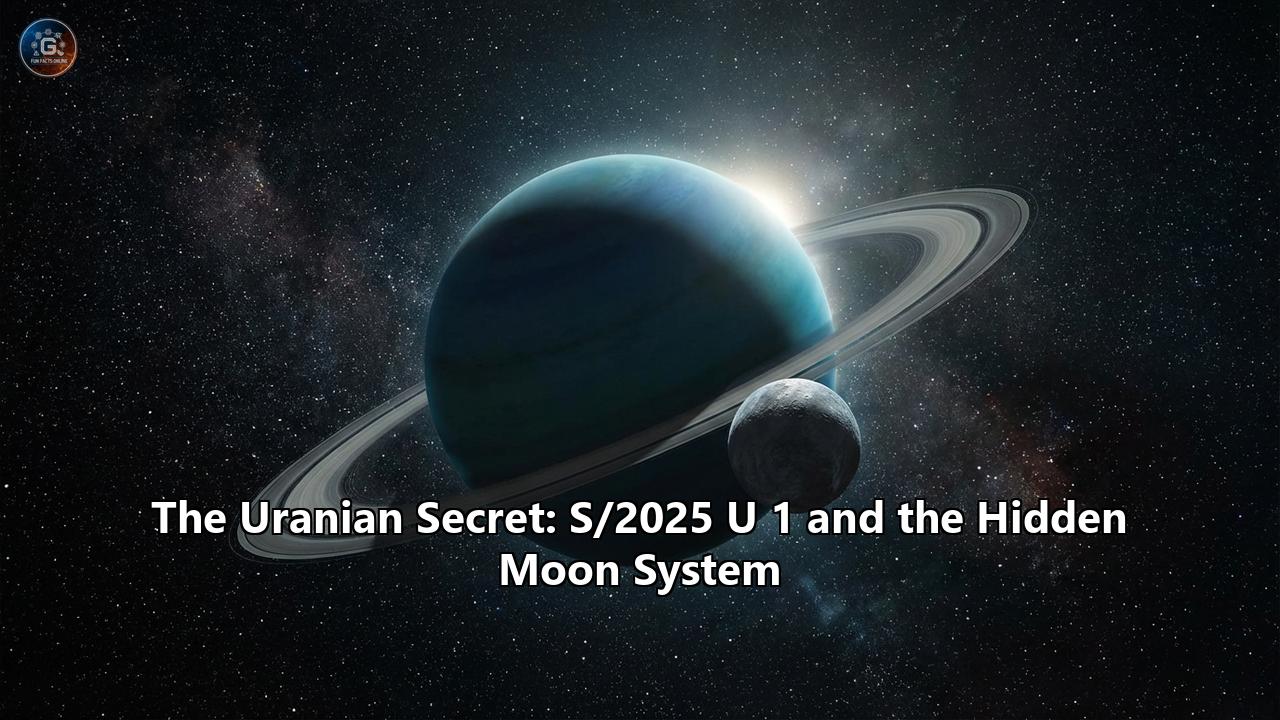
In the silent, freezing expanse of the outer solar system, where the Sun is merely a brilliant star in a tapestry of darkness, the planet Uranus spins on its side. For decades, this ice giant has kept its secrets well-guarded, shrouded in a haze of methane and mystery. It is a world of contradictions—a planet with a calm blue face but a turbulent atmosphere, a magnetic field that defies logic, and a ring system so dark it was only discovered by accident. But perhaps the most tantalizing secret of all has been its retinue of moons, a chaotic family of icy worlds that dance a precarious ballet around their parent.
On August 19, 2025, that silence was broken by a whisper that rippled through the astronomical community. A new moon had been found.
Designated S/2025 U 1, this tiny world is not just another rock in the sky; it is a ghost that has haunted our data for forty years, invisible to the most powerful eyes of humanity until now. Its discovery by the James Webb Space Telescope (JWST) is more than just a tick mark on a census of the solar system. It is a key that unlocks a deeper understanding of the "hidden" moon system of Uranus—a densely packed, chaotic, and dynamic environment that challenges our theories of how solar systems form and evolve.
This article delves into the heart of the Uranian system, exploring the story of S/2025 U 1, the hidden dynamics of the inner moons, the violent history of the rings, and the future missions that will finally unveil the Ice Giant’s full glory.
Part I: The Ghost Moon The Discovery
The story of S/2025 U 1 begins not in the cold vacuum of space, but in the digital archives of the James Webb Space Telescope. In February 2025, a team of astronomers led by Dr. Maryame El Moutamid of the Southwest Research Institute (SwRI) turned the golden honeycomb mirrors of JWST toward the seventh planet. Their goal was to study the complex interplay between the planet's rings and its atmosphere, but they found something else entirely.
Buried within the glare of the planet and its rings was a faint speck of light. It was moving. Over a series of exposures taken on February 2nd, the speck traced a distinct orbit, separate from the background stars and the known moons. It was incredibly faint—tens of thousands of times dimmer than what the naked eye can see—and astonishingly small.
With an estimated diameter of just 8 to 10 kilometers (5 to 6 miles), S/2025 U 1 is the smallest moon ever discovered around Uranus. It orbits within the frantic inner city of the Uranian system, nestled between the moons Ophelia and Bianca, at a distance of approximately 57,844 kilometers from the planet's center.
Why Was It Hidden?The discovery immediately begs the question: How did we miss it? Humanity has visited Uranus before. In January 1986, NASA’s Voyager 2 spacecraft flew past the planet, returning thousands of spectacular images and discovering 10 new moons in a matter of weeks. Why did Voyager 2, a probe that was right there, miss what a telescope a million miles from Earth could see?
The answer lies in the limitations of 1980s technology and the unique nature of the Uranian system.
- The "Dark" Problem: The inner moons of Uranus are some of the darkest objects in the solar system. They are covered in a carbon-rich material, possibly radiation-processed organics, that makes them blacker than asphalt. They reflect less than 10% of the sunlight that hits them. S/2025 U 1 is not only tiny but also incredibly dark, making it a "stealth" moon.
- The Glare: Voyager 2’s cameras were sensitive, but they had to contend with the immense glare of Uranus itself. Trying to spot a 6-mile-wide charcoal briquette next to a giant, reflecting planet is like trying to spot a gnat flying next to a stadium floodlight.
- Orbital Timing: Voyager 2 was a flyby mission. It had only a few hours of prime viewing time. If S/2025 U 1 was on the other side of the planet or hidden amidst the ring particles during the critical window, Voyager would have had no chance to see it.
It took the infrared sensitivity of JWST to pierce the veil. Unlike Voyager’s optical cameras, JWST sees in heat. Even a cold, dark rock emits a faint thermal signature or reflects infrared light differently than the background. The NIRCam instrument on JWST, with its exquisite resolution and dynamic range, was able to suppress the glare of Uranus just enough to reveal the tiny companion.
Part II: The Anatomy of the Uranian System
To understand the significance of S/2025 U 1, we must place it within the context of the broader Uranian family. The moon system of Uranus is unlike any other. While Jupiter has its four Galilean kings and Saturn has the majestic Titan, Uranus possesses a system that is arguably more complex, more compact, and more violent.
The 29 known moons (including S/2025 U 1 and the recently confirmed S/2023 U 1) are divided into three distinct classes:
1. The Major Moons (The Shakespearean Five)These are the worlds that William Herschel and his successors first spotted. They are massive enough to be spherical, and each is a unique world in its own right.
- Miranda: The Frankenstein moon. Its surface looks like it was smashed apart and haphazardly reassembled, with sheer ice cliffs 20 kilometers high and strange "racetrack" features called coronae.
- Ariel: The brightest and potentially most active. Its surface is crisscrossed with canyons that suggest relatively recent geologic activity, perhaps cryovolcanism (ice volcanoes).
- Umbriel: The dark, brooding observer. It is the oldest and darkest of the major moons, covered in craters, with only a mysterious bright ring (the Wunda crater) breaking the gloom.
- Titania & Oberon: The distant giants. Titania is the largest, a world of rift valleys and fault lines, while Oberon stands as the sentinel at the edge of the major system, heavily cratered and ancient.
Far beyond the orbit of Oberon lie the irregulars. These are captured asteroids or comets, orbiting in wild, highly elliptical, and often retrograde paths (orbiting opposite to the planet's rotation).
- S/2023 U 1: Before the discovery of S/2025 U 1, this was the newest member of the family. Discovered by ground-based telescopes, it is a member of this distant, chaotic group. These moons are likely the remnants of the early solar system’s violent billiard game, captured by Uranus's gravity billions of years ago.
This is where S/2025 U 1 resides, and it is the most chaotic place in the Uranian system. This region, inside the orbit of Miranda, is packed with 14 small, dark, potato-shaped moons. They orbit so closely together that if you stood on one, the others would appear as visible disks in the sky, not just stars.
- Puck: The largest of the inner moons, discovered by Voyager.
- Cordelia & Ophelia: The shepherd moons that flank the bright Epsilon ring.
- The Portia Group: A cluster of moons (Bianca, Cressida, Desdemona, Juliet, Portia, Rosalind, Cupid, Belinda, Perdita) that are packed so tightly they defy long-term stability.
S/2025 U 1 fits snugly into this "Portia Group" region, orbiting between Ophelia and Bianca. Its discovery confirms what dynamicists have long suspected: the inner system is even more crowded than we thought.
Part III: The Ring-Moon Dance
The discovery of S/2025 U 1 is intimately tied to the rings of Uranus. Unlike Saturn’s broad, majestic sheets of light, the rings of Uranus are narrow, dark ribbons of dust and boulders. They are named with Greek letters (Alpha, Beta, Gamma, Delta, Epsilon) and numbers.
The existence of these rings is a gravitational puzzle. Gas drag from the planet's extended atmosphere and the solar wind should have caused these rings to spread out and dissipate millions of years ago. The fact that they are still narrow and sharp implies that something is holding them in place.
The Shepherd TheoryThis is where the "Shepherd Moons" come in. Cordelia and Ophelia are the classic examples. Cordelia orbits just inside the Epsilon ring, and Ophelia orbits just outside it. Their gravity acts like a sheepdog:
- If a ring particle drifts inward (slowing down), Cordelia’s gravity pulls it forward, adding energy and pushing it back out.
- If a particle drifts outward (speeding up), Ophelia’s gravity drags on it, removing energy and dropping it back in.
This gravitational "herding" keeps the Epsilon ring razor-sharp. However, many of the other Uranian rings (like Gamma or Eta) do not have visible shepherd moons.
The Missing ShepherdsFor decades, scientists have predicted that there must be "unseen moonlets" lurking in the gaps, shepherding the other rings. S/2025 U 1 is precisely the kind of object they were looking for. While it is not currently identified as a shepherd for a specific ring, its location between Ophelia and Bianca places it in a region where gravitational resonances are strong.
It is highly probable that S/2025 U 1 is just the "tip of the iceberg." The rings themselves may be composed of, or continuously spawning, tiny moonlets. This blurs the line between "moon" and "ring." Is a 1-kilometer rock a moon? What about a 500-meter rock? In the Uranian system, the distinction is meaningless. The rings and inner moons are a single, fluid, dynamic system.
Part IV: The Chaos of the Inner System
The most terrifying implication of S/2025 U 1's discovery is what it tells us about the stability of the Uranian system. The inner moons are packed so tightly that they are dynamically unstable on astronomical timescales.
The Collision CourseComputer simulations of the Portia group (where S/2025 U 1 lives) show that these moons are constantly tugging on each other. These tugs create "chaotic" orbits. We cannot predict their positions with certainty more than a few centuries into the future.
- Desdemona and Cressida: These two moons are on a collision course. Simulations suggest they will likely crash into each other within the next 1 to 10 million years.
- Cupid and Belinda: Another pair doomed to a violent merger.
When these moons collide, they will not just bump; they will shatter. The energy of the impact will pulverize them into a cloud of ice and rock, creating a new ring. Over time, this ring will spread out, accrete into new moonlets, and the cycle will begin again.
The Phoenix MoonsThis leads to the radical theory that the current inner moons of Uranus are not primordial. They are likely the "grandchildren" or "great-grandchildren" of the original moons that formed with the planet.
- Generation 1: Formed 4.5 billion years ago. Collided and shattered.
- Ring Phase: The debris formed a massive ring system.
- Re-accretion: The ring material clumped together to form Generation 2.
- Repeat: This cycle of destruction and rebirth has likely happened multiple times.
S/2025 U 1, being so small, might be a fragment left over from the last great collision, or a new "embryo" trying to grow from the ring material. It is a piece of cosmic shrapnel in a slow-motion demolition derby.
The Roche Limit ConnectionThis cycle is governed by the Roche Limit—the invisible line around a planet where the planet's tidal forces (gravity pulling harder on the front of a moon than the back) are strong enough to rip a moon apart.
- Inside the Roche Limit: Rings exist because moons cannot hold themselves together.
- Outside the Roche Limit: Moons can exist.
The inner moons of Uranus skirt the edge of this limit. They are held together not just by their own weak gravity, but by the tensile strength of their materials. They are essentially piles of rubble held together by friction and ice. If they drift too close, Uranus will rip them apart, turning S/2025 U 1 back into a ring.
Part V: A History of Hidden Worlds
The discovery of S/2025 U 1 is the latest chapter in a 250-year saga of discovery.
1781: The Lonely PlanetWhen William Herschel discovered Uranus, it was a solitary wanderer. It took six years for him to spot the first two moons, Titania and Oberon (1787). For half a century, they were the only known companions.
1851: The Family GrowsWilliam Lassell, a beer brewer and amateur astronomer, used his metal-mirror telescope to spot Ariel and Umbriel. The family was now four.
1948: The CliffhangerGerard Kuiper (father of the Kuiper Belt) discovered Miranda. For nearly 40 years, the count stood at five. Textbooks were written, and generations of students memorized the "five moons of Uranus."
1986: The Voyager FloodThe flyby of Voyager 2 changed everything. In a flurry of data transmission, the moon count jumped from 5 to 15. The discovery of Puck, Juliet, Portia, and the others revealed the crowded inner system for the first time. It was the first glimpse of the "hidden" world.
1997-2003: The Era of the IrregularsWith the advent of digital CCD cameras, ground-based astronomers (like Kavelaars, Gladman, and Sheppard) began hunting for the distant irregular moons. They found Sycorax, Caliban, and a host of others, bringing the count up to the mid-20s.
2025: The Infrared RevolutionAnd now, JWST has opened the "Infrared Era." S/2025 U 1 is likely just the first of many. The sensitivity of modern instruments means we are no longer limited by the glare of the planet. We can now peer into the dusty gaps between the rings.
Part VI: The Future - Exploring the Ice Giant
The discovery of S/2025 U 1 has added urgency to the next great endeavor of planetary science: a return to Uranus.
The Decadal Survey's DecreeIn 2022, the National Academies of Sciences, Engineering, and Medicine released their "Decadal Survey," a roadmap for NASA's priorities for the next decade. The result was a resounding victory for the Ice Giants. The top priority for a new "Flagship" mission (the same class as Voyager, Cassini, and Curiosity) is the Uranus Orbiter and Probe (UOP).
Mission Profile: UOP- Launch: Likely in the early 2030s (2031 or 2032) on a heavy-lift rocket (like Falcon Heavy).
- Journey: A 10-13 year cruise, possibly using Jupiter for a gravity assist.
- Arrival: Orbital insertion around Uranus in the early-to-mid 2040s.
- The Probe: The mission will drop a probe directly into the atmosphere of Uranus to measure composition, temperature, and wind speeds.
- The Orbiter: The main spacecraft will spend years touring the system.
The discovery of S/2025 U 1 gives mission planners a new target.
- Navigation Hazards: The inner system is more crowded than we thought. Planners must account for "invisible" debris fields near S/2025 U 1 to keep the orbiter safe.
- Science Targets: The orbiter will likely perform close flybys of the inner moons to determine their mass and density. Are they solid ice? porous rubble piles? S/2025 U 1 will be a prime candidate for study to understand the lower limit of moon formation.
NASA is not alone. China has announced the Tianwen-4 mission, slated for launch around 2030. It is a dual mission:
- Main Probe: Will orbit Jupiter and eventually land on Callisto.
- Sub-Probe: A smaller spacecraft will separate and continue on a long, lonely journey to Uranus, arriving around 2045 for a flyby.
While a flyby is less comprehensive than an orbiter, having two sets of eyes on Uranus in the 2040s would be a golden age for Ice Giant science.
ESA's VisionThe European Space Agency (ESA) is also looking outward. Their "Voyage 2050" plan identifies the moons of the giant planets as a top priority. While they may not lead a standalone Uranus mission immediately, they are likely to partner with NASA (as they did on Cassini-Huygens), perhaps providing the atmospheric probe or key instruments to study these new, tiny moons.
Conclusion: The Value of the Hidden
S/2025 U 1 is a small rock, barely larger than a city. It will never support life; it has no atmosphere, no volcanoes, no grand vistas. Yet, its discovery is profound.
It reminds us that our census of the solar system is incomplete. It teaches us that "empty" space is rarely empty. Most importantly, it reveals the dynamic, violent, and creative nature of the universe. The Uranian system is not a static clockwork mechanism; it is a living, breathing, crashing ecosystem of gravity and ice.
As we prepare to send our robotic emissaries back to the Blue Planet, S/2025 U 1 stands as a beacon, a tiny lighthouse in the dark, signaling that there are more secrets waiting to be found in the shadows of the rings. The "hidden" moon system is no longer hidden; it is beckoning.
The 2040s will be the decade of Uranus. And when we arrive, S/2025 U 1 will be there waiting—a testament to the power of human curiosity and the endless capacity of the cosmos to surprise us.
Reference:
- https://utkarsh.com/current-affairs/international/science-and-technology/nasas-james-webb-space-telescope-discovers-uranus-29th-moon-s2025-u1
- https://en.wikipedia.org/wiki/Uranus_Orbiter_and_Probe
- https://en.wikipedia.org/wiki/Tianwen-4
- https://www.planetary.org/articles/chinas-plans-for-outer-solar-system-exploration
- https://www.universetoday.com/articles/planetary-decadal-survey-says-its-time-for-a-mission-to-uranus-and-enceladus-too-1
- https://www.space.com/china-probes-jupiter-uranus-same-launch
- https://www.esa.int/Enabling_Support/Space_Engineering_Technology/Shaping_the_Future/Ice_Giant_Exploration_Advancements_in_Atmospheric_Entry_Technology
- https://www.space.com/europe-astronauts-moon-mars-explore-2040