
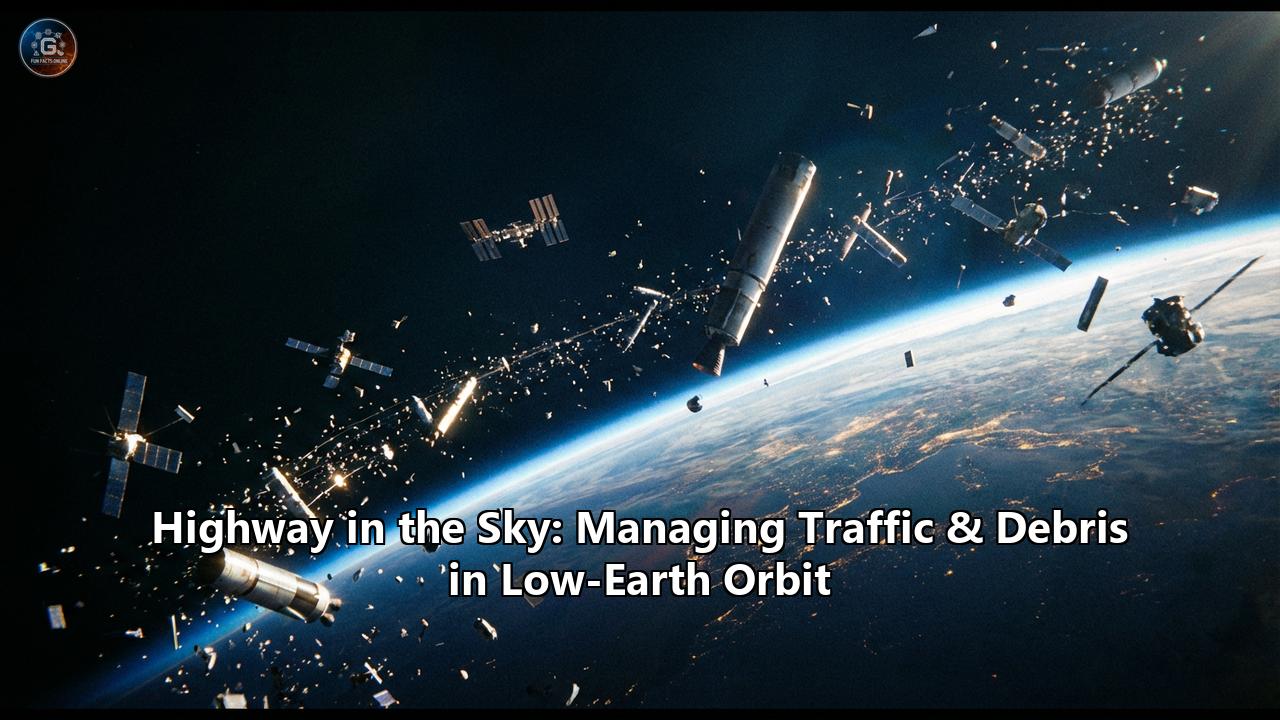
Look up at the night sky, and you might assume the space immediately surrounding our blue planet is a serene, infinite void. The reality, however, is far closer to a bustling, unregulated superhighway with no speed limits, no traffic lights, and millions of invisible potholes. Welcome to Low-Earth Orbit (LEO) in the late 2020s.
A decade ago, only a few thousand active satellites operated in LEO. Today, driven by the commercialization of space and the global race to provide universal broadband coverage, that number has rapidly surged past 10,000. Over the next five years, as mega-constellations like SpaceX’s Starlink, Amazon’s Project Kuiper, and OneWeb aggressively execute their deployment schedules, conservative estimates project tens of thousands of new satellites will crowd our immediate orbital vicinity, with some industry forecasts predicting up to 70,000 active spacecraft.
This orbital boom is democratizing access to the stars, delivering high-speed internet to remote villages, and enabling high-resolution Earth observation. But this explosive growth carries a dark, potentially catastrophic consequence. We are turning the pristine vacuum of space into a high-speed junkyard, and managing this chaotic orbital traffic has become one of the most pressing technological and regulatory challenges of our time.
The Invisible Minefield Above Us
Functional satellites are only half of the story playing out above our heads. The other half is a high-velocity graveyard. Orbital debris, colloquially known as "space junk," encompasses everything from defunct, bus-sized rocket bodies and dead satellites down to microscopic flecks of paint.
In the terrestrial world, a dropped bolt or a chipped piece of paint is a minor nuisance. In Low-Earth Orbit, where objects scream around the Earth at speeds exceeding 17,500 miles per hour, physics takes on a terrifying lethality. At those velocities, a stray millimeter-sized bolt carries the kinetic energy of a hand grenade.
The nightmare scenario keeping aerospace engineers awake at night is known as the Kessler Syndrome. Proposed by NASA scientist Donald Kessler in 1978, this theory outlines a cascading chain reaction of destruction: if the density of objects in LEO becomes high enough, a single collision could spawn a massive cloud of shrapnel. That newly generated shrapnel would then strike other satellites, creating more debris, triggering a runaway reaction that could eventually render entire orbital bands utterly unusable for generations.
This is not mere science fiction; humanity has already caught a terrifying glimpse of this potential. In 2009, the world witnessed the first major accidental hypervelocity collision when a dead Russian Cosmos-2251 military satellite violently T-boned an active commercial Iridium 33 satellite. The catastrophic impact instantly doubled the total amount of trackable debris in certain orbital lanes, scattering a cloud of lethal shrapnel that operators are still forced to dodge today. With the total value of LEO constellation spacecraft rapidly increasing—and overall collision probabilities climbing—the financial and infrastructural risks have never been higher.
The Google Maps of Space: Traffic Management
To prevent the Kessler Syndrome from permanently clipping humanity's wings, the aerospace sector has rapidly birthed a critical new industry: Space Traffic Management (STM) and Space Domain Awareness (SDA).
Historically, the United States military—specifically through the Space Force’s Space Surveillance Network—bore the immense burden of tracking global orbital traffic. However, traditional government infrastructure, built for the Cold War era of large, sparse satellites, has begun to groan under the sheer volume of modern space traffic and the exponential multiplication of tiny, shoebox-sized CubeSats. The threat posture in orbit has also become increasingly complex, with defense officials noting adversarial satellites practicing maneuverability tactics in LEO.
Enter the commercial sector, which has stepped up with advanced, AI-driven Orbital Intelligence to fill the gaps. Companies like LeoLabs have fundamentally transformed how we view the invisible highway. By deploying a proliferated global network of rapidly deployable phased-array radars, LeoLabs currently tracks over 25,000 objects in space. Their authoritative dataset accounts for 99.96% of all active satellites and an astonishing 98.56% of all debris listed in the Department of Defense’s public catalog.
The U.S. government has eagerly leaned into this private-sector innovation. Closing 2025 with over $60 million in government contract awards—a 186% year-over-year growth in U.S. government business—LeoLabs is delivering critical data to both the Space Force and NASA. Crucially, their comprehensive object catalog is being evaluated for integration into the Office of Space Commerce’s (OSC) TraCSS space traffic management tool. This system essentially functions as an automated air traffic control for space, issuing precise conjunction warnings—alerts that two objects are on a collision course—enabling satellite operators to fire their thrusters and step out of the way before disaster strikes.
Other incredibly innovative tracking solutions are also taking flight to ease the burden on radar networks. The Aerospace Corporation recently developed "blinkers"—tiny, inexpensive visual LED transponders that can be attached to miniature satellites. Tested on an experimental CubeSat dubbed Slingshot, these blinkers allow even a 10-cubic-centimeter satellite to be easily located and identified visually, vastly simplifying the categorization of crowded orbits.
The Cosmic Tow Trucks: Active Debris Removal
Dodging debris through collision avoidance maneuvers is a necessary short-term survival tactic, but it does nothing to clean up the existing mess. Relying solely on dodging is akin to swerving around wrecked cars on a highway without ever calling a tow truck. For long-term sustainability, the industry must physically remove the largest threats. Active Debris Removal (ADR) has evolved from a theoretical academic exercise into a billion-dollar commercial reality.
Leading the charge in this orbital sanitation effort are pioneering companies like Astroscale and ClearSpace. Astroscale, a market leader in satellite servicing, has developed robust robotic solutions to wrangle defunct hardware. Their ELSA-M servicer, slated for launch in 2026, is a technological marvel capable of docking with and safely removing several "prepared" inactive satellites (satellites intentionally designed with magnetic docking plates) in a single mission.
However, the most dangerous objects in orbit are "unprepared" debris—massive, tumbling legacy rocket bodies and dead satellites launched decades ago with no thought given to their eventual disposal. To tackle this, Astroscale recently secured a U.S. patent for a highly complex multi-removal method designed to capture these erratic, uncooperative objects and force them into a safe, guided descent to burn up in the Earth's atmosphere. They are also deeply involved in sovereign cleanup efforts, leading the UK’s COSMIC mission which will utilize robotic arms to snatch two defunct British satellites out of orbit. Expanding their portfolio from just removal to active sustainability, Astroscale recently won an ESA contract for the In-Orbit Refurbishment and Upgrading Service (IRUS), a groundbreaking initiative aimed at physically repairing and upgrading older satellites to extend their lifespans rather than letting them die and become debris.
Meanwhile, Swiss startup ClearSpace is matching this momentum. Supported by the European Space Agency and having secured a launch contract with Arianespace, their flagship ClearSpace-1 mission is scheduled to ride a Vega C rocket into LEO in the second half of 2026. The 700-kilogram robotic servicer will hunt down a defunct payload adapter left in orbit by ESA, capture it like a mechanical spider, and drag it down into a destructive atmospheric reentry.
The Regulatory Wild West and the 5-Year Rule
No amount of advanced radar tracking or robotic tow trucks can save Low-Earth Orbit if we continue to treat it like an infinite dumping ground. Recognizing that voluntary guidelines were failing to curb the pollution, international regulatory bodies have finally begun to bare their teeth.
For decades, the standard international guideline suggested that operators should deorbit their spacecraft within 25 years after the end of their mission. As the era of mega-constellations dawned, leaving dead satellites in orbit for a quarter of a century became mathematically unsustainable. In late 2022, the U.S. Federal Communications Commission (FCC) shattered the status quo by officially adopting a stringent "5-Year Rule" for satellites operating in or passing through LEO. Under this mandate, which went into full effect on September 29, 2024, satellite operators must maneuver their dead hardware into a destructive reentry trajectory no later than five years post-mission.
The space industry's reaction to the 5-Year Rule has been deeply divided, largely split along the fault lines of differing corporate business models. SpaceX, whose Starlink satellites operate at very low altitudes that naturally decay into the atmosphere relatively quickly, vigorously supported the rule, claiming operators should remove their hardware "as soon as practicable". This compliance inherently grants them a competitive regulatory advantage.
Conversely, Amazon’s Project Kuiper, which is still aggressively building out its LEO broadband constellation, formally pushed the FCC in late 2025 to scrap the five-year limit. In filings to the Commission, Amazon argued that the timeline is "artificial and rigid," penalizing operators for uncontrollable environmental failures in orbit that prevent a timely deorbit maneuver. However, space sustainability experts and academic researchers fiercely pushed back, asserting that rolling back the 5-Year Rule would be "anathema to ensuring a safe and sustainable space environment" and urged the FCC to hold the line.
Outside the United States, Europe is taking equally aggressive action on the policy front to force a cultural shift in orbital operations. The European Space Agency introduced the "Zero Debris Charter," an ambitious voluntary pledge for all ESA missions to leave absolutely no long-term debris in orbit by 2030, a pact that over 40 major space organizations have already joined. Individual nations are also stepping up; France’s strict Space Operations Act requires comprehensive post-mission disposal strategies, while the broader European Union works toward a binding framework for orbital enforcement across all member states.
The Future of the Highway
As we look toward the end of the 2020s, the "Highway in the Sky" sits at a crucial inflection point. The sheer mathematics of LEO dictate that human oversight alone will no longer be enough. The future of Space Traffic Management lies heavily in the realm of Artificial Intelligence and advanced propulsion.
With mega-constellations fully operational, satellite operators could face the monumental task of processing over 70,000 conjunction warnings annually. AI is being aggressively trained to automate collision avoidance, parsing through the noise, predicting trajectories, and executing evasive maneuvers without requiring human intervention. Furthermore, advancements in spacecraft agility are allowing for rapid evasive action. Innovative startups like Portal Space Systems are developing cutting-edge solar-thermal propulsion technology—envisioned as the "Star Trek" style of orbital movement—capable of executing swift, high-speed orbit changes within hours to dodge sudden debris clouds or adversarial threats.
Low-Earth Orbit is no longer an untouchable, romantic frontier; it is a critical piece of modern human infrastructure, as vital to our daily lives as the undersea fiber-optic cables that connect our continents and the power grids that light our homes. It powers our global financial transactions, our GPS navigation networks, our broadband connectivity, and our vital climate monitoring systems. We have finally recognized that the space right above our heads is a finite, fragile ecosystem.
Through a delicate, interconnected balance of strict regulatory enforcement, unparalleled commercial radar networks mapping the dark, and audacious robotic garbage collectors preparing to haul away our past mistakes, humanity is finally learning how to pave the orbital highway responsibly. The sky is indeed getting crowded, but for the first time in the history of the Space Age, we are actively writing the traffic laws.
Reference:
- https://www.geekwire.com/2025/portal-space-systems-preview-solar-thermal-propulsion/
- https://thebaffler.com/salvos/spoiling-the-last-frontier-king
- https://londoneconomics.co.uk/wp-content/uploads/2020/12/LE-UKSA-Commercial-Space-Surveillance-Tracking-FINAL-FOR-PUBLICATION-S2C060720.pdf
- https://www.airandspaceforces.com/space-traffic-management-future-smaller-sats-more-threats/
- https://www.govcon.com/doc/leolabs-achieves-record-bookings-in-fueled-by-triple-digit-growth-in-u-s-government-contracts-0001
- https://payloadspace.com/leolabs-lands-cross-government-licensing-contract/
- https://www.astroscale.com/en/news/astroscales-new-patent-transforms-space-debris-removal
- https://www.astroscale.com/en/missions/cosmic
- https://www.innovationnewsnetwork.com/astroscale-wins-350000-contract-to-transform-in-orbit-servicing/65595/
- https://www.theleeco.com/insights/how-to-avoid-fcc-fees-for-space-debris-and-help-save-low-earth-orbit/
- https://evona.com/blog/clearspace-arianespace-debris-removal/
- https://aublr.org/2025/11/the-five-year-countdown-rule-satellite-deorbiting-and-the-impact-on-the-space-industry/
- https://www.lightreading.com/satellite/amazon-wants-fcc-to-drop-five-year-rule-on-deorbiting-satellites
- https://www.marketsandmarkets.com/Market-Reports/space-traffic-management-market-170133030.html