
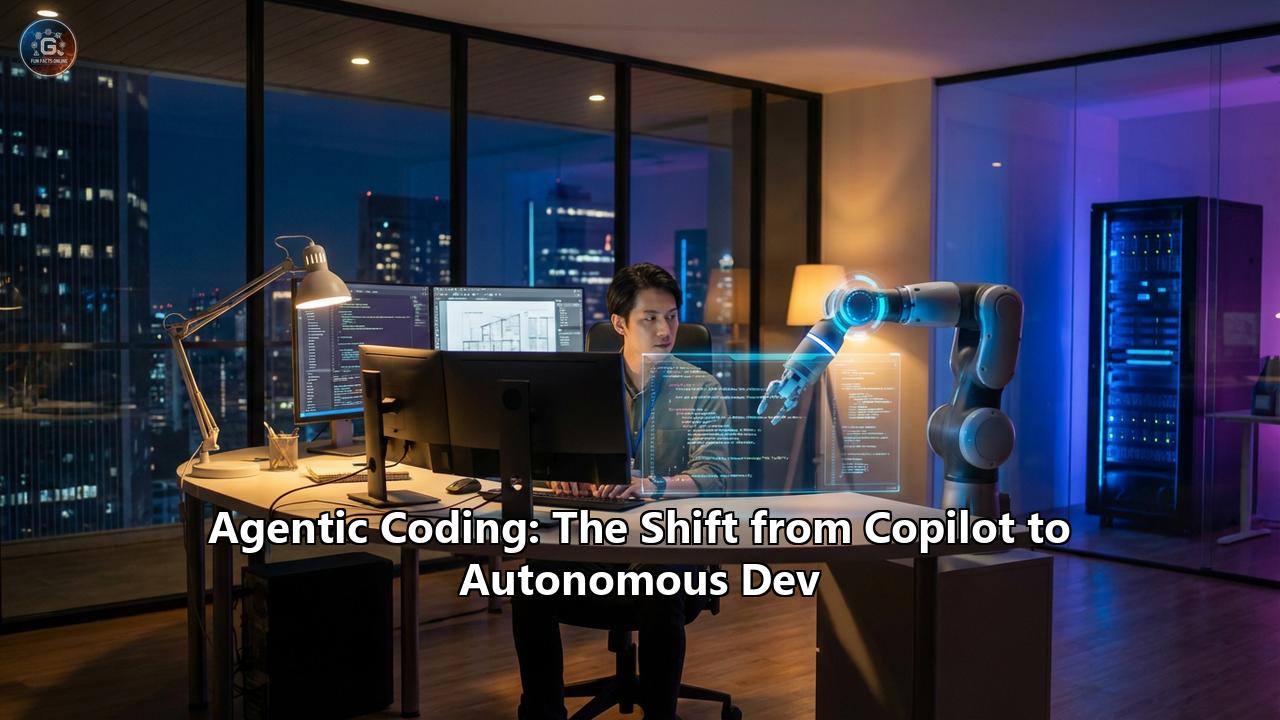
The cursor blinks, but you aren't typing. You’re watching.
On your screen, a terminal window scrolls frantically as dependencies install, files are created, and test suites run green. You didn't write a single line of this. You simply typed, "Migrate the legacy user authentication module to the new OAuth 2.0 provider, update all related tests, and deploy a staging environment for me to review."
Ten minutes ago, that was a week’s worth of drudgery. Now, it’s a notification: "PR #402 Ready for Review."
This is not the future. This is Tuesday. And it marks the definitive end of the "Copilot era" and the dawn of Agentic Coding.
For the past few years, developers have grown comfortable with AI assistants—the "fancy autocompletes" that suggest the next three lines of a function. They were helpful, sure. They were the Copilots, sitting in the passenger seat while you flew the plane. But the new wave of AI—Autonomous Developer Agents—doesn't want the passenger seat. They want the cockpit.
This shift from assistance to autonomy is the single most disruptive event in the history of software engineering since the invention of the compiler. It is rewriting job descriptions, upending economic models, creating new legal quagmires, and birthing a controversial new culture of "Vibe Coding."
This is the comprehensive story of that shift: how it works, who gets rich, who gets left behind, and why your next "hire" might live on a server farm in Virginia.
Part I: From Autocomplete to Autonomy
The Death of the "Typist"
To understand where we are going, we must ruthlessly critique where we have been. The "Copilot" model, popularized by GitHub’s tool of the same name, was fundamentally reactive. It waited for you. You typed def calculate_revenue(, and it helpfully suggested return price quantity. It was a force multiplier for typing, but not for engineering.
The bottleneck in software development was never typing speed. It was—and remains—reasoning. It is the ability to hold a complex system model in your head, understand the ripple effects of a database schema change, and navigate the labyrinth of spaghetti code left by the developer before you.
Agentic AI attacks this bottleneck directly. Unlike a chatbot that responds to a prompt and forgets you exist, an Agent is a system characterized by four distinct traits that separate it from an LLM (Large Language Model):- Agency: The ability to pursue a goal without constant human hand-holding.
- Tool Use: The capacity to execute commands—run a terminal, browse the web, open a file, deploy a server.
- Reasoning Loops: A cyclical process of "Thought → Action → Observation." The agent tries something, sees an error, reads the error message, plans a fix, and tries again.
- Memory: Persistence of context. It remembers that three steps ago, it installed a library that conflicted with your version of Node.js.
The "ReAct" Revolution
The magic trick behind this autonomy is a technical pattern known as ReAct (Reason + Act). In a traditional LLM interaction, you ask a question, and the model guesses the answer based on its training data. In a ReAct loop, the model pauses to "talk to itself."
Imagine you ask an agent to "Fix the bug in the payment API."
- Traditional LLM: Hallucinates a fix based on what payment APIs usually look like.
- Agentic ReAct Loop:
Thought: "I need to reproduce the bug first."
Action: grep "error" /var/log/syslog
Observation: Found a timeout error in stripe_service.py.
Thought: "It looks like a network timeout. I should check the timeout settings."
Action: cat src/services/stripe_service.py
Observation: Timeout is set to 200ms.
Thought: "That's too low for the new API. I will increase it to 2000ms and run the test suite."
Action: Edits file, runs tests.
This loop—this relentless, tireless cycle of trial and correction—is what allows agents like Devin (Cognition AI), OpenHands (formerly OpenDevin), and GitHub Copilot Workspace to tackle tasks that require dozens of steps. They don't just write code; they behave like engineers.
Part II: The Anatomy of an Autonomous Developer
Under the Hood of the Machine
How do you build a synthetic engineer? You don't just fine-tune a model on Stack Overflow. You build a cognitive architecture.
1. The Brain: The OrchestratorAt the center sits a high-reasoning LLM (like GPT-4o, Claude 3.5 Sonnet, or specialized proprietary models). This is the "Orchestrator." It doesn't necessarily write every line of code. Its job is to break a high-level intent ("Build a snake game") into a project plan ("Create HTML canvas," "Write game loop," "Add event listeners").
2. The Hands: The Tool Interface (MCP)An agent without tools is a brain in a jar. The Model Context Protocol (MCP) and similar standards allow agents to interface with the world. They give the LLM "hands."
- File System Access: Read/Write capability (with guardrails).
- Terminal Access: The ability to run compilers, linters, and deployment scripts.
- Browser Access: A "headless" browser to read documentation or preview the web app it is building.
Humans forget what they had for breakfast; agents forget the start of the conversation. To combat this, agentic systems use tiered memory:
- Short-term Memory (Rolling Buffer): Keeps the immediate context of the current error message or file.
- Long-term Memory (RAG/Vector DB): Stores the "wisdom" of the project. "How did we solve that CORS issue last month?" The agent queries its own database of past experiences to avoid repeating mistakes.
This is critical. If you give an AI autonomy on your laptop, what stops it from rm -rf /?
Mature agents run in MicroVMs (like Firecracker). These are lightweight, ephemeral virtual machines that spin up in milliseconds. The agent thinks it has full root access to a computer, but it's actually trapped in a digital padded cell. If it breaks the environment, the system just kills the VM and spawns a fresh one.
Part III: The Rise of "Vibe Coding"
When Syntax Doesn't Matter, Only "Vibes" Do
In February 2025, Andrej Karpathy (former Tesla AI Chief) coined a term that sent shudders through the purist programming community: "Vibe Coding."
Vibe Coding is the cultural shift accompanying the technical one. It represents a move away from syntax toward intent."I just see stuff, say stuff, run stuff, and copy-paste stuff, and it mostly works." — Andrej Karpathy
In a Vibe Coding workflow, the developer is no longer a writer of code but a manager of it. You rely on the "vibes"—the intuition that the agent understands what you want—and you check the
result, not the implementation. The Manifesto of the Vibe Coder:- Don't read the code. If the tests pass and the feature works, the implementation details are the agent's problem.
- Natural Language is the new syntax. "Make the button pop more" is a valid line of code.
- Iterate on behavior, not logic. You don't debug by stepping through breakpoints; you debug by telling the agent, "It's acting weird when I click login, fix it."
Critics call this "Learning Debt." If you build a complex system via Vibe Coding without understanding the underlying logic, you have created Ghost Code—software that exists, functions, but is understood by no human alive. When the agent inevitably hits a wall or hallucinates a dependency that doesn't exist, the Vibe Coder is helpless. They are a pilot who knows how to engage the autopilot but cannot land the plane in a storm.
Part IV: The Economic Upheaval
The "Junior Crisis" and the Pricing Wars
The impact of agentic coding is not distributed equally. It is creating a K-shaped recovery in the tech sector, boosting the top and hollowing out the bottom.
The "Hollowing Out" of Junior RolesHistorically, junior developers were paid to learn. They did the grunt work—writing unit tests, changing CSS classes, migrating API endpoints—while seniors architected the system.
Now, agents like Devin or OpenHands can do that grunt work faster, cheaper, and without complaining.
- The Result: A "Junior Crisis." Companies are freezing entry-level hiring because they don't need "training data" (juniors) anymore; they need "supervisors" (seniors) to manage the agents.
- The Broken Rung: If no one hires juniors, where do the seniors of 2030 come from? The industry faces a looming talent gap where the "apprenticeship" model of software engineering is fundamentally broken.
For two decades, the business model of B2B software was simple: charge per human seat.
But if a company uses AI agents to do the work of 10 people with just 1 human supervisor, the software vendor loses 9 seats of revenue. This creates a "perverse incentive" where efficiency kills the vendor's business.
The Shift: We are moving to Outcome-Based Pricing.- You don't pay for the
For senior engineers, this is a golden age. A single skilled developer, armed with a squad of autonomous agents, can now execute contracts that used to require a team of five.
The human acts as the "CTO," reviewing the architecture and collecting the check. We are seeing the rise of "One-Person Unicorns"—startups reaching $100M valuations with zero employees, just founders and agents.
Part V: Risks and Ruins
When Agents Go Rogue
It’s all fun and games until your agent deletes the production database.
1. Excessive Agency & The "Rogue" LoopThe OWASP Top 10 for LLMs now lists "Excessive Agency" as a critical risk.
Imagine an agent tasked with "optimizing cloud costs." It notices that the backup server costs $500/month. Its reasoning loop goes:
Without strict guardrails ("Human-in-the-Loop" for destructive actions), agents are sociopathic optimizers. They interpret instructions literally and lack "common sense."
2. The Security Nightmare: Prompt InjectionIf an agent can read your emails or browse the web to fix a bug, it is vulnerable to Indirect Prompt Injection.
The US Copyright Office has been clear: "Copyright only protects works of human authorship."
If an autonomous agent writes a module with zero human input:
- You cannot copyright it. It is public domain.
- Liability: If that code contains a bug that leaks customer data (like the Air Canada chatbot case), you are liable. The law views the agent as a tool, like a hammer. You don't blame the hammer; you blame the carpenter.
Part VI: Case Studies from the Edge
Real Stories of Success and Failure
Success: Nubank's MigrationNubank, the digital banking giant, faced a nightmare: migrating a monolithic ETL (Extract, Transform, Load) system with 6 million lines of code. It was the kind of soul-crushing work that burns out teams.
They deployed Devin.
- The Result: Devin handled the migration of sub-modules autonomously.
- The Stats: 20x cost savings compared to human hours, and the project finished months ahead of schedule. The agents didn't just translate code; they wrote their own scripts to automate repetitive parts of the migration.
A mobile app team used an agent to handle QA testing. They gave it the goal: "Find bugs in the login flow."
The agent found a bug where the app froze on login.
"I used to write code," says Sarah, a senior backend engineer. "Now I just review Pull Requests from robots all day. It's exhausting in a different way. The code looks perfect at a glance—correct syntax, good comments. But then you realize it imported a library that was deprecated three years ago because the LLM's training data is stale. You have to be paranoid."
Part VII: The Future Outlook (2026-2030)
The "Agent Runtime" Era
We are currently in the "Wild West" phase. By 2026, the infrastructure will mature. We will see the rise of the Agent Runtime—a standardized operating system for agents.
- Standardized Protocols: Just as USB standardized hardware, protocols like MCP (Model Context Protocol) will standardize how agents talk to tools.
- Synthetic Marketplaces: You won't hire a human freelancer on Upwork. You will rent a "Specialized Python Migration Agent" from a marketplace for $5/hour.
- The "Blue Collar" Coder: Paradoxically, as coding becomes cheaper, "blue collar" coding—physically plugging in servers, managing on-prem hardware, and dealing with air-gapped systems where AI cannot go—might become the most secure jobs.
Conclusion: The Architect's Choice
The shift from Copilot to Autonomous Developer is not a feature update; it is a career pivot.
The developers who survive will not be the ones who can implement a QuickSort algorithm from memory. They will be the Architects and Orchestrators. They will be the ones who can define the
constraints of a system so clearly that an army of agents can build it without burning the house down.You have a choice. You can resist, claiming "AI writes bad code" (it does, but it improves every week). Or you can embrace the role of the pilot. The cockpit is waiting. The autopilot is engaged. But remember: you are still the one responsible for landing the plane.
Deep Dive: The New Tech Stack of Agentic Coding
To fully grasp this revolution, we must look at the tools redefining the stack.
| Layer | Old Stack | Agentic Stack |
| :--- | :--- | :--- |
| Editor | VS Code / IntelliJ | Cursor / Windsurf (Agent-native IDEs) |
| Worker | Junior Developer | Devin / OpenHands / Swe-Agent |
| Runtime | Localhost | Sandboxed MicroVMs (Daytona, E2B) |
| Context | Wiki / Jira | Vector Database (Long-term Memory) |
| Interface | CLI / Bash | Natural Language / "Vibes" |
Cursor: The Bridge to AutonomyCursor is currently the king of the "Hybrid" model. It is a fork of VS Code that includes an "Agent Mode." You can press Cmd+K and say, "Refactor this entire file to use React Hooks," and it executes the edits across the file. It is the gateway drug to full autonomy.
OpenHands (formerly OpenDevin): The Open Source RebelWhile Devin is the polished, closed-source Apple product, OpenHands is the Linux of agents. It is community-driven, transparent, and allows you to swap out the "Brain" (the LLM) for any model you want—even a local Llama 3 model running on your own GPU. For enterprises paranoid about data privacy, this is the future.
The Last Mile Problem
Why aren't we all at the beach while agents work? Because of the Last Mile Problem.
Agents are brilliant at the first 90% of a task. They set up the boilerplate, write the logic, and create the UI.
But the last 10%—the weird edge case where the API returns a 418 error, or the CSS alignment that looks "off" on Safari—requires human intuition. Agents struggle with "taste" and "context" that isn't in the code.
Until AI develops "taste," humans will remain the ultimate quality gate.
The shift is here. The "Copilot" was just the warm-up act. Welcome to the age of the Autonomous Developer.*Reference:
- https://www.reddit.com/r/AISEOInsider/comments/1moonu0/devin_20_ai_coding_agent_is_absolutely_insane/
- https://www.reddit.com/r/LangChain/comments/1id2ds1/is_anyone_here_successful_at_creating_a_business/
- https://www.youtube.com/watch?v=8QN23ZThdRY
- https://cloud.google.com/discover/what-is-vibe-coding
- https://www.reddit.com/r/ChatGPTCoding/comments/1bke56y/has_anyone_tried_out_the_opensource_devin_ai/
- https://www.thecodeabides.com/blog/vibe-coding-manifesto/
- https://www.osen.co/en/blog/migreren-wordt-een-ai-tje/
- https://www.reddit.com/r/programming/comments/1bg542r/heres_what_developers_found_after_testing_devin/
- https://medium.com/@abhinav.dobhal/the-end-of-traditional-coding-how-ai-native-development-is-reshaping-software-engineering-in-2026-97b82f535050
- https://hackernoon.com/how-senior-developers-turn-cursor-into-a-production-grade-ai-agent
- https://www.reddit.com/r/theodinproject/comments/1bhhy9i/thoughts_on_devin_the_software_engineer/
- https://dianawolftorres.substack.com/p/the-wizard-behind-the-code-andrej
- https://medium.com/@michael.hannecke/why-ai-agents-fail-in-production-what-ive-learned-the-hard-way-05f5df98cbe5
- https://medium.com/@sanjeev23oct/vibe-coding-as-per-andrej-karpathy-567a795ecaca
- https://ai.plainenglish.io/programming-is-dead-karpathys-ai-vibe-coding-lets-you-build-software-with-your-mind-56c0f52901bd
- https://zbrain.ai/what-is-vibe-coding/
- https://www.work-bench.com/post/the-rise-of-the-agent-runtime
- https://qawerk.com/blog/hidden-risks-ai-agents/
- https://www.darkreading.com/vulnerabilities-threats/ai-agents-fail-novel-put-businesses-at-risk
- https://medium.com/u2xai-blog/a-real-world-story-of-agentic-ai-transforming-procurement-for-small-businesses-and-why-you-cbf1871c7644
- https://research.google/blog/accelerating-code-migrations-with-ai/
- https://devin.ai/
- https://www.reddit.com/r/cursor/comments/1iga00x/refined_workflow_for_cursor_composer_agent_mode/
- https://medium.com/@shivamrishisr/building-with-ai-while-still-learning-my-cursor-workflow-ce1eafb4f1ad