
Have you ever looked at your hands and wondered why, despite having the exact same components—a thumb, four fingers, a palm—they cannot perfectly overlap if they both face the same direction? This fundamental geometric property, where an object cannot be superimposed onto its mirror image, is known as "chirality" or "handedness." It is a ubiquitous feature of the universe, dictating the spiraling shape of our DNA, the formation of swirling galaxies, and the behavior of the subatomic particles that make up reality. But chirality is not just a property of physical matter; it is also a fundamental characteristic of light.
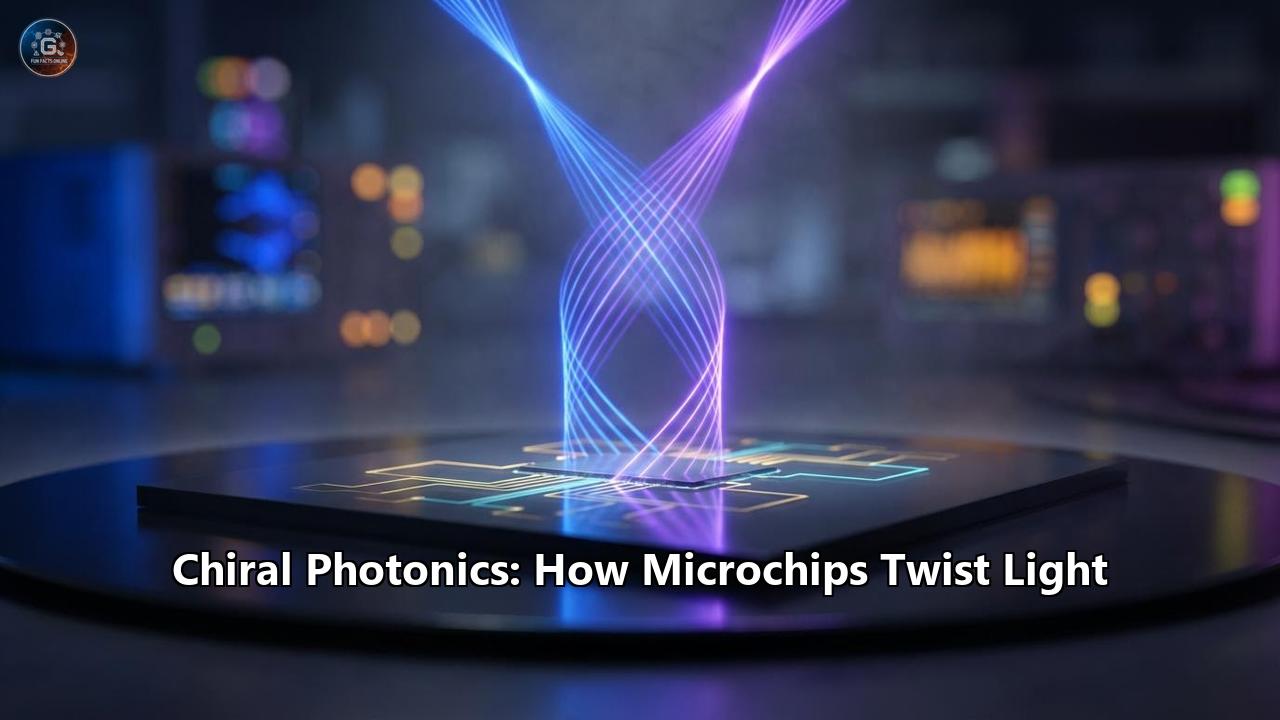
For decades, scientists have understood that light can possess handedness, spiraling through space in right-handed or left-handed corkscrew patterns. Manipulating this twisted light, however, historically required bulky lenses, massive optical tables, and rigid, inflexible crystals. Today, a microscopic revolution is unfolding. Through the emerging field of chiral photonics, scientists and engineers are shrinking these massive optical systems down to the size of a microchip. By engineering synthetic nanomaterials and leveraging advanced micro-mechanics, we are now capable of twisting, sorting, and dynamically tuning light directly on a silicon wafer.
This is not merely a fascinating physics experiment. The ability to control the chirality of light on a microchip is actively unlocking the next generation of technological marvels. From quantum computing and ultra-secure telecommunications to rapid pharmaceutical screening and advanced biological sensors, the way we twist light is about to change the world.
The Hidden Geometry of Light: Understanding Optical Chirality
To appreciate the sheer magnitude of chiral photonics, we must first understand how light—a massless electromagnetic wave—can have a "handedness" in the first place.
Light behaves as both a particle (the photon) and a wave. As an electromagnetic wave, it consists of oscillating electric and magnetic fields perpendicular to each other and to the direction of travel. When we talk about the chirality of light, we are primarily referring to two distinct physical phenomena: Spin Angular Momentum (SAM) and Orbital Angular Momentum (OAM).
Spin Angular Momentum (SAM) is related to the polarization of light. In linear polarization, the electric field oscillates in a single, flat plane. But in circular polarization, the electric field rotates as the wave moves forward, tracing out a helix in space. Depending on the direction of this rotation, the light is either right-circularly polarized (rotating clockwise) or left-circularly polarized (rotating counter-clockwise). This is the most common manifestation of optical chirality, and it dictates how light interacts with chiral molecules. Orbital Angular Momentum (OAM), on the other hand, is a property of the spatial phase of the light beam itself. Imagine a beam of light where the wavefronts are not flat planes, but rather intertwined spiral staircases. A beam carrying OAM has a phase that twists around a central axis of propagation, creating a "doughnut" of light with a dark center where the phase is undefined. Because OAM can theoretically have an infinite number of distinct intertwined spirals (known as topological charges), it provides a near-infinite alphabet for encoding information.When light possesses either SAM, OAM, or both, it becomes a powerful tool. It can exert physical torque on microscopic objects, enabling "optical tweezers" that can rotate cells or nanoparticles. More importantly, chiral light interacts asymmetrically with chiral matter. A left-handed sugar molecule will absorb left-handed circularly polarized light differently than right-handed light—a phenomenon known as circular dichroism. For over a century, chemists have used this principle to identify molecules. But to bring this capability out of the laboratory and into smartphones, medical implants, and quantum processors, we needed to tame this twisting light on a microscopic scale.
The Evolution of Chiral Control: From Crystals to the Nanoscale
Historically, generating and controlling chiral light required naturally occurring birefringent crystals, such as quartz or calcite. These materials naturally possess asymmetric internal structures that alter the polarization of light passing through them. While effective, these components are bulky, expensive, and completely incompatible with the microscopic world of modern integrated circuits.
The first step toward miniaturization occurred with the advent of specialty optical fibers. In the early 2000s, companies and researchers began experimenting with physically twisting the core of optical fibers while they were being drawn from a furnace. By creating a corkscrew-shaped microstructure within the glass itself—sometimes packing 15,000 helical twists into a single inch—they discovered they could create in-fiber broadband polarizers and chiral light filters. These twisted fibers were highly efficient, but they were still discrete components, unable to be seamlessly printed onto the flat, planar surfaces of computer chips.
The true breakthrough arrived with the development of metamaterials and metasurfaces. These are artificial materials engineered to have properties not found in nature. By arranging arrays of sub-wavelength structures—often shaped like microscopic gammadions, spirals, or split rings—researchers could manipulate electromagnetic waves in unprecedented ways. Instead of relying on the natural atomic structure of a crystal, scientists could design the physical geometry of an antenna array to interact with the magnetic and electric fields of light simultaneously.
Metasurfaces allowed for the creation of ultra-thin, flat lenses that could perfectly sort left-handed and right-handed light. However, early designs suffered from a critical limitation: they were static. Once a chiral metasurface was fabricated in a cleanroom, its optical properties were permanently locked in. If you wanted to detect a different molecule or change the polarization state for a communication network, you had to physically swap out the chip.
The Modern Masterpiece: Dynamically Twisting Light on a Chip
The holy grail of chiral photonics has always been active, dynamic control—the ability to dial the handedness of light up, down, or reverse it completely on the fly, all within the confines of a microchip. In March 2026, a groundbreaking leap forward was reported by researchers at the Harvard John A. Paulson School of Engineering and Applied Sciences (SEAS). They engineered a compact, chip-scale device capable of actively controlling optical chirality in real time, drawing inspiration from a seemingly unrelated field: twistronics.
"Twistronics" gained global fame when physicists discovered that stacking two layers of graphene (a single-atom-thick sheet of carbon) and twisting them at a specific "magic angle" could suddenly cause the material to become a superconductor. The Harvard team applied this exact concept to light.
Instead of carbon, the team used photonic crystals—nanoscale structures consisting of a perfectly periodic square lattice of microscopic holes carved into a 400-nanometer-thick slab of silicon nitride. By themselves, a single slab of this patterned silicon nitride is "achiral"; it does not alter the handedness of a passing laser beam. Even if you stack two of these slabs perfectly on top of one another, they preserve their mirror symmetry and remain optically neutral.
The magic happens when the symmetry is broken. By integrating one of these photonic crystals into a Microelectromechanical System (MEMS)—a microscopic mechanical apparatus driven by electrostatic actuators—the researchers suspended the top layer above the bottom layer. Using the MEMS, they could dynamically rotate the lower crystal relative to the upper one, and adjust the vertical spacing between them.
The moment the layers are twisted, the combined structure becomes geometrically chiral. The strong optical coupling between the two intricately patterned layers creates "chiral resonance frequencies". The device is suddenly able to selectively filter right-circularly polarized light while letting left-circularly polarized light pass through—or vice versa.
What makes this achievement revolutionary is its elegant tunability. Without changing any optical components, the researchers could continuously vary the twist angle and the gap between the layers, tuning the device’s response to approach theoretical extremes of perfect selectivity. Furthermore, this all-dielectric platform (meaning it uses insulating materials rather than metals) eliminates the severe energy losses that plagued earlier "plasmonic" metasurfaces. Fabricated using standard CMOS processes, this tunable chiral chip is completely compatible with the manufacturing methods used to build the processors inside your laptop.
Escaping the Flatland: 3D Nanoprinted Light Cages
While twisting stacked layers provides incredible dynamic control, other teams are exploring radical 3D geometries to trap and twist light on chips. Because standard optical fibers are fundamentally incompatible with planar (flat) photonics, bridging the gap between fiber optics and microchips has remained a significant hurdle.
Enter the on-chip twisted hollow-core light cage. Utilizing a state-of-the-art manufacturing technique known as two-photon polymerization—a highly advanced form of 3D nanoprinting that cures light-sensitive resins pixel by pixel—researchers have successfully printed intricate, microscopic hollow structures directly onto photonic chips.
Unlike a solid glass fiber, a light cage traps light within a hollow central core surrounded by a meticulously arranged lattice of microscopic polymer strands. By algorithmically commanding the 3D printer to twist these strands into a macroscopic helix as it builds upward, the geometric twisting forces the fundamental core mode of the light to couple with higher-order modes.
The results are staggering. These nanoprinted twisted light cages enable twist rates that exceed those of traditional twisted glass fibers by more than two orders of magnitude. They exhibit record-breaking geometry-induced optical activity, with rotary powers and circular dichroism that vastly outstrip both naturally occurring chiral media and older waveguide designs. Because the core is hollow and laterally accessible—meaning gases or liquids can easily flow in and out of the twisted optical path—these structures are a dream come true for chemical sensing. They allow for an unprecedentedly strong interaction between the deeply twisted light and whatever physical matter happens to be inside the cage.
Topological Chiral Photonics: The Defect-Immune Superhighways
As we shrink light down to the nanoscale and force it around tight corners on a microchip, we encounter a severe problem: scattering. In traditional waveguides, any microscopic defect—a rough edge from manufacturing, a sharp 90-degree turn, or a slight impurity—causes light to scatter outward, losing precious data and energy. To solve this, chiral photonics has joined forces with another revolutionary concept in physics: Topological Photonics.
Inspired by topological insulators in solid-state physics—materials that act as insulators in their interior but conduct electricity perfectly along their edges—topological photonics seeks to create "edge states" for light. By precisely engineering the repeating patterns of a photonic crystal (often arranging them in honeycomb lattices or dimerized structures), scientists create a synthetic mathematical topology for the electromagnetic waves.
When two topologically distinct photonic crystals are placed side by side, an "interface" or edge is formed. This edge acts as a magical superhighway for light. Because of the mathematical rules governing the topology (defined by invariant integers like the Chern number or Zak phase), light traveling along this interface is completely immune to backscattering. It can flow around incredibly sharp corners, bypass manufacturing defects, and travel flawlessly without losing energy.
But what makes this relevant to chirality? These topological edge states are inherently chiral. In what is known as "spin-momentum locking," the direction the light travels is strictly locked to its polarization (its spin). If you inject left-circularly polarized light, it will only travel forward. If you inject right-circularly polarized light, it will only travel backward.
This unidirectional transmission is a paradigm shift. Researchers have successfully harnessed these robust, chiral edge states to create incredibly compact "ring resonators". By embedding quantum emitters—such as semiconductor quantum dots—into these valley-Hall topological waveguides, scientists have created highly efficient chiral quantum interfaces. When the quantum dot emits a photon, the topological structure ensures that the photon’s spin strictly dictates its path, achieving directional contrast as high as 75%. This forms the critical backbone for future quantum hardware, ensuring fragile quantum states can be moved around a chip without being destroyed by ambient imperfections.
Additionally, researchers working with microwave frequencies have utilized localized sources carrying angular momentum to successfully excite unidirectional edge waves in metamaterial interface waveguides. By sorting the near-field waves according to their handedness, they proved that chiral-sorting metadevices could one day be fully digitized and programmable, creating robust and flexible networks for both photonics and advanced radar and communication systems.
Real-World Revolutions: Why Chiral Chips Matter
The ability to dynamically twist, route, and tune chiral light on a microchip is not just an academic triumph; it is a foundational technology that will directly impact a myriad of industries over the coming decade.
1. Pharmaceuticals and Chiral Biosensing
Perhaps the most immediate and life-saving application of on-chip chiral photonics lies in pharmacology. Many biological molecules, including amino acids, sugars, and proteins, are deeply chiral. In the world of drug development, a molecule and its mirror image (known as enantiomers) can have drastically different effects on the human body.
The most tragic historical example is Thalidomide, a drug prescribed in the late 1950s for morning sickness. While the right-handed version of the molecule was an effective sedative, the left-handed mirror image caused severe birth defects. Separating and identifying these mirror-image molecules is a vital, yet notoriously difficult and time-consuming process known as chiral sorting.
Currently, pharmaceutical quality control relies on large, slow, and expensive liquid chromatography setups. The new generation of dynamically tunable chiral chips, like the MEMS-integrated devices from Harvard, offers a profound alternative. Because these chips can actively switch their response to left- and right-handed light, they can be utilized as ultra-compact, real-time chiral sensors. By shining light through a microscopic fluid channel embedded on the chip, scientists can detect the exact ratio of enantiomers in a drug solution instantly. The hollow-core twisted light cages offer a similar advantage, trapping chiral molecules inside the intensely twisted optical fields to amplify the detection of even the faintest traces of dangerous mirror-molecules.
2. The Future of Optical Telecommunications
Our modern world runs on data, and that data travels through fiber-optic cables via light. However, as global internet traffic explodes, we are rapidly approaching the "capacity crunch"—the physical limit of how much data a standard optical fiber can carry.
Chiral photonics provides an elegant solution through a process called multiplexing. Just as different colors (wavelengths) of light can carry different data streams simultaneously, different twists of light can do the same. By utilizing Orbital Angular Momentum (OAM), telecom engineers can encode separate data streams onto light beams with different topological charges (different spiral patterns). Because a beam with a "twist of 1" does not interfere with a beam with a "twist of 2," multiple data streams can occupy the exact same physical space simultaneously.
Until now, multiplexing and demultiplexing these twisted OAM beams required bulky, off-chip spatial light modulators. With the advent of on-chip chiral photonic circuits, we can dynamically sort, filter, and decode twisted light states directly at the processor level. This capability could exponentially increase the bandwidth of data centers, leading to radically faster, more energy-efficient optical communication networks.
3. Quantum Computing and Secure Networks
As we move into the quantum era, computing relies on the fragile states of individual photons and electrons. Quantum computers process information using qubits, which can exist in a superposition of states. A major challenge in scaling up quantum computers is moving these quantum states around a chip without destroying them via decoherence.
Chiral topological photonics offers the ultimate quantum highway. Because of spin-momentum locking, photons are forced to travel in a specific direction based on their quantum spin, completely immune to backscattering. If a photon encounters a defect, the laws of topology forbid it from bouncing back; it simply flows around the obstacle.
By integrating quantum dots into these chiral waveguides, scientists can create deterministic "single-photon routers" and "optical circulators". This means a microchip can automatically route quantum information based purely on the polarization of the incoming photon. This is the cornerstone of a future Quantum Internet—a network where information is fundamentally secure, governed not by classical encryption algorithms, but by the unbreakable laws of quantum mechanics.
4. Advanced Optical Tweezers and Nanomanipulation
In the realm of biophysics, scientists use highly focused laser beams as "optical tweezers" to physically hold, move, and manipulate microscopic objects like living cells, bacteria, and DNA. When chiral light—specifically light carrying Orbital Angular Momentum—is used in optical tweezers, it transfers its mechanical torque to the trapped particle.
This allows scientists to not only hold a cell but to physically rotate it in three-dimensional space with astonishing precision. On-chip chiral photonics means we can build massive, microscopic arrays of these optical tweezers directly onto lab-on-a-chip devices. This enables automated, high-throughput sorting of diseased cells from healthy cells based on their mechanical and optical properties, paving the way for hyper-personalized medicine and advanced genetic engineering.
Engineering the Future: Challenges and Horizons
The leap from the optical table to the microchip is truly historic, but the journey of chiral photonics is far from over. The path toward commercializing these nanoscale light-twisting devices is paved with extraordinary engineering challenges.
Fabricating intricate twisted structures at the nanometer scale requires mind-boggling precision. While techniques like two-photon polymerization are excellent for rapid prototyping and generating hollow-core light cages, scaling them up for mass production remains a hurdle. Conversely, standard semiconductor manufacturing (CMOS) is perfect for mass production, which is why the recent all-dielectric MEMS-integrated designs are generating such massive excitement. They prove that we can manipulate intrinsic chirality using the exact same manufacturing plants that build our smartphone processors.
Furthermore, integrating broad-spectrum chiral sources remains an area of intense research. While a device might twist light perfectly at a specific near-infrared wavelength, biological sensing often requires a broad sweep across the electromagnetic spectrum, from ultraviolet to terahertz frequencies. Developing broadband metamaterial interface waveguides and fully digitized, programmable metadevices that can reconfigure their unidirectional transmission routes on the fly will be the key to unlocking the full potential of this technology.
The Dawn of a Twisted Era
Humanity's mastery over light has always preceded leaps in civilization. The mastery of the lens gave us the telescope and the microscope, fundamentally altering our place in the cosmos and our understanding of biology. The mastery of stimulated emission gave us the laser, birthing the digital age and the modern internet.
Today, we are mastering the twist. By bending the geometric asymmetry of the universe to our will on slivers of silicon, we are forging tools of unprecedented power. Chiral photonics bridges the macro and the micro, the biological and the quantum. It takes a property as familiar as the handedness of our own bodies and applies it to the fundamental particles of illumination.
As microchips that twist light begin to find their way into pharmaceutical labs, data centers, and quantum processors, they will silently and invisibly revolutionize our technological landscape. The invisible superhighways of topological light, the dynamic spin of MEMS-actuated crystals, and the 3D-printed helical cages of modern nanophotonics represent the pinnacle of modern human engineering. We have not just learned to see the light; we have taught it how to dance, how to spin, and how to carry the future of human knowledge in the spirals of its wake.
Reference:
- https://www.sciencedaily.com/releases/2026/03/260321012702.htm
- https://www.rdworldonline.com/harvards-twistable-light-chip-could-give-drug-developers-a-new-tool-for-sorting-mirror-image-molecules/
- https://www.spiedigitallibrary.org/journals/advanced-photonics/volume-7/issue-4/046002/On-chip-twisted-hollow-core-light-cages--enhancing-planar/10.1117/1.AP.7.4.046002.full
- https://www.inknowvation.com/sbir/story/chiral-photonics-brings-new-twist-optical-devices-lasers
- https://arxiv.org/abs/2409.07602
- https://spie.org/news/chiral-sources-for-metamaterial-interface-waveguides
- https://www.analytica-world.com/en/news/1176998/chiral-sources-for-metamaterial-interface-waveguides.html
- https://www.optica-opn.org/home/newsroom/2026/march/nanostructure_tunes_the_handedness_of_light/
- https://scitechdaily.com/harvard-engineers-build-chip-that-twists-light-to-reveal-its-hidden-handedness/
- https://spie.org/photonics-europe/presentation/Extreme-geometry-induced-optical-chirality-in-vertically-nanoprinted-hollow-core/14082-7
- https://www.psi.ch/en/lnq/topological-photonics
- https://www.frontiersin.org/journals/physics/articles/10.3389/fphy.2022.845579/full
- https://photonlattices.eu/wp-content/uploads/2022/10/HDR_manuscrit_Alberto-AMO.pdf
- https://eprints.whiterose.ac.uk/id/eprint/154973/8/optica-7-12-1690.pdf
- https://validate.perfdrive.com/?ssa=c0daac67-d4b3-89f6-afe9-37bc9626659a&ssb=14982217853&ssc=https%3A%2F%2Fopg.optica.org&ssi=65094288-d3hy-cea9-1b00-a55018942a72&ssk=botmanager_support@radware.com&ssm=96247683579722912132160231253030&ssn=9e07c55a4ce277318e99ba31d21ac30f6888e4bc1ee1-7789-005d-83e0ca&sso=a211b5d-8e89-f4163a8602098cb504414b904968d412d2e5be51b061b34b&ssp=20782068631774164247177419600106485&ssq=43273725862036066962458620388969780096691&ssr=MTgwLjE4OC4xNzQuMjg=&sst=python-requests%2F2.32.3&ssv=&ssw=
- https://www.labmanager.com/chiral-sources-for-metamaterial-interface-waveguides-28497