
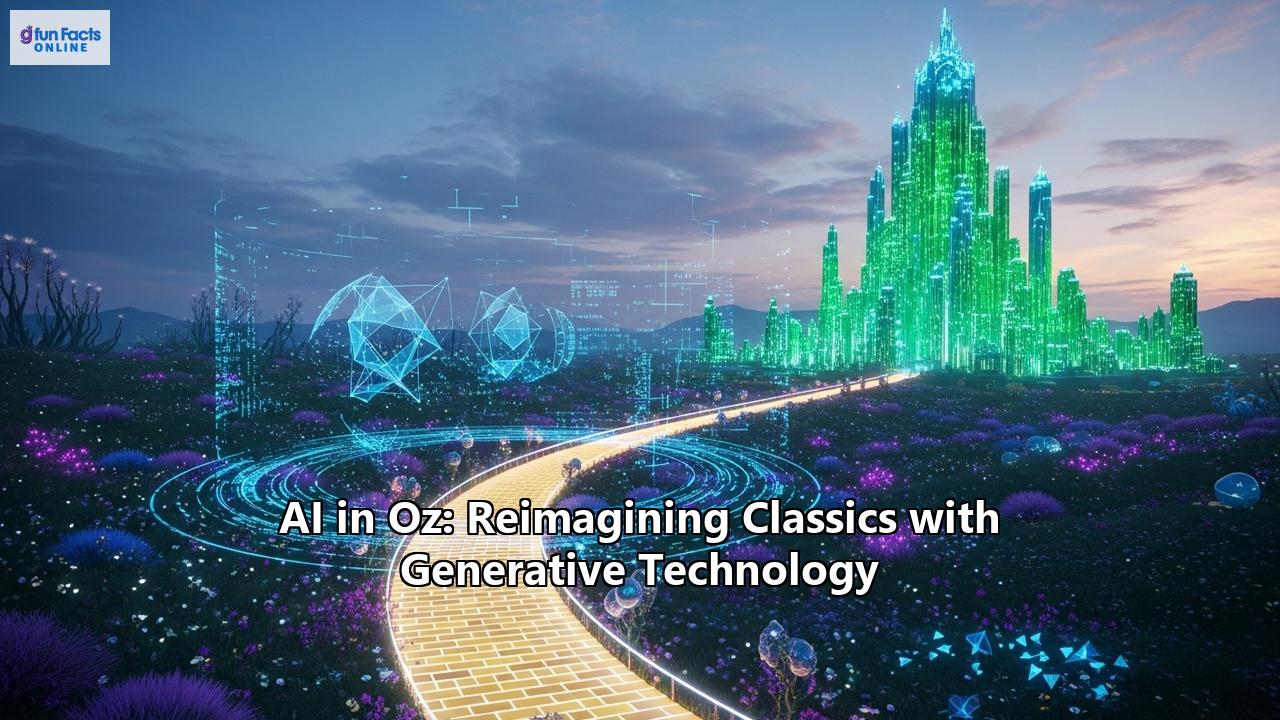
Toto, I've a Feeling We're Not in Kansas Anymore: How Generative AI is Reimagining a Classic
The yellow brick road is being repaved with pixels, and the Emerald City is being rendered in 16K resolution. L. Frank Baum’s cherished American fairy tale, The Wonderful Wizard of Oz, a story that has captured the hearts of generations, is finding a new, bewildering, and often controversial life through the lens of generative artificial intelligence. From immersive cinematic spectacles that place you inside the tornado to AI-penned sequels and surreal digital art, the land of Oz is becoming a vibrant playground for algorithmic creativity. This technological renaissance is not merely about colorizing black-and-white footage; it's a fundamental reimagining of how we experience, interact with, and even create extensions of our most beloved cultural touchstones.
The most monumental example of this trend is "The Wizard of Oz at Sphere," a groundbreaking and polarizing project that transformed the 1939 MGM classic into a fully immersive, multisensory experience for the colossal Las Vegas venue. This ambitious undertaking, a collaboration between Sphere Entertainment, Warner Bros. Discovery, Google Cloud, and the immersive experience studio Magnopus, goes far beyond a simple screening. It represents one of the most significant partnerships between a major film studio and a technology giant to use AI to forge an entirely new form of media. However, this journey into a digitally expanded Oz has been met with both awe and outrage, sparking a crucial debate about the intersection of technology, art, and cultural heritage.
This article will journey down the AI-paved yellow brick road, exploring the multifaceted ways generative technology is reshaping Oz. We will delve into the technological wizardry behind the Sphere experience, witness the birth of new Ozian tales from the minds of machines, and gaze upon surreal, algorithm-generated art. We will also navigate the thorny ethical and legal landscape, questioning the nature of authorship, the sanctity of classic art, and the very future of storytelling itself.
The Great and Powerful AI: Rebuilding a Cinematic Landmark at the Sphere
To adapt a film shot in a 4:3 aspect ratio on 35mm film nearly a century ago for a 160,000-square-foot, 16K wraparound screen is a challenge of epic proportions. Simply stretching the image would result in a blurry, distorted mess, with Judy Garland's face potentially spanning six stories. The creative team behind "The Wizard of Oz at Sphere" quickly realized that traditional methods like CGI would be insufficient and could violate the integrity of the original performances. The only viable tool for a transformation of this scale was artificial intelligence.
A team of thousands, including researchers from Google DeepMind and visual effects artists, embarked on a two-year journey to "reconceptualize" the film. They employed a suite of Google's most advanced AI models, including Gemini, Veo, and Imagen, to not just enhance the film, but to expand its world. The process involved several groundbreaking techniques:
- Super Resolution: The first step was to upscale the original, grainy celluloid frames into crystal-clear, ultra-high-definition imagery. The AI models were fine-tuned not just on the film itself, but on a vast archive of production materials, including the original script, set blueprints, production illustrations, and photographs, to ensure every detail, from the freckles on Dorothy's face to the texture of the Scarecrow's burlap, was rendered with stunning clarity.
- AI Outpainting: This is where the true reimagining begins. "Outpainting" is a technique where AI generates new visual information beyond the boundaries of the original frame. For instance, a tight shot of Dorothy could be expanded to show the entirety of the Yellow Brick Road, the poppy fields stretching to the horizon, and the fantastical landscapes of Oz that the original filmmakers could only imply. Over 90% of the film was "touched up" in this manner, with AI creating skies, extending sets, and filling in the world that was previously left to the audience's imagination.
- Performance Generation: Perhaps the most controversial technique was "performance generation." In the original film, camera cuts and framing often mean that not all characters are visible in a scene, even if they are canonically present. To create a continuous, immersive experience for the Sphere, the AI was used to generate performances for characters who were off-screen. For example, in a scene where the camera might have originally cut away from Uncle Henry, the AI, guided by the script and the actor's mannerisms from other scenes, generates his continued presence and movement within the expanded frame. This allowed for scenes to play out in a continuous shot, keeping Dorothy and her friends together in the frame for entire sequences.
Beyond the visual, the experience is designed to be fully multisensory. The score was re-recorded with a live orchestra on the original MGM soundstage to be played through the Sphere's 167,000 speakers. The immersive environment includes 4D effects like 750-horsepower fans to simulate the tornado, vibrating seats, and even helium-filled, drone-powered flying monkeys that swoop over the audience.
A Tale of Two Reactions: Artistic Desecration or a New Form of Entertainment?
The unveiling of the AI-enhanced Oz was met with a firestorm of divided opinions. On one hand, many who have seen previews have been captivated by the sheer spectacle. USA Today called it an "exhaustive, finely detailed endeavor," and producer Jane Rosenthal argued that the project uses "AI for good" to create a new, communal experience for a classic film. The argument from the creators is that they are not altering the film's essence, but rather bringing the audience into the film, as if they were on set during its creation. They contend that this is what the original filmmakers would have done if they had the technology.
However, clips released online sparked a significant backlash from film purists, critics, and social media users. The Oz Archive, a fan account on X (formerly Twitter), called the AI touch-ups "disgraceful." Critics lamented the "garishly ugly" visuals, where the natural grain of celluloid film is replaced with an "uncanny plasticity" and a "poreless plastic sheen" on the actors' faces. Many found the AI-generated additions, like the extended roof of the Gale's farmhouse, to be unnecessary and distracting.
The most potent criticism was leveled at the "performance generation." The idea of using AI to reanimate deceased actors like Charley Grapewin (Uncle Henry) and have them perform new actions was seen by many as ethically troubling, with some calling it "gross and disrespectful" and an "affront to art and nature." Film critic Stephen Whitty declared the project a "desecration," part of a long and ugly tradition of butchering classic films. The debate raises a fundamental question: Is this a restoration or a revision? Ben Grossmann, the visual effects supervisor, clarified, "What we're doing is not a Scorsese restoration. What we're doing... is an experiential version."
This split reaction highlights a growing cultural anxiety around AI. While some see a tool that can "breathe new life" into classics and make them accessible to younger audiences accustomed to immersive experiences, others see a technology that threatens artistic integrity and the very definition of a film. The controversy suggests that while the technology may be powerful, the "why" and "how" of its application are paramount.
Beyond the Sphere: AI's Creative Journey Through the Land of Oz
While the Sphere project is the most high-profile example, it is far from the only instance of AI venturing into Oz. The public domain status of L. Frank Baum's original fourteen Oz books provides a fertile ground for AI-driven creativity, free from the stringent copyright restrictions of the 1939 film.
New Tales from an Algorithmic Bard
Generative text models are now capable of mimicking authorial styles and creating new narratives within established fictional universes. This has led to a rise in AI-assisted fan fiction and even entirely AI-penned stories. Tools like HyperWrite's FanFic Creator AI and platforms like Talefy allow users to input characters, settings, and plot points to generate new stories.
This technology offers a fascinating way to explore the world of Oz. One could prompt an AI to:
- Write a new chapter of The Wonderful Wizard of Oz from the perspective of the Cowardly Lion.
- Create a short story about the Tin Woodman's life before he was made of tin.
- Generate a plot for a new Oz book where Dorothy and her friends must confront a technological threat to their magical world.
- Even create interactive, role-playing adventures. The company Hidden Door launched playtests for a digital tabletop RPG set in the land of Oz, using generative AI to create customized games for each player, drawing from the rich lore of Baum's public domain books.
One creative individual has embarked on a project to use generative AI to author three sequels to Baum's original fourteen novels, explicitly aiming for a style that blends Baum's fairy tale with the science fiction sensibilities of authors like Larry Niven. This collaborative process, where a human creator guides and refines the output of an AI, represents a new frontier in storytelling.
The Emerald City Through a Digital Looking-Glass: AI Visuals
The surreal and fantastical imagery of Oz has also proven to be a rich source of inspiration for AI art generators. Artists and hobbyists are using tools like Midjourney, Recraft, and NightCafe to create stunning and often bizarre interpretations of Baum's world.
By crafting detailed text prompts, users can generate:
- Hyper-realistic portraits of the Scarecrow, Tin Woodman, and Cowardly Lion.
- Surrealist landscapes of the Emerald City, combining architectural styles with fantastical elements.
- Character designs in the style of famous artists, such as a "Cowardly Lion in the style of Matthew Barney."
- Reimagined movie posters and entirely new scenes that exist only in the digital realm.
These tools allow for an endless exploration of "what if." What would the Emerald City look like as a cyberpunk metropolis? What if the Winged Monkeys were biomechanical creatures? AI art platforms provide a canvas for these questions, allowing anyone to become a visual world-builder in the land of Oz.
An AI-Composed Lullaby for a Lion
The musical landscape of Oz is also being explored through AI. While the score of the 1939 film is iconic, AI music generators like Suno are now capable of creating original compositions inspired by text prompts. This opens up the possibility of creating entirely new, context-aware scores. For instance, one could generate:
- A "haunting lullaby for a cowardly lion."
- An "epic, orchestral theme for the defense of the Emerald City."
- A "jaunty, ragtime tune for the Munchkins' celebration."
One TikTok creator used Suno to create music for whimsical AI animations inspired by The Wizard of Oz, demonstrating a multi-modal approach where both visuals and audio are algorithmically generated. While AI-generated music is still in its early stages, it presents a fascinating tool for amateur creators and professionals alike to score their own Oz-inspired projects.
The Man Behind the Curtain: Navigating the Legal and Ethical Maze
The reimagining of a cultural icon like The Wizard of Oz inevitably raises complex legal and ethical questions that society is only beginning to grapple with. The core of this issue lies in the dual copyright status of the Oz universe.
Public Domain vs. Copyright: A Tale of Two Ozes
L. Frank Baum's original 1900 book, The Wonderful Wizard of Oz, and thirteen of his subsequent Oz books are in the public domain in the United States. This means that the characters, settings, and plots from these books are free for anyone to use, adapt, and build upon. This is why projects like the Hidden Door RPG and independently authored AI sequels are legally possible.
However, the 1939 MGM film is a different story. It is a "derivative work" and is still protected by copyright, which is not set to expire until December 31, 2034. This copyright covers all the elements unique to the film, including:
- The specific visual likeness of the characters as portrayed by the actors.
- The iconic ruby slippers (they were silver in the book).
- The film's musical score and songs like "Over the Rainbow."
- Dialogue that was written for the film and does not appear in the book.
This legal minefield means that any AI project that uses the 1939 film as its source material, like the Sphere experience, must be done with the permission and licensing of the copyright holder, in this case, Warner Bros. Discovery.
Authorship, Fair Use, and the Ghost in the Machine
The use of generative AI introduces even more legal complexity. Who is the author of an AI-generated work? The U.S. Copyright Office has been clear that works generated entirely by AI without meaningful human authorship are not eligible for copyright protection. This means if you simply prompt an AI to "write a story about Dorothy," the resulting text may fall into the public domain. However, if a human significantly modifies, arranges, or curates the AI's output, the work may be copyrightable.
Another contentious issue is the training of AI models. These models are trained on vast datasets of text and images, much of which is copyrighted material scraped from the internet. Lawsuits, such as the one filed by The New York Times against OpenAI, are currently testing the legal theory of "fair use." Proponents of AI argue that training is a transformative use, similar to how a human artist learns from studying the works of others. Critics argue it constitutes mass copyright infringement. The outcome of these legal battles will have profound implications for the future of generative AI.
The ethical considerations are just as tangled. The AI-enhancement of classic films has been criticized for altering or even destroying the original artistic intent. Film restoration experts express concern that AI tools, particularly those that smooth out film grain or generate new frames, can create an "unreal" or "plasticine" look that disrespects the original cinematography. There is a fine line between restoration, which aims to preserve, and revisionism, which fundamentally changes the work.
Furthermore, the "performance generation" seen in the Sphere project raises ethical questions about the use of a deceased actor's likeness. While likely legally permissible due to older contracts, the act of reanimating performers to create new scenes they never consented to makes many uncomfortable and strikes some as a form of digital desecration.
Follow the Yellow Brick Road: A DIY Guide to AI in Oz
The tools to reimagine Oz are not solely in the hands of massive corporations. A wealth of user-friendly AI platforms allows anyone with a computer and an imagination to create their own Oz-inspired content.
- For the Visual Artist: Platforms like Midjourney, Recraft, and NightCafe are excellent starting points for generating fantasy art.
Prompting is Key: Be specific in your prompts. Instead of "the Emerald City," try "The Emerald City as a sprawling, art deco metropolis, with flying vehicles and glowing green towers, cinematic lighting, hyper-detailed."
Style Modifiers: Use artist names or styles to guide the output, such as "The Scarecrow in the style of a charcoal sketch by Käthe Kollwitz" or "A surrealist painting of the poppy field by Salvador Dalí."
Character Consistency: To create a series of images with consistent characters, try using the same "seed" number in your prompts (if the platform allows) or by referencing a previously generated image of the character in your new prompt.
- For the Storyteller: Text generators like HyperWrite, NovelAI, or even the advanced models in ChatGPT can be used to write fan fiction or brainstorm new stories.
Set the Scene: Begin by providing the AI with the core elements: "Write a short story set in the Land of Oz. The main characters are Dorothy, who is now a young adult and the ruler of the Emerald City, and a cynical talking clock who used to belong to the Wicked Witch of the West."
Iterate and Refine: Don't accept the first output. Use the AI as a collaborative partner. Ask it to rewrite a paragraph from a different character's perspective, to make the dialogue funnier, or to add a surprising plot twist.
- For the Composer: AI music tools like Suno and Udio can generate songs and scores from text prompts.
Mood and Instrumentation: Be descriptive. Try prompts like "An epic, orchestral adventure theme with soaring strings and triumphant brass, in the style of John Williams, for a journey to the Emerald City" or "A sad, minimalist piano melody for the Tin Woodman missing his heart."
The Future of Oz and the End of the Rainbow
The journey of The Wizard of Oz through the landscape of generative AI is a microcosm of a much larger cultural shift. We are at a crossroads, where the technology to alter, expand, and even resurrect our shared cultural heritage is advancing at a breathtaking pace. This presents both incredible opportunities and profound risks.
The AI-powered reimagining of classics could introduce these timeless stories to new generations in formats they find more engaging, sparking a renewed interest in our literary and cinematic history. It can empower individual creators with tools that were once the exclusive domain of major studios, democratizing the act of world-building and storytelling.
However, this power must be wielded with caution. The debate surrounding the Sphere's Wizard of Oz demonstrates a clear public concern for the integrity of art. There is a difference between a loving homage and a digital facelift that erases the artist's original intent. The ethical frameworks for using AI in cultural heritage are still being built, and they must prioritize authenticity, respect for the original creators, and transparency.
As we stand at this new dawn, looking out over a landscape where Dorothy's path can be rendered in infinite variations, we must ask ourselves what we want from our stories. Do we want them preserved in amber, or do we want them to be living, breathing entities that can be endlessly remixed and reimagined? The answer likely lies somewhere in between. The magic of Oz has always been its ability to transport us. Now, technology is offering a new kind of transportation, not just over the rainbow, but into entirely new versions of the worlds we thought we knew. The road ahead is uncertain, paved with both brilliant yellow bricks and potential pitfalls, but it is undeniably a journey we have already begun.
Reference:
- https://pulitzercenter.org/stories/saving-cinema-ais-starring-role-preserving-film-archives
- https://www.tiktok.com/discover/how-to-use-novel-ai-to-make-fanfics
- https://neon.reviewjournal.com/kats/enhanced-but-classic-wizard-of-oz-preview-dazzles-at-sphere-in-las-vegas-3310421/
- https://www.dailydot.com/news/wizard-of-oz-ai-the-sphere/
- https://slate.com/culture/2025/08/ai-wizard-of-oz-sphere-las-vegas-google.html
- https://www.thewrap.com/the-wizard-of-oz-at-sphere-vegas-artificial-intelligence-controversy-report/
- https://techstrong.ai/articles/follow-the-ai-brick-road-makes-sphere-version-of-movie-classic-more-like-the-wizard-of-odds/
- https://curiositythematt.design/?page_id=10066
- https://blog.google/products/google-cloud/sphere-wizard-of-oz/
- https://www.thehindu.com/sci-tech/technology/google-gives-the-wizard-of-oz-an-ai-refresh-as-it-heralds-a-new-paradigm-in-immersive-storytelling-at-the-las-vegas-sphere/article69430514.ece
- https://journeyaiart.com/tag/Wizard-of-Oz
- https://ca.news.yahoo.com/ai-enabled-wizard-oz-clicks-221047907.html
- https://www.slashfilm.com/1953739/ai-sphere-wizard-of-oz-cameos-david-zaslav-james-dolan/
- https://timesofindia.indiatimes.com/technology/tech-news/disgusting-ai-enhancements-to-classic-movies-spark-viewer-backlash/articleshow/109509149.cms
- https://www.hyperwriteai.com/aitools/fanfic-creator-ai
- https://www.firstcomicsnews.com/using-ai-story-generator-as-a-boost-to-fan-fiction-creation/
- https://www.recraft.ai/blog/ai-fantasy-art-tools
- https://www.aiarty.com/ai-image-generator/ai-fantasy-art-generator.htm
- https://www.reddit.com/r/midjourney/comments/11xl3no/prompt_help_how_to_make_characters_look_like_they/
- https://www.reddit.com/r/midjourney/comments/1012k37/playing_around_with_some_wizard_of_oz_surrealism/
- https://www.tiktok.com/@kelly_boesch_ai_art/video/7444930420640156970
- https://www.tiktok.com/discover/ai-generated-dance-german-music-wizard-of-oz
- https://nofilmschool.com/ai-resoration
- https://www.youtube.com/watch?v=Ln3bFbpSnoA
- https://www.youtube.com/watch?v=bLCBpvpXag8
- https://domitor.org/artificial-intelligence-film-restoration-and-early-cinema-notes-from-amia-2022/