
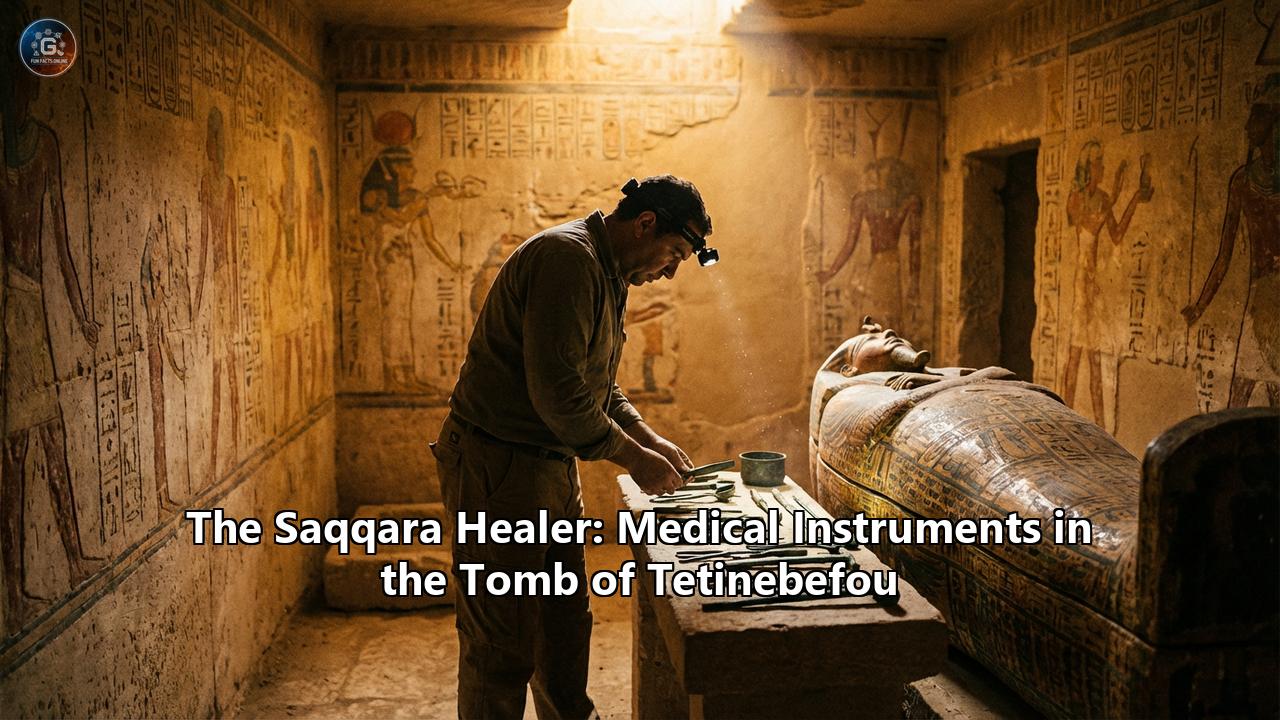
The desert sands of Saqqara have once again parted to reveal a chapter of history that rewrites our understanding of life, death, and the desperate struggle for health in the Old Kingdom. In a discovery that has sent ripples through the Egyptological and medical communities alike, the tomb of a royal physician named Tetinebefou (also read as Teti-Neb-Fu) has been unearthed.
While the pyramids of kings dominate the skyline, it is the tombs of their courtiers that often whisper the most intimate secrets of the past. Tetinebefou was no ordinary courtier. His walls and inscriptions proclaim him a man of three distinct but overlapping worlds: he was a Chief Dentist, a Director of Medicinal Plants, and a Conjurer of the Goddess Serqet.
This article explores the significance of this find, reconstructing the "medical instruments" of Tetinebefou—not just the physical tools that may have once rested in his plundered sarcophagus, but the botanical, surgical, and magical apparatus he wielded to keep a Pharaoh alive.
The Discovery: An Oven in the Shadow of Pepi
The discovery was made by a joint French-Swiss archaeological mission led by Professor Philippe Collombert of the University of Geneva. Working in the southern sector of the Saqqara necropolis, an area already famous for the pyramid of Pepi I, the team was excavating a series of modest mudbrick structures.
To the untrained eye, these structures look like little more than ancient ovens or storage pits. However, as the team cleared the sand from a shaft cut into the bedrock, they found themselves staring at a false door stele—the spirit gate of the ancient dead—remarkably preserved and vivid in color.
The hieroglyphs were crisp, the limestone lintel bearing a name that had not been spoken in over 4,100 years: Tetinebefou.
Though the tomb dates to the late Old Kingdom (roughly the reign of Pepi II, c. 2246–2152 BC), a time of political twilight and crumbling central authority, the artistry within suggests a man of immense wealth and status. The walls were alive with color, depicting not just the standard offering scenes, but rows of carefully rendered vessels, jars, and chests.
The Plundered Chamber
It must be noted immediately that the tomb was not found intact. Like so many in the Memphite necropolis, Tetinebefou’s resting place had been visited by robbers in antiquity. The gold, the jewelry, and—most tragically for historians of science—the physical medical kit that likely accompanied him were gone.
However, the robbers left behind something far more valuable: information. The walls of the burial chamber, covered in intricate reliefs and paintings, serve as a catalog of his professional life. Furthermore, by cross-referencing this find with the nearby tomb of the physician Qar (discovered years prior, which did contain model copper surgical tools), we can reconstruct the arsenal of the "Saqqara Healer."
The Three-Fold Physician: Reconstructing His Instruments
Tetinebefou’s titles are unique. In the Old Kingdom, medicine was rarely a single discipline. It was a spectrum running from the practical (surgery) to the pharmaceutical (plants) to the theological (magic). Tetinebefou mastered all three.
1. The Instruments of the "Chief Dentist" (Wer-Ibeh)
The title "Chief Dentist" is exceptionally rare in the archaeological record. Dentistry in ancient Egypt was a brutal but necessary trade, largely focused on draining abscesses and extracting loose teeth. The diet of the time—bread full of wind-blown desert sand—ground teeth down to the nerve, causing agonizing cysts.
While Tetinebefou's physical tools are lost, we know what they looked like based on Old Kingdom depictions and surviving examples from other sites. His dental kit would have included:
- Bronze Forceps: Heavy, plier-like instruments used not for the delicate extraction of impacted wisdom teeth, but for the forceful removal of molars that had become loose due to gum disease.
- Bone Drills: Bow-drills, similar to those used by carpenters or bead-makers, were sometimes adapted to drain the pressure from an abscess building up under a tooth.
- Gold Wire: We have physical evidence from the Old Kingdom of "bridge" work, where a loose tooth was wired to a healthy neighbor to keep it stable. Tetinebefou would have likely possessed fine coils of gold wire for this restorative work.
The wall paintings in his tomb depict rows of small, sealed alabaster jars. For a dentist, these would not hold organs, but painkillers. Analysis of residues in similar vessels has shown traces of willow bark (a precursor to aspirin) and opium, used to numb the gums before the Chief Dentist went to work.
2. The Pharmacy: "Director of Medicinal Plants"
This title is the most exciting aspect of the discovery. It suggests that Tetinebefou was not just a user of herbs, but an administrator of them—perhaps overseeing a royal garden or a state-sponsored trade network of pharmaceuticals.
The "instruments" here are the Vessels of the Pharmacopeia. The tomb walls feature detailed paintings of storage jars, distinct from the typical wine or beer amphorae. These jars are short, squat, and sealed, shapes associated with viscous oils and dried herbs.
If we could open the phantom jars painted on his walls, we would likely find:
- Myrrh and Frankincense: Imported from Punt (modern-day Somalia/Eritrea), these resins were powerful antiseptics used to pack wounds.
- Honey: The base of almost all Egyptian wound dressings. Honey is naturally antibacterial and hygroscopic (drawing moisture out of infected wounds).
- Acacia Gum: Used as a binder for bandages.
- Malachite Green: The eye-paint worn by Egyptians was made of crushed malachite (copper carbonate), which prevented eye infections. Tetinebefou would have had palettes and grinders to prepare this medicinal cosmetic.
The title implies that Tetinebefou was responsible for the logistics of health. He ensured the Pharaoh’s court had a steady supply of these rare ingredients, making his "instruments" the scribe’s palette and the inventory scroll as much as the pestle and mortar.
3. The Magic: "Conjurer of Serqet"
To the modern mind, a doctor is a scientist. To the ancient Egyptian, a doctor without magic was negligent. Serqet was the scorpion goddess, the mistress of venom. A "Conjurer of Serqet" was a toxicologist—a specialist in snakebites and scorpion stings.
In the desert environment of Saqqara, a scorpion sting could kill a child or an elderly noble in hours. Tetinebefou’s toolkit for this role would have been entirely different:
- The Magician’s Wand: Curved ivory wands, often carved from hippopotamus tusk, were used to "draw circles" of protection around a patient or a bed. These wands, covered in carvings of protective demons, were found in other tombs of this era.
- Cippi of Horus: Small stone stelae depicting the child Horus standing on crocodiles and grasping snakes. Water was poured over these stones, absorbing the magical inscriptions, and then given to the patient to drink.
- The Knife of Reed: While bronze scalpels were available, certain ritual incisions (possibly to cut out venom) were often performed with a sharp reed or flint blade to avoid "polluting" the wound with metal, which was associated with the god Seth.
The "Phantom" Surgical Tools
One of the most persistent questions regarding Old Kingdom medicine is the extent of invasive surgery. Did Tetinebefou perform operations?
The nearby tomb of Qar, another physician from the Sixth Dynasty, famously contained a set of copper models: probes, saws, and knives. Since Tetinebefou was a contemporary and a peer of Qar, we can assume he possessed a similar kit.
- The Scalpel: Small, sharp bronze knives, often with a wooden handle. These were used for lancing boils or removing cysts.
- The Probes: Long, thin metal rods used to explore the depth of a wound or to apply medication to a specific point inside a cavity.
- The Cautery Iron: A metal rod heated in fire, used to sear blood vessels and stop hemorrhaging—a critical tool in an era before sutures were fully understood.
The fact that Tetinebefou’s tomb paintings focus on containers rather than knives tells us something about his status. By the time he reached the rank of "Chief Palace Physician," he may have left the bloody work of cutting to his subordinates, focusing instead on the high-level administration of cures (the plants) and the theological protection of the King (the magic).
Why This Tomb Matters
The Tomb of Tetinebefou is a time capsule from the edge of a collapse. The Sixth Dynasty ended in chaos, famine, and civil war. The fact that the Pharaoh Pepi II could afford to maintain such a specialized medical retinue—with a specific Director for plants and a Chief Dentist—shows the incredible sophistication of the royal court even as the political situation deteriorated.
Tetinebefou represents the holistic healer. He did not see a toothache as merely a dental problem; it was a physical ailment requiring a drill, a chemical imbalance requiring herbal pain relief, and a spiritual breach requiring the protection of the gods.
While the robbers may have taken his copper knives and gold amulets, they could not steal his titles. Through the work of the French-Swiss mission, the Saqqara Healer has returned, reminding us that 4,000 years ago, humanity was already fighting the battle against pain with every tool—metal, plant, and prayer—at its disposal.
Reference:
- https://www.earth.com/news/tomb-of-a-doctor-tetinebefou-who-lived-4100-years-ago-is-found-in-saqqara/
- https://www.youtube.com/watch?v=KFBGtnzLdrY
- https://www.smithsonianmag.com/smart-news/archaeologists-discover-intricately-decorated-tomb-belonging-to-a-doctor-who-treated-egyptian-pharaohs-4100-years-ago-180985788/
- https://www.livescience.com/archaeology/ancient-egyptians/4-100-year-old-tomb-of-doctor-who-treated-pharaohs-discovered-at-saqqara
- https://archaeology.org/news/2025/01/09/tomb-of-pharaohs-physician-explored-in-saqqara/
- https://whatsthejam.com/world-news/ancient-egyptian-tomb-dating-back-4100-years-uncovered-belonging-to-royal-doctor-with-rare-skill/