
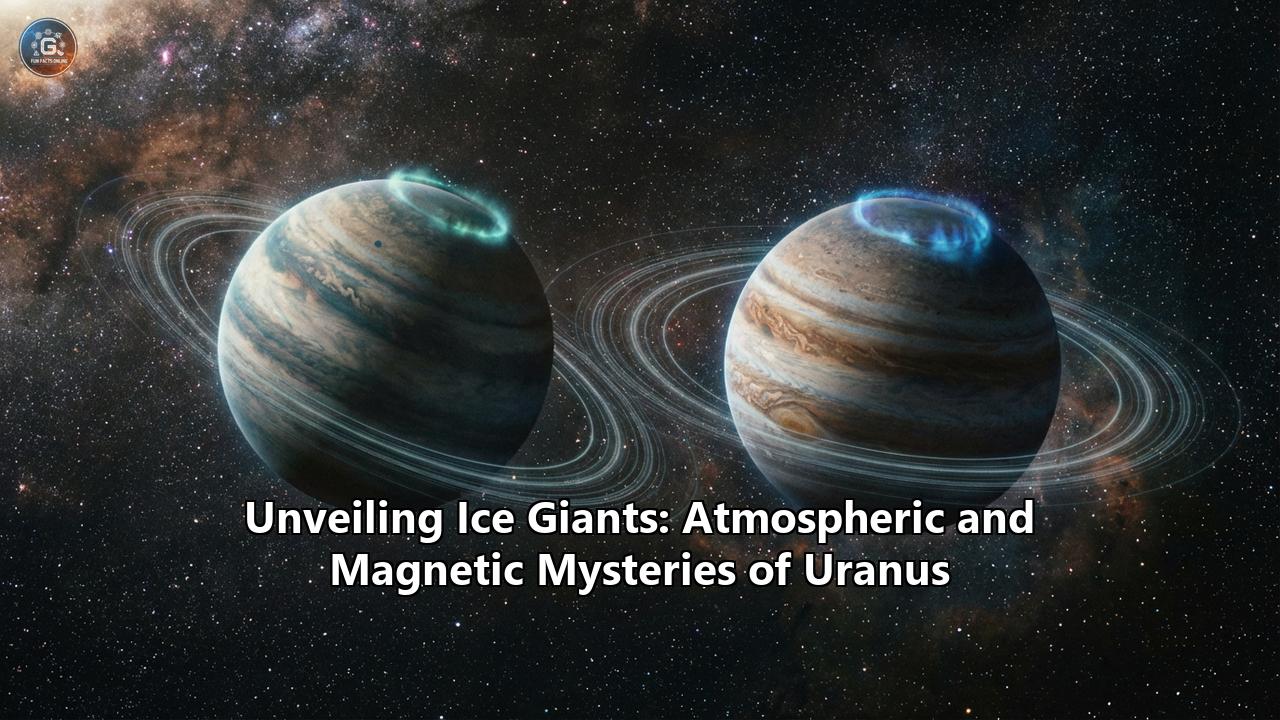
For decades, the seventh planet from the Sun was treated as the quiet, featureless oddity of our solar system. When NASA’s Voyager 2 spacecraft executed its historic flyby in 1986, it sent back images of a pale, cyan-colored sphere that seemed almost aggressively bland compared to the swirling, storm-ravaged atmosphere of Jupiter or the dazzling ringed majesty of Saturn. But in planetary science, appearances can be deeply deceiving. Beneath that serene, muted haze lies a world of violent cosmic history, bizarre atmospheric chemistry, and magnetic phenomena so chaotic that they defy the standard laws of planetary physics.
Uranus is not just a planet; it is a profound scientific laboratory for a class of worlds known as "ice giants." In recent years, a combination of advanced computer modeling, exhaustive reanalysis of decades-old data, and groundbreaking observations from the James Webb Space Telescope (JWST) have shattered our initial perceptions. From the discovery of a hidden internal heat source to the mapping of an eccentric, lopsided magnetic field, Uranus is finally stepping out of the shadows.
To understand the sheer strangeness of Uranus, one must first look at how it moves. All planets in our solar system orbit the Sun like spinning tops, with their axes of rotation roughly perpendicular to the plane of their orbits. Earth, for instance, has a gentle axial tilt of 23.5 degrees, which gives us our four seasons. Uranus, however, boasts a staggering axial tilt of 98 degrees. It does not spin like a top; it rolls along its orbital path like a barrel.
Because of this extreme tilt, Uranus experiences the most dramatic seasons in the solar system. As it completes its languid 84-Earth-year journey around the Sun, each pole is plunged into 42 years of continuous, unbroken sunlight, followed by 42 years of deep, freezing darkness. The equator, meanwhile, experiences rapid day-night cycles but receives sunlight at such steep, glancing angles that the thermal dynamics of the planet are uniquely skewed.
How did a planet roughly 14 times the mass of Earth and four times its diameter end up knocked entirely on its side? For years, the prevailing theory was a colossal cosmic hit-and-run, and recent supercomputer simulations have provided compelling evidence to back this up. Around 4 billion years ago, during the violent, chaotic infancy of our solar system, a rogue protoplanet—estimated to be a world of rock and ice roughly twice the mass of Earth—slammed directly into the young Uranus.
This cataclysmic impact was not a head-on collision, which might have obliterated the planet or stripped away its atmosphere entirely. Instead, it was a grazing blow. The sheer kinetic energy of the impact flipped Uranus on its side, while the debris ejected from the collision coalesced to form the planet’s delicate, narrow ring system and its family of regular, prograde moons. Furthermore, this ancient trauma may have profoundly altered the planet's internal structure, melting ice deep within its mantle and trapping layers of rock that continue to dictate the planet's bizarre thermal and magnetic behaviors today.
The term "ice giant" is slightly misleading to the uninitiated. If you were to plunge beneath the thin upper atmosphere of Uranus, you would not find solid glaciers of frozen water. Instead, the "ice" refers to the astrophysical definition of volatiles—elements heavier than hydrogen and helium, such as water, ammonia, and methane.
The atmosphere of Uranus is a deep, suffocating envelope of molecular hydrogen and helium, heavily laced with methane. It is this high-altitude methane that absorbs the red portion of the solar spectrum, scattering blue and green light back into space and giving the planet its signature aquamarine hue. But descending through the atmosphere reveals a truly alien environment. The atmospheric pressure mounts exponentially, and the temperature fluctuates wildly.
High above the cloud tops, recent observations have revealed an atmosphere that is far from tranquil. If human senses could withstand the crushing pressure and freezing temperatures, the smell would be instantly recognizable and entirely repugnant. Spectroscopic analyses have confirmed that the upper cloud decks of Uranus are heavily composed of hydrogen sulfide—the same chemical compound that gives rotten eggs their distinctive stench. Mixing with ammonia, the Uranian skies form a toxic, swirling miasma.
Deeper still, the atmosphere transitions seamlessly into a supercritical fluid mantle. In this extreme state of matter, there is no distinct boundary between gas and liquid. The crushing pressures and temperatures strip methane molecules apart, freeing carbon atoms that bond together under the immense weight of the planet. These carbon chains compress into diamonds, which literally sink through the fluid mantle—a continuous, glittering rain of precious gems falling toward the planet's core.
For decades, scientists operated under a frustrating assumption: Uranus was a "dead" planet, thermally speaking. The data collected by Voyager 2 during its 1986 flyby indicated that Uranus radiated almost the exact amount of energy it received from the Sun, meaning its internal heat flux was essentially zero. This anomaly stood in stark contrast to the other giant planets—Jupiter, Saturn, and Neptune—all of which emit significantly more heat than they absorb due to gravitational contraction and remnant heat from their formation.
Uranus, with a tropopause temperature plummeting to a staggering 49 Kelvin (-224°C or -371°F), was dubbed the coldest planet in the solar system. Theorists speculated that the same cataclysmic impact that knocked the planet on its side had also somehow "vented" its primordial heat into space, or that a mysterious layer of internal turbulence was trapping the heat deep within the core, preventing it from radiating outward.
However, the scientific narrative shifted dramatically in 2025. By meticulously reanalyzing decades of spacecraft observations alongside advanced thermal computer models, an international team of researchers finally solved the heat conundrum. Uranus does, in fact, possess internal heat. The researchers discovered that over the course of its 84-year orbit, Uranus emits approximately 12.5% to 15% more heat than it absorbs from the Sun.
This revelation is monumental. It proves that Uranus is still slowly leaking the residual heat of its violent birth. The earlier assumption of a "zero heat" planet was an artifact of incomplete data and the planet's extreme seasons, combined with the fact that Voyager 2 only captured a brief snapshot in time. Recognizing that Uranus maintains internal warmth forces planetary scientists to rewrite their models of how ice giants evolve, how they maintain their complex weather systems, and how they govern their atmospheric dynamics.
If the atmosphere of Uranus is toxic and bizarre, its magnetosphere is nothing short of structural anarchy. Earth's magnetic field is relatively straightforward: it behaves roughly like a giant bar magnet aligned with the planet's axis of rotation, originating from the molten iron core at the center of the planet.
Uranus laughs at such symmetry. When Voyager 2 measured the Uranian magnetic field, scientists were bewildered. The magnetic field is tilted at a severe angle of 60 degrees relative to the planet's axis of rotation. Even more bizarrely, the source of the magnetic field is not at the center of the planet; it is offset from the core by roughly one-third of the planet's radius. If Earth’s magnetic field were structured like Uranus’s, our magnetic north pole would be somewhere in the middle of the Pacific Ocean, shifting violently with every rotation.
Because Uranus spins on its side while dragging this highly offset, tilted magnetic field along with it, the magnetosphere tumbles through space like a chaotic, asymmetrical corkscrew. This erratic geometry causes magnetic reconnection—a process where magnetic field lines snap and realign, releasing immense bursts of energy—to occur daily. The lopsided field also directly influences the planet's radiation belts. Recent studies using the Boris algorithm to simulate particle dynamics have shown that the asymmetrical field causes charged particles to drastically change speed as they drift around the planet, creating localized regions where radiation density drops by up to 20 percent.
For nearly forty years, astronomers believed this magnetic strangeness was just an inherent, albeit baffling, property of the planet. They noted that Voyager 2 found the radiation belts around Uranus to be inexplicably barren—about 100 times weaker than models predicted, devoid of the dense plasma and charged particles typically trapped by a gas giant's magnetic field. This led scientists to classify the five major moons of Uranus as geologically dead, assuming they weren't ejecting any material into the magnetosphere.
But in 2024, a groundbreaking reassessment of the 1986 Voyager data offered a stunning plot twist: we caught Uranus on a very bad day.
Researchers realized that just days before Voyager 2 arrived, a massive, intense solar wind storm—a sudden eruption of charged particles from the Sun—had slammed into Uranus. This solar barrage dramatically compressed the planet's magnetosphere, effectively "sweeping away" the plasma and charged particles that scientists had expected to find. The intense solar pressure also temporarily shifted the magnetic field further off its rotational axis.
The Voyager 2 probe had unwittingly observed Uranus under extreme, highly atypical conditions that only occur about 4% of the time. Had the spacecraft arrived just a few days earlier, it would have recorded a rich, dynamic magnetosphere teeming with charged particles. This realization has profoundly altered our understanding of the Uranian system, reigniting the tantalizing possibility that the major moons of Uranus might actually be geologically active "ocean worlds" capable of pumping ions into the planet's magnetic field.
While Voyager 2 provided our only close-up encounter with Uranus, modern telescopic technology is finally bridging the gap. In early 2026, the scientific community celebrated a massive leap forward when an international team of astronomers used the James Webb Space Telescope (JWST) to map the vertical structure of Uranus's upper atmosphere in unprecedented 3D detail.
Using the telescope's Near-Infrared Spectrograph (NIRSpec), researchers observed Uranus for nearly a full rotation, tracking the faint glow of molecules up to 5,000 kilometers above the cloud tops. This continuous monitoring granted humanity its first real-time view into the ice giant's ionosphere. The data yielded startling discoveries about the distribution of energy in the planet's upper layers.
The JWST detected that temperatures in the upper atmosphere peak between 3,000 and 4,000 kilometers in altitude, reaching roughly 150 degrees Celsius. Meanwhile, the density of charged ions reaches its maximum at a much lower altitude of 1,000 kilometers. Most strikingly, these ion densities were significantly weaker than traditional models had predicted, and they exhibited clear longitudinal variations directly linked to the planet's wildly tilted magnetic field.
The telescope's unparalleled sensitivity also allowed scientists to map the spectacular Uranian auroras. Unlike the relatively stable auroras at Earth's poles, Uranus's auroras sweep across the planet's surface in highly complex, erratic patterns dictated by its offset magnetic core. JWST captured two bright auroral bands near the magnetic poles, separated by a distinct, darkened zone where both emission and ion density were heavily depleted. This depleted zone is thought to be shaped by transitions in the magnetic field lines, similar to localized magnetic geometries previously observed at Jupiter.
Crucially, the JWST data also confirmed a lingering mystery: the upper atmosphere of Uranus is continuing to cool. The JWST measured an average upper atmospheric temperature of 426 Kelvin (about 150°C), which is definitively lower than readings taken by ground-based observatories in the 1990s. Understanding the dynamics behind this ongoing energy loss is now a primary focus for astrophysicists, as it holds the key to explaining how ice giants regulate their atmospheric energy balances across decades-long seasonal shifts.
The mysteries of Uranus do not end at its atmosphere; they extend to its orbital entourage. Uranus commands a sprawling system of 27 known moons and a set of faint, dark rings that reflect only about 2% of incoming light.
The moons of Uranus are named not after figures from classical mythology, but after characters from the works of William Shakespeare and Alexander Pope. The inner system is a chaotic jumble of 14 small, dark moons tightly packed together, constantly perturbing each other's orbits. Beyond them lie the five major moons: Miranda, Ariel, Umbriel, Titania, and Oberon. Finally, orbiting at vast distances are the irregular moons, likely captured asteroids or comets ensnared by Uranus's gravity long after the planet's formation.
For decades, the assumption was that these moons were cold, dead blocks of rock and ice. But the recent revelation that Voyager 2 observed the Uranian magnetosphere during a solar storm—and thus missed the plasma that might have been ejected by these moons—has cast them in an entirely new light. Planetary geologists now suspect that moons like Ariel and Miranda may harbor, or recently harbored, subsurface oceans of liquid water. Miranda, in particular, is one of the most visually bizarre objects in the solar system, featuring extreme fault canyons, terraced valleys, and the towering Verona Rupes—a cliff face that drops a staggering 20 kilometers, making it the tallest known cliff in the solar system. The sheer geological violence etched into Miranda's surface suggests tidal heating, a process where the gravitational pull of Uranus continuously flexes the moon's interior, generating friction and heat.
With JWST peeling back the atmospheric layers and historical data reanalyses reshaping our understanding of the planet's thermal and magnetic realities, the scientific appetite for a return to Uranus has reached a fever pitch.
In the 2023–2032 Planetary Science and Astrobiology Decadal Survey, the National Academies of Sciences, Engineering, and Medicine issued a definitive mandate: the exploration of Uranus must be NASA's highest priority for the coming decade. The recommended mission, known as the Uranus Orbiter and Probe (UOP), is a flagship-class endeavor designed to provide the ultimate ground-truth data on the ice giant.
The UOP mission concept is ambitious and comprehensive. It involves sending a massive orbiter to Uranus that will embark on a multi-year tour of the planet, its rings, and its moons. Upon arrival, the spacecraft will drop a sacrificial atmospheric probe directly into the Uranian clouds. As it plummets into the crushing depths, the probe will sample the atmosphere's chemical composition, trace the isotopic ratios of noble gases, and transmit critical data about the planet's temperature profiles and wind speeds before it is inevitably destroyed by the extreme pressure. Meanwhile, the orbiter will spend years mapping the lopsided magnetic field, searching for subsurface oceans on the major moons, and observing the deep-seated circulation patterns of the planet's fluid mantle.
Historically, the sheer distance to Uranus—roughly 19 times further from the Sun than Earth—has been the primary deterrent to exploration. Initial proposals for the UOP mission assumed the use of an expendable rocket like the Falcon Heavy, which would require a complex series of gravity assists from other planets and a painstakingly long cruise time of 13 to 15 years. Furthermore, a shortage in the production of Plutonium-238, the vital radioactive isotope required to power deep-space missions via Radioisotope Thermoelectric Generators (RTGs), threatened to push the launch window into the late 2030s, meaning arrival wouldn't occur until nearly 2050.
However, the rapid advancement of next-generation heavy-lift launch vehicles may drastically rewrite this timeline. Recent engineering analyses suggest that utilizing a fully refueled SpaceX Starship in Earth orbit could launch the UOP directly to Uranus, effectively cutting the transit time in half and bypassing the need for decades-long gravity assists. By shortening the cruise phase, mission planners can reduce operational costs, maintain team expertise, and deliver scientific returns far sooner than previously imagined.
The drive to explore Uranus is not merely an exercise in cataloging our local cosmic neighborhood. It is fundamentally an investigation into the most common type of planet in the universe. As telescopes like Kepler and TESS sweep the galaxy for exoplanets, they have discovered that ice giants—worlds the size of Uranus and Neptune—are incredibly abundant. By understanding Uranus, we unlock the thermodynamic and magnetic secrets of countless worlds orbiting distant stars.
Uranus has shed its reputation as the boring, dormant blue marble. It is a world still reeling from a primordial collision, raining diamonds through a supercritical ocean, leaking ancient heat into the freezing void, and generating a chaotic, corkscrewing magnetic forcefield that sculpts magnificent, sweeping auroras. The ice giant is wide awake, and as the next era of interplanetary exploration dawns, humanity is finally ready to listen to what it has to say.
Reference:
- https://www.newsweek.com/uranus-magnetic-field-radiation-belt-mystery-1920765
- https://en.wikipedia.org/wiki/Uranus
- https://www.sciencealert.com/uranus-weird-tilt-explained-glancing-giant-impact-magnetic-field-moons
- https://worldbuilding.stackexchange.com/questions/194939/could-uranus-have-a-solid-surface-due-to-its-internal-composition-and-lack-of-in
- https://www.indiatoday.in/science/story/james-webb-telescope-looked-at-uranus-and-saw-the-planet-mysteriously-glowing-2871456-2026-02-20
- https://www.uh.edu/news-events/stories/2025/july/07142025-uranus-internal-heat-study.php
- https://newatlas.com/space/uranus-is-warmer-than-everyone-thought/
- https://www.sciencedaily.com/releases/2025/08/250812234557.htm
- https://www.northumbria.ac.uk/about-us/news-events/news/phd-student-maps-mysterious-upper-atmosphere-of-uranus-for-the-first-time/
- https://davidson.org.il/read-experience/en/science-news-en/uranus-new-insights-into-a-magnetic-mystery/
- https://www.ynetnews.com/health_science/article/s1gwllpx1g
- https://www.esa.int/Science_Exploration/Space_Science/Webb/Webb_maps_Uranus_s_mysterious_upper_atmosphere
- https://www.sciencedaily.com/releases/2026/02/260221000303.htm
- https://www.sci.news/astronomy/webb-uranus-ionosphere-14572.html
- https://www.space.com/astronomy/james-webb-space-telescope/the-james-webb-space-telescope-just-mapped-auroras-on-uranus-in-3d-for-the-1st-time-and-scientists-are-thrilled
- https://www.spacescout.info/2023/09/uranus-orbiter-and-probe/
- https://en.wikipedia.org/wiki/Uranus_Orbiter_and_Probe
- https://www.nationalacademies.org/read/27209/chapter/8
- https://science.nasa.gov/wp-content/uploads/2023/10/uranus-orbiter-and-probe.pdf
- https://news.mit.edu/2025/3-questions-new-mission-to-uranus-0930