
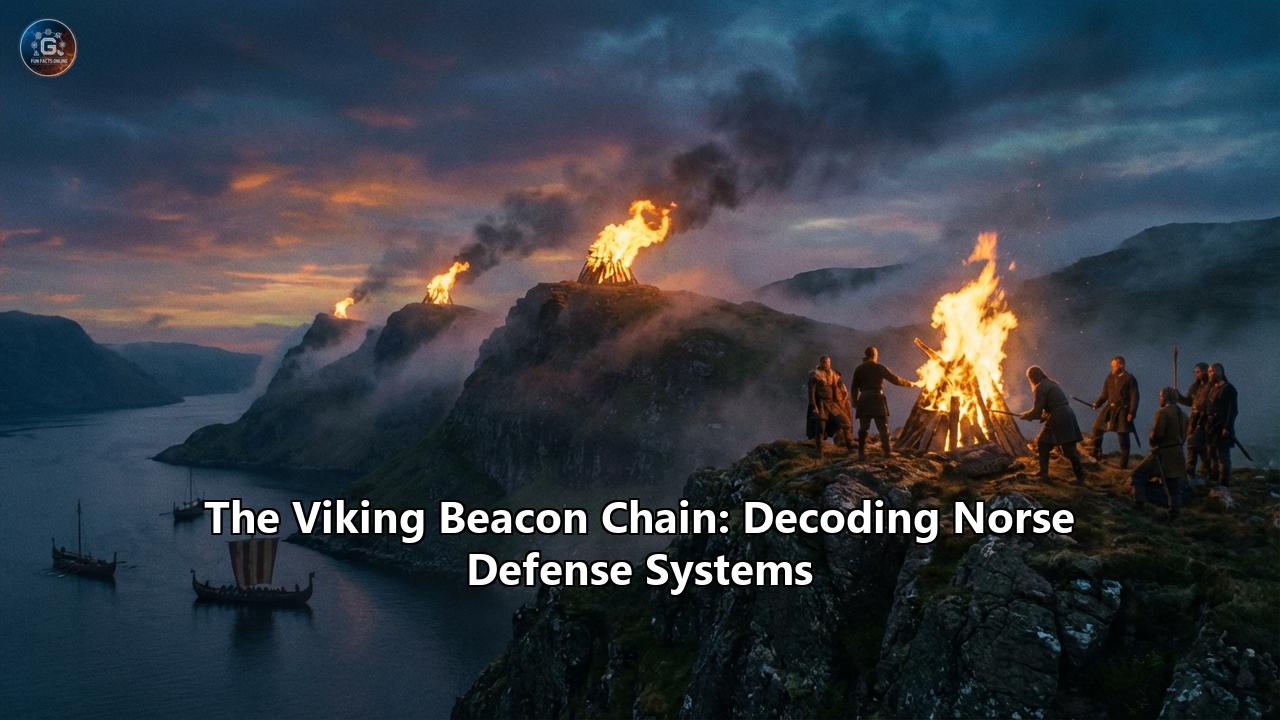
The wind howls across the granite peak of Veten, a jagged tooth of rock jutting out from the Hordaland coast. It is the year 955 AD. The air is biting cold, carrying the salt spray of the North Sea a thousand feet up to where a solitary figure huddles in a crude stone shelter. He is a vord—a watchman. His eyes are red-rimmed from the stinging wind and the strain of staring at the grey, churning horizon. He is not looking for whales. He is not looking for trade ships. He is looking for the dragon heads.
Beside him stands a structure that looks like a peculiar, hollow log cabin, packed tight with birch bark, tarred wood, and dry brush. It is a viti—a beacon.
Suddenly, a flicker of light pricks the darkness to the south. It is faint, a mere pinprick of orange against the bruising purple of the twilight sky. But the watchman knows what it means. It is the fire from the neighboring peak, twenty miles away. The enemy is coming.
His heart hammers against his ribs. He grabs a torch, thrusts it into the base of his own timber stack, and watches as the flames roar upward, caught by the draft of the hollow construction. Within minutes, a pillar of fire thirty feet high is raging against the night.
Twenty miles to the north, another watchman sees the signal and lights his own. Then another. And another.
This was the Viking "Internet of Fire." Long before fiber optics or satellites, the Norsemen engineered a high-speed, optical communication network capable of transmitting a binary signal—War is here—across the entire length of Norway in seven nights. This is the story of the Vetevarder, the Norse defense system that turned a loose collection of warring tribes into a unified kingdom capable of repelling the greatest fleets of the age.
Part I: The Threat from the Sea
To understand the beacon system, one must first understand the terror that necessitated it. For centuries, the Vikings were the predators of Europe. From Lindisfarne to Paris, the sight of a shallow-draft longship sliding up a river meant death, slavery, or extortion. But by the mid-10th century, the political landscape of Scandinavia was shifting. The raiders were becoming the raided.
Norway, with its jagged, impossible coastline, was a nightmare to defend. The "Northern Way" (Norðvegr) was a maritime highway. High mountains and deep fjords made land travel excruciatingly slow. The sea was the only road that mattered. Whoever controlled the coast controlled the country.
But this maritime highway was a double-edged sword. An enemy fleet could appear from the mist, burn a village, slaughter the cattle, and vanish before the local chieftain could even strap on his sword belt. The Danes to the south, united under powerful kings like Gorm the Old and later Harald Bluetooth, cast envious eyes on the Norwegian throne. The sons of the deposed tyrant Eric Bloodaxe were constantly probing the coast, looking for a weakness, looking to reclaim their father's kingdom with Danish steel.
The Norwegian kings, particularly Haakon the Good, faced a logistical paradox. They had the manpower to fight off an invasion—the fierce, axe-wielding farmers of the fjords were no strangers to violence—but they could never be in the right place at the right time. An army in Trondheim was useless if the Danes landed in Stavanger.
They needed speed. They needed a way to shrink the massive geography of Norway. They needed to move information faster than a longship could sail.
The Geography of Fear
Norway is long. Terrifyingly long. If you were to flip the country on its southern axis, the North Cape would reach all the way to Rome. The coastline, if you include the fjords and islands, is longer than the equator. Defending this with a standing army was economically impossible. The Vikings had no standing army; they were a warrior society of farmers and fishermen who fought when called upon.
The solution required utilizing the very landscape that made defense so difficult. The mountains that blocked land travel offered the perfect platform for line-of-sight communication. The peaks were natural watchtowers.
Part II: The Architect — Haakon the Good
The genius behind the formalization of this system was King Haakon Haraldsson, known to history as Haakon the Good. His story is one of the most fascinating in the Norse sagas, and his unique background is likely the key to the beacon system’s efficiency.
Haakon was not raised in the rough, pagan courts of Norway. As a child, he was sent to England to be fostered by King Athelstan, the grandson of Alfred the Great. Athelstan was the first true King of the English, a master administrator who had organized the Anglo-Saxon defenses against the Danes. Growing up in the English court, Haakon witnessed firsthand the power of centralized government, written laws, and organized defense systems—specifically the fyrd (militia) and the English beacon networks used to warn of Viking raids.
When Haakon returned to Norway to claim his throne from his brutal brother Eric Bloodaxe, he brought these "foreign" ideas with him. He realized that to hold the kingdom, he needed to fundamentally restructure Norwegian society. He couldn't just be a warlord; he had to be an administrator.
The Twin Pillars: Leidang and Viti
Around the year 950 AD, Haakon instituted a sweeping legal and military reform that would define Norwegian history for centuries. He divided the coastal regions into skipreider (ship districts).
The deal was simple: The King promised to protect the farmers' land rights (the odal rights). In exchange, the farmers had to provide two things:
- The Leidang: A naval levy. Each district was required to build, maintain, and crew a warship of a specific size. When the king called, the farmers became the navy.
- The Viti: The beacon system. The farmers were responsible for building and manning the signal fires on the mountain peaks.
These two systems were two halves of the same machine. The Leidang was the muscle; the Viti was the nervous system. One was useless without the other. If the beacons were lit but the ships weren't ready, the village burned. If the ships were ready but the beacons failed, the fleet would sit idle while the enemy landed hundred of miles away.
Part III: The Anatomy of a Viti
When we imagine a beacon, thanks to Hollywood and The Lord of the Rings, we often picture a simple pile of wood on a mountain—a bonfire. But a Norse viti was a piece of military engineering. A simple bonfire might smolder, or light too slowly, or collapse in the wind. A viti had to catch fire instantly and burn with a ferocity that could be seen for 30 kilometers in a blizzard.
The Structure
Archaeological reconstructions and descriptions in the Gulating Law suggest that the viti was a constructed tower.
- The Foundation: It often started with a stone base or cairn to elevate the timber off the damp ground and provide a draft from below.
- The Core: A central pole or "heart" of dry, resinous pine or fir.
- The Chamber: The wood was not just stacked; it was often built in a conical or pyramid shape, sometimes hollow in the center like a teepee or a chimney. This design was crucial. It created a "stack effect." When the fire was lit at the bottom (or through a "door" in the side), the hollow core drew air in rapidly, acting like a blast furnace.
- The Fuel: The Vikings were experts in wood. They knew that green wood smokes and dry wood burns. The viti was packed with "fat wood" (wood saturated with natural resin/tar), birch bark (nature’s best firestarter), and dried brushwood.
The result was not a campfire. It was a flare. When lit, a proper viti would erupt into a pillar of flame almost immediately, minimizing the critical "lag time" between spotting the enemy and sending the signal.
The Three Orders of the Chain
The system wasn't just a single line of fires. It was a depth-defense network, categorized into three "orders" or tiers:
- The Sea Beacons (Vitar of the 1st Order): These were located on the outermost islands and headlands. They were the eyes of the realm. Their job was solely to scan the open ocean. These were the most dangerous posts, exposed to the worst weather and the first to be attacked.
- The Fjord Beacons (Vitar of the 2nd Order): Located further inland, on high points along the major fjords. They relayed the signal from the coast to the interior.
- The Warning Beacons (Vitar of the 3rd Order): These were local signals, often smaller, used to alert specific villages or muster points to man the ships.
This hierarchy ensured that a signal could travel linearly along the coast to warn the King, while simultaneously branching sideways into the fjords to mobilize the leidang fleet.
Part IV: The Watchman’s Burden — Law and Duty
Technology is nothing without the humans who operate it. The viti system relied entirely on the discipline of the men on the mountain. If a watchman fell asleep, or got drunk, or mistook a whale for a ship, the kingdom could fall.
To ensure compliance, Haakon the Good didn't just ask for volunteers. He codified the duty into the Gulating Law, the oldest legal code in the Nordic countries. The section regarding the beacons is brutal, specific, and terrifying.
The Law of the Watch
The law stated that the beacons were to be manned from the "Spring Equinox to the Winter Nights"—roughly the sailing season. Vikings rarely raided in the dead of winter (the seas were too rough), so the watch was a seasonal duty.
The duty of vetevakt (beacon watch) rotated among the farmers of the district. It was a tax paid in time and misery.
The Penalties:The Gulating Law was explicitly clear on the consequences of failure.
- Sleeping on Duty: If a bailiff or chieftain climbed the mountain and found the watchman sleeping, the penalty was a fine of 12 oras of silver. This was a massive sum for a farmer—enough to bankrupt a family.
- The "Enemy Comes" Clause: If the watchman slept, and the enemy did arrive while he was sleeping, the penalty was Utlag—Outlawry. In Viking society, being made an outlaw was a death sentence. You lost all property, all rights, and anyone could kill you without penalty. You were "dead to the law."
- False Alarm: Lighting the beacon without cause was arguably worse. If a nervous watchman lit the fire for a school of porpoises, he triggered a national mobilization. Thousands of men would drop their scythes, arm themselves, and launch ships. The economic cost of a false alarm was ruinous. The penalty for a false alarm that caused a general mobilization was also severe fines or outlawry, unless the watchman could prove he had "reasonable cause" (e.g., shapes that genuinely looked like ships).
The Psychology of the Peak
Imagine the life of the vord. You are sent up the mountain for a week-long shift. You live in a small stone hut (many of which have been found by archaeologists). It is raining sideways. You are cold. You are bored. But you are terrified to close your eyes.
Every wave crest looks like a sail. Every shadow looks like a hull. You know that if you light the fire, you change history. If you don't light it, your family might die. The mental burden must have been crushing.
To mitigate this, the law required two men to be on watch at all times, so they could keep each other awake and verify sightings. They were also often equipped with a lur—a long wooden trumpet—to signal local farms audibly if the visual signal was obscured by fog, though the fire was the primary long-range transmitter.
Part V: The Mechanics of the "Seven Nights"
The Sagas claim that when the beacon at the southernmost tip of Norway was lit, the signal would reach the northernmost law-rock in "seven nights."
Is this true? Or is it Viking propaganda?
Let’s look at the math. The distance from the southern tip (Lindesnes) to the northern reaches of the organized law districts (Hålogaland) is roughly 1,500 kilometers following the coastal route.
If the weather was clear, the physics of light allows for near-instantaneous transmission. The delay lies in the human reaction time.
- Watchman A sees the fire. (Reaction: 5 seconds)
- Watchman A runs to his beacon with a torch. (Reaction: 30 seconds)
- The fire catches and grows large enough to be seen 20km away. (Reaction: 5-10 minutes).
Total transmission time per "hop" is roughly 10 to 15 minutes.
If the beacons are spaced 20-30km apart, there might be 50 to 75 beacons in the chain.
75 hops x 15 minutes = 1,125 minutes = ~19 hours.
Theoretically, the signal could travel the entire country in less than one day.
So why did the Sagas say "seven nights"?
- Weather: Norway is cloudy. If a peak is socked in by fog, the chain breaks. The watchmen would have to send runners or use boats to bridge the gap to the next clear peak, slowing the signal drastically.
- Mobilization: The "seven nights" might not refer to the signal itself, but to the result—the gathering of the fleet. The signal travels in a day; the men gather in a week.
Regardless of the exact hours, the system compressed time. A message that would take a ship two weeks to deliver against the wind could be delivered by fire in a single night. It was a strategic advantage that the attacking Danes could not replicate.
Part VI: Triumph and Disaster — The System in Action
We have two major historical examples that show both the brilliance and the fragility of the beacon system. Both involve King Haakon the Good.
The Success: The Battle of Rastarkalv (955 AD)
The sons of Eric Bloodaxe, backed by the Danish King, launched a massive surprise invasion. They sailed north, hoping to catch Haakon at a feast.
The beacons worked. The chain ignited. The watchmen did their job.
Haakon was at a farm in the interior when the news reached him. Because of the warning, he had time. However, he realized he didn't have enough time to gather the full levy from the whole country. He only had the local troops.
But because he had the information early, he could choose the terrain. He positioned his smaller force on the ridge of Rastarkalv. He used the time bought by the beacons to employ psychological warfare. He spread his men out and planted ten standards (flags) far apart along a ridge, making his small army look like a massive host.
When the Danes arrived, they saw the "huge" army and panicked. They were routed. The beacon system had bought the King the most valuable commodity in war: the initiative.
The Failure: The Battle of Fitjar (961 AD)
Six years later, the sons of Eric returned. They had learned. They knew about the beacons.
This time, they didn't just sail up the coast. They moved with extreme stealth, staying far out to sea, beyond the visual range of the outer vitar. They waited for a heavy fog—the Achilles heel of the optical telegraph.
They landed at Fitjar, on the island of Stord, where Haakon was holding court. The watchmen on the outer islands were blind. The chain was silent.
Haakon was eating lunch when a guard burst in, shouting that he saw ships. Not on the horizon, but landing on the beach.
"Is it the enemy?" the King asked.
"It is the enemy," the guard replied. "And there are many."
The system had failed. The "Internet of Fire" had been severed by weather and stealth.
Haakon, ever the warrior, grabbed his sword and armor. He rallied his bodyguard and the few local farmers present. In the ensuing battle, Haakon won a tactical victory—he drove the invaders back to their ships—but in the final moments of the pursuit, a stray arrow struck him in the arm, below the shoulder plate.
The wound festered. The King who built the defense system died not because the enemy was stronger, but because the warning came too late. It was a poetic, tragic end to the architect of the beacons.
Part VII: Resurrecting the Chain — Modern Archaeology
For centuries, the viti system existed mostly in Sagas and place names. But in recent years, a groundbreaking project by the Museum of Archaeology at the University of Stavanger, led by researcher Marie Ødegaard, has brought the system out of the realm of myth and into hard science.
Using a combination of digital map analysis (GIS) and radiocarbon dating, the team has identified hundreds of beacon sites.
The Evidence in the Dust
How do you find a bonfire that burned 1,000 years ago? You look for the charcoal.
The team climbed the peaks known in local folklore as "Veten" or "Våtta." They dug into the soil. In many places, they found distinct layers of charcoal, separated by layers of soil. This suggests the beacons were used, burned, rebuilt, and used again over centuries.
Radiocarbon dating of these charcoal layers confirmed the timeline: the deepest layers often date back to the Viking Age (800-1050 AD), with usage continuing through the Middle Ages and even up to the Napoleonic Wars (1807-1814), when Norway feared a British invasion.
The Map of Names
The most enduring legacy of the system is on the map of Norway itself. If you look at a modern map, you will see hundreds of hills named:
- Veten / Vetan
- Våtta
- Viti
- Baune (a later term, from "Baune" meaning fire)
- Vardafjell
These names are the ghosts of the watchmen. They trace the invisible lines of sight that once protected the nation.
Part VIII: The Legacy — From Fire to Radar
The Viking beacon system was not merely a primitive alarm; it was a sophisticated state infrastructure. It required a level of social organization that contradicts the stereotype of Vikings as chaotic barbarians. To make it work, you needed laws, tax systems, hierarchy, and a collective sense of "nationhood." You had to care enough about the village 100 miles away to stand in the freezing rain and watch the sea for them.
In a sense, the viti system created Norway. It connected the isolated fjords into a single defensive organism.
The Gondor Connection
It is impossible to discuss this topic without addressing the Elephant (or Oliphaunt) in the room: J.R.R. Tolkien.
In The Return of the King, the lighting of the Beacons of Gondor is one of the most stirring scenes in literature and cinema. Tolkien, a professor of Anglo-Saxon and Norse mythology, was undoubtedly aware of the viti system (and the English equivalent). The scene where Pippin watches the spark grow into a blaze, and then sees another light answer in the distance, is perhaps the most accurate historical reenactment of how the Norse system actually felt.
"The Beacons of Gondor are alight, calling for aid!" is a line that resonates because it taps into that ancient, primal fear of the dark and the relief of seeing a signal that says: You are not alone.
The Modern Shield
Today, the peaks where the vitar stood are often occupied by new structures: radar domes and microwave communication towers. The technology has changed. We use the Naval Strike Missile (NSM) and F-35s instead of the leidang fleet. We use radar instead of eyes.
But the principle remains exactly the same. The geography of Norway still dictates its defense. The high ground is still the key. And the goal is still the same as it was in the time of Haakon the Good: to see the danger coming before it lands.
When you stand on a Norwegian mountain today, look for the blackened soil under the heather. You might be standing on the ashes of a fire that once saved a kingdom.
Appendix: The Terminology of the Watch
- Viti (pl. Vitar): Old Norse for a sign, mark, or signal. The specific term for the warning fire.
- Varde: A cairn of stones. Often used to mark the location of the viti, or used as waymarkers for travelers. Today, "varde" is often used interchangeably with beacon, but viti is the specific fire-signal term.
- Leidang (Old Norse: Leiðangr): The naval levy system. The mobilization of free farmers into a fleet.
- Vord: Watch/Guard.
- Budstikke: A wooden message stick (often shaped like an axe or sword) passed from farm to farm to mobilize the leidang. While the beacon said "War is here," the budstikke carried the specific orders of where to meet.
The beacon fires have long since burned out, but the history they illuminated remains visible to those who know where to look.
Reference:
- https://www.philipsparke.com/the-saga-of-haakon-the-good-brass-band
- https://www.youtube.com/watch?v=gwXpPTwTNC0
- https://thevikingherald.com/article/new-study-analyzes-viking-age-beacon-warning-system-in-norway/1277
- https://www.uis.no/en/museum-of-archaeology/archaeology/viking-beacons-militarism-in-northern-europe
- https://2yachts.com/blog/obazannosti-vahtennogo
- https://valhalla-vikings.co.uk/blogs/viking-history/viking-house
- https://www.battlemerchant.com/en/blog/viking-architecture-from-longhouses-to-defensive-ramparts