
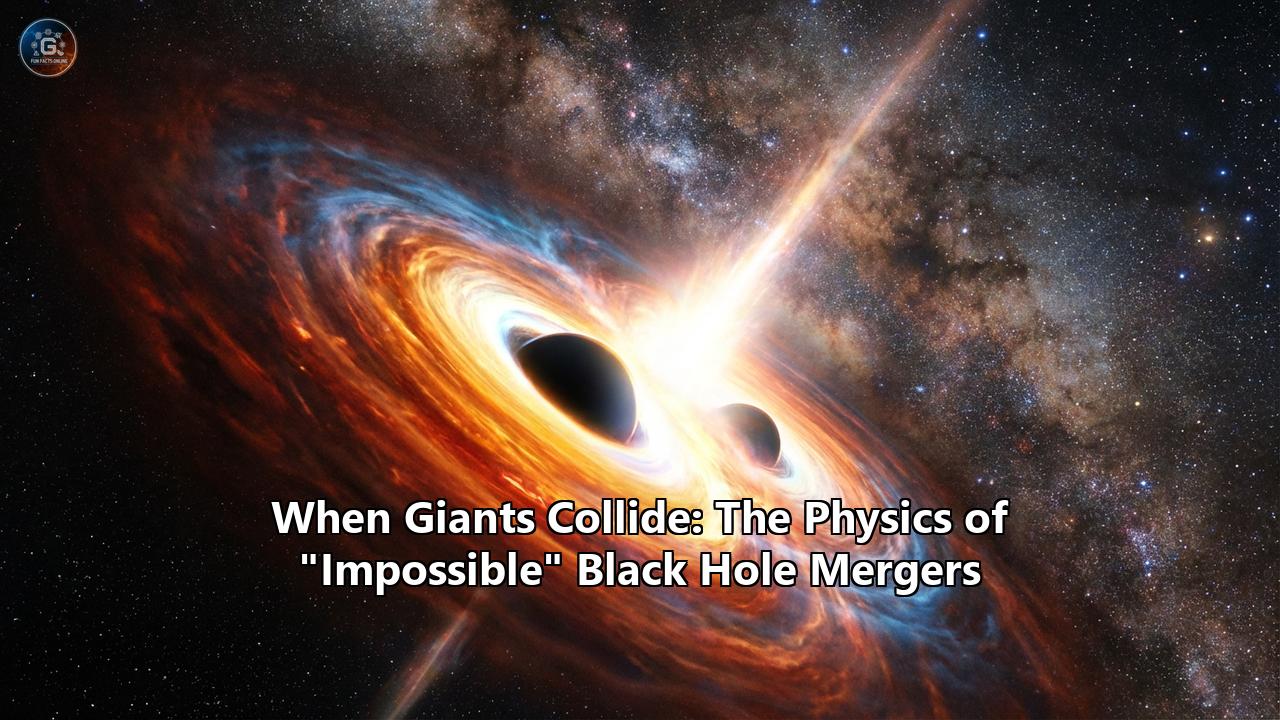
The cosmos has a playbook. For billions of years, the life and death of stars have followed a strict set of thermodynamic laws—a celestial bureaucracy that dictates exactly how massive a star can be, how it burns its fuel, and what it leaves behind when it dies. For decades, astrophysicists believed they had read the fine print. They believed they knew the limits.
Then, the ground shook.
It started with a ripple in spacetime, a "chirp" heard by detectors on Earth that shouldn't have existed. It was the sound of two giants colliding, black holes so massive they defied the standard models of stellar evolution. They were "impossible" objects, monsters lurking in a mass range that theory said should be empty.
Today, as we look back at the landmark detection of GW190521 and the even more shattering recent confirmations like GW231123, we are forced to confront a thrilling reality: the universe is far more creative, and far more violent, than we ever imagined. We are witnessing the breakdown of the "old" physics and the birth of a new understanding of how the dark giants of our universe are born, how they feed, and how they grow.
This is the story of the Pair-Instability Mass Gap, the "forbidden" zone of black hole physics, and the cataclysmic events that are filling it with shadows.
Part I: The Death of Stars and the "Forbidden" Zone
To understand why these recent mergers are so shocking, we must first understand the "standard model" of stellar death. It is a story of gravity versus pressure, a war that lasts for millions of years.
The Nuclear Furnace
A massive star is essentially a pressure cooker. Gravity wants to crush the star inward; nuclear fusion in the core pushes outward. For most of a star's life, these forces are in balance. The star burns hydrogen into helium, then helium into carbon, and so on, fusing heavier and heavier elements to generate the heat required to hold gravity at bay.
But this game has a time limit. Eventually, the star attempts to fuse iron. Iron is the cosmic dead end; fusing it consumes energy rather than creating it. The outward pressure vanishes in an instant. Gravity wins. The core collapses, and the outer layers are blasted into space in a supernova.
What remains depends on the mass of the core:
- Neutron Stars: If the core is between about 1.4 and 2.5 solar masses, it becomes a city-sized ball of neutrons.
- Stellar-Mass Black Holes: If the core is heavier, typically up to about 50 solar masses, it collapses completely into a singularity—a black hole.
The Pair-Instability Mechanism
Here lies the problem. Theoretical physics predicts that there is a "self-destruct" mechanism for stars that are too massive.
When a star is incredibly heavy (with a helium core between roughly 64 and 135 solar masses), the temperature inside becomes so extreme that high-energy gamma rays—the very photons providing the pressure to support the star—start interacting with atomic nuclei to spontaneously create pairs of electrons and positrons. This is Einstein’s $E=mc^2$ in action: pure energy turning into matter.
This conversion is disastrous for the star. Photons provide pressure; electrons and positrons do not provide nearly enough. The pressure support suddenly drops. The star contracts rapidly, heating up even further. This triggers a runaway thermonuclear explosion so violent that it doesn't just collapse the core—it obliterates it.
The star is blown entirely apart. No remnant remains. No neutron star. No black hole.
This phenomenon is called a Pair-Instability Supernova (PISN). It creates a "Mass Gap"—a desert in the black hole population distribution between approximately 50 and 135 solar masses. According to standard stellar physics, black holes in this range cannot form from dying stars.
So, when the Laser Interferometer Gravitational-Wave Observatory (LIGO) and Virgo detectors picked up signals from black holes weighing 85, 100, or 140 solar masses, the scientific community didn't just see a new data point. They saw a violation of the law.
Part II: The "Impossible" Events
The First Shock: GW190521
The event that cracked the dam occurred on May 21, 2019. The signal was short, a mere tenth of a second, resembling a dull thud rather than the long chirps of lighter mergers.
Analysis revealed a nightmare for theorists:
- Primary Black Hole: ~85 solar masses.
- Secondary Black Hole: ~66 solar masses.
- Final Remnant: ~142 solar masses.
The primary black hole sat squarely in the forbidden range. The secondary was teasing the edge. And the remnant? It was the first definitive detection of an Intermediate-Mass Black Hole (IMBH), the elusive "missing link" between small stellar black holes and the supermassive monsters at the centers of galaxies.
The energy released in those final milliseconds was equivalent to 8 solar masses converted purely into gravitational waves. For a brief moment, this invisible collision was more powerful than all the light from all the stars in the observable universe combined.
The New Giants: GW231123 and Beyond
If GW190521 was a fluke, we could have written it off as a measurement error or a freak statistical outlier. But the universe persisted. The detection of GW231123, announced in mid-2025, confirmed that the "impossible" is actually common.
This event involved progenitors of approximately 100 and 140 solar masses, merging to form a colossus of nearly 225 solar masses. Both progenitors were deeply forbidden. The signal was cleaner, the data undeniable. The Mass Gap wasn't empty; it was populated.
The question shifted from "Did this happen?" to "How did this happen?"
Part III: Scenes of the Crime (Formation Scenarios)
If a single star cannot die to create these black holes, then these black holes must not be the children of stars. They are likely the children of other black holes. We are looking at "Second Generation" (2G) mergers.
Scenario A: The Stellar Graveyard (Globular Clusters)
Imagine a dense beehive of a million stars, ancient and packed tightly together—a Globular Cluster. In the center of these clusters, gravity is a chaotic puppeteer. Heavier objects sink to the middle, creating a segregation of mass.
Here, a "Hierarchical Merger" process can occur:
- Generation 1: Two standard stars collapse into two standard black holes (e.g., 30 solar masses each). They merge, creating a 60 solar mass black hole.
- Retention: Usually, the force of a merger gives the new black hole a "kick," ejecting it from the cluster. But in the densest clusters with immense gravity, the black hole is trapped.
- Generation 2: This new 60 solar mass black hole—now lurking in the forbidden mass gap—sinks back to the center, finds a new partner (perhaps another 60 solar mass giant), and merges again.
Black holes born from stars usually have low spins. Black holes born from mergers, however, inherit the orbital energy of their parents, spinning them up rapidly to about 0.7 times the speed of light. If we detect high spin in these forbidden giants, it points to a hierarchical origin. Recent data from the 2024-2025 observing runs strongly supports this "cluster dynamics" theory for a significant fraction of these events.
Scenario B: The AGN "Fast Lane"
There is an environment even more extreme than a globular cluster: the Active Galactic Nucleus (AGN). This is the disk of superheated gas swirling around a Supermassive Black Hole (SMBH) at a galaxy's center.
In this scenario, smaller black holes are trapped in the gas disk like debris in a whirlpool. The gas does two things:
- Migration: It creates friction (migration torques) that forces black holes to move closer together rapidly, speeding up the merger rate.
- Accretion: The black holes can gorge themselves on the surrounding gas, gaining mass rapidly before they even merge.
A black hole in an AGN disk is like a shark in a feeding frenzy. It can grow past the 50 solar mass limit simply by eating, or it can merge repeatedly with other trapped "sharks." Some theories suggest GW190521 may have occurred in such a disk, which would explain an associated (though debated) flash of light detected by the Zwicky Transient Facility.
Scenario C: The Exotic "Failed" Supernova
There is a minority view that challenges the PISN physics itself. Could a star retain a massive envelope of hydrogen that cushions the explosion? Could strong magnetic fields or "uncertain" nuclear reaction rates allow a 90 solar mass star to collapse directly without blowing apart?
Recent papers (2024-2025) have tweaked the nuclear reaction rates for carbon and oxygen burning, suggesting the "gap" might start higher, perhaps at 70 or 80 solar masses. But explaining a 140 solar mass progenitor (as seen in GW231123) with stellar evolution alone remains physically arduous. The hierarchical merger hypothesis remains the heavyweight champion.
Part IV: The Missing Link and the Cosmic Web
Why does this matter? Why do we care about a few overweight black holes colliding in the dark?
Because these events are the solution to a cosmological crisis: the origin of Supermassive Black Holes.
We see SMBHs with masses of billions of suns existing when the universe was only a few hundred million years old. There simply wasn't enough time for a standard 10 solar mass black hole to eat enough gas to grow that big that fast. They needed a head start. They needed "seeds."
The "Forbidden" mergers we are detecting now—these 100 to 200 solar mass objects—are those seeds. They are the Intermediate-Mass Black Holes (IMBHs). We are finally seeing the mechanism of growth in action. We are watching the Lego bricks of the universe's greatest structures being snapped together.
The Era of "Precision" Gravitational Astronomy
As we move deeper into the late 2020s, the LIGO-Virgo-KAGRA network, soon to be joined by LIGO-India, is moving from "discovery" mode to "census" mode. We aren't just finding these impossible mergers; we are mapping their demographics.
We are learning that the universe is messy. It doesn't strictly follow the simple rules of isolated stellar evolution. It is dynamic, interacting, and violent. The "Mass Gap" is not a wall; it is a filter. It stops single stars, but it cannot stop the dynamic hustle of dense clusters and galactic nuclei.
When giants collide, they don't just shake the fabric of spacetime; they shake the foundations of our understanding. And as the detectors grow more sensitive, tuning into the lower frequencies where even larger monsters lurk, we can be certain of one thing:
The "impossible" is just the beginning.
Deep Dive: The Physics of the "Chirp"
For the physics enthusiasts, let's look under the hood of how we know the masses of these invisible objects.When two black holes spiral inward, they emit gravitational waves. The frequency of these waves increases as they get closer—this is the "chirp."
- The Frequency: Tells us the total mass. Heavier systems chirp at lower frequencies. The "impossible" mergers are so heavy their chirps are incredibly deep, almost too low for current detectors to hear (like a bass note vibrating the floor).
- The Amplitude: Tells us the distance.
- The Waveform Shape: Encodes the spin and the orientation.
The signal from GW190521 was so short (0.1 seconds) because the objects were so massive they merged almost immediately after entering the detector's sensitive band. They only completed about two observable orbits before crashing. This brevity makes analysis difficult, leading to alternative theories (like eccentric orbits or boson stars), but the "heavy binary" conclusion has withstood the most rigorous scrutiny to date.
Conclusion
The detection of black holes in the Pair-Instability Mass Gap is one of the most significant astrophysical discoveries of the 21st century. It has forced a marriage between the physics of the very small (nuclear reactions, particle pair production) and the very large (cluster dynamics, general relativity).
We now know that black holes are social creatures. They live in swarms, they pair up, they merge, and they grow. The giants we see today are the survivors of a cosmic battle royale, climbing the mass ladder one collision at a time. The "impossible" is real. And it is watching us from the dark.
Reference:
- https://www.youtube.com/watch?v=1GVpEDAPJSE
- https://www.space.com/astronomy/black-holes/gravitational-waves-reveal-most-massive-black-hole-merger-ever-detected-one-forbidden-by-current-models
- https://science.thewire.in/the-sciences/gw190521-ligo-virgo-gravitational-waves-heaviest-black-holes-mass-gap-mystery/
- https://physicsworld.com/a/was-biggest-black-hole-merger-more-lopsided-than-previously-thought/
- https://www.youtube.com/watch?v=9vqxtgsviPg
- https://www.youtube.com/watch?v=rIsGM2xkjHg
- https://astrobites.org/2025/06/27/pisngap_gws_flexible_models/
- https://www.researchgate.net/publication/351509211_The_Pair-instability_Mass_Gap_for_Black_Holes
- https://en.wikipedia.org/wiki/GW190521
- https://www.gadgets360.com/science/news/ligo-detects-unusual-signal-hinting-at-tiny-primordial-black-holes-9730024
- https://en.wikipedia.org/wiki/Intermediate-mass_black_hole
- https://www.scholars.northwestern.edu/en/publications/demographics-of-hierarchical-black-hole-mergers-in-dense-star-clu
- https://www.mdpi.com/2073-8994/13/9/1678