
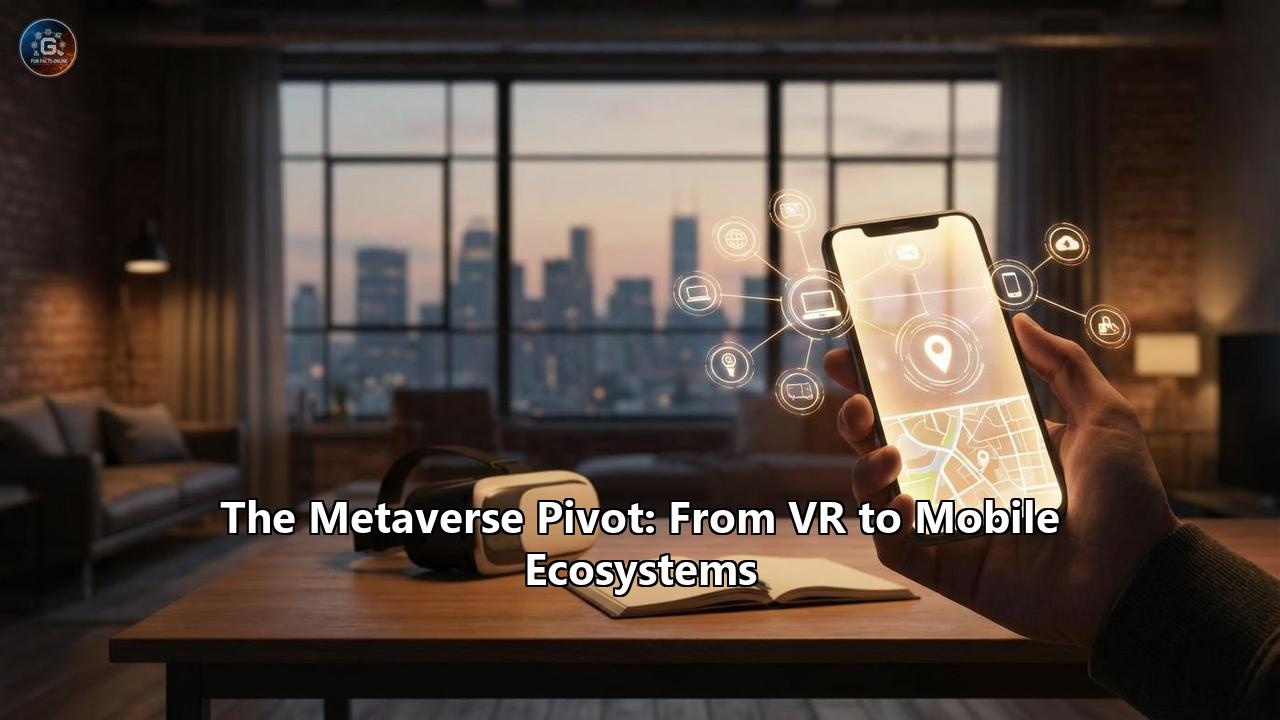
The grand, immersive vision of the metaverse—one where billions of people strap on virtual reality headsets to work, play, and socialize in endless digital vistas—has collided head-on with human nature. By 2026, the tech industry has collectively awoken to a sobering realization: the future of the internet will not be built on our faces, but in our hands.
The "Metaverse Pivot" is now complete. Driven by staggering financial losses in VR hardware, stagnant adoption rates, and the runaway success of platform-agnostic gaming titans, the digital frontier has fundamentally shifted. The metaverse is no longer a bulky, isolated destination. It is an ambient, mobile-first ecosystem, accessible via the billions of smartphones already residing in our pockets, quietly bridging the gap to lightweight augmented reality.
To understand how we arrived at this pivotal moment, we have to look at the spectacular rise and fall of the headset-exclusive dream, the undeniable triumph of accessibility over immersion, and the technological leaps that are making the mobile metaverse the most lucrative digital real estate of the decade.
The Hubris of the Headset: Why VR Stumbled
When Mark Zuckerberg rebranded Facebook to Meta in 2021, the accompanying presentation featured polished, floating avatars navigating pristine, three-dimensional spaces. The implication was clear: Virtual Reality was the inevitable successor to the mobile internet.
However, this vision fundamentally misunderstood how human beings consume digital social interactions. Social networks—from early web forums to TikTok—have always thrived on micro-interactions. We check our phones while waiting in line for coffee, during commercial breaks, or while commuting. The smartphone is friction-free; it demands mere seconds of our attention and allows us to seamlessly dip in and out of the digital world.
Virtual reality, by contrast, is a high-friction environment. Donning a headset is a physical commitment. It requires clearing physical space, enduring potential motion sickness, and, most crucially, blinding oneself to the physical world and everyone in it. You cannot casually check a VR metaverse while waiting for a bus.
The financial toll of this friction became impossible to ignore. By the end of 2025, Meta’s Reality Labs division—the incubator for its metaverse ambitions—reported a staggering $19.1 billion operating loss, up from $17.7 billion the previous year. Despite generating $2.2 billion in revenue, the cash burn was historic. The flagship VR social application, Horizon Worlds, became a notorious ghost town. At its peak, VR monthly active users barely scraped a few hundred thousand, with daily active users sometimes dropping to alarming lows. The digital malls were built, but the foot traffic never arrived.
The reality check culminated in early 2026. Facing immense pressure, Meta executed a 10% reduction in its Reality Labs workforce, closing multiple internal VR game studios and discontinuing its VR workplace product, Horizon Workrooms. The company was forced to acknowledge that network effects—the very phenomenon that built the Facebook empire—are mathematically impossible to achieve when your platform requires a $500 piece of peripheral hardware.
The Mobile Reality: Meeting Users Where They Are
While Silicon Valley giants were attempting to force a hardware revolution, a different breed of metaverse was quietly capturing the attention of a generation. Platforms like Roblox, Epic Games’ Fortnite, and Naver’s Zepeto did not ask users to buy new equipment. They met users where they already lived: on smartphones, tablets, and PCs.
These platforms understood the golden rule of the modern internet: Accessibility beats immersion.
Roblox, operating as a virtual universe of user-generated content, soared past 71 million daily active users by the end of 2023, and its mobile dominance only accelerated through 2025 and 2026. The platform proved that users don't need photorealistic graphics or spatial audio to feel a sense of presence. A blocky, low-polygon world where you can instantly hang out with your friends on a lunch break is infinitely more valuable than a high-fidelity VR simulation that you must visit alone.
Epic Games followed a similar trajectory, transforming Fortnite from a standalone Battle Royale game into a comprehensive metaverse hub. By treating the game as a "gateway" rather than just a shooter, Epic expanded its ecosystem with persistent social spaces, virtual concerts, and user-created worlds. In 2026, Fortnite took a monumental leap by integrating Unity, allowing games developed on the Unity engine to be playable directly within Fortnite's mobile and console ecosystem. This shattered the walled gardens of game development, turning the Fortnite mobile app into a ubiquitous portal for endless, diverse digital experiences.
The data from these mobile-first platforms proved undeniable. When Meta finally began experimenting with mobile access to Horizon Worlds, the results were an indictment of their previous VR-only strategy. Mobile access yielded a 4x growth in users and a 250% increase in in-game sales. Mobile users may spend less per transaction than hardcore VR enthusiasts, but the sheer volume of a billions-strong mobile market easily eclipses the niche VR demographic.
Meta’s Great 2026 U-Turn
The definitive moment of the Metaverse Pivot occurred in the spring of 2026, a period of chaotic strategy realignment for Meta. Acknowledging that the creator and consumer energy had overwhelmingly shifted to mobile, Meta initially announced a shocking decision: they would shut down the VR version of Horizon Worlds entirely by June 2026 to focus 100% on the mobile application.
This move sent shockwaves through the tech industry. The company that had literally changed its name to champion the VR metaverse was abandoning its own hardware platform. Following a massive community backlash from the dedicated VR user base, Meta CTO Andrew "Boz" Bosworth executed a rapid partial reversal. He confirmed that while existing VR games in Horizon Worlds would remain accessible, the company was halting the development of new VR experiences for the platform.
"We are not bringing new games," Bosworth stated transparently. "Most of our energy is going toward mobile and the Meta Horizon engine there. The reason for that is because that's where most of the consumer and creator energy already was".
This pivot from "VR-exclusive" to "Mobile-first, VR-enhanced" is a masterclass in pragmatic tech strategy. By decoupling its social platform from its headset hardware, Meta can leverage its most massive asset: the billions of users already engaging with the Instagram, WhatsApp, and Facebook mobile apps. Horizon Worlds is no longer an isolated destination; it is becoming a digital layer accessible from the apps people already check dozens of times a day.
The Technological Enablers of the Pocket Metaverse
Moving an immersive, 3D social internet to a 6-inch glass screen is not merely a matter of porting software. The pivot to a mobile ecosystem relies on a trinity of technological advancements that reached maturity in 2025 and 2026.
1. Thin Clients and Cloud RenderingHistorically, the primary argument for expensive gaming PCs or dedicated VR headsets was computing power. Rendering interactive, multiplayer 3D environments requires massive graphical processing. However, the proliferation of 5G and early 6G networks, coupled with edge computing, has enabled the rise of "thin clients." In 2026, a smartphone doesn't need to render an expansive metaverse locally; it only needs to receive a high-speed, low-latency stream of the environment rendered on a remote server. This cloud-based infrastructure allows mobile users to experience deep, graphically intense virtual worlds without draining their batteries or overheating their processors.
2. Generative AI as the World BuilderThe bottleneck of the early metaverse was content creation. Building 3D assets, coding logic, and designing environments required specialized skills, limiting the speed at which virtual worlds could grow. Generative Artificial Intelligence fundamentally solved this in 2025 and 2026. Meta's unveiling of the AI-powered Horizon Studio allowed mobile users to build entire interactive spaces using simple conversational prompts.
In the Fortnite ecosystem, AI integration moved beyond creation and into gameplay. Deep neural networks now power interactive AI bots that respond to voice commands and populate the world dynamically, making mobile environments feel endlessly alive and responsive. AI has lowered the barrier to entry so dramatically that anyone with a smartphone is now a potential metaverse architect.
3. Cross-Platform InteroperabilityThe mobile metaverse of 2026 is defined by the dismantling of walled gardens. For the metaverse to function like the physical world, identity and assets must transcend individual apps. We are seeing the early stages of cross-ecosystem engagement, driven largely by ad networks and creator economies that target the user across devices, rather than locking them into a single platform. A user can purchase a digital cosmetic item on their phone while on a train, wear it in a PC game that evening, and display it in an augmented reality filter the next morning.
The Evolution of Hardware: From Goggles to Glasses
To say the metaverse pivoted to mobile is not to say that hardware innovation has died. Rather, it has fundamentally shifted its philosophy. If Virtual Reality isolates the user from their environment, Augmented Reality (AR) integrates the digital into the physical.
As the losses mounted in the VR sector, tech giants quietly redirected their hardware R&D toward smart glasses. Meta’s early partnership with Ray-Ban proved to be a Trojan horse for the ambient metaverse. Unlike a Quest headset, smart glasses look normal, feel lightweight, and keep the user anchored in the real world. By 2025, sales of smart glasses had tripled, signaling a massive consumer appetite for unobtrusive wearable tech.
These glasses do not replace the smartphone; they act as a peripheral display for the mobile ecosystem. The computational heavy lifting is still done by the phone in your pocket, seamlessly communicating with the glasses via Bluetooth and ultra-wideband technology. This is the "Ambient Metaverse"—a digital overlay on the real world, accessed via voice and AI, completely bypassing the isolation of VR.
Imagine walking down the street and receiving a spatial audio notification about a nearby virtual pop-up shop, visible only through your smart glasses, but powered and transacted entirely through the mobile wallet on your smartphone. This is the hybrid future the industry is actively building in 2026.
The New Economics of Virtual Real Estate
The shift to mobile has also rescued the metaverse economy. In the hype cycle of 2021 and 2022, brands poured millions into purchasing "virtual real estate" in isolated Web3 VR platforms, only to discover they had built elaborate storefronts in digital deserts.
The pivot to mobile platforms like Roblox and Fortnite changed the math entirely. These platforms offer instant, massive audiences. In 2026, the strategy for brands is no longer building a standalone VR destination; it is integrating into existing mobile behaviors.
This has birthed a hyper-lucrative creator economy. Platforms are fiercely competing for developers and world-builders. Epic Games, for instance, expanded its revenue share for creators up to 74% through 2026, incentivizing independent developers to build their games directly inside the Fortnite mobile ecosystem rather than launching standalone apps.
For advertisers, the mobile metaverse significantly lowers experimentation risk. Brands can test virtual sponsorships, limited-edition digital wearables, or branded mini-games with existing mobile audiences before committing to large-scale campaigns. The economics have shifted from premium, high-cost VR transactions to massive-volume, micro-transaction mobile economies. It is the freemium model of mobile gaming successfully applied to spatial computing.
The Persistent Digital Layer
The narrative that "the metaverse is dead" was ultimately a misdiagnosis. What died was a specific, hardware-dependent iteration of the metaverse that ignored human psychology and the friction of daily life.
The Metaverse Pivot of 2024 to 2026 represents a technological maturation. The industry learned that you cannot mandate how people interact with the digital world; you can only build upon the behaviors they have already adopted. By shifting from the isolation of virtual reality to the ubiquity of mobile ecosystems, companies have finally laid a sustainable foundation for the spatial internet.
Today, the metaverse isn't a place you go to by putting on a blindfold. It is a persistent, interactive digital layer woven seamlessly into our daily routines. It is powered by cloud computing, generated by artificial intelligence, and accessed through the ubiquitous glow of the smartphone screen. The future of the internet has arrived, and appropriately enough, we are holding it in the palms of our hands.
Reference:
- https://mlq.ai/news/metas-reality-labs-division-reports-191-billion-loss-in-2025-amid-ongoing-vr-challenges/
- https://www.sportspro.com/news/technology/meta-horizon-worlds-vr-metaverse-closure-march-2026/
- https://www.kavout.com/market-lens/has-meta-platforms-meta-abandoned-its-metaverse-dream
- https://www.zebrar.com/articles/roblox-and-fortnite-are-the-metaverse-for-now
- https://sccgmanagement.com/sccg-news/2025/12/26/fortnite-in-2026-evolving-into-a-full-fledged-metaverse-hub/
- https://www.gamesindustry.biz/meta-discontinues-horizon-worlds-vr-as-it-focuses-on-mobile
- https://gizmodo.com/meta-after-killing-the-metaverse-just-kidding-2000735795
- https://mashable.com/article/meta-metaverse-vr-horizon-worlds-update
- https://phemex.com/news/article/meta-reverses-horizon-worlds-vr-shutdown-focuses-on-mobile-metaverse-67991
- https://www.techbuzz.ai/articles/meta-unveils-ai-powered-horizon-tools-to-revive-metaverse-push
- https://www.pocketgamer.biz/mobile-mavens-on-the-biggest-games-industry-trends-of-2025-and-2026-predictions-part-1/