
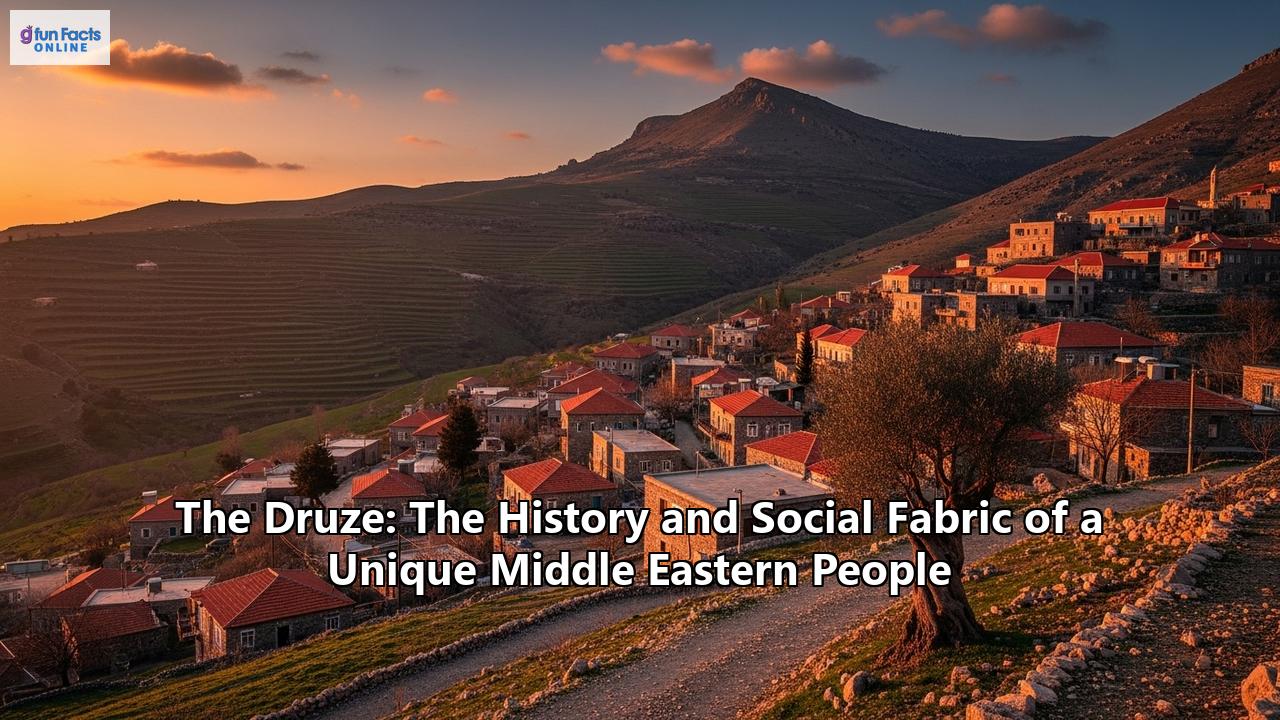
A People of Mystery and Resilience
Nestled in the mountainous heartlands of the Levant, the Druze people represent one of the Middle East's most fascinating and enigmatic communities. Known to themselves as the Muwahhidun, or "the Unitarians," they are a people defined by a unique, esoteric faith, a tightly-knit social fabric, and a history marked by both fierce independence and pragmatic adaptation. For a millennium, they have navigated the turbulent political currents of the region, carving out a distinct identity that endures to this day. From the reign of a controversial Fatimid Caliph in 11th-century Cairo to their pivotal roles in the modern states of Lebanon, Syria, and Israel, the story of the Druze is a profound saga of faith, community, and survival.
With a global population estimated to be between one and two million, the largest communities reside in Syria, particularly in the southern province of As-Suwayda, and Lebanon, in the Chouf Mountains. Significant populations also exist in Israel and Jordan, with a growing diaspora in countries like Venezuela, the United States, Canada, and Australia. Though they speak Arabic and share many cultural traits with their neighbors, the Druze maintain a distinct identity rooted in their secretive religion and a powerful sense of communal solidarity.
The Genesis of a Faith: Origins in Fatimid Egypt
The Druze faith emerged from the complex religious and political landscape of 11th-century Egypt, then the seat of the Isma'ili Shi'a Fatimid Caliphate. The genesis of the faith is inextricably linked to the reign of the sixth Fatimid Caliph, Abu Ali Mansur, who took the regnal title Al-Hakim bi-Amr Allah ("The Ruler by God's Command").
Al-Hakim's reign (996–1021 CE) is one of the most debated in Islamic history. Ascending to the throne at the young age of eleven, he was a complex and eccentric figure. Historical accounts, often written by his detractors, portray him as a tyrannical and erratic ruler, issuing bizarre edicts and brutally persecuting minorities. He is recorded as having banned certain foods, restricted the movement of women, and ordered the destruction of the Church of the Holy Sepulchre in Jerusalem in 1009.
However, other perspectives offer a more nuanced view, suggesting his actions were often politically motivated, aimed at consolidating power, combating corruption, and asserting Fatimid authority against the rival Abbasid Caliphate in Baghdad. He was also a patron of knowledge, completing the construction of a major mosque in Cairo that bears his name and founding the Dar al-Hikma (House of Wisdom), a center for learning and Isma'ili missionary activity.
It was within this environment of intellectual ferment and political intrigue that a new religious movement began to coalesce around Al-Hakim. In 1017, a group of Isma'ili missionaries began to publicly preach a new doctrine, asserting that Al-Hakim was not merely a divinely appointed Imam, but the final and direct manifestation of God in human form. This concept of theophany, or divine manifestation, became the cornerstone of the new faith.
The principal architect of this new creed was a Persian Isma'ili missionary named Hamza ibn Ali ibn Ahmad. Born in Zuzan, Persia, Hamza arrived in Cairo and became the leader of the burgeoning Unitarian movement, earning the title of Imam. He established his headquarters at a mosque outside the city walls, where he organized a missionary structure and began to articulate the sophisticated theology that would define the Druze faith.
The proclamation of Al-Hakim's divinity was met with fierce resistance from the established Fatimid religious authorities and the general population of Cairo, leading to riots. The movement faced persecution, but it was supported by Al-Hakim himself. The faith takes its name, ironically, from another early preacher, Muhammad bin Ismail Nashtakin ad-Darazi. Ad-Darazi was an enthusiastic but controversial figure who, according to Druze tradition, distorted the true teachings and sought personal power, eventually being branded a heretic by Hamza ibn Ali. Despite this, the name "Druze" was applied to the community by outsiders and has persisted.
The pivotal moment in the faith's early history came on the night of February 13, 1021, when Al-Hakim rode out on one of his customary nocturnal journeys to the Mokattam hills outside Cairo and vanished without a trace. All that was found were his donkey and his blood-stained garments. His disappearance remains an unsolved mystery, with theories ranging from a planned assassination, possibly involving his influential sister Sitt al-Mulk, to a voluntary withdrawal from the world.
For his followers, Al-Hakim's disappearance was not a death but an occultation (a state of being hidden from the world). They believe he is testing their faith and will one day return to usher in a golden age of justice and truth. Following the occultation, the Druze faced severe persecution in Egypt under Al-Hakim's successor, al-Zahir. The movement was effectively extinguished in Egypt but survived in the mountainous regions of Syria and Lebanon, where missionaries had already established strong communities. One of Hamza's disciples, Baha al-Din al-Muqtana, took leadership of the scattered community and continued to elaborate on Druze doctrine through a series of pastoral letters. In 1043, Baha al-Din made a momentous decision: he declared the "closing of the gate," meaning the faith would no longer accept new converts. From that point forward, one could only be born a Druze, a decision that has profoundly shaped their identity as a closed, endogamous community.
The Esoteric World of Druze Theology
The Druze faith, or Tawhid (Unitarianism), is a syncretic religion that blends Isma'ili Islam with elements of Gnosticism, Neoplatonism, Christianity, Judaism, and other philosophical traditions. Its theology is esoteric, meaning its deepest truths are reserved for a spiritual elite, and it emphasizes an allegorical, rather than literal, interpretation of scripture.
The Oneness of God and the Rejection of Ritual
The central tenet of the Druze faith is the absolute, indivisible unity of God (Tawhid). They believe God is so transcendent as to be beyond all attributes and comprehension, a concept that echoes the Neoplatonic idea of "The One." God is seen as both transcendent (above existence) and immanent (part of all existence). The physical world is understood as an emanation from the divine essence.
This profound emphasis on God's unity leads to a rejection of formal religious rituals. The Druze do not follow the Five Pillars of Islam, such as the five daily prayers, the fast of Ramadan, or the pilgrimage to Mecca (Hajj). They believe such external practices can become a substitute for true, inner faith. For the Druze, every moment is a time for spiritual reckoning before God. Religious gatherings are held in simple, unadorned prayer houses known as khalwat, typically on Thursday evenings, for spiritual discussion and community matters.
The Epistles of Wisdom and Sacred Figures
The foundational text of the Druze faith is the Rasa'il al-Hikma, or the Epistles of Wisdom. This collection of 111 letters, authored primarily by Hamza ibn Ali, Baha al-Din al-Muqtana, and other early leaders, contains the core doctrines, philosophical arguments, and ethical guidelines of the faith. The Epistles are not accessible to the general public or even to all Druze; they are reserved for the initiated elite. The texts reveal a complex cosmology deeply influenced by Neoplatonism, detailing a hierarchy of cosmic principles that are personified by the leaders of the original Druze movement.
While their primary scripture is secret, the Druze acknowledge the validity of other holy books, including the Old Testament, the New Testament, and the Qur'an, often interpreting them allegorically. They revere a number of prophets, including Adam, Noah, Abraham, Moses, Jesus, and Muhammad. They also hold in high esteem figures like John the Baptist, Saint George, and the Greek philosophers Plato and Aristotle. However, their most venerated prophet is Shu'ayb, identified with the biblical Jethro, the father-in-law of Moses. His tomb near the Horns of Hattin in Israel is the site of the most important Druze pilgrimage, the Ziyara, held annually from April 25th.
Reincarnation and the Soul's Journey
A core and defining belief of the Druze is reincarnation, or the transmigration of the soul (taqammus). They believe that the number of souls in existence is fixed, created at the same time. When a person dies, their soul is immediately reborn into a newborn Druze infant. This cycle of rebirth continues until the soul, through many lifetimes of ethical conduct and the pursuit of knowledge, achieves a state of purification and is ultimately reunited with the Cosmic Mind. This belief strongly reinforces community solidarity, as every Druze is considered the reincarnation of a previous member. It also provides the theological basis for not accepting converts, as all souls had their chance to join the faith during the initial "opening of the gate" in the 11th century. Because the body is seen as a temporary vessel, defilement of corpses is considered a minor issue, which can explain practices like mass graves in some villages and a lack of ornate cemeteries.
The Social Fabric: A Community of 'Uqqal and Juhhal
Druze society is traditionally divided into two distinct groups: the ʻuqqāl (the "wise" or "initiated") and the juhhāl (the "ignorant" or "uninitiated"). This division is not based on wealth or social standing but on religious knowledge and commitment.
The juhhāl constitute the majority of the Druze population. They are not privy to the esoteric secrets of the faith and are not expected to adhere to the stricter ascetic practices. They are, however, expected to live by the faith's strong ethical code, which emphasizes truthfulness, mutual protection, and community solidarity.
The ʻuqqāl are the religious elite, a minority of both men and women who have chosen to undergo a process of initiation to study the sacred texts. They are distinguished by their modest dress—men often wear a white turban, and women wear a white headscarf known as the mandil. The ʻuqqāl lead lives of piety and self-discipline, abstaining from alcohol and tobacco, and serving as the moral and spiritual guides of the community. The most influential among them become the religious leaders, or sheikhs.
This structure reinforces the faith's secrecy while ensuring its core ethical principles permeate the entire community. Despite the hierarchy of knowledge, a strong sense of egalitarianism and mutual support, known as Hifz al-Ikhwan (the safeguarding of the brethren), is a cornerstone of Druze society. This principle dictates that Druze must aid and protect one another, a value that has been critical to their survival as a minority.
Family, Marriage, and the Role of Women
Family is the central institution of Druze life, with strong emphasis placed on honor, dignity, and extended family bonds. The community is strictly endogamous, with marriage outside the faith strongly prohibited and often leading to social ostracization. This practice is seen as essential for preserving the religion and the community's unique identity.
Druze personal status law, which governs matters like marriage, divorce, and inheritance, is distinct from Islamic Sharia law. In Lebanon and Israel, the Druze have their own religious courts to adjudicate these matters. Unlike traditional Islamic law, the Druze faith is strictly monogamous. Divorce is permitted, but remarriage of divorcees was traditionally discouraged. Recent amendments to the personal status law in Lebanon, for instance, have introduced modern considerations, such as consulting social workers in custody disputes and allowing women greater inheritance rights, reflecting an effort to align traditional laws with contemporary principles of equality.
Historically and in the present day, Druze women have enjoyed a relatively high status compared to many other societies in the region. The faith itself allows women to become part of the ʻuqqāl and to participate in religious services, giving them religious equality. Historically, several women from elite backgrounds rose to positions of significant political and religious leadership, particularly between the 16th and 20th centuries. These women were often characterized by their charisma, courage, and spiritual authority. In the modern era, there has been a notable increase in higher education and professional employment among Druze women, particularly in Israel, where a new generation of female leaders is emerging.
A History Forged in the Mountains
After its suppression in Egypt, the Druze faith found a permanent home in the mountainous regions of the Levant, primarily in what is now Lebanon and Syria. This rugged, defensible terrain became both a refuge and a cradle for their political and military development.
The Crusades and the Mamluk Era
The Druze first emerged as a significant military and political force during the Crusades (1099–1291). Acting as powerful warriors, Druze feudal lords allied with Muslim rulers in Damascus, such as the Ayyubids and later the Mamluks, to resist the advances of the Frankish Crusaders along the coast. In recognition of their military service, they were granted feudal authority and land revenues, solidifying their control over regions like the Chouf Mountains. They played a role in the Battle of Hattin in 1187 alongside Saladin and later helped the Mamluks defeat the Mongols at the Battle of Ain Jalut in 1260, demonstrating their martial prowess and strategic importance.
The Ma'anid and Shihabi Dynasties under the Ottomans
Under the Ottoman Empire (1516-1918), the Druze enjoyed considerable autonomy in their mountain strongholds, though they often clashed with the central authorities. This period was dominated by powerful Druze feudal families, most notably the Ma'an dynasty.
The most celebrated of these leaders was Fakhr al-Din II (1572–1635), who is widely regarded as the founder of modern Lebanon. An ambitious and visionary ruler, Fakhr al-Din II united the Druze and Maronite Christian communities of Mount Lebanon under a single authority for the first time. He expanded his domain to cover much of the Levant, from the outskirts of Tripoli to the Beqaa Valley. Though he technically ruled in the name of the Ottomans, he acted with great autonomy, modernizing his territory, building a professional army, and forging close commercial and military ties with European powers, particularly Tuscany. His ambition ultimately provoked the Ottomans, who captured and executed him in 1635.
The Ma'anid legacy was continued by their marital relatives, the Shihab dynasty, who ruled Mount Lebanon until the mid-19th century. This era saw the deepening of the "Maronite-Druze dualism," a social and political system that formed the basis of the future Lebanese state. However, this period of coexistence was shattered by the 1860 civil conflict in Mount Lebanon, a brutal war between the Druze and Maronites that led to widespread bloodshed and a French intervention that politically weakened the Druze, prompting many to emigrate to the Hauran region of Syria and the Americas.
The Great Syrian Revolt and the French Mandate
The breakup of the Ottoman Empire after World War I brought the region under French and British control. The Druze, particularly in Syria, fiercely resisted the imposition of the French Mandate. This resistance culminated in the Great Syrian Revolt of 1925–1927, led by the charismatic Druze chieftain Sultan Pasha al-Atrash.
The revolt erupted in the Jabal al-Druze (the Druze Mountain) and quickly spread across Syria, becoming a nationwide uprising against French rule. Al-Atrash, leading his rebels with the slogan "Religion is for God, the nation is for all," won several early victories against the technologically superior French forces. Although the revolt was eventually suppressed by a massive French military deployment, it stands as a seminal moment in Syrian nationalism. Sultan Pasha al-Atrash remains a revered national hero in Syria, a symbol of resistance to foreign domination and a champion of Syrian unity who rejected French offers to create a separate Druze state.
The Druze in the Modern Middle East
The drawing of modern borders across the Levant left the Druze as a significant minority in three main countries: Syria, Lebanon, and Israel. In each, they have navigated a unique path, balancing the preservation of their identity with the political realities of their host nations.
The Druze of Syria: A Precarious Neutrality
Syria is home to the world's largest Druze population, concentrated in the southern province of As-Suwayda, also known as Jabal al-Druze. Throughout the Syrian Civil War that began in 2011, the Druze community largely adopted a position of cautious neutrality. While many were conscripted into the Syrian army, the community also formed its own local militias to defend their areas, resisting attempts by both the Assad regime and opposition forces, particularly radical Islamist groups, to fully control their region.
This delicate balancing act was shattered in July 2025 by a devastating outbreak of violence. What began as localized clashes between Druze fighters and Bedouin tribes over a kidnapping quickly escalated. The Syrian transitional government, which had replaced the Assad regime, deployed security forces to As-Suwayda, ostensibly to restore order. However, their intervention led to a massacre, with eyewitnesses reporting that government forces carried out field executions of Druze civilians inside their homes and madaafas (gathering halls), sacred social spaces.
The violence triggered a wider regional crisis, with Israel launching airstrikes against Syrian government positions, claiming it was acting to protect the Druze. This intervention was met with deep ambivalence by Druze leaders. Sheikh Hikmat al-Hijri, an influential cleric, called for armed resistance against the government and appealed for international protection. In contrast, Lebanese Druze leader Walid Jumblatt called for a ceasefire and dialogue, condemning the Israeli strikes as an exploitative trap and rejecting any talk of separation from Syria. The clashes, which resulted in hundreds of deaths and displaced tens of thousands, have left the Syrian Druze community in a state of profound crisis, facing what many described as a campaign of "ethnic cleansing" and grappling with deep internal divisions over their future path.
The Druze of Lebanon: Power-Brokers in a Sectarian State
In Lebanon, the Druze constitute about 5% of the population and are officially recognized as one of the country's main religious communities. Despite their small numbers, they have always played a disproportionately influential role in the nation's politics. Under Lebanon's confessional system, key state positions are allocated by sect, and the Chief of the General Staff of the armed forces must be a Druze.
For much of the 20th and 21st centuries, Lebanese Druze politics has been dominated by the Jumblatt family and their Progressive Socialist Party (PSP). Founded by the charismatic intellectual Kamal Jumblatt in 1949, the PSP was officially a secular, socialist party. During the Lebanese Civil War (1975–1990), Kamal Jumblatt led the Lebanese National Movement, an alliance of leftist and pan-Arabist parties allied with the Palestine Liberation Organization (PLO) against the Christian-dominated Lebanese Front.
After Kamal's assassination in 1977, his son, Walid Jumblatt, took over the leadership of the PSP and the Druze community. He proved to be a pragmatic and formidable leader, securing the community's survival during the brutal "Mountain War" of the 1980s and becoming one of Lebanon's most powerful and enduring political figures. Known for his shifting alliances, Walid Jumblatt has navigated the treacherous waters of post-war Lebanese politics, often acting as a "kingmaker" in a deeply divided system. In 2023, he passed the leadership of the PSP to his son, Taymur, marking a new generation for the Jumblatt dynasty and the Lebanese Druze.
The Druze of Israel: A 'Covenant of Blood'
The Druze community in Israel, numbering around 150,000, occupies a unique position. Unlike other Arab citizens of Israel, who are largely exempt, Druze men are subject to mandatory conscription in the Israel Defense Forces (IDF). This arrangement dates back to a 1956 agreement between Druze leaders and the Israeli government and has been described as a "covenant of blood" (brit damim).
This alliance has its roots in the pre-state period, when Druze leaders found common cause with the Jewish community against rising Arab nationalism. In Israel, the Druze have achieved high ranks in the military and prominent positions in politics and public service. They are generally seen as a loyal and integrated minority, and many identify strongly as Israeli.
However, this integration is not without its complexities. The Druze in the Golan Heights, which Israel captured from Syria in 1967, have largely retained their Syrian identity and rejected Israeli citizenship. Furthermore, many Israeli Druze feel that despite their loyalty and sacrifice, they face discrimination and do not receive full equality, particularly in matters of land planning and government funding. The controversial 2018 Nation-State Law, which defines Israel as the nation-state of the Jewish people, was met with strong protests from the Druze community, who felt it relegated them to second-class citizen status. The recent violence in Syria has also highlighted the deep-seated bond Israeli Druze feel with their brethren across the border, creating a powerful emotional and political dynamic within Israeli society.
The Druze Diaspora: Preserving Identity Abroad
Beginning with migrations in the late 19th and early 20th centuries, significant Druze communities have formed outside the Levant. The largest diaspora populations are found in Venezuela, with an estimated 60,000 members, and the United States, with around 50,000.
These communities have faced the profound challenge of preserving their unique and insular identity in open, multicultural societies. In the United States, early immigrants founded fraternal organizations to maintain social ties and cultural traditions. The first, El-Bakaurat El-Dirziyat, was established in 1908, later evolving into the American Druze Society (ADS) in 1946. In 1989, the American Druze Foundation (ADF) was created to further promote an understanding of Druze values, particularly among the youth, and has sponsored academic initiatives like a fellowship for Druze Studies at Georgetown University.
A central challenge for the diaspora is maintaining the rule of endogamy. Marrying outside the faith is a significant issue that can lead to disconnection from the community. To counter assimilation, community organizations like the ADS hold annual conventions and social events to help young American Druze meet and form relationships. Despite these efforts, the pressures of assimilation are strong, and second and third-generation Druze in the diaspora often navigate a complex identity, balancing their ancient heritage with the realities of modern life in their new homelands. The practice of taqiyya (precautionary dissimulation), which historically allowed the Druze to conceal their faith to avoid persecution, has sometimes found a modern expression in diaspora homes, where Christian icons might be displayed to blend in with the dominant culture.
Enduring Symbols and Culture
The Five-Colored Star
The most prominent symbol of the Druze is their five-colored star, with each color representing a core cosmic principle or emanation of the divine intelligence:
- Green for Al-Aql (The Universal Mind)
- Red for Al-Nafs (The Universal Soul)
- Yellow for Al-Kalima (The Word)
- Blue for Al-Sabiq (The Precedent/Cause)
- White for Al-Tali (The Subsequent/Effect)
This symbol is a profound representation of Druze cosmology and is displayed on their flag and in their communities as a marker of identity.
Festivals and Cuisine
The primary religious festival celebrated by the Druze is Eid al-Adha, the Feast of the Sacrifice. While shared with Muslims, the Druze observe it differently. Instead of focusing on the pilgrimage to Mecca, they place special importance on the preceding ten days, which are a time for fasting, prayer, and charity. The Eid itself is a time for family gatherings, wearing new clothes, and preparing special holiday sweets like ma'amoul (date-filled cookies) and ka'ak biscuits.
Another major event, particularly for the Druze in Israel, is the annual pilgrimage, or Ziyara, to the tomb of the prophet Shu'ayb (Jethro) in late April. It is an official public holiday for the community in Israel and a time for both religious devotion and social gathering, attended by religious and political leaders from across the country.
Druze cuisine is a flavorful reflection of their Levantine environment, sharing much with Syrian and Lebanese food but with its own distinct character. It is a seasonal cuisine, relying heavily on ingredients from family gardens. Staples include pita bread, often a large, thin, foldable variety served with labneh (strained yogurt), olive oil, and za'atar. Popular dishes include mejadara (lentils and rice with caramelized onions), kibbeh, stuffed grape leaves, and a variety of fresh salads like tabbouleh. Hospitality is a core value, and sharing a meal is a central part of social life.
A People at the Crossroads
For a thousand years, the Druze have carved a remarkable path through history. Theirs is a story of a community bound by a secret faith, a powerful code of solidarity, and an unyielding will to survive. From the mystical proclamations in Fatimid Cairo to the battlefields of the Crusades and the Great Syrian Revolt, they have consistently demonstrated a capacity for both fierce resistance and pragmatic political maneuvering.
Today, they stand at another critical juncture. In Syria, they face an existential threat in the wake of brutal violence, testing their resilience and unity as never before. In Lebanon, they continue to navigate a fragile and volatile political system, striving to maintain their influence. In Israel, they grapple with the contradictions of being both a loyal, integrated minority and a community that still struggles for full equality. And in the diaspora, they work to keep the flame of their unique heritage alive for future generations.
The Druze, the Muwahhidun, remain a people of the mountains, their identity forged in the crucible of history and faith. Their journey, marked by profound secrecy and extraordinary resilience, is a testament to the enduring power of community in one of the world's most tumultuous regions. Their future, like their past, will undoubtedly be shaped by their ability to uphold their ancient traditions while adapting to the relentless currents of change.
Reference:
- https://en.wikipedia.org/wiki/Druze
- https://kfuture.media/the-druze-of-syria-history-faith-and-cultural-identity/
- https://www.aljazeera.com/news/2025/7/20/syrian-troops-clear-bedouin-fighters-from-suwayda-declare-end-to-clashes
- https://www.americandruzefoundation.org/about-the-druze/druze-in-america/
- https://themonstrousregimentofwomen.com/2022/07/25/sitt-al-mulk-lady-of-the-kingdom/
- https://en.wikipedia.org/wiki/Al-Hakim_bi-Amr_Allah
- https://www.wisemuslimwomen.org/muslim-woman/sitt-al-mulk-2/
- https://www.newworldencyclopedia.org/entry/Al-Hakim_bi-Amr_Allah
- https://www.reddit.com/r/AcademicQuran/comments/1bjhern/fatimid_imamcaliph_alhakim_debunking_the_mad/
- https://sister-hood.com/sister-hood-staff/sitt-al-mulk-970-1023/
- https://www.youtube.com/watch?v=5uw-GtqBraE&pp=0gcJCfwAo7VqN5tD
- https://www.timesofisrael.com/syrias-sharaa-urges-bedouin-to-honor-truce-with-druze-slams-israeli-intervention/
- https://bibliotekanauki.pl/articles/707393.pdf
- https://www.google.com/search?q=time+in+Cede%C3%B1o,+VE
- https://en.wikipedia.org/wiki/Southern_Syria_clashes_(July_2025%E2%80%93present))
- https://www.specialeurasia.com/2025/07/20/syria-druze-bedouin-risk/
- https://en.wikipedia.org/wiki/Epistles_of_Wisdom
- https://www.infinite-women.com/women/sitt-al-mulk/
- https://www.amdigital.co.uk/insights/blog/the-druze-and-al-hakim-the-religion-with-no-converts
- https://www.researchgate.net/publication/367315249_Divorce_in_the_Druze_Community_as_a_Minority_in_the_State_of_Israel
- https://brill.com/display/book/9789004661783/B9789004661783_s004.pdf
- https://www.spiritualarts.org.uk/druze-faith-and-the-mystery-of-the-divine/
- https://www.understandingreligion.org.uk/p/druze-faith/
- https://en.wikipedia.org/wiki/Syrian_Venezuelans
- https://womenof1000ad.weebly.com/sitt-al-mulk-and-taqarrub.html
- http://nebula.wsimg.com/e64e93326f11520dc876742710338f01?AccessKeyId=78DE0B507702AF1B4B7C&disposition=0&alloworigin=1
- https://openmindproject.com/islam/types-sects/shia/druzism
- http://druzowie.pl/the-origin-of-the-druze/?lang=en
- https://cristobalpicon.medium.com/diary-of-a-druze-woman-the-price-of-dishonour-inside-venezuelas-hidden-arab-minority-613fe365fcbe
- http://druzowie.pl/the-law-of-the-druze/?lang=en
- https://dokumen.pub/family-law-in-lebanon-marriage-and-divorce-among-the-druze-9780755607686-9781780765624.html
- https://www.uscirf.gov/sites/default/files/2023-09/2023%20Personal%20Status%20and%20Family%20Laws%20in%20MENA.pdf
- https://english.legal-agenda.com/lebanons-druze-personal-status-law-developing-deference-to-the-constitution/
- https://www.frontiersin.org/journals/sociology/articles/10.3389/fsoc.2023.1206494/full
- https://www.mdpi.com/2077-1444/16/5/589
- https://www.researchgate.net/publication/391405781_Druze_Women-Political_and_Religious_Leaders_Throughout_History
- https://pmc.ncbi.nlm.nih.gov/articles/PMC10551645/
- http://americandruzeheritage.com/History%20Of%20The%20Druze%20In%20America.html
- https://www.habtoorresearch.com/programmes/what-if-as-suwayda-sought-independence/
- https://www.pbs.org/newshour/world/druze-bedouin-clashes-reignite-after-government-forces-pull-out-of-southern-syria
- https://www.researchgate.net/publication/393084407_The_Reign_of_the_Fatimid_Imam-caliph_al-Hakim_bi-Amr_Allah_Historiographical_Considerations
- https://www.britannica.com/topic/Druze
- https://globalpolitics.in/view_cir_articles.php?ArticleNo=1757&url=CW%20Note&recordNo=1762
- https://www.aljazeera.com/news/2025/7/16/sectarian-tension-israeli-intervention-what-led-violence-syria
- https://cris-test.huji.ac.il/en/publications/a-druze-nusayr%C4%AB-debate-in-the-epistles-of-wisdom
- https://www.americandruzefoundation.org/about/adf-history/
- https://cris.haifa.ac.il/en/publications/a-druze-nusayri-debate-in-the-epistles-of-wisdom
- http://www.americandruzeheritage.com/hodia1975%20to1980.html