
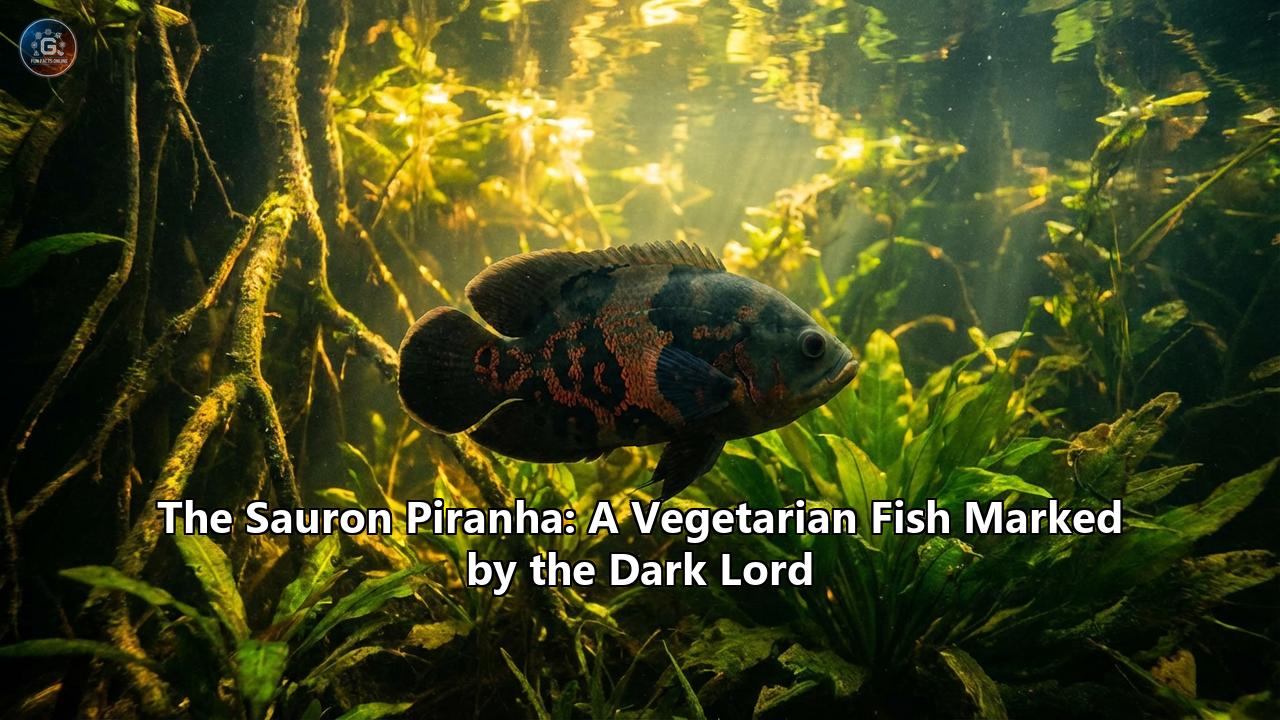
*Deep in the heart of the Amazon, a new species has emerged from the shadows. It bears the mark of a villain, the teeth of a human, and the name of a legend. Meet Myloplus sauron—the fish that has the scientific community and pop culture fans obsessed.
When scientists peered into the murky, biodiversity-rich waters of the Xingu River, they found something staring back at them. It wasn't a monster, but it certainly looked like one. With a round, silver body, vivid orange patches, and a vertical black bar slashing across its flank like a slit pupil, the fish bore an uncanny resemblance to the "Eye of Sauron" from J.R.R. Tolkien’s The Lord of the Rings.
But unlike the Dark Lord of Mordor, this creature doesn't want to rule Middle-earth. It just wants a salad.
The Discovery: One Ring to Rule Them All?
For nearly two centuries, Myloplus sauron was hiding in plain sight. To the untrained eye, it looked identical to another species, Myloplus schomburgkii, a well-known fish in the Amazon basin. Both share the discoid shape and the distinctive black bar on their sides.
It wasn't until June 2024 that a team of researchers from the Natural History Museum in London and universities in Brazil decided to take a closer look. Using DNA barcoding—a method of analyzing specific genetic markers—they realized that what they thought was one species was actually three distinct lineages.
"As soon as my colleagues suggested the name for this fish, we knew it was perfect for it," said Dr. Rupert Collins, the Senior Curator of Fishes at the Natural History Museum. "Its pattern looks a lot like the Eye of Sauron, especially with the orange patches on its body."
And thus, Myloplus sauron was officially entered into the scientific record, joining a prestigious club of creatures named after Tolkien's characters, including a genus of butterflies (Saurona) and a tree frog (Hyloscirtus tolkieni).
A Case of Mistaken Identity: Pacu vs. Piranha
The headline "Sauron Piranha" is enough to send a shiver down anyone's spine. It conjures images of a bloodthirsty predator swarming the riverbanks. However, the truth is far more evolutionary fascinating.
Myloplus sauron is technically a pacu—a close relative of the piranha. Both belong to the family Serrasalmidae, a diverse group of fish that split into different dietary paths millions of years ago.
- The Piranha: Famous for its razor-sharp, interlocking triangular teeth designed for shearing flesh.
- The Pacu (Myloplus sauron): Famous for its "human-like" teeth.
If you were to open the mouth of a Sauron Piranha (please don't), you wouldn't find jagged daggers. Instead, you would see rows of square, blunt, molar-like teeth. These chompers are an evolutionary masterpiece, designed not for tearing meat, but for crushing seeds, nuts, and tough aquatic vegetation.
While its cousin the Red-Bellied Piranha is the "wolf" of the river, the Sauron Piranha is the "cow." It plays a critical role in the Amazonian ecosystem as a seed disperser. When the Xingu River floods into the surrounding forests, these fish swim among the submerged tree trunks, eating falling fruit and excreting the seeds miles away, effectively planting the forest of the future.
The Eye of the Xingu: Habitat and Range
The "Eye of Sauron" doesn't gaze out over the volcanic plains of Mordor, but rather the clear, fast-flowing rapids of the Xingu River.
The Xingu is a major tributary of the Amazon and a biodiversity hotspot. It is a river of contrasts—deep, slow-moving pools and violent, shallow rapids. Myloplus sauron is endemic to this basin, meaning it is found nowhere else on Earth.
This exclusivity makes the species incredibly special, but also incredibly vulnerable. Evolution has tailored this fish perfectly to the Xingu's seasonal pulses. It relies on the annual flood cycle to access the fruit-laden forests that line the riverbanks. Without this pulse, the "gardener of the Amazon" cannot do its job.
A Shadow in the East: The Real Threat
In Tolkien's lore, the threat to the world came from the industrial machinery of Isengard and the dark magic of Mordor. For the Sauron Piranha, the threat is strikingly similar: the industrialization of the river.
The Xingu River is the site of the Belo Monte Dam, a massive hydroelectric complex that has fundamentally altered the flow of the river. The dam has reduced the water volume in the "Volta Grande" (Big Bend) of the Xingu by up to 80% in some sectors.
This is an ecological catastrophe for a fish like Myloplus sauron.
- Lost Forests: The reduced water levels mean the river no longer floods the surrounding forests deeply enough or for long enough. The fish cannot reach the fruit and seeds they rely on for food.
- Confused Signals: Amazonian fish rely on the chemical and physical signals of the flood pulse to trigger spawning. The dam disrupts these signals, leading to reproductive failure.
- Habitat Loss: The rapids where these fish thrive are being dried out or turned into stagnant pools, favoring different, often invasive, species.
The naming of Myloplus sauron is not just a fun pop-culture reference; it is a desperate call for attention. By invoking the name of a villain, scientists are highlighting a creature that is innocent, yet imperiled by the "dark towers" of human development.
Why It Matters
You might ask, "Why should I care about a vegetarian fish in Brazil?"
The answer lies in the web of life. Myloplus sauron is a keystone species. If the seed-eaters disappear, the trees that rely on them for dispersal eventually die out. If the trees die, the riverbanks erode, the water becomes silty, and the entire ecosystem—including the commercially important fish that local indigenous communities rely on for food—collapses.
The discovery of Myloplus sauron proves that even in the 21st century, the Amazon still holds secrets. We are still finding large, distinct species in rivers we thought we knew. But it also serves as a warning: we are altering these environments faster than we can catalog the life within them.
Conclusion: The Eye is Watching
The Sauron Piranha is a testament to the wonders of evolution. It is a fish that mimics the terrifying, yet lives peacefully. It bears a mark of evil, yet does only good for its forest home.
Next time you hear about the "monsters" of the Amazon, remember Myloplus sauron*. It’s not coming for your blood; it’s just looking for a nut to crack. And perhaps, with its unblinking, eye-like spot, it is watching us, waiting to see if we will protect its Middle-earth before it's too late.
Reference:
- https://www.researchgate.net/publication/343656157_Phylogenomics_of_Piranhas_and_Pacus_Serrasalmidae_Uncovers_How_Dietary_Convergence_and_Parallelism_Obfuscate_Traditional_Morphological_Taxonomy
- https://www.monsterfishkeepers.com/forums/threads/difference.9099/
- https://animals.howstuffworks.com/fish/pacu-fish.htm
- https://www.researchgate.net/publication/339720802_Phylogenomics_of_piranhas_and_pacus_Serrasalmidae_uncovers_how_convergent_diets_obfuscate_traditional_morphological_taxonomy
- https://www.biorxiv.org/content/10.1101/2020.03.02.973503v1.full-text
- https://www.cabidigitallibrary.org/doi/full/10.5555/20193251755
- https://news.mongabay.com/2016/07/fish-kills-at-amazons-belo-monte-dam-point-up-builders-failures/
- https://escholarship.org/content/qt6x27d4hr/qt6x27d4hr.pdf
- https://news.mongabay.com/2023/06/fishers-confirm-scientists-warning-brazils-belo-monte-dam-killed-off-the-river/
- https://www.lifegate.com/diga-belo-monte-fish-turtles
- https://www.researchgate.net/publication/384089989_Community-based_monitoring_reveals_the_impacts_of_the_permanent_river_drought_imposed_by_the_Belo_Monte_Hydroelectric_Power_Plant_at_Volta_Grande_do_Xingu_Amazonia