
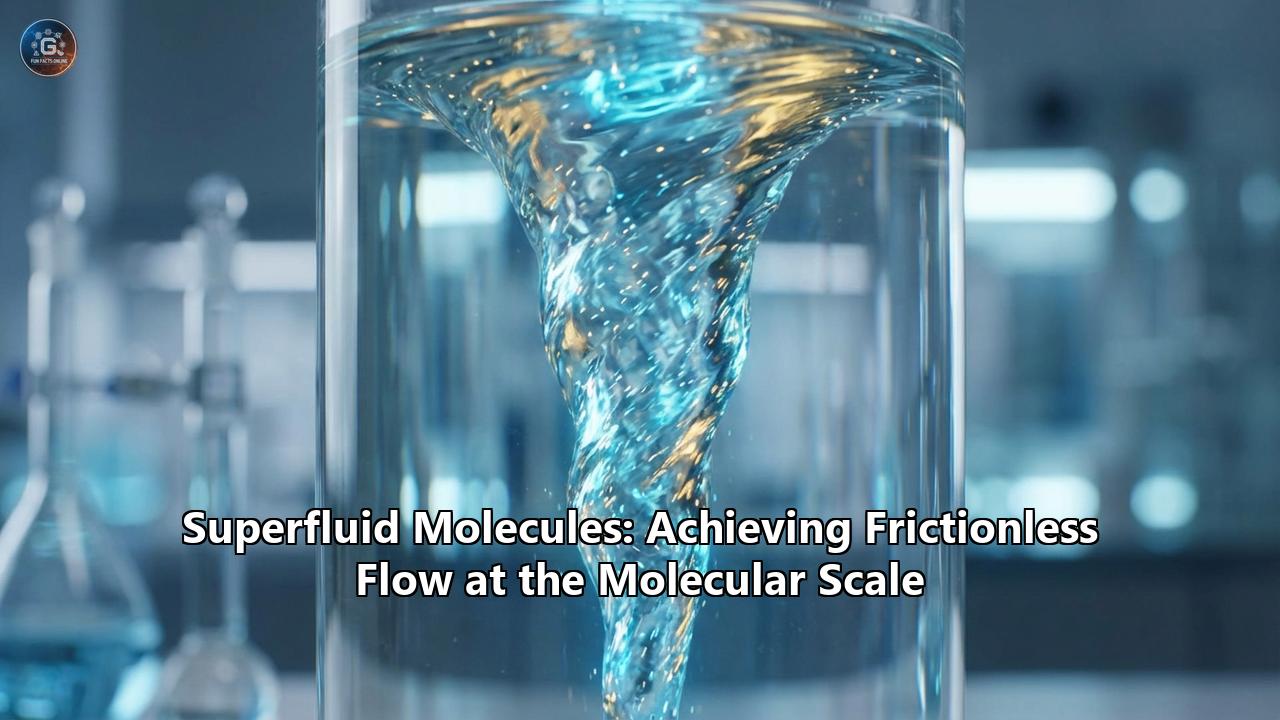
1. The Impossible Fluid
Imagine a cup of coffee that, once stirred, never stops swirling. A week later, you return, and the liquid is still rotating at the exact same speed, defying the laws of friction that govern our daily lives. Imagine a liquid that can creep up the walls of its container, escape through microscopic pores that would block a gas, and conduct heat with such efficiency that it effectively becomes "thermally invisible."
This is not science fiction; it is the reality of superfluidity. For nearly a century, this quantum phenomenon was the exclusive domain of helium atoms—simple, spherical, noble gas atoms that refused to freeze even at absolute zero. But the universe is rarely so simple. The vast majority of matter is not atomic; it is molecular. It vibrates, it rotates, it bonds.
For decades, physicists asked a daring question: Can a molecule become a superfluid? Can a complex object with internal moving parts lock into a single quantum state and flow without friction?
In February 2025, an international team of scientists answered with a resounding "Yes." By creating the world’s coldest "nano-labs" inside droplets of liquid helium, they observed the first definitive evidence of superfluid molecular hydrogen. This discovery has shattered the glass ceiling of low-temperature physics, opening the door to a new era of "quantum hydrodynamics" where the rules of chemistry and the strange laws of the quantum world collide.
2. The 2025 Breakthrough: The Spinning Canary
The quest to find a molecular superfluid has been one of the "holy grails" of condensed matter physics. The primary candidate has always been molecular hydrogen (H₂). It is the lightest molecule in the universe and, like the helium-4 atom, it is a boson—a particle that follows Bose-Einstein statistics, allowing it to condense into a single collective quantum state.
However, hydrogen has a fatal flaw: it loves to freeze. While helium remains liquid down to absolute zero (at standard pressure), hydrogen solidifies at a "balmy" 13.8 Kelvin (-259°C). Long before it can get cold enough to become a superfluid (predicted to happen around 1-2 Kelvin), it turns into a block of ice.
The Nano-Lab Solution
To cheat nature, researchers from the University of British Columbia (UBC), RIKEN in Japan, and Kanazawa University devised an ingenious workaround. They couldn't stop bulk hydrogen from freezing, so they stopped it from acting like a bulk solid.
They used helium nanodroplets—microscopic beads of superfluid helium-4—as tiny, floating refrigerators. Inside these droplets, they trapped clusters of parahydrogen molecules. Because the clusters were so small (ranging from just a few molecules to several dozen), they couldn't arrange themselves into a rigid crystal lattice. They remained in a fluid-like state at temperatures as low as 0.4 Kelvin—far below hydrogen's normal freezing point.
The Quantum Rotor Test
Proving the liquid was superfluid required a "smoking gun." You cannot simply stick a viscometer into a nanodroplet. Instead, the team used a molecular probe: methane (CH₄).
They embedded a single molecule of methane inside the hydrogen cluster. Methane acts like a molecular gyroscope. By hitting it with precise infrared laser pulses, they could make the methane molecule spin.
- In a normal fluid: The surrounding molecules would drag against the spinning methane, creating friction and slowing its rotation. This "viscous drag" would blur the spectroscopic signal, increasing the molecule's effective mass.
- In a superfluid: The fluid would have zero viscosity. The methane molecule would spin as if it were in a vacuum, slipping perfectly past the hydrogen neighbors.
The results were stunning. As the researchers increased the number of hydrogen molecules in the cluster, they watched the friction vanish. Once the cluster reached a critical size (around 12 molecules), the methane began to rotate freely. The surrounding hydrogen had decoupled from the probe, effectively becoming a "ghost fluid." The hydrogen molecules were no longer individual bumping particles; they had merged into a collective quantum wavefunction—a superfluid molecule.
3. The Physics of the "Super-Molecule"
To understand why this is so revolutionary, we must distinguish between atomic superfluidity (Helium) and molecular superfluidity (Hydrogen).
The Boson Requirement
Superfluidity is a macroscopic quantum phenomenon. It occurs when particles, which normally act like chaotic billiard balls, cool down enough that their "matter waves" overlap. They lose their individual identities and march in lockstep, forming a Bose-Einstein Condensate (BEC).
This is only possible for bosons—particles with integer spin (0, 1, 2...).
- Helium-4 is a perfect boson. It has 2 protons, 2 neutrons, and 2 electrons. All spins cancel out, leaving a total spin of 0.
- Hydrogen (H₂) is trickier. It consists of two protons and two electrons. Depending on how the nuclear spins of the two protons align, hydrogen comes in two flavors:
1. Orthohydrogen: Proton spins are parallel (Spin = 1).
2. Parahydrogen: Proton spins are anti-parallel (Spin = 0).
Only parahydrogen is a true boson at low energy. Orthohydrogen behaves differently and has higher energy. At room temperature, hydrogen is mostly "ortho," but to achieve superfluidity, the sample must be converted to nearly 100% pure "para." This purity was a critical requirement for the 2025 experiment.
The Rotational Complication
Here lies the key difference: Helium atoms are spheres. They are simple points of mass. They can move left, right, up, or down (translation), but spinning a sphere of uniform charge distribution doesn't really change its state in the same way.
Hydrogen molecules are dumbbells. They have shape. They can rotate end-over-end. This adds rotational degrees of freedom. In a normal liquid, these tumbling dumbbells collide and transfer angular momentum, creating complex friction.In a molecular superfluid, the rotational energy levels become quantized. The molecules don't just stop moving; they stop tumbling randomly. They enter the ground rotational state (J=0). This creates a unique form of "superfluidity with texture." The fluid flows without friction, but it still possesses an internal orientation. This opens the door to new phenomena where the flow of the superfluid and the rotation of its constituent molecules are coupled in exotic ways.
4. A History of Cold: The 50-Year Prediction
The discovery of superfluid hydrogen is the culmination of a theoretical journey that began at the height of the Cold War.
The Ginzburg-Sobyanin Prediction (1972)
In 1972, the legendary Soviet physicist Vitaly Ginzburg (who would later win a Nobel Prize) and his student A.A. Sobyanin published a seminal paper titled "Can liquid molecular hydrogen be superfluid?"
At the time, the idea was borderline heretical. Superfluidity was the exclusive property of Helium. Ginzburg and Sobyanin calculated that if one could somehow prevent hydrogen from crystallizing, its transition temperature ($T_\lambda$) to a superfluid state would be roughly 6 Kelvin. Later, more refined Monte Carlo simulations lowered this prediction to between 1K and 2K.
For 50 years, this prediction remained a "physics ghost." Experimentalists tried everything to keep hydrogen liquid below 14K:
- Supercooling: Carefully cooling clean liquid hoping to bypass nucleation. (It always froze).
- Confinement: Trapping hydrogen in porous glass (Vycor) to disrupt crystal formation. (This showed hints of weird behavior, but friction never vanished).
- Shock Waves: Compressing hydrogen to metallic states. (This created conductive fluids, but not superfluids).
It wasn't until the development of helium nanodroplet spectroscopy—a technique refined in the late 1990s and early 2000s—that scientists finally had the tool to test Ginzburg’s theory. It took another two decades to refine the resolution enough to see the subtle "spectral slip" of the methane probe that confirmed the theory in 2025.
5. Beyond Hydrogen: The Andreev-Bashkin Effect and Frontiers
The confirmation of molecular superfluidity has reignited interest in even more exotic theoretical phenomena. Now that we have two different types of superfluids (atomic He and molecular H₂), we can imagine mixing them.
The Andreev-Bashkin Effect
In a mixture of two different superfluids (e.g., superfluid hydrogen mixed with superfluid helium), theory predicts a bizarre phenomenon called the Andreev-Bashkin effect.
In normal fluid mixtures, drag is caused by collisions. In a mixture of two superfluids, there are no collisions. However, quantum mechanics predicts that the two fluids will still "drag" each other, not through friction, but through entrainment.
Essentially, if you push the hydrogen superfluid, the helium superfluid will start moving too, instantly and without any physical contact or viscosity. The two fluids become "locked" by their inter-particle interactions. While this has been studied in cold atom gases and neutron stars, the ability to create superfluid hydrogen clusters brings us one step closer to observing this "collisionless drag" in molecular liquids.
Water: The Ultimate Molecular Challenge
With hydrogen conquered, the eyes of the physics community are shifting to the ultimate molecule: Water (H₂O).
Water is a nightmare for quantum physicists. It is highly polar, forms strong hydrogen bonds, and has complex rotational modes. However, theoretical simulations suggest that if water could be confined in strictly one-dimensional channels (like inside a carbon nanotube) and cooled near absolute zero, the water molecules might align their dipoles and form a superfluid phase. The success with hydrogen clusters proves that "molecular complexity" is not a showstopper for superfluidity, making the dream of superfluid water slightly less impossible.
6. Future Applications: From Energy to Quantum Sensors
Why does it matter if a few molecules of hydrogen in a helium droplet have zero viscosity? The implications extend far beyond the laboratory.
1. The Hydrogen Economy and Transport
Currently, transporting liquid hydrogen is energy-intensive and difficult due to "boil-off" and viscosity losses in pumps and pipes. While bulk superfluid hydrogen is still difficult to maintain (requiring temperatures below 1K), understanding the onset of frictionless flow helps engineers design better transport systems.
If stable metastable states of superfluid hydrogen can be scaled up, we could theoretically pump hydrogen fuel through pipelines with zero pumping energy loss. The fluid would simply coast through the pipe forever once started.
2. Ultra-Sensitive Gyroscopes
The technique used to discover this phenomenon—using a molecule as a rotational probe—hints at a new class of sensors. A "superfluid molecular gyroscope" would be incredibly sensitive to external rotation. Because the superfluid decouples from the container, any change in the rotation of the housing (the "bucket") vs the fluid can be measured with quantum precision. This could lead to navigation systems that are orders of magnitude more accurate than current laser gyroscopes.
3. Quantum Solvents
Superfluid helium is already used as a "quantum solvent" to hold molecules still for spectroscopy. Superfluid hydrogen offers a new solvent with different properties. Because hydrogen interacts differently with dissolved molecules than helium does, it could allow scientists to study chemical reactions at absolute zero in ways previously impossible. We could watch two molecules react quantum mechanically, tunneling through reaction barriers rather than jumping over them thermally.
7. Conclusion: The New Quantum Hydrodynamics
The 2025 observation of superfluidity in parahydrogen clusters is more than just a new entry in a textbook. It represents the maturation of Quantum Hydrodynamics. We are no longer limited to the simple, spherical approximations of the 20th century. We are entering a world where molecular shape, rotation, and chemical identity play a role in the formation of macroscopic quantum states.
We have moved from the age of the "Superfluid Atom" to the age of the "Superfluid Molecule." And as we peer deeper into these frictionless fluids, we are likely to find that the rabbit hole goes much deeper—into a world where fluids don't just flow; they dance.
Reference:
- https://en.wikipedia.org/wiki/Degrees_of_freedom_(physics_and_chemistry))
- https://computecanada.github.io/molmodsim-md-theory-lesson-novice/05-degrees-of-freedom/index.html
- https://www.fastechus.com/blog/hydrogen-superfluid-breakthrough/
- https://science.ubc.ca/news/february-21-2025/hydrogen-becomes-superfluid-nanoscale-confirming-50-year-old-prediction
- https://pmc.ncbi.nlm.nih.gov/articles/PMC11844719/
- https://genh2.com/blog/hydrogen-a-to-z-series-o-for-orthohydrogen/
- https://chem.libretexts.org/Bookshelves/Physical_and_Theoretical_Chemistry_Textbook_Maps/Supplemental_Modules_(Physical_and_Theoretical_Chemistry)/Quantum_Mechanics/11%3A_Molecules/Ortho_and_Para_hydrogen/Quantum_Mechanics/11%3A_Molecules/Ortho_and_Para_hydrogen)
- https://en.wikipedia.org/wiki/Spin_isomers_of_hydrogen
- https://adpcollege.ac.in/online/attendence/classnotes/files/1586929739.pdf
- https://pubmed.ncbi.nlm.nih.gov/39983001/
- https://www.researchgate.net/publication/319056988_Andreev-Bashkin_effect_in_superfluid_cold_gases_mixture