
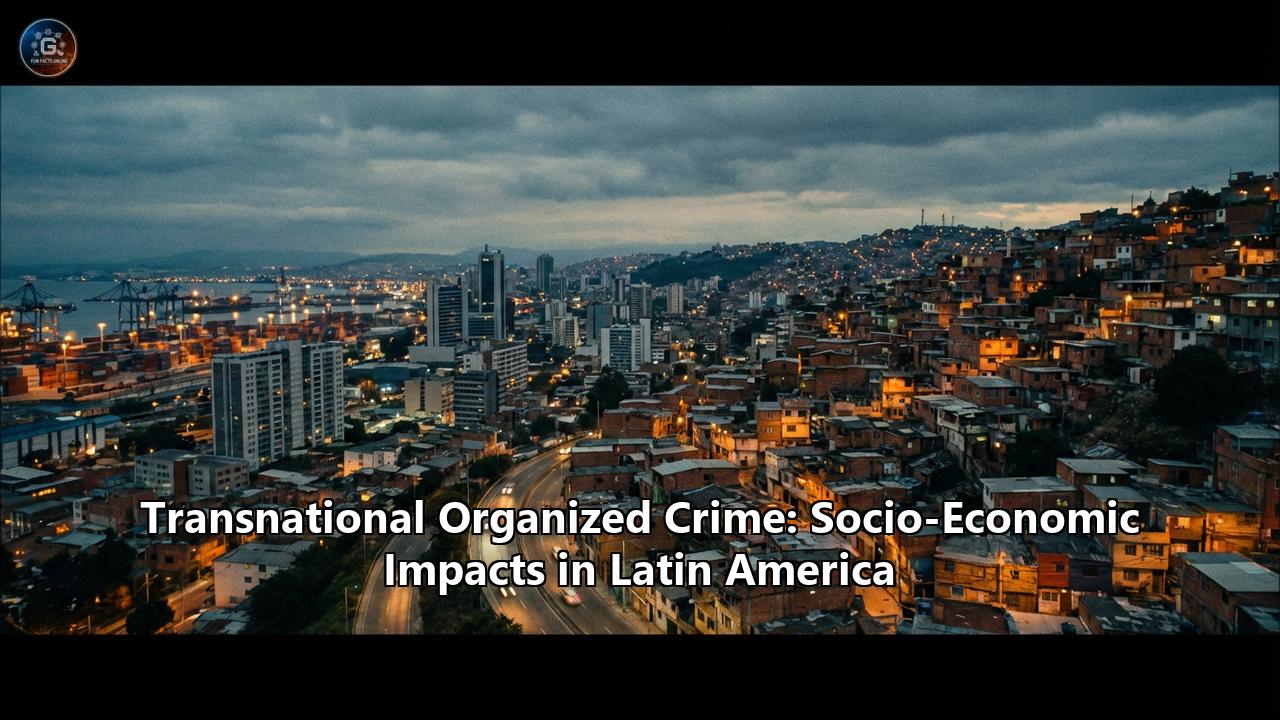
The landscape of transnational organized crime in Latin America has undergone a radical and terrifying metamorphosis. Gone are the days when the criminal underworld was defined solely by localized drug cartels fiercely guarding their cocaine routes. Today, criminal syndicates in the region operate with the sophistication, diversification, and logistical prowess of multinational corporations. They have infiltrated legal supply chains, exploited mass migration, and weaponized digital finance, fundamentally altering the socio-economic fabric of the Western Hemisphere.
Far from being a marginal issue of public security, organized crime has become a macro-economic anchor dragging down the region's potential. It is an aggressive parasite attached to the host of Latin America’s legitimate markets, reshaping governance, draining resources, and dictating the daily lives of millions. To understand the true socio-economic impact of this phenomenon in 2026, one must look beyond the tragic headlines of violence and examine the balance sheets of illicit empires, the hidden taxes levied on everyday citizens, and the environmental plunder financing the new underworld.
The Macroeconomics of Violence: Latin America’s “Hidden Tax”
In Latin America and the Caribbean, crime is no longer just a distortion of public order; it is a central economic variable. According to studies by the Inter-American Development Bank (IDB), violence and organized crime operate as a silent, regressive "hidden tax" that costs the region approximately 3.5% of its gross domestic product (GDP) annually. In absolute terms, this staggering figure exceeds $170 billion a year—an amount nearly equivalent to the region's entire public spending on education.
This socio-economic hemorrhage can be divided into three distinct categories. First, private spending on security accounts for roughly 47% of this cost. Businesses of all sizes are forced to divert capital from innovation and expansion into hiring private guards, armoring vehicles, installing surveillance grids, and paying extortion fees. For multinational corporations and local exporters, crime acts as a transferable risk premium. For example, cargo insurance at Latin American ports is routinely 20% to 50% more expensive than comparable ports in Europe or Asia.
Second, public spending to combat crime eats up another 31%. State budgets are increasingly militarized, channeling desperately needed funds away from infrastructure, healthcare, and social safety nets toward prisons, police forces, and armed interventions. Finally, the loss of human capital accounts for 22% of the cost. This represents the lost productivity of individuals who are murdered, incarcerated, or permanently disabled, stripping the formal economy of its workforce and driving a massive brain drain as professionals flee to safer countries.
The International Monetary Fund (IMF) has concretely quantified this relationship. Looking at recent data from Ecuador, IMF economists found that a mere 1% increase in the local murder rate correlates to a drop in the level of economic activity of up to 0.5%. Transnational organized crime chokes foreign direct investment, artificially inflates consumer prices, and perpetuates a vicious cycle of poverty and lack of opportunity that feeds the very gangs causing the crisis.
The Illicit Gold Rush: Environmental Plunder and Money Laundering
Historically, the illicit economy in Latin America was synonymous with cocaine. While drug trafficking remains highly lucrative, the financial portfolio of transnational crime has radically diversified. In an era marked by shifting global markets, criminal organizations have discovered a safer, more profitable, and arguably more destructive enterprise: illegal gold mining.
In illegal gold, criminal groups found a highly convenient mechanism to launder drug proceeds while generating massive new revenue streams. Unlike narcotics, once illegally mined gold is smelted and introduced into the formal supply chain with forged paperwork, it becomes a legal commodity that can move freely across international borders. Today, illegal gold consistently out-earns cocaine as a revenue source for criminal networks in countries like Colombia and Peru.
The scale of this illicit extraction is breathtaking. Recent reports indicate that an astonishing 77% of all gold mined in Ecuador, 80% in Colombia, 80-90% in Venezuela, and roughly 28% in Peru is produced illegally. The profits are phenomenal. In 2024, illegal gold miners operating on a single Amazon River tributary at the Brazil-Colombia border generated more yearly revenue than the entire annual budget of Brazil's federal anti-deforestation agency.
The socio-economic and environmental tolls of this gold rush are deeply intertwined. In the Tapajós River Basin of the Brazilian Amazon, the expansion of wildcat mining (garimpo) has brought devastating deforestation, mercury contamination of waterways, and the displacement of Indigenous communities. But the destruction goes beyond the environment. The United Nations Office on Drugs and Crime (UNODC) has documented strong links between illegal mining and severe human rights abuses, including modern-day slavery, human trafficking, and the sexual exploitation of minors. Criminal syndicates like Brazil’s First Capital Command (PCC) and Colombia's Clan del Golfo control the logistics, supply the heavy machinery, and extort the artisanal miners, enforcing their rule with lethal violence. This ecosystem of environmental crime threatens global climate stability while entrenching a shadow economy that actively erodes state sovereignty.
Blurring the Lines: Infiltration of the Licit Economy
As criminal syndicates amass billions in untraceable capital, their integration into the legitimate economy has accelerated. The Global Initiative Against Transnational Organized Crime refers to this phenomenon as the creation of "murky markets," where traditional distinctions between the licit and illicit vanish.
The most prominent example of this corporate evolution is Brazil’s Primeiro Comando da Capital (PCC). Originating as a prison gang in São Paulo, the PCC has grown into a transnational juggernaut. According to the Brazilian Forum on Public Security, the PCC currently generates over $25 billion annually within the legal economy. They have systematically infiltrated Brazil's fuel production chain—controlling everything from oil wells and refineries to urban gas stations. By dominating legitimate logistical networks, the PCC can launder immense amounts of cash while holding significant leverage over local economies.
Furthermore, the digital age has provided transnational crime with frictionless avenues for financial crimes. Cyber-dependent crimes, including ransomware attacks against state infrastructure, identity theft, and cryptocurrency fraud, have surged across the region. In Brazil, federal authorities dismantled a criminal network that had created its own cryptocurrency specifically to launder the proceeds of illegal gold mining, highlighting the dizzying technical sophistication of modern cartels.
Case Study: The Collapse of Ecuador’s Security
Perhaps no country illustrates the catastrophic socio-economic impact of transnational organized crime more starkly than Ecuador. A decade ago, Ecuador was considered a relative island of peace situated between two cocaine-producing giants, Colombia and Peru. Today, it is grappling with an existential security crisis.
The country's transformation into a criminal epicenter was driven by its strategic geography. The port city of Guayaquil became a highly coveted logistical node for transnational cartels—including Mexico’s Sinaloa and Jalisco New Generation cartels, as well as European Balkan mafias—to ship cocaine hidden in maritime agricultural exports like bananas. Local Ecuadorian street gangs, such as Los Choneros, Los Lobos, and Los Tiguerones, evolved into deeply entrenched mafia-style organizations by acting as the outsourced logistical muscle for these global cartels.
The resulting turf wars triggered a terrifying wave of violence. Ecuador's homicide rate exploded from 8 per 100,000 inhabitants in 2020 to roughly 46 per 100,000 in 2023, surpassing notoriously violent nations like Mexico and Honduras. Projections for 2025 estimate the rate could near 50 per 100,000, solidifying Ecuador’s tragic status as one of the deadliest countries in Latin America. The violence reached a crescendo in early 2024 when armed gang members stormed a live television broadcast, prompting President Daniel Noboa to declare an "internal armed conflict" against 22 criminal organizations.
The socio-economic fallout in Ecuador is pervasive. Extortion, known locally as "vacunas" (vaccines), has become a parallel tax on survival. Over 10,700 extortion cases were reported by late 2024, targeting everyone from large corporations to neighborhood corner-store owners and teachers. In cities like Durán, the state has practically evaporated. Amidst a vacuum of basic services like water and sanitation, drug traffickers have created a parallel service economy, providing marginalized citizens with twisted forms of security and income.
This environment of fear has choked domestic consumption and triggered a massive wave of displacement. Between January and October of 2024, an estimated 80,000 Ecuadorians were internally displaced by violence, while tens of thousands more fled north through the treacherous Darién Gap, driven by a toxic combination of economic stagnation and mortal fear. The government's militarized response, while popular in the short term, has drained the public treasury and led to documented human rights abuses, creating a volatile environment that threatens the long-term stability of the nation's democratic institutions.
The Economics of Diaspora Exploitation: The Rise of Tren de Aragua
While the drug trade fueled the rise of the Andean cartels, the catastrophic collapse of the Venezuelan economy gave birth to a different kind of monster: Tren de Aragua (TdA). Originating in Venezuela's notorious Tocorón prison, TdA capitalized on the mass exodus of over 7.7 million Venezuelans fleeing hyperinflation and authoritarianism.
Tren de Aragua operates on a unique, parasitic economic model. Rather than primarily controlling drug production, the gang embedded itself within the vulnerable flows of the Venezuelan diaspora. As border crossings were shuttered, TdA seized control of the irregular border trails, known as "trochas," extorting desperate migrants simply for the right to flee their homeland.
As the diaspora spread south into Colombia, Peru, and Chile, and north toward the United States, Tren de Aragua followed. The syndicate established a transnational franchise model based on extreme violence—frequently utilizing public executions to intimidate rivals and locals alike. In cities like Lima, Peru, and Santiago, Chile, TdA engineered horrific human trafficking and forced prostitution rings. They specifically targeted vulnerable Venezuelan women, smuggling them across borders and forcing them into the sex industry to pay off insurmountable debts.
The group's revenue is derived from a diversified portfolio of misery: migrant smuggling, kidnapping for ransom, retail theft, and the systematic extortion of diaspora-owned businesses. TdA’s rapid expansion across the hemisphere—triggering national security alerts from the Atacama Desert to urban centers in the United States—demonstrates how transnational crime weaponizes geopolitical crises. The syndicate thrives where the social safety net has failed, creating violent cells in communities where migrants, due to their irregular legal status, cannot turn to local law enforcement for protection.
The Erosion of the Social Fabric and "Narcocultura"
The economic metrics of transnational crime—billions laundered, GDP percentages lost, port seizures—often mask the profound psychological and social devastation inflicted on Latin American communities.
The institutionalization of crime has fractured the social contract. In regions where state presence is weak, criminal organizations step in as the de facto authority. They mediate neighborhood disputes, enforce localized curfews, and even distribute food during economic downturns, weaving themselves into the community’s fabric. This creates a tragic dependency. When the state is viewed not as a protector but as an absent or corrupt entity, the local cartel boss becomes both the oppressor and the benefactor.
This reality has a devastating impact on the region’s youth. Across Latin America, marginalized adolescents facing bleak economic prospects and failing education systems are heavily recruited into criminal ranks. In Guayaquil, Ecuador, and Rosario, Argentina, criminal gangs actively recruit minors to act as hitmen and lookouts, exploiting legal loopholes that prevent harsh sentencing for juveniles. This systemic recruitment is reinforced by the pervasive spread of "narcocultura"—a cultural phenomenon glorified in music, television, and social media that equates criminal association with wealth, power, and social status. For a teenager living in a slum with no running water, the cartel offers an immediate, albeit deadly, avenue for upward economic mobility.
Furthermore, the pervasive nature of organized crime fundamentally corrupts democratic institutions. To ensure the smooth operation of their illicit supply chains, cartels systematically bribe politicians, judges, police commanders, and customs officials. This co-optation hollows out the state from within. According to anti-corruption watchdogs, the infiltration of illicit money into political campaigns across Latin America ensures that policies designed to combat money laundering and resource smuggling are routinely watered down or entirely ignored. This impunity breeds deep public cynicism, destabilizing governments and paving the way for authoritarian populism as desperate citizens demand security at any cost to their civil liberties.
Reclaiming the Future: A Paradigm Shift
Addressing the socio-economic impacts of transnational organized crime in Latin America requires acknowledging that the traditional "War on Drugs" and militarized mano dura (iron fist) policies are insufficient. While deploying the military to reclaim gang-controlled territories or prisons can yield short-term reductions in violence, it does not dismantle the economic engine of organized crime.
A comprehensive response must treat transnational crime as the complex, corporate, and economic threat that it is. First, governments must attack the financial lifelines of these syndicates. This requires robust international cooperation to tackle money laundering, tighten regulations on shell companies, and implement strict traceability in the extraction of strategic resources like gold and timber. Without the ability to integrate their billions into the formal banking system and the global real estate market, the power of these syndicates is severely bottlenecked.
Second, the structural socio-economic drivers of crime must be addressed. Security cannot be achieved without opportunity. Reclaiming marginalized communities requires state intervention that goes beyond police raids. It demands heavy investment in public infrastructure, education, and legitimate economic alternatives for the millions of youths and informal workers who currently view the illicit economy as their only means of survival.
Lastly, the migration crisis must be managed regionally, with a focus on integrating migrants into the formal economy. Providing legal pathways and work permits strips organizations like Tren de Aragua of their most vulnerable prey, cutting off a major source of their extortion and human trafficking revenues.
Transnational organized crime is an evolving, adaptive hydra that feeds on inequality, institutional weakness, and the voracious global demand for illicit commodities. The battle for Latin America’s future is no longer just being fought in the jungles or on the streets; it is being waged in corporate boardrooms, unregulated financial markets, and marginalized neighborhoods. Reclaiming the region’s economic potential and democratic integrity demands a unified, structurally deep, and relentless commitment to dismantling the shadow economy before it wholly consumes the light.
Reference:
- https://wfm-igp.org/blog/transnational-organized-crime-in-latin-america-a-regional-approach/
- https://ocindex.net/assets/downloads/2025/english/ocindex_profile_ecuador_2025.pdf
- https://thewatch-journal.com/2025/04/15/organized-crimes-transformation-in-latin-america-and-its-impact-on-the-region/
- https://www.gisreportsonline.com/r/organized-crime-latin-america/
- https://latinoamerica21.com/en/reducing-violence-latin-americas-pending-economic-policy/
- https://track.unodc.org/uploads/documents/corruption/meetings/Safeguarding_strategic_resources_in_Latin_America_and_the_Caribbean_Conference_outcome_document_Sep_2025_ENG.pdf
- https://thedialogue.org/analysis/transnational-organized-crime-in-the-western-hemisphere
- https://www.elibrary.imf.org/view/journals/002/2024/358/article-A003-en.xml
- https://globalinitiative.net/analysis/ecuadors-criminal-crisis/
- https://www.cfr.org/articles/illegal-gold-finances-latin-americas-dictators-cartels-united-states-must-lead-fight-against
- https://globalinitiative.net/wp-content/uploads/2016/03/Organized-Crime-and-Illegally-Mined-Gold-in-Latin-America.pdf
- https://respect.international/organised-crime-and-illegal-gold-mining-in-the-americas/
- https://news.mongabay.com/2025/06/organized-crime-gold-trade-are-increasingly-connected-report-shows/
- https://en.wikipedia.org/wiki/Tren_de_Aragua
- https://www.hrw.org/world-report/2025/country-chapters/ecuador
- https://refugees.org/2025-country-conditions-ecuador/
- https://americasquarterly.org/article/how-much-of-a-threat-is-tren-de-aragua-in-the-u-s/
- https://www.theguardian.com/world/2025/apr/27/what-is-tren-de-aragua-trump-venezuela
- https://www.ibiconsultants.net/_upload/mediaandpublications/document/tren-de-aragua-overview-latam.pdf
- https://www.securefreesociety.org/research/weaponized-chaos/