
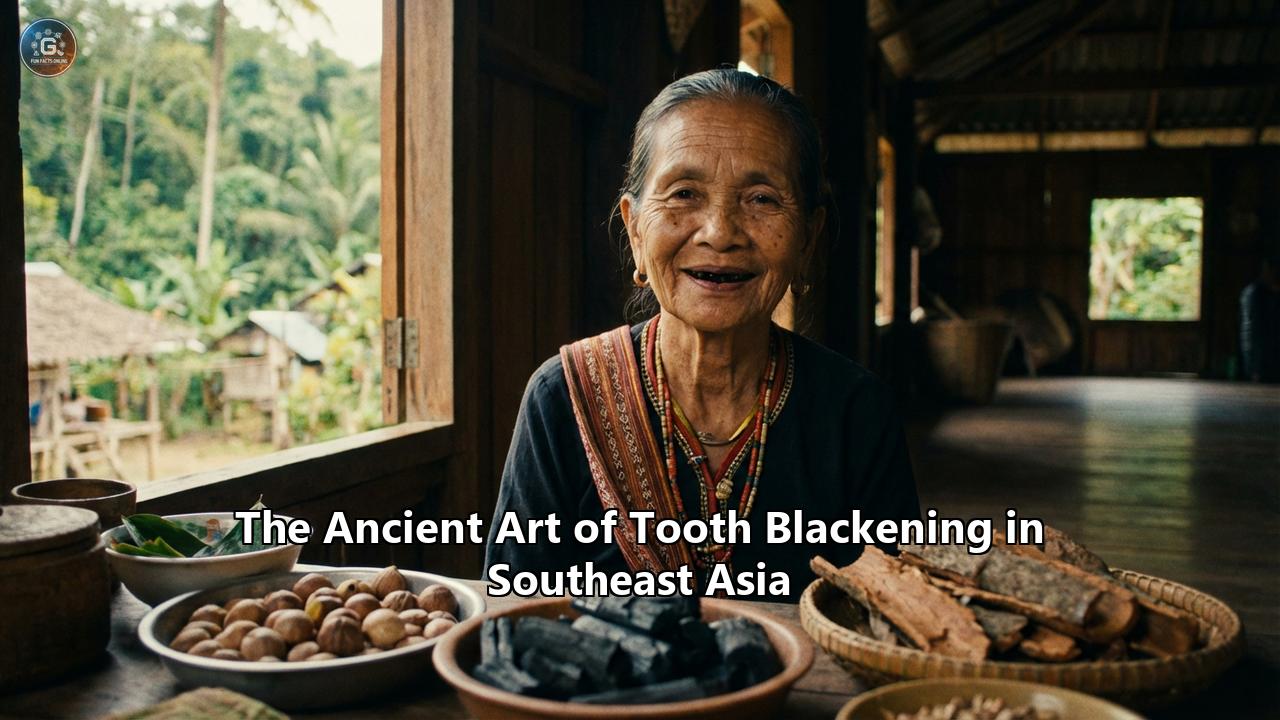
If you were to step into a time machine and emerge in a bustling village in 18th-century Vietnam, a pre-colonial Philippine settlement, or a royal court in ancient Southeast Asia, you would be struck by a beauty standard that sharply contradicts the modern multi-billion-dollar dental industry. In these vibrant, historical societies, a beaming smile did not flash pearly white. Instead, it revealed a row of teeth polished to a gleaming, iridescent, and pitch-black finish.
While the modern world equates blindingly white teeth with health, beauty, and status, for thousands of years, the peoples of Southeast Asia and the Pacific Islands believed the exact opposite. To them, white teeth were the mark of wild animals, savage beasts, and malevolent demons. To be civilized, to be mature, and to be truly beautiful meant undergoing the arduous, painful, and highly ritualized process of intentional tooth blackening.
Far from a mere cosmetic whim, the ancient art of tooth blackening—practiced widely across Vietnam, the Philippines, Indonesia, Thailand, Malaysia, and stretching up to Japan (where it was known as Ohaguro)—was a profound cultural cornerstone. It was a rite of passage, an ancient form of preventative dentistry, and a spiritual shield. Today, this captivating practice has almost vanished, pushed to the fringes of remote mountain tribes and the memories of the oldest generations. Yet, the story of the ebony smile offers a fascinating glimpse into the fluid nature of human beauty, ancient chemical ingenuity, and the cultural collisions that shaped the modern world.
The Philosophy of the Obsidian Smile
To understand the appeal of black teeth, one must discard contemporary Western beauty ideals and look through the lens of ancient animist and Southeast Asian philosophies. The desire to alter the natural color of human teeth was deeply rooted in the need to differentiate humanity from the wild, untamed natural world.
Separating Man from Beast
In many indigenous Southeast Asian cultures, the natural state of the human body was considered raw and unrefined. To leave the body completely unaltered was to exist in a state akin to animals. Dogs, pigs, and monkeys had white teeth; therefore, a civilized human being should not. In Vietnam, a popular ancient proverb sneered at the unrefined aesthetic of foreigners: "Any dog can have white teeth." By intentionally modifying the body—through tattooing, teeth filing, and teeth blackening—individuals elevated themselves above the animal kingdom, demonstrating their capacity for culture, discipline, and aesthetic refinement.
A Shield Against the Supernatural
Beyond the physical world, tooth blackening served a vital spiritual purpose. In local folklore across the region, evil spirits, underworld ghouls, and wild demons were frequently depicted with long, terrifyingly white fangs. It was believed that these malevolent entities were attracted to those who resembled them. By filing the teeth down to make them even and dyeing them a protective, impenetrable black, an individual effectively camouflaged themselves against the supernatural. The blackened smile acted as a talisman, assuring the spirits that the person was a civilized human and not a wandering demon ripe for spiritual abduction.
The Ultimate Rite of Passage
Tooth blackening was rarely performed on children. Instead, it was inextricably linked to puberty, sexual maturity, and readiness for marriage. As boys and girls came of age, usually around the onset of menstruation for women or adolescence for men, the community would gather for the blackening ritual. A successfully blackened set of teeth broadcasted to the village that a young person was now a full-fledged adult, capable of enduring pain, upholding tradition, and entering into matrimony. In fact, in many traditional Vietnamese and Philippine societies, finding a suitable spouse was nearly impossible if one's teeth remained naturally white.
The Alchemy of Blackening: Chemistry and Agony
Achieving the perfect, lustrous black smile was not a simple matter of painting the teeth. It was a complex chemical process that required expert practitioners, days of fasting, and a considerable threshold for pain. The specific recipes varied depending on the region's available flora and minerals, but the underlying chemical reaction remained remarkably consistent: the interaction between tannic acids (derived from plants) and iron or copper salts (derived from metals or minerals).
The Vietnamese Recipe
In Vietnam, where the practice reached an apex of cultural sophistication in the Imperial City of Hue, the dye was a highly guarded recipe of organic alchemy. The primary ingredient was often red sticklac—a resinous secretion left by tiny aphid-like insects on the branches of host trees. This resin was harvested, diluted with lemon juice or rice alcohol, and stored in the dark for several days to ferment.
Other recipes utilized the powder of ant wings, black alum, and the syrupy tar of burned coconut shells. To trigger the chemical reaction that turned the dye from a dark red to an insoluble, impenetrable blue-black, iron or copper filings were added.
The Grueling Application Process
The physical application of the dye was an ordeal that tested the endurance of the young initiates. The process began with rigorous sanitation. For several days, the mouth was scrubbed using dried betel husks, stewed charcoal powder, and coarse salt.
Once the teeth were scoured, the practitioner would prepare the enamel by having the initiate rinse their mouth with a highly acidic mixture of rice wine and lemon juice. This step was notorious for causing immense pain, as the acid eroded the pellicle layer of the teeth and caused the lips, tongue, and gums to swell violently. During this period, the initiate could not eat solid food and had to survive on soft porridge or liquid sipped through a bamboo straw.
Once the teeth were properly primed, the blackening resin was applied with heavy pressure. Because natural saliva would constantly try to wash the foreign substance away, the application had to be repeated every other day for up to two weeks. The initiate would keep their mouth open for hours, sometimes with their lips propped apart, allowing the dye to dry and bond to the enamel. When the swelling finally subsided and the process was complete, the result was a permanent, glossy, obsidian-like coating that would last for years, requiring only occasional touch-ups.
Cultural Epicenters of the Ebony Smile
While the underlying chemistry was similar, the cultural execution of tooth blackening varied vibrantly across the diverse landscapes of Southeast Asia.
Vietnam: Poetry, Royalty, and the Dong Son Legacy
In Vietnam, tooth blackening (nhuộm răng) was not limited to remote hill tribes; it was the mainstream standard of beauty for the majority Kinh people, as well as minority groups like the Dao, Hmong, and Si La. Archaeological discoveries at the Dong Dau and Dong Xa sites have unearthed 2,000-year-old skulls with permanently blackened teeth, proving that the roots of this practice stretch back to the ancient Dong Son bronze culture.
During the dynastic eras, particularly in the imperial capital of Hue, black teeth were the pinnacle of aristocratic elegance. Eunuchs, concubines, princes, and princesses all subjected themselves to the painful dyeing process to achieve the coveted look. The black smile was heavily romanticized in Vietnamese folklore, poetry, and folk songs (ca dao). A woman's beauty was often measured by the darkness and shine of her teeth; the blacker and glossier the lacquer, the more captivating she was deemed to be.
The Philippines: Tar, Gold, and the Boxer Codex
Before the arrival of the Spanish in the 16th century, the inhabitants of the Philippine archipelago practiced complex forms of dental modification. Early Spanish explorers and chroniclers, though thoroughly repulsed by the practice, documented it extensively. The Boxer Codex, an early colonial manuscript, alongside the writings of Antonio de Morga in 1609, noted that the Tagalog and Visayan people filed their teeth to render them perfectly even before dyeing them a lasting, polished black.
In the Visayas, a tar-based coating known as tapul was applied to the teeth, giving them the appearance of polished ebony. The chewing of the anipay root was also used to regularly maintain the inky hue.
Fascinatingly, the ancient Filipinos combined tooth blackening with another display of immense wealth: gold pegging (bansil). Skilled dental artisans would drill tiny holes into the blackened incisors using an awl (ulok) and insert solid gold pegs. Some pegs were simple dots, while others had overlapping flat heads that resembled golden fish scales or intricate filigree designs. The visual contrast of glittering gold set against a backdrop of jet-black enamel was considered the absolute zenith of beauty and martial prestige.
Island and Mainland Southeast Asia: The Betel Nut Connection
In Indonesia, Malaysia, Thailand, and Myanmar, intentional tooth blackening often overlapped with, but remained distinct from, the widespread custom of chewing betel nut. A quid of betel—comprising the areca nut, a betel pepper leaf, and slaked lime paste—is a mild stimulant chewed for its warming, euphoric effects. A side effect of chronic betel chewing is the staining of the teeth to a dark, rusty red or purplish-black.
However, many cultures intentionally accelerated and darkened this staining process. In island Southeast Asia, teenagers undergoing the potong gigi (tooth filing) ceremonies would simultaneously have their newly flattened teeth treated with burnt coconut husk char and plant tannins to achieve an instant, uniform blackness. In these regions, a mouth full of teeth "as black as a bumble bee's wings" or "as black as pomegranate seeds" was celebrated in local literature and song.
Surprising Science: Ancient Dentistry Ahead of Its Time
When European colonial powers arrived in Southeast Asia, they quickly condemned tooth blackening as a barbaric, mutilating, and unhygienic practice. Yet, modern dental science has revealed a stunning irony: the ancient Southeast Asians were inadvertently practicing a highly effective form of preventative dentistry.
The thick, black lacquer applied to the teeth functioned precisely like modern dental sealants. The ingredients used to create the dye—particularly the tannic acids from plant galls and the resins from specific trees (such as the Cratoxylum species)—possessed potent antimicrobial and anti-plaque properties. Furthermore, the iron and copper salts utilized in the oxidation process created an alkaline environment in the mouth, which severely inhibited the growth of Streptococcus mutans, the primary bacteria responsible for producing the acids that cause tooth decay.
Consequently, individuals with blackened teeth rarely suffered from cavities. Historical surveys and modern ethnographic studies have repeatedly shown that elderly women in Vietnam and the Philippines who maintained their blackened teeth kept a full set of healthy adult teeth well into their seventies and eighties, far outlasting their peers who adopted modern, sugar-rich diets and Western dental practices. The ancient aesthetic choice was, in reality, a medical marvel that protected the teeth against the harsh realities of historical diets.
The Fading of the Ebony Smile
Despite its deep cultural roots and undeniable health benefits, the tradition of tooth blackening could not withstand the relentless pressure of colonialism, globalization, and shifting beauty standards.
The decline began in earnest in the late 19th and early 20th centuries. French colonists in Vietnam, Spanish and American occupiers in the Philippines, and British administrators in Malaya brought with them the rigid European ideal that white teeth were the hallmark of civilization, hygiene, and modernity. Colonial medical reports often conflated tooth blackening with poor hygiene, ignoring the protective benefits of the resin.
In 1938, a French survey noted that 80 percent of the rural population in northern Vietnam still had blackened teeth. However, the cultural tide was already turning in the cities. As Southeast Asian nations began pushing for modernization and independence, younger generations increasingly viewed the customs of their ancestors as backward and rural. In the early 20th century, forward-thinking Vietnamese women, eager to participate in social reforms and the liberation of their country, went to agonizing lengths to scrape the black dye off their teeth, utilizing abrasive sands and pumice to reveal the white enamel underneath.
A similar phenomenon occurred in the Philippines, where the deeply entrenched matapobre (elitist) attitudes of urbanized, colonially influenced Filipinos framed the black teeth of indigenous tribes as ugly and uneducated. The practice was rapidly abandoned in the lowlands, surviving only among fiercely independent groups like the B'laan people, who retreated deep into the mountains of southern Mindanao to escape colonial influence.
Legacy and Resurrection in the Modern Era
Today, the era of the obsidian smile is in its twilight. The complex recipes for the dyes have largely been lost, the master practitioners have passed away, and the availability of modern toothpaste has permanently established the reign of the white smile. If you travel to the remote highlands of northern Vietnam, the mountains of Luzon or Mindanao in the Philippines, or the deep interior of the Indonesian archipelago, you may still find a handful of elderly women flashing brilliant, jet-black smiles. They are the last living bearers of a 2,000-year-old tradition.
However, the legacy of tooth blackening is experiencing a quiet renaissance in the realms of history, anthropology, and cultural pride. Contemporary scholars and descendants of these ancient cultures are re-examining the practice not as a primitive oddity, but as a sophisticated expression of identity, an incredible feat of ethnobotany, and a profound statement on the subjectivity of beauty.
The story of Southeast Asia’s blackened teeth challenges us to look in the mirror and question our own modern rituals. In a world where millions of people undergo painful chemical bleaching procedures to achieve an unnatural, blinding whiteness, the ancient preference for a polished, protective, and spiritually significant black enamel does not seem so strange after all. It stands as a powerful reminder that beauty is not a universal truth, but a canvas upon which humanity paints its ever-changing values, fears, and connections to the natural world.
Reference:
- https://en.wikipedia.org/wiki/Teeth_blackening
- https://traveldudes.com/tooth-blackening-of-traditional-vietnamese-tribes/
- https://prehispaniccebu.wordpress.com/2019/12/25/visayan-dentistry/
- https://saigoneer.com/saigon-culture/10573-black-teeth-how-vietnam-s-hottest-makeup-regimen-went-from-vogue-to-obscurity
- https://www.livescience.com/archaeology/2-000-year-old-skulls-reveal-people-in-ancient-vietnam-permanently-blackened-their-teeth-a-stylish-practice-that-persists-today
- https://morefuntravel.com/2019/12/tooth-blackening-was-a-unique-culture-of-the-vietnamese-people/
- https://www.mytempesmiles.com/blog/ohaguro-teeth-blackening-tradition/
- https://www.ddsltdlab.com/wp-content/uploads/2021/04/All-Metal-Gold_work_filing_and_blackened_teeth_Den.pdf
- https://www.quora.com/What-was-the-cultural-significance-of-teeth-blackening-in-traditional-Vietnamese-culture
- https://www.sunstar.com.ph/more-articles/intentional-cavities
- https://openlab.citytech.cuny.edu/city-tech-writer-sampler/files/2019/07/Matthews-2012.pdf
- https://ethnobotanyjournal.org/index.php/era/article/download/433/315
- https://en.wikipedia.org/wiki/Ohaguro
- https://en.clickpetroleoegas.com.br/Why-did-Vietnamese-people-paint-dogs%27-teeth-black/