
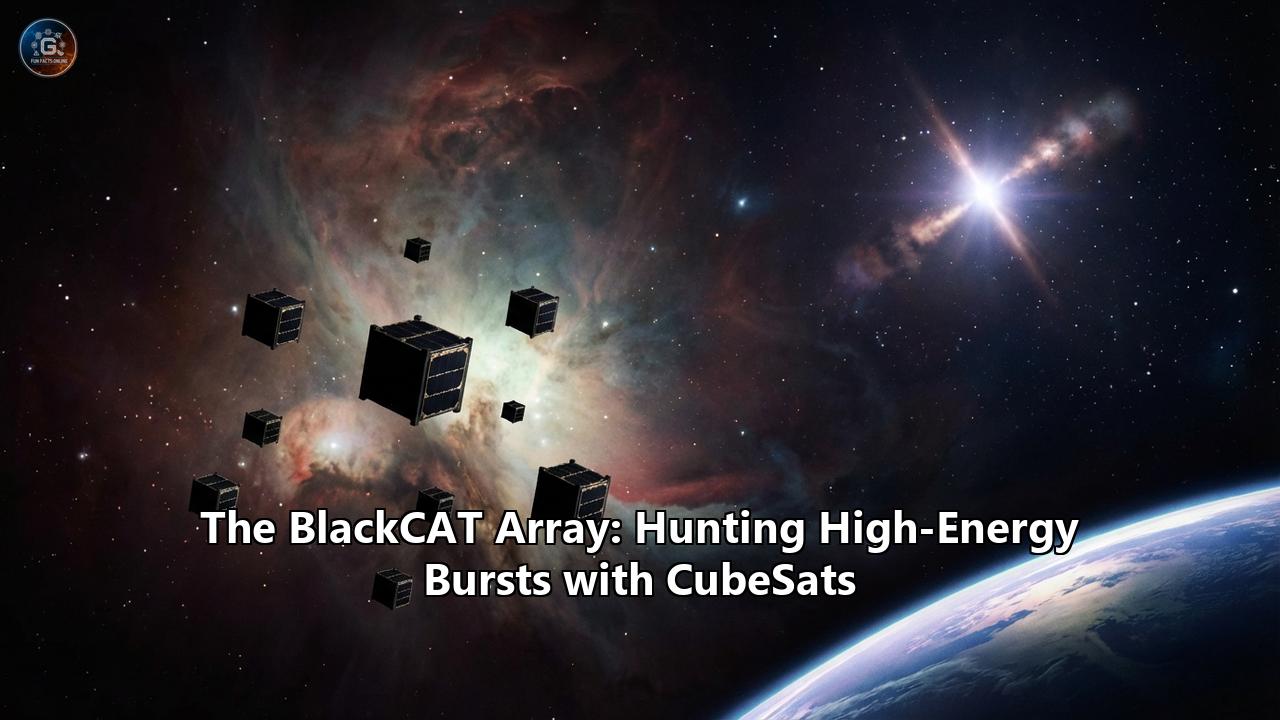
The era of "big glass" dominance is changing. For decades, the story of astronomy was written by giants: massive mirrors polished to atomic smoothness, hoisted onto isolated mountain peaks, or school-bus-sized observatories lofted into orbit by heavy-lift rockets. These titans—Hubble, Chandra, James Webb—stare deep into the cosmos, collecting ancient photons with unmatched precision. But they have a weakness. They are tunnel-visioned. To see the universe in such detail, they must look at a tiny patch of sky, oblivious to the fireworks erupting behind them.
The universe, however, is not static. It is a violent, flashing, dynamic arena. Stars collapse in seconds; neutron stars slam into each other, rippling the very fabric of spacetime; black holes strip material from companion stars in sudden, lethal feasts. These events, known as "transients," are the universe’s screamers. They don't wait for a scheduled observation. They flash and fade, sometimes in milliseconds. To catch them, you don't need a giant eye that sees one thing perfectly; you need a thousand unblinking eyes watching everything at once.
Enter the BlackCAT Array.
Launched on January 11, 2026, amidst the dawn of a new year for astrophysics, the BlackCAT (Black Hole Coded Aperture Telescope) mission represents a paradigm shift. It is not a billion-dollar flagship. It is a "CubeSat"—a spacecraft roughly the size of a shoebox, built with the agility of a startup and the precision of a national laboratory. Yet, this small sentinel is poised to solve some of the biggest mysteries in cosmology, acting as the "tip of the spear" for the global network of multi-messenger astronomy.
This is the story of how a team of engineers and astrophysicists packed a high-energy observatory into a 6U CubeSat, how they revived a "forgotten" imaging technology to see the invisible, and why this tiny hunter is our best bet for finding the golden forges of the universe.
Part I: The Violent Sky and the Multi-Messenger Era
To understand the mission of BlackCAT, one must first understand the prey it hunts. The X-ray sky is nothing like the serene tapestry of stars we see with our naked eyes. If you could see in X-rays (photons with energies thousands of times higher than visible light), the universe would look like a strobe-lit rave.
The Gamma-Ray Burst (GRB)
The crown jewel of high-energy transients is the Gamma-Ray Burst. First discovered accidently in the late 1960s by the Vela satellites (military spacecraft designed to detect nuclear bomb tests), GRBs are the most luminous electromagnetic events since the Big Bang. For a few brief seconds, a single GRB can outshine the entire rest of the universe combined.
For decades, they were a mystery. Today, we know they come in two primary flavors, both of which BlackCAT is designed to hunt:
- Long GRBs: Lasting more than two seconds, these are the death cries of massive stars (supernovae/hypernovae) collapsing into black holes. They are beacons from the early universe, allowing us to probe the cosmos when it was mere toddlers.
- Short GRBs: Lasting less than two seconds, these are the result of a cosmic car crash—the merger of two neutron stars (or a neutron star and a black hole). These are the events that create the universe's heavy metals, like gold and platinum.
The Ripple and the Flash
The game changed forever on August 17, 2017. The LIGO and Virgo gravitational wave detectors felt a tremor in spacetime—a signal named GW170817. Two seconds later, the Fermi satellite detected a short GRB from the same direction. Telescopes around the world swiveled to the spot and found a "kilonova"—the radioactive afterglow of the neutron star debris.
This was the birth of Multi-Messenger Astronomy. We were no longer just "watching" the universe (electromagnetic waves); we were "listening" to it (gravitational waves).
But there is a bottleneck. Gravitational wave detectors are like ears; they can hear a crash and tell you roughly where it came from ("over there on the left"), but they have poor localization. They might narrow the source down to a patch of sky the size of a thousand full moons. A traditional telescope like James Webb cannot scan that much sky quickly enough. It’s like trying to find a needle in a haystack by looking through a drinking straw.
We need a wide-angle scout. We need a hunter that can watch a huge swath of the sky, detect the X-ray flash that accompanies the gravitational wave, and pinpoint it instantly so the big telescopes can follow up. We need BlackCAT.
Part II: The Anatomy of a CubeSat Hunter
How do you shrink an X-ray observatory, which usually requires heavy mirrors and long focal lengths, into a box that measures just 10 x 20 x 30 centimeters (a "6U" form factor)? The answer lies in a clever mix of retro-technology and cutting-edge silicon.
The Eye: The Coded Aperture Mask
X-rays are notoriously difficult to focus. They are so energetic that they don't bounce off standard mirrors; they punch right through them. To focus X-rays, you usually need heavy, nested shells of metal called "Wolter optics" that gently graze the X-rays toward a detector. These are heavy, expensive, and have a very narrow field of view.
The BlackCAT team, led by Dr. Abe Falcone at Penn State, abandoned the idea of a lens entirely. Instead, they looked back to a technique rooted in the mid-20th century: Coded Aperture Imaging.
Imagine you are in a dark room with a single window. If you cover the window with a piece of cardboard that has a single pinhole in it, an image of the outside world will be projected onto the opposite wall. This is a "pinhole camera." It works, but it’s dim because very little light gets through.
Now, imagine you punch thousands of holes in the cardboard in a very specific, complex pattern. The image on the wall will become a jumbled mess of overlapping shadows and light. To the human eye, it looks like noise. But if you know the exact pattern of the holes (the "code"), you can use a computer to mathematically untangle the mess. You can reconstruct the image of the outside world, but now it is thousands of times brighter because you let so much more light in.
BlackCAT uses a mask made of tungsten or gold (dense materials that stop X-rays), perforated with a precise pattern of holes. This mask sits above the detectors. When an X-ray burst occurs, it casts a shadow of the mask onto the sensor. By analyzing the shift and shape of this shadow, the onboard computer can calculate exactly where in the sky the burst came from.
The advantage? A massive Field of View (FOV). While Chandra sees a fraction of a degree, BlackCAT watches a massive 0.85 steradians of the sky—a wide, unblinking stare ready to catch a transient event anywhere in its vision.The Retina: Speedster-EXD Detectors
The mask is only half the battle. You need a sensor capable of recording the shadow. Traditional X-ray telescopes use CCDs (Charge-Coupled Devices), similar to the chip in an old camcorder. CCDs are great, but they are slow. They read out the image pixel by pixel, row by row. If the sky is bright or the burst is intense, a CCD can get "piled up"—bombarded by so many photons that it can't count them accurately.
BlackCAT debuts a revolutionary technology: the Speedster-EXD.
These are Hybrid CMOS detectors. Unlike CCDs, where charge is dragged across the chip to be read, every single pixel in a CMOS sensor has its own amplifier. This makes them incredibly fast. But the "Speedster" goes a step further. It uses Event-Driven Readout.
Think of a CCD as a security guard who walks around a building checking every single door, one by one, to see if it's unlocked. It takes time. The Speedster is like a security system where an unlocked door instantly triggers an alarm. The detector doesn't waste time reading empty black space. It only reads the pixels that get hit by an X-ray.
This allows BlackCAT to:
- React in Microseconds: It can capture the rapid flickering of a black hole accretion disk or the millisecond pulses of a magnetar.
- Save Power: CubeSats have limited battery life (solar panels are small). By only reading active pixels, the Speedster sips power compared to the thirsty gulp of a CCD.
- Survive Radiation: The CMOS architecture is inherently more robust against the harsh radiation of space, a crucial trait for a mission operating in Low Earth Orbit (LEO).
Part III: The Hunt Begins
On January 11, 2026, BlackCAT roared into the sky aboard a SpaceX Falcon 9, part of the "Twilight" rideshare mission. Released into a Sun-Synchronous Orbit (SSO) at an altitude of approximately 550 kilometers, it began its lonely vigil.
The Dawn/Dusk Patrol
BlackCAT’s orbit is strategic. A Sun-Synchronous Orbit means the satellite rides the "terminator"—the line between day and night. This keeps its solar panels constantly bathed in sunlight (power) while allowing its instruments to point away from the Sun, into the deep dark of the cosmos.
As it circles the Earth every 95 minutes, BlackCAT scans the sky. The onboard software is not just recording data; it is analyzing it in real-time. This is "Edge Computing" in the vacuum of space. The satellite doesn't wait to download gigabytes of raw data to a ground station to ask, "Did I see something?" It decides for itself.
The Trigger
Here is the sequence of a kill:
- The Event: Two neutron stars collide 130 million light-years away in the galaxy NGC 4993. A ripple of gravitational waves washes over Earth, triggering LIGO.
- The Flash: Milliseconds later, a jet of high-energy particles drills through the debris, launching a beam of X-rays and Gamma-rays.
- The Detection: The X-ray wavefront hits BlackCAT. The coded mask casts a shadow on the Speedster detectors. The pixels light up.
- The Calculation: Within seconds, the onboard processor notices the spike in activity. It compares the shadow pattern to its internal map and calculates the coordinates of the source (Right Ascension and Declination) to sub-arcminute precision.
- The Alert: BlackCAT cannot wait for a ground station pass. It powers up its low-latency transmitter, linking to a global relay network (like the Iridium constellation or TDRSS). It sends a "text message" to Earth: "TARGET DETECTED. COORDS: 13h 09m, -23° 22’. MAGNITUDE: HIGH."
- The Response: This message hits the Gamma-ray Coordinates Network (GCN). Within seconds, robotic telescopes on the ground (like the Zwicky Transient Facility) and major space observatories (Swift, Chandra) slew to the coordinates.
This entire sequence happens faster than you can read this paragraph. In the old days, data analysis could take hours or days. BlackCAT does it in seconds. In the transient game, speed is everything. The afterglow of a kilonova fades rapidly; if you miss the first hour, you miss the physics of the explosion.
Part IV: Science in the Dark Ages
While catching local neutron star mergers is the "flashy" goal, BlackCAT has a deeper, more ancient quarry: High-Redshift GRBs.
Light travels at a finite speed. Looking far away is looking back in time. Astronomers use a metric called "redshift" (z) to denote distance and time. A redshift of z=0 is here and now. A redshift of z=6 or 7 takes us back to the "Epoch of Reionization"—the time, less than a billion years after the Big Bang, when the very first stars were turning on and clearing the cosmic fog of neutral hydrogen.
We know very little about the first stars (Population III stars). They were likely massive, composed of pure hydrogen and helium, and they lived fast and died young. When they died, they likely produced massive Gamma-Ray Bursts.
Current GRB satellites (like the venerable Swift) operate in "hard" X-rays and Gamma-rays. While excellent, they sometimes miss the most distant bursts. Why? Because as the light from these ancient explosions travels through the expanding universe for 13 billion years, it gets stretched. A high-energy Gamma-ray burst from the early universe arrives at Earth as a softer X-ray burst.
BlackCAT is optimized for this "soft" X-ray band (0.5–20 keV). It is tuned to hear the whispers of the first stars.
By detecting these high-redshift GRBs, BlackCAT acts as a time machine. It illuminates the early universe, allowing us to answer fundamental questions:
- When did the first stars form?
- How massive were they?
- How did they enrich the universe with the first heavy elements?
Each high-z GRB detected by BlackCAT is a backlight that shines through the cosmic web, revealing the structure of the infant universe in silhouette.
Part V: The CubeSat Revolution
BlackCAT is more than just a telescope; it is a statement. For decades, space science was risk-averse. "Too big to fail" meant billion-dollar budgets and decades-long development cycles. If a component failed, the mission was doomed.
CubeSats like BlackCAT are the "Mosquito Fleet" of astronomy.
- Cost: At roughly $5-10 million (including development), you can build dozens of BlackCATs for the price of one traditional observatory.
- Risk: They allow for novel technology. The Speedster-EXD detectors might have been considered "too experimental" for a flagship mission. On a CubeSat, they can be flight-tested. If they work (and they do), they reach "Technology Readiness Level 9" (TRL-9) and can be used on future giants like the proposed Lynx X-ray Observatory.
- Scalability: BlackCAT is a pathfinder. The vision is not just one BlackCAT, but a litter of them. Imagine a constellation of 10 or 20 BlackCATs orbiting Earth, providing 100% coverage of the sky, 100% of the time. No transient could ever escape detection. We would have a "Panopticon of the Cosmos."
Part VI: Challenges and Triumphs
Building a telescope in a shoebox is an engineering nightmare.
- Thermal Control: In space, you cycle between boiling sunlight and freezing shadow every 45 minutes. Traditional telescopes use massive heaters and radiators to keep their optics stable. BlackCAT doesn't have the power budget for that. The team had to design a passive thermal system using advanced materials and flexures (flexible mounts) that allow the metal structure to expand and contract without warping the precise alignment of the coded mask and detectors.
- Data Budget: The Speedster detectors generate megabytes of data per second. The radio downlink can only handle kilobits. This is why the onboard AI is crucial. It must ruthlessly discard "boring" data (background noise) and only save the "interesting" bits (potential bursts). It’s an exercise in autonomous judgment.
- Noise: The space environment is filled with charged particles (cosmic rays) that slam into detectors, creating false signals. The BlackCAT team spent years modeling the "South Atlantic Anomaly"—a region where Earth's radiation belts dip low—to ensure their software could distinguish between a cosmic ray hit and a true X-ray from a black hole.
Part VII: The Future is Bright (and Fast)
As BlackCAT settles into its commissioning phase in these final weeks of January 2026, the data is beginning to flow. The "first light" images—likely of the Crab Nebula or the bright X-ray source Scorpius X-1—will confirm that the coded mask is casting sharp shadows and the Speedsters are clocking photons with nanosecond precision.
But the real excitement lies in the unknown. Sometime soon—maybe tomorrow, maybe next month—a black hole will devour a star, or two neutron stars will dance their final waltz. A ripple will pass through the Earth. LIGO will trigger. And high above, a tiny box of aluminum and silicon, built by students and dreamers, will swivel its digital mind toward the flash.
It will catch the light that has traveled for a billion years. It will send a ping to a server in Pennsylvania. And suddenly, thousands of astronomers around the world will wake up, race to their control rooms, and turn their eyes to the patch of sky BlackCAT has marked.
The BlackCAT Array is not just hunting high-energy bursts; it is hunting the answers to our origins. It is proof that in the vastness of space, you don't always need to be the biggest to make the greatest discovery. Sometimes, you just need to be fast, sharp, and wide-awake.
Welcome to the era of the agile hunter. Welcome to the age of BlackCAT.
Reference:
- https://en.wikipedia.org/wiki/Coded_aperture
- https://ntrs.nasa.gov/api/citations/20180007287/downloads/20180007287.pdf
- https://en.wikipedia.org/wiki/Gamma-ray_burst
- https://news.oregonstate.edu/news/research-shows-short-gamma-ray-bursts-do-follow-binary-neutron-star-mergers
- https://www.youtube.com/watch?v=_ezhdhHNku0
- https://ecuip.lib.uchicago.edu/multiwavelength-astronomy/gamma-ray/tools/07.html
- https://www.spiedigitallibrary.org/journals/Journal-of-Astronomical-Telescopes-Instruments-and-Systems/volume-9/issue-04/046002/Initial-characterization-of-the-first-Speedster-EXD550-event-driven-X/10.1117/1.JATIS.9.4.046002.pdf
- https://arxiv.org/abs/2311.16270
- https://www.spiedigitallibrary.org/journals/Journal-of-Astronomical-Telescopes-Instruments-and-Systems/volume-9/issue-4/046002/Initial-characterization-of-the-first-Speedster-EXD550-event-driven-X/10.1117/1.JATIS.9.4.046002.full
- https://www.researchgate.net/publication/260867918_The_speedster-EXD_-_A_new_event-triggered_hybrid_CMOS_x-ray_detector
- https://en.wikipedia.org/wiki/BlackCAT
- https://en.wikipedia.org/wiki/Sun-synchronous_orbit
- https://jossonline.com/wp-content/uploads/2021/03/Final-Simms-Lessons-Learned-Using-Iridium-to-Communicate-with-a-CubeSat-in-Low-Earth-Orbit-2.pdf