
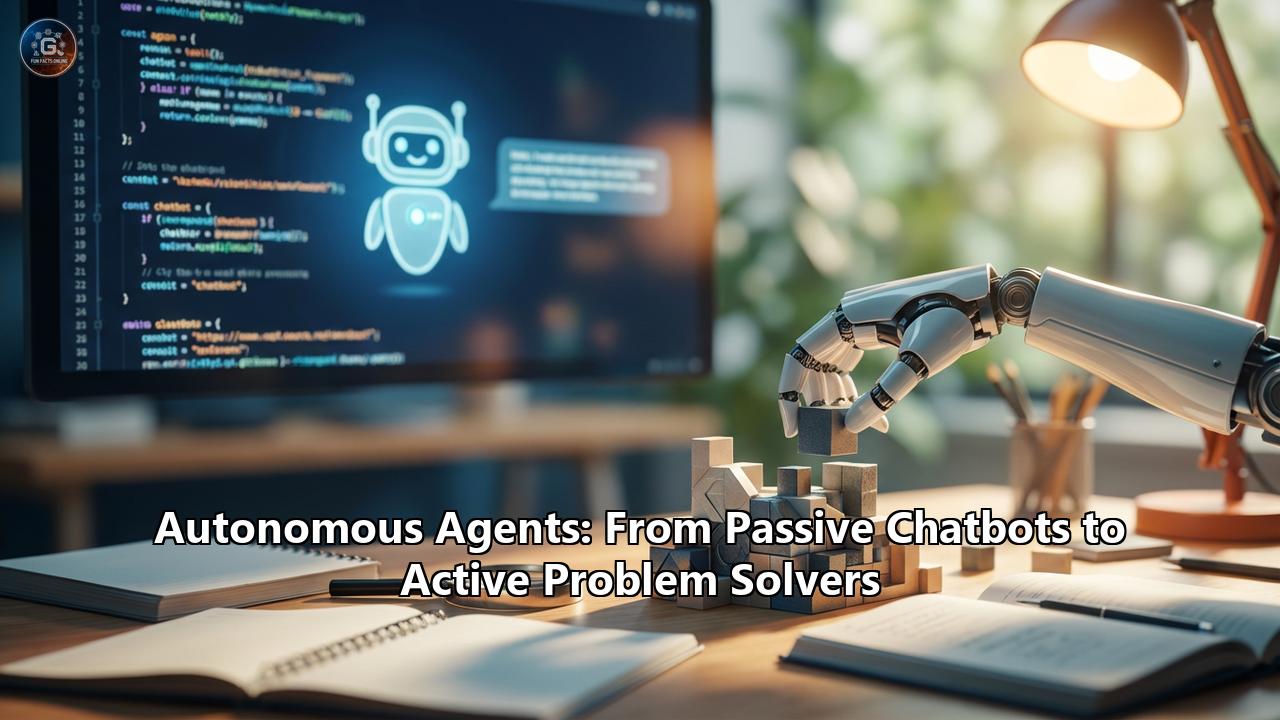
The history of artificial intelligence will likely be divided into two distinct eras: Before Agents and After Agents.
For nearly a decade, we lived in the era of the "chatbot"—a helpful but fundamentally passive interface. You asked a question, and it gave an answer. If you wanted to book a flight, write code, or analyze a spreadsheet, the AI could tell you how to do it, but you still had to do the heavy lifting. The AI was a brilliant encyclopedia, but it had no hands.
In 2024 and 2025, that paradigm shattered. We have entered the era of Autonomous Agents. These are not systems that just talk; they are systems that do. They possess the ability to perceive their environment, reason about complex goals, break them down into actionable plans, and execute those plans using tools—all with little to no human intervention.
This is the story of that transformation. In this comprehensive guide, we will explore the anatomy of these digital workers, the architectures that power them, the frameworks developers are using to build them, and the profound economic and ethical questions they raise.
Part 1: The Great Shift—From "Chat" to "Act"
To understand where we are going, we must understand what changed. The shift from a Large Language Model (LLM) to an Autonomous Agent is a shift from prediction to agency.
The Passive Era: The Oracle in the Box
Traditional LLMs (like GPT-3 or early GPT-4) function as probabilistic engines. They predict the next likely token in a sequence based on vast amounts of training data. When you ask, "How do I fix this Python bug?", the model draws upon millions of GitHub repositories it has "read" to generate a solution. However, once it generates the text, its job is done. It doesn't know if the code actually runs. It cannot see your terminal. It cannot install the library for you. It is an Oracle: all-knowing (mostly), but paralyzed.
The Agentic Era: The Digital Coworker
An autonomous agent wraps that "brain" (the LLM) in a body of capabilities. It gives the model agency.
- Perception: It can "see" your file system, read your emails, or browse the web.
- Action: It can execute code, call APIs, click buttons on a web page, or send Slack messages.
- Persistence: It has memory. It remembers what it tried five minutes ago, realizes it failed, and tries a different approach.
Imagine asking an AI, "Plan a marketing campaign for our new product launch."
- A Chatbot says: "Here is a suggested 5-step plan for your launch..."
- An Agent does: It browses your competitor's websites to analyze their pricing. It logs into your CRM to export customer segments. It drafts email copy, creates a temporary campaign in your email marketing tool, sends a test email to itself, verifies the formatting, and then Slack’s you a link saying, "Campaign drafted and ready for your approval. Click here to send."
This is not just automation; it is goal-oriented reasoning. The agent is not following a rigid script; it is figuring out the steps as it goes.
Part 2: The Anatomy of an Agent
What makes an agent tick? If we were to dissect a modern autonomous agent in 2025, we would find four critical organs working in harmony. This architecture is often referred to as the Cognitive Architecture.
1. The Brain (The LLM/LAM)
At the center sits the Large Language Model (LLM) or increasingly, the Large Action Model (LAM). This is the reasoning engine. Its job is not just to generate text, but to function as a "Router" or "Controller." It analyzes the user's high-level goal (e.g., "Refund this customer") and decides which tools are needed to achieve it.
- Role: Decision making, error handling, and intent understanding.
2. Memory (The Context)
Humans rely on short-term memory to hold a conversation and long-term memory to learn skills. Agents are now mimicking this structure.
- Short-Term (Working) Memory: This stores the immediate context of the current task. "I just tried to query the database, but it failed with Error 500. I should try again."
- Long-Term (Episodic) Memory: This is often powered by Vector Databases (like Pinecone or Weaviate). It allows the agent to recall experiences from days or weeks ago. "Last time the user asked for a 'weekly report,' they preferred the PDF format, not Excel. I will default to PDF this time."
3. Planning (The Strategy)
An agent doesn't just blindly execute. It plans. Before taking a single step, advanced agents engage in Decomposition. They break a vague goal like "Research the EV market" into sub-tasks:
- Search Google for top EV manufacturers in 2025.
- scrape their latest annual reports.
- Extract revenue figures.
- Summarize findings in a table.
- Generate a chart.
Techniques like Chain of Thought (CoT) and Tree of Thoughts (ToT) allow agents to explore different possible paths, simulate the outcome of each, and select the most promising one before acting.
4. Tools (The Hands)
This is the interface with the real world. Tools are defined as functions or APIs that the agent knows how to use.
- Search Tools: Google Search, Bing API.
- File Tools: Read/Write files, modify codebases.
- Software Tools: Jira, Salesforce, GitHub, Slack, Gmail.
- Code Execution: A sandboxed Python environment (like a Jupyter notebook) where the agent can write and run code to analyze data or fix bugs.
Part 3: Agentic Design Patterns
Building an agent is not as simple as giving an LLM access to tools. Developers have discovered that LLMs can be lazy, hallucinate, or get stuck in loops. To solve this, the industry has coalesced around several robust Design Patterns—architectural blueprints for reliable agents.
1. The ReAct Pattern (Reason + Act)
This is the grandfather of agentic patterns. Instead of asking the model to solve the problem in one go, the system forces a loop:
- Thought: "The user wants to know the weather in Tokyo. I need to check the weather API."
- Action: call_weather_api("Tokyo")
- Observation: "API returned: 15°C, Rainy."
- Thought: "I have the data. I can now answer the user."
- Answer: "It is currently 15°C and rainy in Tokyo."
This explicit separation of "thinking" and "doing" reduces hallucinations significantly.
2. Reflection and Reflexion
Agents, like humans, make mistakes. The Reflection pattern involves adding a "critic" step.
- Agent writes code.
- Critic Agent reviews code: "You missed an edge case on line 45. This will crash if the input is zero."
- Agent rewrites code.
3. Tool Use & RAG (Retrieval Augmented Generation)
Agents are now standardizing on RAG not just for knowledge, but for process. An agent facing a complex legal contract might use a "Legal Knowledge Tool" to retrieve specific case law before drafting a clause. The pattern here is dynamic: the agent decides when it needs external info, rather than having it force-fed.
4. Multi-Agent Collaboration (The "Swarm")
Perhaps the most exciting development in 2025 is the move from single agents to Multi-Agent Systems (MAS).
Just as you wouldn't ask your CFO to write production code, you shouldn't ask a single "Generalist Agent" to do everything.
- The Orchestrator Pattern: A "Manager" agent receives the user request and delegates it to specialized "Worker" agents.
Manager: "We need to build a website."
Coder Agent: Writes the HTML/CSS.
Designer Agent: Generates the image assets.
QA Agent: Tests the code and reports bugs back to the Coder.
- The Hierarchical Pattern: Similar to a corporate ladder, where data flows up and commands flow down.
- The Joint Chat Pattern: Agents sit in a virtual chat room and "talk" to each other to solve a problem, passing the baton back and forth until the goal is met.
Part 4: The Framework Wars—LangGraph vs. CrewAI vs. AutoGen
If you want to build an agent today, you aren't writing raw Python code to query an LLM. You are likely using one of the "Big Three" frameworks. Each has a different philosophy.
1. LangGraph (The Engineer’s Choice)
Built by the LangChain team, LangGraph treats agent workflows as a Graph.
- Philosophy: Control. It views agents as "State Machines." You define nodes (tasks) and edges (transitions).
- Best For: Production-grade, highly reliable systems where you need to force specific paths. It excels at "Human-in-the-Loop" workflows (e.g., stopping the graph to wait for a human manager to approve an expense before continuing).
- Vibe: "I want to engineer the exact logic flow."
2. CrewAI (The Manager’s Choice)
CrewAI focuses on Role-Playing. You define a "Crew" of agents, each with a specific persona, backstory, and goal.
- Philosophy: Structure. It mimics a human team. You assign a "Senior Researcher" and a "Junior Writer" and tell them to work together.
- Best For: Creative tasks, content generation, and straightforward automation where defining roles helps the LLM stay in character and focus.
- Vibe: "I am hiring a digital team."
3. AutoGen (The Researcher’s Choice)
Created by Microsoft, AutoGen pioneered the Conversational paradigm.
- Philosophy: Conversation. Agents are just entities that send messages to each other. A "User Proxy" agent can sit in the chat and execute code on behalf of the AI.
- Best For: Coding tasks and complex, open-ended problem solving where agents need to go back and forth many times (e.g., "Write a snake game," "Fix the error," "Try again").
- Vibe: "Let's put smart agents in a room and see what happens."
Part 5: A Day in the Life of an Agent
To truly grasp the power of this technology, let's look at two detailed scenarios of agents in action.
Scenario A: The Autonomous Software Engineer
- 09:00 AM: A human developer assigns a GitHub issue: "Fix the slow database query on the checkout page."
- 09:01 AM: The Coding Agent wakes up. It clones the repository to its sandboxed environment.
- 09:02 AM: It scans the codebase for "checkout" and "database." It identifies a specific SQL query in checkout_service.py.
- 09:05 AM: It writes a test script to reproduce the slowness. It runs the script and confirms the query takes 2.5 seconds.
- 09:10 AM: It attempts a fix: adding an index to the orders table. It modifies the migration file.
- 09:12 AM: It runs the test script again. The query now takes 0.1 seconds.
- 09:15 AM: It runs the full regression test suite to ensure it didn't break anything else.
- 09:20 AM: It pushes the code, opens a Pull Request, writes a detailed description of the fix, and tags the human developer for review.
- Status: Ticket resolved in 20 minutes without human coding.
Scenario B: The Tier-2 Customer Support Agent
- 02:00 PM: A customer emails: "My refund hasn't arrived, and I was double-charged!"
- 02:01 PM: The Support Agent reads the email. It detects "High Sentiment: Angry" and "Topic: Billing."
- 02:02 PM: It uses its Stripe Tool to look up the transaction ID. It sees two charges: one successful, one failed/pending.
- 02:03 PM: It reasons: "The customer sees the pending charge as a double charge. It will drop off in 24 hours."
- 02:04 PM: It checks the refund status. It sees the refund was processed yesterday.
- 02:05 PM: It drafts a reply explaining the "pending" charge vs. the real charge, attaches a PDF receipt of the refund, and offers a $10 coupon for the trouble.
- 02:06 PM: Human-in-the-Loop Trigger: Because the coupon value is >$5, it pauses and pings a human manager via Slack: "Approve $10 coupon for angry customer?"
- 02:10 PM: Manager clicks "Approve."
- 02:10 PM: Agent sends the email and closes the ticket.
Part 6: The Economics of Agency
Why are businesses rushing to deploy agents? It comes down to the Marginal Cost of Cognitive Labor.
In the past, high-quality reasoning was expensive. You had to hire a human. Today, the cost of "renting" a sophisticated brain (like GPT-4o or Claude 3.5 Sonnet) for a few minutes is fractions of a cent.
- Human Agent Cost: ~$6.00 - $12.00 per complex interaction (salary, benefits, training, overhead).
- AI Agent Cost: ~$0.10 - $0.50 per complex interaction (token costs, tool usage).
This 12x to 60x cost reduction fundamentally changes business models. It means you can offer "Concierge Level" support to every customer, not just VIPs. It means you can have a software engineer (agent) spend 24 hours straight optimizing a legacy codebase—a task no human would want to do—for the cost of a nice lunch.
However, a new economic risk emerges: Runaway Costs.
If an agent gets stuck in an infinite loop—repeatedly trying to fix a bug, failing, and trying again—it can burn through thousands of dollars in API credits overnight. This has led to the rise of "FinOps for AI," where strict budget "guardrails" are hard-coded into agent frameworks (e.g., "Maximum 20 steps per task" or "Max $5.00 spend per run").
Part 7: The Dark Side—Risks and Challenges
With great agency comes great risk. Moving from "Chat" to "Act" introduces dangers that never existed with simple chatbots.
1. The Loop of Death (Infinite Loops)
Agents can get obsessive. If an agent is told to "maximize profit" on a simulated trading desk and it encounters a bug, it might execute thousands of buy/sell orders in seconds, draining an account. "Watchdog" agents are now required to monitor the primary agents and kill them if they exhibit repetitive behavior.
2. Hallucinated Actions
A chatbot hallucinating a fact is annoying. An agent hallucinating an action is dangerous.
- Scenario: You ask an agent to "Delete all temporary files."
- Hallucination: The agent mistakenly identifies your operating system files as "temporary" and deletes System32.
- Defense: Agents are now usually deployed in Docker containers or secure sandboxes with limited permissions (Principle of Least Privilege).
3. Non-Human Identities (NHIs) & Security
Agents need login credentials. They need API keys for Stripe, AWS, and Slack. This has created a massive security blind spot. We have strict protocols for onboarding human employees, but who manages the "identity" of Agent-007? If a hacker hijacks an agent via Prompt Injection (tricking the agent into ignoring its instructions), they inherit all the agent's permissions. They can use the agent to exfiltrate data or modify databases, all while looking like valid "authorized" traffic.
Part 8: The Future—2026 and Beyond
As we look toward the latter half of the decade, the trajectory is clear.
1. From Pilot to Production:2024 was the year of the prototype. 2025 is the year of production. Companies are moving from "cool demos" to agents that handle mission-critical workflows in finance (auditing), healthcare (patient intake), and law (contract review).
2. Ubiquitous "Digital Coworkers":The term "user" will evolve. You won't just be a user of software; you will be a manager of agents. The skill set of the future knowledge worker will shift from "doing the work" to "orchestrating the agents who do the work." Resume skills will include "Multi-Agent Systems Management" and "Agentic Workflow Optimization."
3. Autonomous Observability:We will see agents designed solely to debug other agents. "Doctor" agents will monitor the logs of "Worker" agents, diagnosing why they failed and patching their prompts or code in real-time.
ConclusionThe transition from passive chatbots to active problem solvers is not just a feature update; it is a fundamental reimagining of our relationship with computers. For fifty years, computers have been tools—hammers we had to swing. Now, they are becoming carpenters. They can look at the blueprint, pick up the hammer, and build the house alongside us. The future belongs to those who learn to lead them.
Reference:
- https://nhimg.org/community/agentic-ai-and-nhis/the-top-10-identity-risks-you-must-know-about-autonomous-ai-agents/
- https://www.getmonetizely.com/articles/the-economics-of-agentic-ai-pricing-autonomous-digital-workers
- https://medium.com/@amitkharche14/agentic-ai-pitfalls-loops-hallucinations-ethical-failures-fixes-77bd97805f9f
- https://www.weforum.org/stories/2025/10/non-human-identities-ai-cybersecurity/
- https://www.unite.ai/the-ai-agents-trap-the-hidden-failure-modes-of-autonomous-systems-no-one-is-preparing-for/
- https://securitybrief.com.au/story/tenable-hack-of-copilot-ai-agent-exposes-fraud-risks
- https://www.kumohq.co/blog/cost-to-build-an-ai-agent
- https://galileo.ai/blog/debug-multi-agent-ai-systems
- https://www.rapidops.com/blog/ai-agent-development-cost/
- https://blog.tonic3.com/guide-to-smart-ai-agent-budget-token-consumption
- https://medium.com/@rakesh.sheshadri44/the-dark-psychology-of-multi-agent-ai-30-failure-modes-that-can-break-your-entire-system-023bcdfffe46
- https://magai.co/ai-vs-human-agents-cost-benefit-breakdown/
- https://hoeijmakers.net/ai-agent-cost-compared-to-a-human/
- https://retool.com/blog/cost-of-ai-agents-hourly-pricing-model
- https://proquantic.com/blog/ai-agent-development-cost-2025
- https://medium.com/@kamyashah2018/top-5-debugging-techniques-for-complex-multi-agent-systems-3efb71688b0f
- https://grokkingtechcareer.substack.com/p/3-ai-system-design-skills-companies
- https://itbrief.co.uk/story/ai-agents-spark-new-identity-security-fears-for-2026