
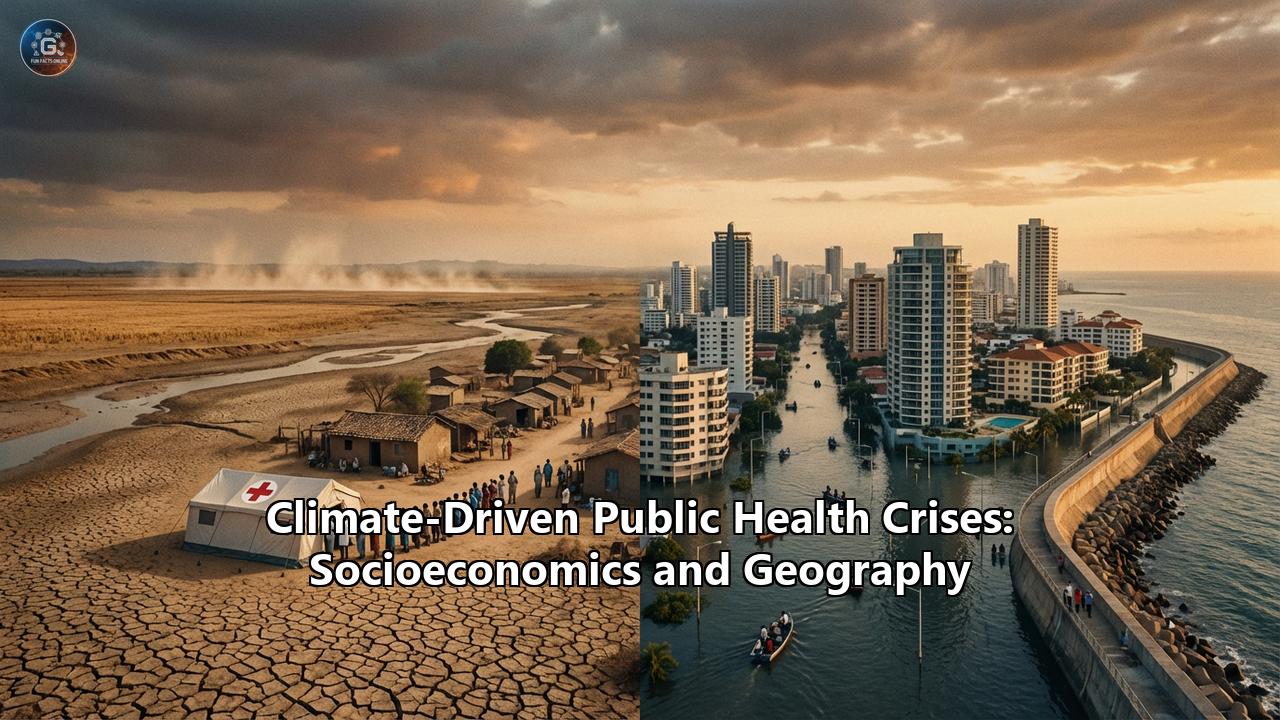
The intersection of climate change and public health has ceased to be a distant, theoretical scenario reserved for the closing chapters of scientific reports. It has aggressively breached our daily reality, transforming into a global health emergency that is currently reshaping how we live, how long we live, and how we die. With 2024 confirmed as the hottest year on human record and subsequent years continuing the relentless warming trend, the narrative of climate change has shifted from shrinking ice caps and struggling polar bears to overcrowded emergency rooms, collapsing agricultural systems, and the relentless spread of infectious diseases.
Yet, this crisis is profoundly undemocratic. While the changing climate spans the entire globe, its health impacts do not strike equally. The severity of the blow is heavily mediated by two critical dimensions: socioeconomics and geography. Where you happen to be born, the elevation of your city, the proximity of your home to a coastline, and the balance of your bank account are now the primary determinants of your physical resilience against a warming world.
To understand the modern public health crisis, we must view it through the dual lenses of the geographic lottery and the socioeconomic divide.
The Anatomy of a Climate-Health Emergency
Before dissecting the inequalities of the crisis, we must understand the sheer breadth of the physiological threats posed by a warming planet. The human body is a highly calibrated machine, designed to operate within a narrow thermal and environmental window. Climate change forces the body to adapt to conditions it was never evolutionarily prepared to endure.
The Silent and Immediate Killer: Extreme HeatHeat is the most direct, tangible, and lethal consequence of global warming. While dramatic natural disasters like hurricanes and floods capture global headlines, extreme heat is a silent killer that claims vastly more lives. In 2022 and 2023 combined, more than 100,000 people across 35 countries in the European Region died due to heat-related complications.
When ambient temperatures exceed the body’s core temperature, the cardiovascular system goes into overdrive. The heart pumps aggressively to push blood to the skin's surface, attempting to release heat through sweat. For the elderly, infants, or those with pre-existing cardiovascular and respiratory conditions, this intense strain can trigger fatal heart attacks or strokes. Furthermore, chronic exposure to high temperatures combined with physical exertion—a reality for millions of agricultural and construction workers globally—has been linked to an epidemic of chronic kidney disease of unknown etiology, as relentless dehydration and heat stress destroy renal function over time. According to recent World Health Organization (WHO) data, approximately 37% of heat-related deaths are directly attributable to human-induced climate change, with heat-related mortality among individuals over 65 rising by an astonishing 70% over the last two decades.
The Expanding Empire of Vector-Borne DiseasesThe geographic boundaries that once contained deadly diseases are dissolving. Mosquitoes, ticks, and other vectors are highly sensitive to temperature and humidity. As global temperatures soar and rainfall patterns become erratic, the habitats suitable for the Aedes aegypti and Anopheles mosquitoes are expanding poleward and into higher altitudes previously shielded by cooler climates.
The recent explosion of dengue fever perfectly illustrates this trend. The global average transmission potential of dengue has surged by up to 49% since the 1950s. Driven by soaring temperatures that accelerate the mosquito life cycle and viral replication rates, dengue spread to roughly one in every 800 people on the planet in the early months of 2024 alone. In the Americas, climate change has been identified as a driving factor behind a record-breaking surge of approximately 45 million dengue infections a year. Public health infrastructure in regions newly exposed to these pathogens is often caught entirely off guard, lacking the diagnostic tools, treatments, and vector-control protocols that traditionally endemic regions have spent decades developing.
Air, Water, and the Foundations of LifeThe climate crisis is systematically dismantling the fundamental building blocks of human health: clean air, safe water, and adequate food. Rising temperatures and prolonged droughts have turned vast swathes of forests into tinderboxes. The resulting wildfires produce massive quantities of fine particulate matter (PM2.5), which can travel thousands of miles, penetrating deep into the lungs and entering the bloodstream. In 2024, an estimated 154,000 deaths were linked to wildfire smoke-derived small particulate matter.
Simultaneously, erratic precipitation leads to catastrophic flooding, which routinely overwhelms sanitation systems and contaminates drinking water supplies. In Africa, changing weather patterns and flash floods recently contributed to a massive surge in waterborne diseases, with the Africa CDC recording over 300,000 cholera cases by late 2025.
The Geographical Lottery: Where You Are Dictates What You Face
Geography is destiny in the era of climate change. The specific topography, latitude, and regional climate of a given area dictate the precise nature of the health threats its population will endure.
Coastal Communities and Small Island Developing States (SIDS)For the billions living in coastal regions, sea-level rise represents an existential threat that extends far beyond lost real estate. As oceans rise, saltwater intrudes into freshwater aquifers, severely compromising drinking water supplies and destroying agricultural land. Consuming highly salinized water is linked to hypertensive disorders, particularly dangerous for pregnant women, leading to pre-eclampsia and premature births. Furthermore, coastal communities are the first line of defense against increasingly intense tropical cyclones and hurricanes, which decimate health infrastructure, sever supply chains for essential medicines, and leave stagnant water in their wake—the perfect breeding ground for cholera and malaria outbreaks.
The Urban Heat Island EffectMore than half of the global population resides in urban centers, and these concrete jungles present a unique micro-geographical hazard. Cities are composed of asphalt, concrete, and steel—materials that absorb and re-radiate solar heat. Combined with a lack of vegetation and waste heat generated by vehicles and air conditioning units, urban areas can be several degrees hotter than their rural surroundings. This "Urban Heat Island" effect turns cities into thermal traps during heatwaves, meaning urban populations face a disproportionately higher risk of heatstroke and respiratory distress as heat exacerbates ground-level ozone pollution.
The Shifting Subtropics and Arid ZonesIn arid and semi-arid regions, such as the Sahel in Africa or parts of the Middle East, the crisis manifests primarily as drought and desertification. The health impacts here are insidious: chronic water scarcity, catastrophic crop failures leading to severe malnutrition, and an increase in respiratory diseases caused by massive dust storms.
Conversely, temperate regions that historically enjoyed mild climates are now experiencing the "tropicalization" of their weather patterns. European countries, which are warming faster than any other WHO region, are finding their populations uniquely vulnerable because their architectural and public health infrastructures were never designed for extreme, sustained heat.
The Socioeconomic Divide: The Price of Survival
If geography dictates the nature of the climate-health threat, socioeconomics dictates a population's ability to survive it. Climate change acts as a brutal magnifying glass, exposing and exacerbating existing inequalities. The wealthy have the capital to purchase adaptation; the poor are left entirely exposed to the elements.
The Wealth Shield vs. The Frontline VictimsAffluence buys distance from environmental disaster. High-income individuals can afford robust air conditioning to survive heatwaves, purchase air purifiers to filter out wildfire smoke, secure comprehensive health insurance to treat climate-related ailments, and, ultimately, relocate when their geography becomes uninhabitable.
For marginalized and low-income populations, this "wealth shield" does not exist. Vulnerable communities are often geographically relegated to areas with the highest environmental risks—floodplains, areas adjacent to heavily polluting industries ("fenceline communities"), or densely packed urban neighborhoods devoid of tree canopies. In the United States, historical practices like redlining have left minority neighborhoods with significantly less green space, meaning these areas experience significantly higher temperatures during heatwaves compared to affluent, tree-lined suburbs.
Furthermore, the economic imperative to work traps many in hazardous environments. Outdoor laborers—agricultural workers, construction crews, and delivery personnel—cannot seek refuge indoors when temperatures soar. They bear the brunt of thermal extremes, sacrificing their long-term health to maintain their livelihoods and, ironically, the societal infrastructure that allows the wealthy to remain comfortable.
The Global South and the Burden of InjusticeOn a macro level, the socioeconomic divide is starkly visible between the Global North and the Global South. Low- and middle-income countries, which have contributed the least to historical greenhouse gas emissions, are suffering the most severe health consequences. These nations often struggle with underfunded health systems, high baseline rates of poverty, and a lack of resilient infrastructure.
The financial cost of this injustice is staggering. The World Bank estimates that a changing climate could lead to excess health costs in low- and middle-income countries of at least $21 trillion by 2050, eating up approximately 1.3% of their projected GDP. Furthermore, the compounding effects of climate-driven health crises—such as lost labor productivity due to extreme heat or the medical costs associated with a malaria outbreak—are expected to drive at least 44 million people into extreme poverty by 2030.
When a climate disaster strikes a developing nation, the healthcare system is often a casualty. Floods wash away clinics, power grids fail, and supply chains for life-saving medications rupture. Without robust international support, these nations are forced into a vicious cycle of disaster and delayed recovery, permanently stunting their economic and social development.
Building Resilience: Bridging the Gap and Fighting Back
Addressing the climate-driven public health crisis requires moving beyond mere acknowledgment and investing heavily in targeted adaptation, innovative technologies, and systemic equity. If climate change is the ultimate threat multiplier, our response must be a resilience multiplier.
Hyper-Local Predictive Surveillance and AIOne of the most promising frontiers in climate-health adaptation is the integration of Artificial Intelligence (AI) and epidemiological forecasting. Rather than waiting for an outbreak or a heatwave to claim lives, forward-thinking nations are using data to anticipate the crisis. In India, for example, the indigenous Bharat Forecasting System utilizes AI to offer 6km resolution predictions, combining satellite imagery of land surface temperatures with socio-economic data to identify vulnerable urban heat islands in real-time.
Similarly, predictive vector-borne disease modeling is transforming public health from a reactive to a proactive discipline. By analyzing non-linear climatic variables such as humidity, stagnant water patterns, and temperature fluctuations, AI models—such as the Random Forest and Long Short-Term Memory (LSTM) systems deployed in Kerala, India—can predict dengue and malaria outbreaks weeks before they occur. This allows public health officials to pre-position resources, issue hyper-local alerts, and implement larval control measures precisely where and when they are needed.
Greening the Infrastructure and Strengthening Health SystemsAdaptation must also take a physical form. Cities must be redesigned to mitigate the urban heat island effect, focusing heavily on implementing green infrastructure in historically marginalized, low-income neighborhoods. Expanding tree canopies, creating cooling centers, utilizing reflective building materials, and integrating urban wetlands can dramatically lower ambient temperatures and manage floodwaters.
Simultaneously, healthcare systems themselves must undergo a radical transformation. Hospitals must become climate-resilient—equipped with independent, renewable energy microgrids to ensure life-saving machinery continues operating during grid failures. Healthcare systems must also address their own carbon footprints; ironically, the global healthcare sector is a massive emitter of greenhouse gases, and decarbonizing health infrastructure is a crucial step in mitigating the very crisis it is treating.
Closing the Climate-Health Financing GapUltimately, the barrier to global resilience is financial. There is a staggering gap between the need for adaptation in low- and middle-income countries and the funding currently available. While 95% of Nationally Determined Contributions (NDCs) to the Paris Agreement now include health considerations, financial pledges to international adaptation funds have frequently fallen short or faced concerning political pushback.
To address the crisis equitably, the global community must fulfill and expand its financial commitments. Initiatives like the multilateral health and climate investment framework—championed by organizations like the Green Climate Fund, the WHO, and global philanthropies—aim to channel necessary funds into health adaptation. Scaling up grant-based climate finance is critical; expecting developing nations to take on high-interest debt to adapt to a crisis they did not create is both morally indefensible and economically unsustainable.
The Imperative for Action
The convergence of climate change, socioeconomics, and geography has created a complex web of vulnerability that threatens to undo the last 50 years of global public health progress. As the planet approaches critical temperature thresholds, the window to protect human health is rapidly closing.
We can no longer afford to treat environmental policy and public health policy as separate disciplines. Every fraction of a degree of warming prevented is millions of lives saved, and every dollar invested in community resilience is an economic catastrophe averted. The defining challenge of our era is not merely stopping the thermometer from rising, but ensuring that as the world changes, the right to health, safety, and survival is not determined by the latitude of your birth or the size of your wallet. Addressing the climate-driven public health crisis is not just a scientific necessity; it is the ultimate test of our global humanity.
Reference:
- https://news.un.org/en/story/2025/06/1164261
- https://www.cfr.org/reports/climate-adaptation-crisis-global-health
- https://research-and-innovation.ec.europa.eu/news/all-research-and-innovation-news/climate-change-and-public-health-new-roadmap-research-and-innovation-reduce-risks-2025-06-05_en
- https://www.worldbank.org/en/topic/health/brief/health-and-climate-change
- https://www.who.int/news-room/fact-sheets/detail/climate-change-and-health
- https://reliefweb.int/report/world/bridging-climate-health-gap
- https://www.ibtimes.co.in/earth-faces-its-greatest-battle-beyond-wars-34c-warming-could-trigger-hothouse-earth-898901
- https://www.youtube.com/watch?v=teiXpwBvems
- https://lancetcountdown.org/2025-report/
- https://healthpolicy-watch.news/2025-a-brutal-year-for-global-health/
- https://www.drishtiias.com/daily-updates/daily-news-editorials/ai-at-the-frontline-of-indias-climate-health-battle
- https://www.lancetcountdownus.org/2024-lancet-countdown-u-s-brief/
- https://pmc.ncbi.nlm.nih.gov/articles/PMC7616816/