
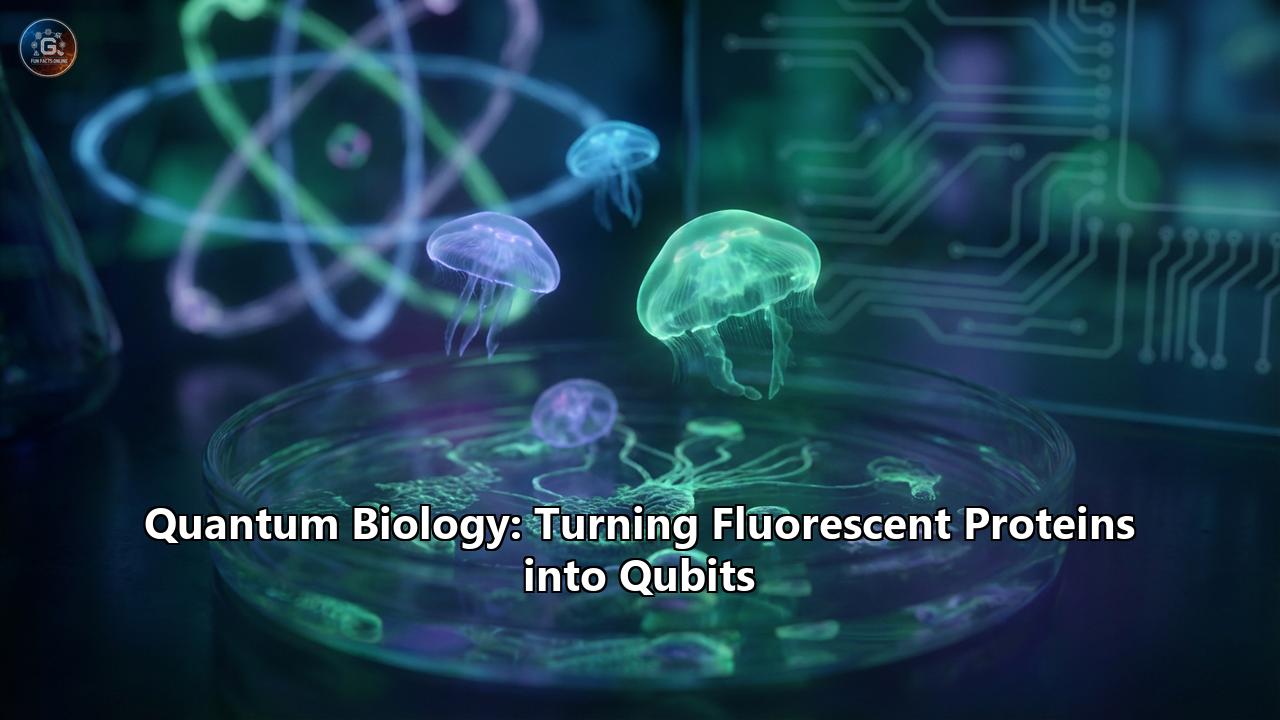
Imagine a computer that isn't built in a sterile cleanroom by robotic arms, but rather grown inside a petri dish, self-assembling from the basic building blocks of life. Imagine a sensor so small it can slip inside a single living cell, riding the cytoplasmic currents to measure the magnetic firing of individual neurons or the feverish heat of a mitochondria gone rogue. For decades, this has been the domain of hard science fiction—the "wetware" processors of cyberpunk novels and the biological ships of space opera.
But in August 2025, fiction became fact.
In a landmark paper published in Nature, researchers from the University of Chicago’s Pritzker School of Molecular Engineering shattered the barrier between the cold, hard world of quantum physics and the warm, wet chaotic world of biology. They successfully demonstrated that Enhanced Yellow Fluorescent Protein (EYFP)—a derivative of the same protein that makes jellyfish glow—can function as a quantum bit, or qubit.
This is not just another incremental step in quantum computing. It is a paradigm shift. Traditional quantum computers, like those built by Google and IBM, rely on superconducting circuits or trapped ions that must be kept at temperatures colder than deep space to function. They are fragile, isolated, and utterly incompatible with life. The Chicago team, led by pioneers like David Awschalom and Peter Maurer, did the opposite. They didn't try to make a quantum sensor biocompatible; they took a biological molecule and made it quantum.
By turning a protein into a qubit, humanity has effectively unlocked the door to Quantum Biology 2.0. We are no longer just observing quantum effects in nature (like birds navigating by magnetic fields or plants harvesting light); we are now engineering them. We are standing on the precipice of a future where computers can heal, where sensors can replicate, and where the boundary between a machine and an organism is not just blurred—it is erased.
This comprehensive guide will take you through the entire journey of this discovery. We will dive deep into the atomic-level physics of how a "wet" protein can hold a quantum state. We will explore the history of quantum biology, from Schrödinger’s doubts to the mysteries of avian navigation. We will compare these new "bio-qubits" to their solid-state cousins, and finally, we will peer into the future to see how "wetware" computing could revolutionize medicine, technology, and our very understanding of life itself.
Part I: The Spark of Life – How a Protein Becomes a Qubit
To understand the magnitude of this breakthrough, we first have to understand the unlikely hero of our story: the Green Fluorescent Protein (GFP), and its golden cousin, EYFP.
1.1 The Lantern in the Jellyfish
In the cold waters of the Pacific Northwest, the crystal jellyfish (Aequorea victoria) drifts along, pulsating with a faint green light. This bioluminescence is powered by a protein that has revolutionized modern biology. Isolated in the 1960s and cloned in the 1990s, GFP became the "microscope of the 21st century." By attaching the DNA for GFP to other genes, scientists could make specific parts of a cell glow. Suddenly, we could see when a cancer cell divided or how a virus invaded a host.
But for decades, GFP was just a light bulb. It was a passive tool. No one suspected that hidden inside its glowing barrel structure was the potential for quantum calculation.
1.2 The Architecture of a Bio-Qubit
The magic of fluorescent proteins lies in their shape. Imagine a soda can made of woven molecular strands. This is the beta-barrel—a rigid, cylindrical cage made of protein sheets. Safely tucked inside the center of this can, protected from the sloshing water and ions of the cellular environment, sits the chromophore. This is the small chemical structure that actually absorbs and emits light.
The Chicago researchers realized that this beta-barrel wasn't just a physical shield; it was a quantum shield.
In a standard quantum computer, the biggest enemy is decoherence. This is when the environment (heat, vibration, stray electromagnetic fields) interacts with a qubit and causes it to lose its quantum information—collapsing its superposition of "0" and "1" into a plain old bit. This is why quantum computers are usually kept in giant dilution refrigerators at near absolute zero.
However, the beta-barrel of EYFP is so rigid and protective that it creates a tiny, isolated pocket of "quiet" for the chromophore, even at room temperature. It acts like a molecular Faraday cage, preserving the delicate quantum states of the electrons inside.
1.3 The Physics: Entering the Triplet State
How do you actually turn this glowing protein into a qubit? The mechanism relies on the spin of electrons.
- Initialization (The Blue Flash): The process begins by hitting the protein with a pulse of blue light (488 nanometers). This excites the electrons in the chromophore from their ground state ($S_0$) to an excited singlet state ($S_1$).
- Intersystem Crossing (The Quantum Leap): Normally, the electron would just fall back down and emit a photon (fluorescence). But in EYFP, there is a small probability that the electron will undergo a "forbidden" transition called intersystem crossing (ISC). It flips its spin and enters a metastable triplet state ($T_1$).
Think of the Singlet state as an electron spinning "up" and its partner spinning "down." They cancel each other out.
In the Triplet state, the electron flips so it is parallel to its partner. This state is "metastable," meaning the electron gets stuck there. It can't easily fall back down because the rules of quantum mechanics forbid it from flipping its spin back without help.
- The Qubit ($T_1$): This long-lived Triplet state is our qubit. It has three sublevels (Tx, Ty, Tz) based on its magnetic orientation. By applying precise microwave pulses, researchers can manipulate the electron between these sublevels, creating a superposition—effectively writing "0" and "1" at the same time.
- Readout (The Infrared Trigger): This was the team's "secret sauce." Reading the state of the qubit without destroying it is hard. They developed a technique called Optically Activated Delayed Fluorescence (OADF). They hit the protein with a second laser pulse—this time infrared (912 nm).
This pulse kicks the electron from the Triplet state ($T_1$) up to a higher energy Triplet state ($T_2$).
From there, it creates a "backdoor" for the electron to flip back to the Singlet state and emit a photon.
The Result: If the protein glows after the infrared pulse, you know the qubit was in one state. If it stays dark, it was in the other. This "triggered readout" provided a massive boost in signal contrast, making the bio-qubit readable even in the noisy environment of a cell.
1.4 By the Numbers: Performance
How does a protein stack up against a supercomputer?
- Coherence Time ($T_2$): The protein qubit can maintain its quantum state for about 16 microseconds at cryogenic temperatures. While this sounds short compared to the milliseconds of solid-state diamonds, it is an eternity in the world of biology.
- Spin-Lattice Relaxation ($T_1$): The energy stays trapped in the spin state for roughly 141 microseconds.
- Room Temperature: Crucially, the team detected quantum signals (ODMR) in live bacterial cells at room temperature, though with reduced contrast (around 8%). This proves that quantum operations can survive the warm, wet chaotic environment of life.
Part II: The History of Quantum Biology – From Schrödinger to Robins
The discovery of the protein qubit didn't happen in a vacuum. It is the culmination of a century-long debate about whether the "spooky action" of quantum mechanics plays a role in the messy business of being alive.
2.1 1944: The Prophecy
The story begins with Erwin Schrödinger, the father of the quantum wave function (and the famous cat). In his seminal book What is Life?, he speculated that the genetic code (which hadn't been discovered yet) must be an "aperiodic crystal"—a structure stable enough to resist thermal chaos, likely governed by quantum laws. He planted the seed that life might be a macroscopic quantum phenomenon.
2.2 1960s-1990s: The Tunneling Enzymes
For decades, biologists ignored physics. Biology was about shapes—keys fitting into locks. But in the late 20th century, anomalies started appearing. Enzymes, the catalysts that speed up chemical reactions in our bodies, were working too fast. Classical physics couldn't explain how they moved protons around so quickly.
The answer was Quantum Tunneling. Instead of climbing over energy barriers, protons in enzymes were "teleporting" through them, vanishing from one side of a molecule and appearing on the other. This was the first solid proof that our metabolism relies on quantum weirdness.
2.3 The Photosynthesis Mystery (The FMO Complex)
In 2007, another bombshell dropped. Researchers studying green sulfur bacteria found that the Fenna-Matthews-Olson (FMO) complex—a protein antenna that harvests sunlight—was almost 100% efficient. When a photon hits the antenna, the energy doesn't bounce around randomly like a pinball; it takes every possible path simultaneously to reach the reaction center. This is Quantum Coherence. The bacteria were performing a quantum search algorithm, similar to Grover's algorithm, to find the most efficient path for energy transfer.
2.4 The Compass in the Eye (Cryptochromes)
Perhaps the most famous example of natural quantum biology is the European Robin. These birds migrate thousands of miles, navigating by the Earth's magnetic field—a field so weak it shouldn't be detectable by biological tissues.
The leading theory, now supported by massive evidence, is the Radical Pair Mechanism. Inside the bird's eye is a protein called Cryptochrome. When blue light hits it, it knocks an electron loose, creating a pair of entangled radicals. These entangled electrons are incredibly sensitive to magnetic fields. As the bird turns its head, the Earth's magnetic field alters the spin of these electrons, changing the chemical signals sent to the brain. The bird literally sees the magnetic field lines as quantum patterns overlaid on its vision.
The Chicago team’s EYFP qubit is a direct spiritual successor to Cryptochrome. Both use light to create spin-correlated states in a protein structure. But where nature used evolution to build a compass, we are now using engineering to build a computer.
Part III: Biological Qubits vs. The World
So, why bother with protein qubits? Why not just stick to the silicon and superconducting circuits we already have? Let’s compare the contenders in the Quantum Arena.
| Feature | Superconducting Qubits (IBM/Google) | NV Centers (Diamond) | Protein Qubits (EYFP) |
| :--- | :--- | :--- | :--- |
| Operating Temp | Near Absolute Zero (~0.015 K) | Room Temp to Cryogenic | Room Temp (Sensing) to Cryogenic (Control) |
| Size | Micrometers (Huge) | Nanometers | ~3 Nanometers (Tiny) |
| Fabrication | Complex Lithography (Cleanroom) | High-Pressure synthesis | Self-Replicating (Bacteria grow them) |
| Biocompatibility| None (Toxic/Frozen) | Moderate (Hard to deliver into cells) | Perfect (Genetically Encodable) |
| Coherence | High (~100 µs+) | Very High (~1 ms+) | Moderate (~16 µs) |
| Scalability | Hard (Wires everywhere) | Hard (Placement issues) | Massive (Billions in a test tube) |
The Advantage of "The Wet"
- Genetic Encodability: This is the killer app. You cannot inject a diamond NV center into a specific organelle of a specific cell and expect it to stay there. But with EYFP, you can just splice the gene into the cell's DNA. The cell becomes the factory. It will synthesize the quantum sensor and send it exactly where you want it—to the nucleus, the mitochondria, or the cell membrane.
- Identical Qubits: In solid-state physics, every diamond defect is slightly different due to lattice strain. In biology, every protein produced by a DNA sequence is atomically identical. Nature has perfected mass manufacturing.
- Self-Assembly: You don't need a billion-dollar fab. You need a flask of E. coli and some sugar water.
Part IV: The "Wetware" Revolution – Future Applications
The immediate application of this technology is not to run Crysis or crack bank codes. It is Quantum Sensing. But the long-term potential points toward a hybrid future of biological and technological integration.
4.1 The Quantum Doctor: Intracellular Sensing
Current medical diagnostics are like trying to fix a watch with a hammer. We take blood tests that measure averages across billions of cells. We miss the tiny, initial sparks of disease.
- Metabolic Monitoring: An EYFP sensor targeted to mitochondria could measure the magnetic fields generated by electron transport chains. A drop in efficiency could signal the onset of metabolic diseases like diabetes or aging before symptoms appear.
- Neuronal Mapping: Today, we measure brain activity with electrodes (clunky) or calcium imaging (slow). Protein qubits could detect the magnetic pulse of a single neuron firing. We could map the brain at a resolution previously impossible, unlocking the secrets of consciousness and memory.
- Cancer Detection: Cancer cells have different pH and thermal signatures than healthy cells. A quantum protein sensor could detect the slight temperature rise of a dividing tumor cell, flagging it for the immune system or a targeted drug.
4.2 Wetware Computing: The Hybrid Brain
Futurists have long dreamed of "wetware"—computers made of biological neurons. But biological neurons are slow (milliseconds). Quantum neurons would be fast.
Imagine a hybrid chip. The logic gates are protein arrays. The interconnects are photons. The power source is glucose.
- Self-Healing Computers: If a protein qubit breaks (photobleaches), the cell just degrades it and makes a new one. Your computer would effectively have an immune system.
- Brain-Computer Interfaces (BCI): Instead of jamming metal wires into the brain (like Neuralink), we could use viral vectors to deliver quantum sensor proteins into neurons. These proteins could be read out by an external optical device, creating a non-invasive, high-bandwidth link between the human mind and the digital cloud.
4.3 The Ethics of Quantum Life
As with any powerful technology, we must tread carefully. If we engineer proteins to be sensitive to quantum states, are we fundamentally altering the nature of life?
- The "Radio-Telepathy" Problem: If we fill a brain with quantum sensors that can be read by lasers, we also create the ultimate surveillance device. Thoughts and neural patterns could potentially be read remotely.
- Directed Evolution: We are essentially taking the tools of evolution and forcing them to prioritize quantum coherence. What happens if these quantum-enhanced genes escape into the wild? Could we accidentally create bacteria that are hyper-sensitive to electromagnetic fields, disrupting ecosystems?
Part V: Challenges and The Road Ahead
The Chicago breakthrough is just the starting gun. Significant hurdles remain before we have a "Pentium Protein" processor.
- Brightness and Contrast: The 8% contrast signal in cells is impressive for a first try, but too low for reliable computing. It needs to be closer to 90%.
- Photobleaching: Fluorescent proteins burn out. After too many laser pulses, they stop glowing. Solid-state diamonds last forever; proteins die. We need to engineer "zombie proteins" that are far more robust.
- The Temperature War: While sensing works at room temperature, controlling the qubit (writing data) still works best at cryogenic temperatures. Closing this gap is the Holy Grail.
For centuries, we have viewed life as a chemical engine—a complex clockwork of pumps and valves. Then, we viewed it as an information processor—a digital code written in DNA. Now, we are beginning to see life as a quantum phenomenon.
The creation of the fluorescent protein qubit is the bridge. It connects the silicon valley of our technology with the carbon valley of our biology. It suggests a future where our devices are not just smart, but alive. Where we don't just build computers, we grow* them. Where the green glow of a jellyfish is not just a wonder of the deep sea, but the heartbeat of the next technological revolution.
We have turned the lights on in the quantum biological age. And the future looks bright green.
Reference:
- https://www.spinquanta.com/news-detail/qubit-coherence-time-a-critical-factor-in-quantum-computing
- https://medium.com/cognetics/when-wetware-meets-qubits-charting-the-post-silicon-frontier-b8e066b64cb7
- https://www.youtube.com/watch?v=HNhHcHjbJ4w
- https://news.uchicago.edu/story/scientists-program-cells-create-biological-qubit-quantum-breakthrough
- https://www.ntt-review.jp/archive/ntttechnical.php?contents=ntr201209fa2.html
- https://www.livescience.com/technology/scientific-breakthrough-leads-to-fluorescent-biological-qubit-it-could-mean-turning-your-cells-into-quantum-sensors
- https://thequantuminsider.com/2025/08/20/proteins-double-as-qubits-a-step-that-could-one-day-bridge-quantum-computing-and-biology/
- https://www.youtube.com/watch?v=fQ1iZDo5Ahc