
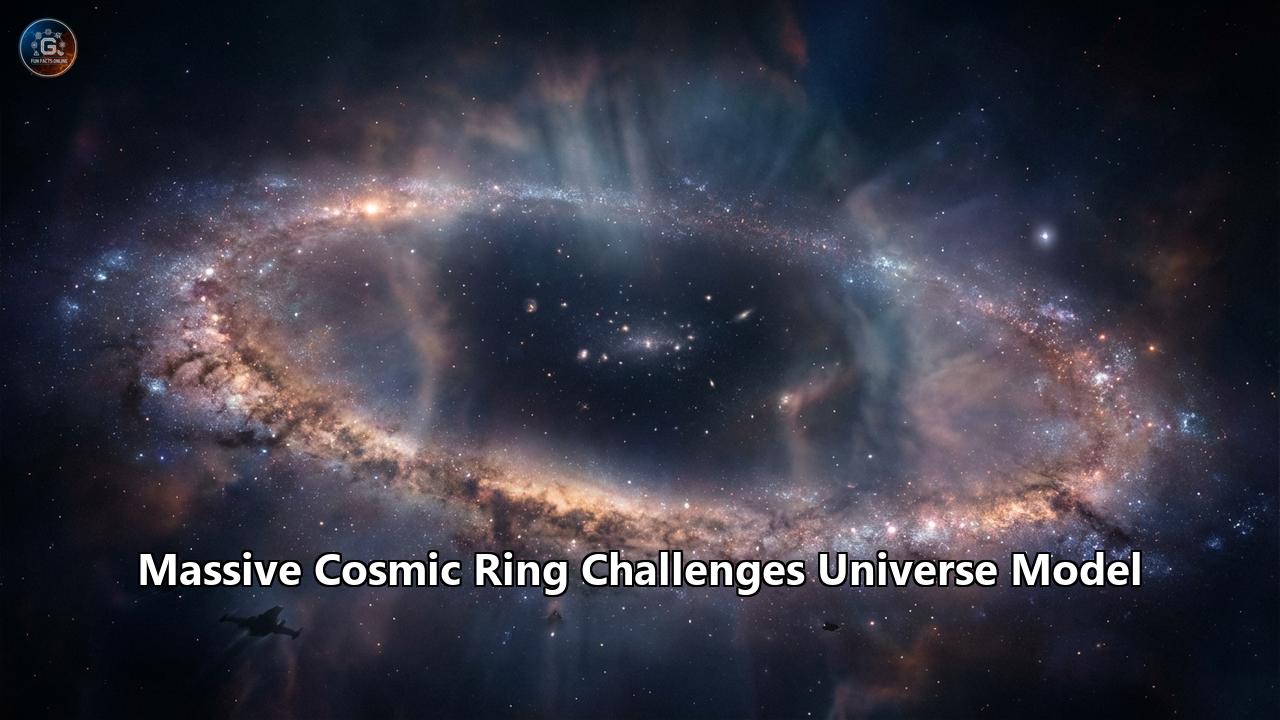
The night sky, to the unaided eye, is a tapestry of chaos and calm—a scattering of stars that seems at once random and eternal. For millennia, humanity looked up and saw patterns: hunters, bears, queens, and scales. We drew lines between the dots, creating constellations to make sense of the void. We believed these shapes were real, etched into the celestial sphere by gods. Then, science taught us better. We learned that the stars in a constellation are often light-years apart, unconnected, their alignment a mere trick of perspective from our lonely outpost on Earth. We learned to trust the math, the physics, and the models that told us the universe, on its grandest scales, was not a collection of special shapes, but a smooth, featureless sea of matter.
We were wrong.
Or, at the very least, we are beginning to suspect that our map of the cosmos is missing a crucial legend. Deep in the remote darkness, some 9.2 billion light-years from where you sit reading this, lies a structure that defies the laws of cosmic architecture. It does not fit the models. It should not exist.
It is called the Big Ring.
Together with its neighbor, the Giant Arc, this colossal formation has thrown the world of cosmology into a quiet, thrilling turmoil. It is a discovery that challenges the Cosmological Principle—the very bedrock upon which our understanding of the universe is built. If these structures are real, and the mounting data suggests they are, then the standard model of the universe, the framework we have used to explain everything from the Big Bang to the drift of galaxies, may need a radical renovation.
This is the story of that discovery. It is a journey that takes us from a university office in Lancashire to the edge of the observable universe, from the sketches of Einstein to the wilder speculations of cosmic strings and cyclic aeons. It is a story about the size of things, the limits of time, and the human need to find the shape of the unknown.
Part I: The Anomalies in the Deep
The constellation Boötes, the Herdsman, is a familiar sight in the northern sky, anchored by the bright orange giant star Arcturus. For amateur astronomers, it is a kite-shaped guidepost. But for Alexia Lopez, a cosmologist at the University of Central Lancashire (UCLan), Boötes hides a secret that is far larger than any star.
The story begins not with the Big Ring, but with its predecessor. In 2021, while still a PhD student, Lopez was analyzing data from the Sloan Digital Sky Survey (SDSS). She was looking at the absorption patterns of magnesium ions (Mg II) in the spectra of distant quasars. Quasars are the blazing hearts of active galaxies, powered by supermassive black holes. They act as cosmic lighthouses, their beams shining across billions of years of space. As this light travels toward Earth, it passes through clouds of gas, galaxies, and invisible halos of matter. Each encounter leaves a fingerprint—a dark line in the spectrum where specific wavelengths of light have been absorbed.
By mapping these absorption lines, astronomers can trace the invisible skeleton of the universe. They can see where matter is clumped, even if the galaxies themselves are too faint to be seen directly.
It was in this data that Lopez noticed something strange. A pattern of absorbers, all at the same redshift (roughly 0.8), tracing a massive curve across the sky. It wasn't a random scattering. It was a distinct, coherent shape.
She called it the Giant Arc.
The dimensions were staggering. The Arc spanned 3.3 billion light-years. To put that in perspective, the distance from the Milky Way to our nearest major neighbor, Andromeda, is a mere 2.5 million light-years. The Giant Arc was a structure of a scale that the human mind struggles to comprehend. If you could see it in the night sky with the naked eye, it would stretch for 20 full moons.
The discovery was met with a mix of excitement and caution. Large structures had been found before—the Sloan Great Wall, the Huge Large Quasar Group—but the Giant Arc was pushing the envelope. It was dangerously close to the theoretical limit of how big a structure could be.
But the universe wasn't done with Alexia Lopez.
In early 2024, Lopez and her team—including her advisor Roger Clowes and collaborator Gerard Williger—returned to the data. They were looking in the same patch of sky, near Boötes, at the same cosmic depth (redshift ~0.8), corresponding to a time when the universe was about half its current age.
There, just 12 degrees away from the Giant Arc, was another monster.
This one wasn't a crescent. It was a circle. A perfect, coherent ring of galaxies and matter, measuring 1.3 billion light-years in diameter. Its circumference was roughly 4 billion light-years.
"It was surreal," Lopez would later say. "Identifying two extraordinary ultra-large-scale structures in such close configuration raises the possibility that together they form an even more extraordinary cosmological system."
They named it the Big Ring.
The discovery was presented at the 243rd meeting of the American Astronomical Society in New Orleans, sending ripples through the community. The Big Ring wasn't just a flat hoop; detailed 3D analysis suggested it had a coil-like shape, resembling a corkscrew, pointing towards Earth.
The existence of one such structure is a statistical anomaly. The existence of two—the Giant Arc and the Big Ring—sitting right next to each other, at the same distance, is a statistical impossibility under current theories. It suggests that they are not isolated flukes, but parts of a vast, interconnected web that our current maps fail to predict.
To understand why this is such a problem, we have to leave the observational data behind and delve into the theory. We have to look at the rulebook of the universe: The Cosmological Principle.
Part II: The Architect's Blueprint
Cosmology is the study of the universe as a whole. It asks the biggest questions: How did it begin? What is it made of? How is it shaped? To answer these questions, scientists rely on a fundamental assumption known as the Cosmological Principle.
The principle is simple, elegant, and democratic. It states that on large scales, the universe is both homogeneous and isotropic.
- Homogeneity means that the universe looks the same wherever you are. There are no special locations. If you were to teleport to a galaxy 10 billion light-years away, the density of stars and galaxies around you would be roughly the same as it is here. There is no "edge" and no "center."
- Isotropy means that the universe looks the same in every direction. There is no special axis of rotation, no preferred direction for galaxies to align.
This principle is a direct descendant of the Copernican Principle, which knocked Earth off its pedestal at the center of the solar system. The Cosmological Principle knocks humanity off any pedestal whatsoever. We are not in a special place; we are in a typical place, in a typical galaxy, in a typical universe.
This assumption is crucial because it allows us to use the laws of physics discovered on Earth to explain the entire cosmos. It allowed Albert Einstein to apply his General Theory of Relativity to the universe as a whole, leading to the Friedmann-Lemaître-Robertson-Walker (FLRW) metric—the mathematical backbone of the Big Bang theory.
However, the Cosmological Principle comes with a caveat: "on large scales."
We know that on small scales, the universe is lumpy. Solar systems are lumps; galaxies are lumps; even clusters of galaxies are lumps. But the theory dictates that if you zoom out far enough, these lumps should smooth out. Imagine a sandy beach. Up close, you see individual grains, shells, and pebbles. It is distinct and chaotic. But if you look at the beach from an airplane, it looks like a smooth, uniform ribbon of beige.
Cosmologists have calculated the "scale of homogeneity"—the point at which the lumps should disappear and the universe should look smooth. That scale is generally accepted to be around 370 million light-years.
Beyond this scale, we should not see distinct structures. We shouldn't see walls, or rings, or arcs. We should just see a uniform "sand" of galaxies.
This leads to a theoretical limit on the size of cosmic structures. Based on the standard model of cosmology (Lambda-CDM), which includes Dark Matter and Dark Energy, there simply hasn't been enough time since the Big Bang for gravity to organize matter into structures larger than about 1.2 billion light-years.
Gravity is a weak force. It takes billions of years to pull gas and dark matter together to form a galaxy. It takes even longer to pull galaxies together into clusters. To form a structure spanning 3 billion light-years—like the Giant Arc—would require a mechanism that operates faster than gravity or started earlier than the Big Bang.
The Big Ring, with its diameter of 1.3 billion light-years and circumference of 4 billion, sits right on the edge of this impossibility. When viewed in conjunction with the Giant Arc (3.3 billion light-years), the violation becomes stark.
These structures are too big. They are the "Mona Lisa" appearing in the static of the TV screen. They imply that the "sand" of the universe isn't smooth at all. It contains boulders the size of mountains.
Part III: The Standard Model Under Siege
The current ruling theory of the universe is known as Lambda-CDM.
- Lambda (Λ) stands for Dark Energy, the mysterious force accelerating the expansion of the universe.
- CDM stands for Cold Dark Matter, the invisible substance that holds galaxies together.
This model has been incredibly successful. It explains the Cosmic Microwave Background (CMB) radiation, the abundance of light elements (hydrogen and helium), and the large-scale distribution of galaxies—mostly.
Lambda-CDM relies heavily on the Cosmological Principle. It assumes that the universe began in a state of extreme uniformity, with only tiny quantum fluctuations. As the universe expanded (via Cosmic Inflation), these tiny fluctuations were stretched out. Over 13.8 billion years, gravity amplified these fluctuations, pulling matter into the "cosmic web"—a network of filaments and voids.
Computer simulations of Lambda-CDM, such as the famous Millennium Run or the IllustrisTNG project, create virtual universes that look very much like our own. They show galaxies clustering into filaments, separated by vast voids.
But here is the catch: In these simulations, the largest structures that form are significantly smaller than the Giant Arc or the Big Ring. The simulations do not produce rings 4 billion light-years around. They do not produce walls 10 billion light-years long.
When Alexia Lopez and her colleagues ran statistical tests, they found that the likelihood of the Big Ring forming by random chance in a Lambda-CDM universe was vanishingly small. The likelihood of the Big Ring and the Giant Arc forming next to each other was even lower.
This suggests one of two things:
- The Observations are Wrong: Perhaps we are misinterpreting the data. Maybe these galaxies aren't actually part of a single structure; they just look that way from Earth, like a constellation.
- The Model is Wrong: Perhaps Lambda-CDM is incomplete. Maybe the universe is not homogeneous. Maybe there is "new physics" at play.
Let's explore the first possibility. Could it be a mistake?
The method used by Lopez—Mg II absorption lines—is robust. It doesn't rely on seeing the faint light of distant galaxies directly. It relies on the bright light of quasars. It’s like seeing the shadow of a hand puppet on a wall; the puppet might be invisible in the dark, but the shadow is sharp and clear. The redshift measurements are precise. These clouds of magnesium are indeed at the same distance.
Furthermore, statistical analysis tries to rule out "apophenia"—the human tendency to see patterns in random noise. Lopez used 3D clustering algorithms that don't care about shapes; they just look for over-densities of matter. The algorithms confirmed that the Big Ring region is significantly denser than the surrounding space.
So, if the structure is real, we are left with the second option: The physics needs an update.
Part IV: A History of Giants
To understand the magnitude of this challenge, we must recognize that the Big Ring is not a lone rebel. It is the latest and most visually striking member of a growing club of "cosmic anomalies."
For decades, astronomers have been finding things that shouldn't be there.
- 1989: The Great Wall (CfA2 Great Wall). The first shock. A sheet of galaxies 500 million light-years long. At the time, it was huge, but fit within the upper limits of theory.
- 2003: The Sloan Great Wall. Discovered by the same survey data that Lopez would later use. This wall spans 1.37 billion light-years. It pushed the uncomfortable limit of the Cosmological Principle.
- 2013: The Huge-LQG (Large Quasar Group). A cluster of 73 quasars spanning 4 billion light-years. Roger Clowes (Lopez’s supervisor) was central to this discovery. Critics argued it wasn't a bound structure, just a chance alignment.
- 2014: The Hercules-Corona Borealis Great Wall. The current heavyweight champion. Detected via Gamma-Ray Bursts, this structure is estimated to be 10 billion light-years across. That is more than 10% of the diameter of the observable universe. If confirmed, this structure alone essentially kills the Cosmological Principle. However, because it relies on sparse Gamma-Ray Burst data, it remains controversial.
The Giant Arc (2021) and the Big Ring (2024) are significant because they are detected using a different tracer (Mg II) and are geometrically distinct. They aren't just blobs; they are shapes. An arc. A ring. A helix.
Shapes imply mechanisms. A wall can form by gravity pulling matter into a sheet. But a ring? A helix? These shapes suggest forces other than simple gravitational collapse.
Part V: The Echoes of Aeons
If gravity under Lambda-CDM can't build a Big Ring, what can?
This is where the theorists step in, and the ideas get wild.
1. Conformal Cyclic Cosmology (CCC)Sir Roger Penrose, the Nobel Prize-winning physicist, has proposed a theory that challenges the idea of a single Big Bang. He suggests that our universe is just one "aeon" in an infinite series of cycles.
In CCC, the universe expands until all matter decays into radiation, losing all scale. This infinitely large, empty state becomes mathematically identical to the infinitely small, hot state of a new Big Bang.
Penrose has predicted that extreme events in the previous aeon—specifically, the collision of supermassive black holes—would send out gravitational waves. These waves would pass through the transition between aeons and imprint themselves on the new universe.
What would these imprints look like?
Concentric rings.Penrose and his colleague Vahe Gurzadyan previously claimed to find such rings in the Cosmic Microwave Background (CMB), though this was heavily debated. The discovery of the Big Ring—a literal ring of galaxies—has reignited interest in this idea. Could the Big Ring be the fossilized remnant of a super-structure or a gravitational shockwave from a universe that existed before ours?
While the Big Ring is made of galaxies, not just CMB temperature fluctuations, the circular geometry is tantalizing for CCC proponents. It offers a mechanism that creates large circular structures before the current epoch of structure formation even began.
2. Cosmic StringsAnother exotic possibility involves Cosmic Strings. These are hypothetical "topological defects" in the fabric of spacetime, formed during the early universe's phase transitions (much like cracks forming in ice as water freezes).
Cosmic strings would be infinitely thin tubes of immense energy, stretching across the universe. If a cosmic string formed a closed loop, it could wiggle and vibrate. The gravitational pull of such a string could attract matter, acting as a seed for galaxy formation.
A loop of cosmic string could, theoretically, seed a ring of galaxies. As the loop decays or oscillates, it could leave behind a "wake" of matter that forms the structures we see today. The "corkscrew" nature of the Big Ring is particularly interesting in this context, as cosmic string loops can twist and coil.
3. Primordial Non-GaussianityA less "sci-fi" but equally revolutionary explanation lies in the mathematics of the Big Bang itself. Standard inflation assumes "Gaussian" fluctuations—random, bell-curve distributions of density.
If the early universe had "non-Gaussian" features—rare, extreme peaks in density—these could seed larger structures than standard theory predicts. This would imply that the mechanism of Inflation (the rapid expansion just after the Big Bang) was more complex than the simple "slow-roll" models we currently teach.
Part VI: The Skeptics’ Lens
Science is a conservative enterprise, and rightly so. Extraordinary claims require extraordinary evidence. The cosmological community has not universally accepted the death of the Cosmological Principle.
Skeptics point to the Look-Elsewhere Effect. This is a statistical trap. If you look at a large enough dataset (like the entire sky) and search for any pattern, you will inevitably find something that looks incredibly rare.
Imagine staring at clouds. If you look for a cloud shaped exactly like a 1967 Ford Mustang, you probably won't find one. But if you look for "anything that looks like a car," you might find one. If you look for "anything that looks like a recognizable object," you will definitely find something.
Critics argue that the human brain is a pattern-matching machine. We see faces on Mars and animals in the stars. Is the Big Ring just a chance alignment of unrelated galaxy clusters that our brains (and our algorithms, if biased) have connected into a circle?
Furthermore, the "Zone of Avoidance" (the dust of our own Milky Way) blocks our view of large parts of the universe. This makes mapping the full 3D structure difficult. We are peering through a dirty window.
However, Lopez and her team are aware of these pitfalls. They have performed "jackknife" tests and bootstrap analyses—statistical methods designed to see if a result is just a fluke of the data. Their results consistently show that the Big Ring is a "3-sigma" or "4-sigma" event—scientific shorthand for "very, very unlikely to be a fluke."
The fact that the Big Ring and Giant Arc are neighbors adds a layer of difficulty for the skeptics. Finding one car-shaped cloud is luck. Finding a car-shaped cloud next to a road-shaped cloud suggests a picture.
Part VII: The Future of the Past
We are currently standing at a crossroads in cosmology. The year is 2026. The James Webb Space Telescope has been rewriting the history of early galaxies for a few years now. But the resolution to the "Big Ring" mystery requires a different kind of tool.
We need wide-angle surveyors.
The Euclid mission (launched by ESA) and the Nancy Grace Roman Space Telescope (NASA) are designed to map the geometry of the dark universe. They will survey billions of galaxies, creating a 3D map of the cosmos with unprecedented precision.
Even more critical is the Vera C. Rubin Observatory in Chile. Its Legacy Survey of Space and Time (LSST) will photograph the entire southern sky every few nights for a decade. It will catalog 20 billion galaxies.
If the Big Ring and the Giant Arc are real, these future maps will show them in exquisite detail. They will reveal the filaments connecting the galaxies, the dark matter halos supporting them, and perhaps even more structures hidden in the deep.
If these surveys confirm that the universe is filled with structures larger than 1.2 billion light-years, the Cosmological Principle will fall.
What replaces it?
Perhaps a "fractal" universe, where structures exist on all scales, nested inside each other infinitely. Perhaps an anisotropic universe, where the cosmos is stretching in one direction more than others. Or perhaps a cyclic universe, where the ghosts of the past haunt the present.
Part VIII: A New Humility
In the 16th century, Copernicus moved the Earth from the center. In the 20th century, Hubble moved the Galaxy from the center. In the 21st century, discoveries like the Big Ring may move us away from the idea that the universe is "simple."
For a long time, we took comfort in the idea of Homogeneity. It made the math solvable. It made the universe knowable. It told us that if we understood one patch of space, we understood it all.
The Big Ring challenges that comfort. It tells us that the universe may be stranger, more textured, and more complex than our equations allow. It hints that there are monsters in the deep—structures so vast that they dwarf the imagination, remnants of forces we have yet to discover.
Alexia Lopez, looking at her computer screen in Lancashire, saw a ring of magnesium absorbers and pulled a loose thread in the tapestry of modern science. As we pull harder on that thread, we may find that the whole tapestry unravels, only to be woven into something far richer and more beautiful.
The universe, it seems, is not done surprising us.
Technical Appendix: The Science Behind the Ring
For those who wish to understand the mechanics of the discovery. 1. The Mg II DoubletThe primary tool for this discovery is the Magnesium-II (Mg II) absorption doublet. Magnesium atoms, when ionized (stripped of one electron), absorb light at two very specific wavelengths in the ultraviolet spectrum: 2796 Å and 2803 Å.
When light from a quasar (at redshift z=2 or z=3, for example) passes through a cloud of magnesium (at redshift z=0.8), these UV lines are "redshifted" into the visible optical range.
Because the doublet has a specific spacing ratio, it is easy to identify in a noisy spectrum. It is a unique chemical fingerprint. This allows astronomers to precisely measure the distance (redshift) of the absorbing gas.
2. The Alcock-Paczynski EffectTo measure the shape of a large structure, one must convert redshift (velocity) into physical distance. This requires assuming a cosmological model (specifically, the values of the Hubble Constant and Matter Density).
If the assumed model is wrong, a sphere will appear distorted into an oval. This is known as the Alcock-Paczynski effect. Lopez’s team accounted for this, ensuring that the "ring" shape wasn't just a sphere distorted by incorrect math. The circular nature held up under various cosmological parameters.
3. Significance TestingThe team used a "Minimal Spanning Tree" (MST) algorithm to analyze the clustering. They compared the MST of the Big Ring data to the MST of thousands of simulated random universes. The density and connectivity of the Big Ring appeared in fewer than 0.01% of the random simulations, giving it high statistical significance.
The Final Word
The Big Ring is a whisper from the cosmos saying, "Look closer." It is a reminder that in a universe 93 billion light-years wide, our assumptions are only as good as our next observation. As we build bigger telescopes and smarter algorithms, we must be prepared to abandon the maps of the past. The sky is not a static wallpaper; it is a dynamic, evolving, and perhaps cyclic story, written in the language of gravity and light. And we are just beginning to learn how to read it.
Reference:
- https://en.wikipedia.org/wiki/List_of_largest_cosmic_structures
- https://www.iflscience.com/giant-arc-structure-115th-the-size-of-the-observable-universe-challenges-what-we-know-about-the-cosmos-80924
- https://www.space.com/big-ring-galactic-superstructure-celestial-anomaly
- https://newatlas.com/space/big-ring-colossal-cosmic-structure/
- https://theness.com/neurologicablog/big-ring-challenges-cosmological-principle/
- https://en.wikipedia.org/wiki/Big_Ring
- https://www.sciencenews.org/article/cosmic-ring-cosmology-principle
- https://www.vice.com/en/article/scientists-discover-big-ring-ultra-large-structure-in-space/
- https://www.advancedsciencenews.com/a-big-ring-in-the-sky-challenges-modern-cosmology/
- https://www.youtube.com/watch?v=hgyMPz5Bse4
- https://www.sciencealert.com/largest-structure-in-the-universe-may-be-50-larger-than-we-thought
- https://en.wikipedia.org/wiki/Giant_Arc
- https://www.tomorrowsworld.org/commentary/gods-big-ring-in-the-heavens
- https://skyandtelescope.org/astronomy-news/astronomers-find-big-ring-1-3-billion-light-years-across/
- https://www.quora.com/How-and-why-could-galactic-walls-bigger-than-1-2-billion-light-years-prove-that-we-are-wrong-about-the-universe
- https://www.youtube.com/watch?v=JeahffPMR5c
- https://www.youtube.com/watch?v=fIFhF92hzR8
- https://www.quora.com/In-Roger-Penroses-Conformal-Cyclic-cosmology-if-in-one-eon-the-universe-has-expanded-and-is-cold-and-with-very-low-density-how-does-the-big-bang-occur-for-the-next-eon-Thanks-a-lot
- https://physicsworld.com/a/new-evidence-for-cyclic-universe-claimed-by-roger-penrose-and-colleagues/