
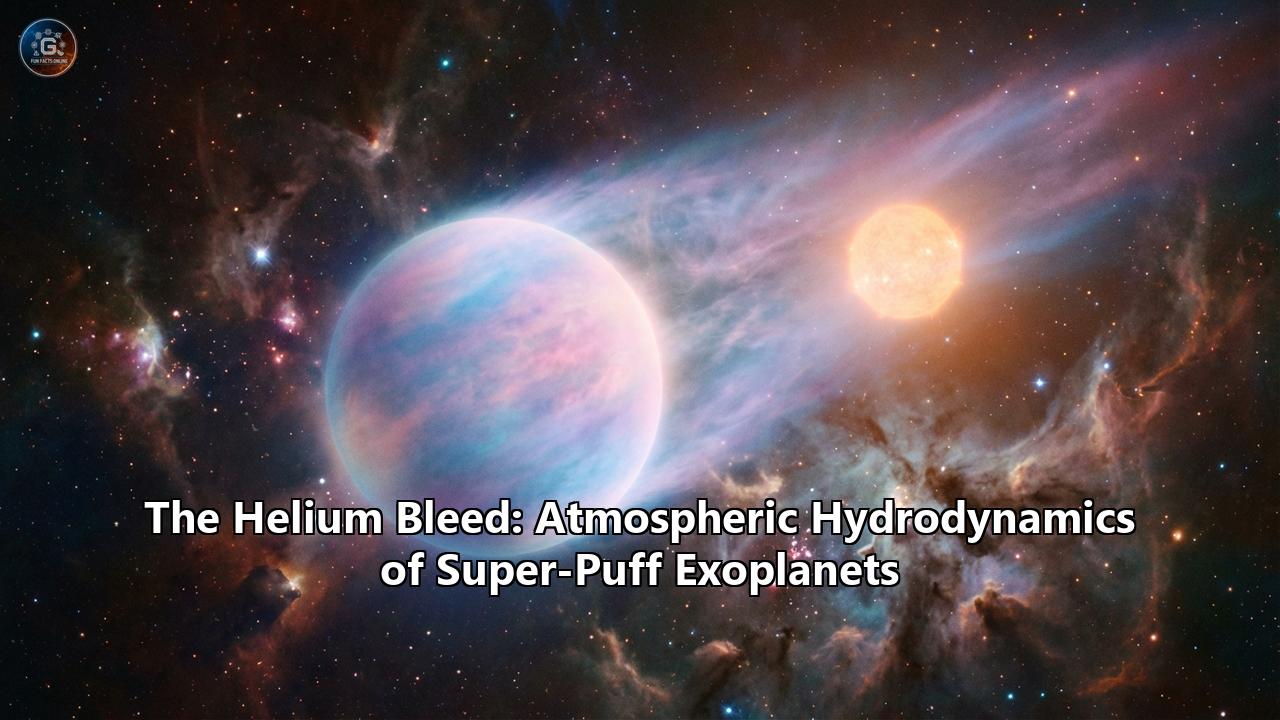
Prologue: The Paradox of the Cotton Candy Worlds
In the grand census of the galaxy, our solar system is a realm of neatly ordered densities. We have the dense, rocky inner worlds—Mercury, Venus, Earth, and Mars—huddled close to the hearth of the Sun. Further out lie the gas giants, Jupiter and Saturn, immense spheres of hydrogen and helium, massive enough to crush their own interiors into metallic oceans. Between these extremes, we found order. We found rules.
Then, we looked deeper, and the universe laughed at our rules.
Among the thousands of exoplanets discovered by missions like Kepler and TESS, astronomers stumbled upon a class of worlds that defied physical intuition. These planets possessed radii rivaling Jupiter’s, yet their masses were shockingly low—sometimes merely a few times that of Earth. Their densities were not like rock (5 g/cm³) or even water (1 g/cm³). They were less dense than cork, less dense than Styrofoam. They were comparable to cotton candy.
They were christened "Super-Puffs."
For years, these worlds were a haunting paradox. How could a planet with the gravity of a Super-Earth hold onto an atmosphere puffed up to the size of a gas giant? Why hadn't the relentless radiation of their host stars stripped them bare?
The answer, we are discovering, is that it is stripping them. We are catching these worlds in a moment of cosmic trauma. They are bleeding. They are hemorrhaging their atmospheres into the void in vast, comet-like tails of escaping gas. This phenomenon, often traced by the spectral signature of metastable helium, has opened a new window into the violent hydrodynamics of planetary evolution. This is the story of the Helium Bleed.
Part I: The Physics of the Bleed
To understand why super-puffs are dying, we must first understand how an atmosphere is supposed to work. On Earth, our atmosphere is in a state of hydrostatic equilibrium. Gravity pulls the air down; pressure pushes it up. The two forces balance, creating a stable, relatively thin layer of gas that hugs the surface. The particles at the top of our atmosphere—the exosphere—are hot, but only a tiny fraction of them move fast enough to escape Earth’s gravity. This trickle is known as Jeans escape, a slow, particle-by-particle evaporation that takes billions of years to make a dent.
Super-puffs operate in a different regime entirely.
1.1 The Parker Wind Mechanism
When a planet with a thick hydrogen-helium envelope orbits close to a young, active star, it is bathed in a torrent of extreme ultraviolet (XUV) and X-ray radiation. This high-energy light doesn't just warm the surface; it penetrates deep into the upper atmosphere, depositing immense amounts of energy. The gas heats up—to 10,000 Kelvin or more.
At these temperatures, hydrostatic equilibrium breaks down. The thermal pressure of the gas overcomes the planet's weak gravity. The atmosphere doesn't just evaporate; it flows. It behaves like a fluid, expanding outward in a continuous, supersonic wind.
This is hydrodynamic escape, often modeled using the same physics Eugene Parker used to describe the Solar Wind in the 1950s.
- The Sonic Point: As the gas expands, it accelerates. At a specific altitude, known as the sonic point, the outflow velocity breaches the speed of sound.
- The Bondi Radius: Beyond this point lies the Bondi radius, the distance where the thermal energy of the gas particles exceeds their gravitational potential energy. Once gas crosses this line, it is lost to the planet forever.
For a super-puff, the Bondi radius is perilously close. Because their cores are so light (low gravity) and their atmospheres so hot (high pressure), they are essentially "boiling off" into space. The planet is not just losing a few atoms; it is exhaling its own substance in a planetary wind that can carry away billions of tons of material every second.
1.2 The Roche Lobe Overflow
The situation is exacerbated by the host star. Every planet has a gravitational territory called its Hill sphere or Roche lobe—the volume of space where the planet's gravity dominates over the star's tides.
Super-puffs often have huge radii and orbit very close to their stars. This means their atmospheres are physically large, while their Roche lobes are shrunken by the star’s proximity. In extreme cases, the upper atmosphere of a super-puff can expand until it literally spills over the edge of its Roche lobe. The star’s gravity then grabs this material, stripping it away in a process similar to an accretion disk feeding a black hole. This is the "bleed" in its most visceral form—a gravitational disembowelment.
Part II: The Golden Ticket—Metastable Helium
For decades, hydrodynamic escape was largely theoretical. We knew it should happen, but observing it was a nightmare. The primary component of these atmospheres, neutral hydrogen, absorbs light in the ultraviolet (the Lyman-alpha line). Unfortunately, interstellar space is filled with hydrogen that absorbs UV light, and Earth’s atmosphere blocks the rest. Observing Lyman-alpha requires space telescopes like Hubble, and even then, the signal is often swallowed by the interstellar medium (ISM).
Enter the Metastable Helium Triplet.
2.1 The Quantum Trap
Helium is the second most abundant element in these atmospheres. In its ground state, it is noble and unreactive, invisible to most easy-to-access wavelengths. However, when a helium atom is bombarded by XUV radiation from a star, one of its electrons can be kicked up to a high-energy state. As it falls back down, it can get stuck.
Quantum mechanics dictates "selection rules"—traffic laws for electrons. An electron can get trapped in a specific state called the 2³S triplet state. It cannot simply drop back to the ground state because doing so would require an "illegal" spin flip (changing from a triplet state to a singlet state).
This trapped, or "metastable," helium can survive for hours or even days in the low-density upper atmosphere. While it sits there, it is essentially a loaded spring. Crucially, it absorbs light at a very specific wavelength: 10,830 Angstroms (1083 nm), which is in the near-infrared.
2.2 The Observational Revolution
This 1083 nm line is the "Golden Ticket" for exoplanet astronomers for three reasons:
- It penetrates the ISM: Unlike UV light, infrared light travels largely unhindered through interstellar gas.
- It is observable from Earth: We don't need a space telescope. Ground-based observatories with high-resolution spectrographs (like CARMENES or SPIRou) can see it.
- It traces the wind: Because metastable helium only forms in the low-density, irradiated upper layers, it is a perfect tracer for the escaping outflow. By measuring the Doppler shift of this line, we can calculate the speed of the wind.
If we see the 1083 nm line absorption blueshifted (moving toward us) by 10 or 20 kilometers per second, we are directly measuring the speed of the planetary wind blowing toward the telescope.
Part III: Case Study—WASP-107b, The Comet Planet
If there is a celebrity among the bleeding worlds, it is WASP-107b. Discovered in 2017, this planet became the Rosetta Stone for atmospheric escape.
3.1 The "Fluffiest" Anomaly
WASP-107b is roughly the size of Jupiter but has only 10% of Jupiter’s mass (about 30 Earth masses). It orbits a cool, orange K-type star every 5.7 days. Its density is so low that it was initially baffling how it formed; standard core-accretion models suggested a core this small shouldn't have been able to gather so much gas before the protoplanetary disk dissipated.
3.2 The Discovery of the Tail
In 2018, astronomers pointed Hubble at WASP-107b and detected helium. But it wasn't just a simple detection. The helium absorption was immense—far deeper than the planet’s solid body could explain.
Subsequent observations, including those with ground-based telescopes and later JWST, revealed the truth: WASP-107b is dragging a colossal tail of helium behind it. This tail extends for tens of planetary radii, trailing millions of kilometers into space. The radiation pressure from the star is blowing the escaping atmosphere backward, exactly like the ion tail of a comet.
Calculations suggest WASP-107b is losing mass at a rate of roughly 0.1% to 4% of its total mass every billion years. While this sounds small, it is hydrodynamically significant. It means the planet is actively shrinking.
3.3 The 2024 Methane Mystery & The Tidal Solution
In May 2024, the narrative of WASP-107b took a dramatic turn. New data from the James Webb Space Telescope (JWST) measured the planet's atmospheric composition with unprecedented precision. The expectation was a standard mix of chemicals for a planet of its temperature (~740 K).
The result was a shock: Methane was depleted by a factor of 1,000.
Where was the methane? In a planet this cool, carbon should prefer to bond with hydrogen to form methane (CH₄). Instead, the carbon was found in Carbon Monoxide (CO) and Dioxide (CO₂).
This chemical imbalance implied that the interior of the planet was far hotter than equilibrium models predicted. A hot interior would drive vigorous vertical mixing, dragging methane-depleted gas from the deep, hot layers up to the observable photosphere faster than it could cool down and chemically reform into methane.
But what was heating the core? The answer solved two mysteries at once. WASP-107b has a slightly eccentric orbit. As it swings around its star, the changing gravitational forces knead the planet’s interior like a ball of dough. This tidal heating pumps massive amounts of energy into the core.
- It solves the Methane Mystery: The heat drives the mixing that destroys methane.
- It solves the Super-Puff Paradox: The internal heat inflates the atmosphere like a hot air balloon, explaining why the planet is so large despite its low mass.
WASP-107b is not just a ball of gas; it is a tidally-tortured engine, puffing itself up while simultaneously bleeding into the void.
Part IV: The "Great Dust Cover-Up"—The Kepler-51 System
While WASP-107b represents the "hot, bleeding" archetype, the Kepler-51 system represents the "dusty, confusing" archetype. Located about 2,600 light-years away, this star hosts three planets (b, c, and d), all of which are super-puffs. Kepler-51d, for instance, is the size of Saturn but has a mass only a few times that of Earth.
4.1 The Cotton Candy Density
The calculated density of Kepler-51d is below 0.1 g/cm³. If you could find a bathtub big enough (and filled with water), this planet would float—and it would float high, bobbing on the surface like a beach ball.
4.2 The Flat Spectrum Problem
When astronomers used Hubble to look at the transmission spectra of these planets, they expected to see huge, clear signals of water and methane, thanks to the massive scale heights of their light atmospheres.
They saw nothing. The spectra were flat lines.
A flat spectrum in transmission spectroscopy usually means one thing: Clouds or Haze.
Just as a cloudy day on Earth hides the blue sky, a high-altitude layer of haze on a super-puff blocks the light from passing through the deep atmosphere.
4.3 The "Trojan Horse" Theory
This led to the "Great Dust Cover-Up" theory. Some researchers proposed that super-puffs might not actually be as big as they look. If a smaller planet has a layer of photochemical haze (smog) lofted very high into the atmosphere—perhaps 1,000 km up—it would block the starlight at that altitude.
When we measure the radius of an exoplanet using the transit method, we are essentially measuring the size of its shadow. An opaque haze layer makes the shadow bigger, tricking us into thinking the planet is huge and low-density, when it might actually be a smaller, denser world wearing a "puffy jacket" of smog.
However, recent hydrodynamic models challenge this. To keep heavy dust or haze particles lofted that high against gravity requires a powerful outward flow of gas. The haze isn't just sitting there; it is likely being carried upward by the helium bleed itself. The outflowing wind acts like a conveyor belt, lifting the smog into the upper atmosphere. Thus, even if the "puffy jacket" theory is true, it requires the hydrodynamic escape mechanism to sustain it.
Part V: The Cosmic Shoreline & The Valley of Death
The story of super-puffs is not an isolated curiosity; it is a missing link in the grand evolutionary theory of planets.
5.1 The Fulton Gap (Radius Valley)
When we look at the size distribution of all small planets, we see a "valley." There are many Super-Earths (radii ~1.3 Earths) and many Sub-Neptunes (radii ~2.4 Earths), but very few planets in between (radii ~1.8 Earths).
This Radius Valley is the scar left by atmospheric escape.
The prevailing theory is that many planets are born as Sub-Neptunes—rocky cores wrapped in thick hydrogen envelopes (essentially baby super-puffs).
- If a planet is massive enough or far enough from its star, it keeps its gas and remains a Sub-Neptune.
- If a planet is too small or too close to the star, the helium bleed kicks in. The hydrodynamic wind strips the entire hydrogen envelope away, leaving behind the naked rocky core—a Super-Earth.
5.2 The Mechanisms of Strip-Mining
Two main theories battle to explain this stripping, and super-puffs are the testing ground for both:
- Photoevaporation: The X-ray/UV flux from the star drives the escape (as described with the Parker Wind). This is an "outside-in" attack.
- Core-Powered Mass Loss: The planet’s own internal heat (leftover from formation) radiates outward, pushing the atmosphere off. This is an "inside-out" push.
Super-puffs like Kepler-51 (which is very young, only ~500 million years old) are likely in the early, frantic stages of this process. They are "teenage" planets. They haven't finished shrinking yet. Over the next billion years, the Kepler-51 planets will likely bleed away much of their bulk, contracting down to become standard Sub-Neptunes.
We are witnessing planetary metamorphosis in real-time.
Part VI: The Future of the Bleed
The study of atmospheric hydrodynamics is entering a golden age.
JWST is currently revolutionizing the field. Its NIRSpec instrument can detect the 1083 nm helium line with incredible sensitivity, and its MIRI instrument is probing the chemical inventories (water, SO2, CO2) of these escaping winds. By measuring the ratio of these chemicals in the tail, we can learn about the composition of the planet's deep interior and even its crust. Ground-based high-resolution spectroscopy (using instruments like SPIRou at CFHT or CARMENES at Calar Alto) allows us to map the 3D velocity structure of these winds. We can see the gas moving towards the star (day-side upflow) and away from the star (night-side tail). We can effectively build a Doppler weather map of a planet dying light-years away. The Ultimate Question:Are we seeing the exceptions, or the rule?
It is possible that Earth once had a primordial hydrogen atmosphere that "bled" away in our solar system's violent youth. By studying the super-puffs, we are looking into a mirror of the deep past, watching the hydrodynamic sculpting processes that carve habitable worlds out of the chaotic raw material of the nebula.
The Helium Bleed is not just a story of destruction; it is a story of genesis. It is the process that refines the galaxy, stripping away the excess to reveal the rocky gems hidden beneath.
(End of Article Summary)
Reference:
- https://hub.jhu.edu/2024/05/20/wasp107b-core-exoplanet/
- https://www.labroots.com/trending/space/27158/findings-wasp-107-challenge-assumptions-gas-giant-composition-2
- https://www.llnl.gov/article/51256/mystery-puffy-exoplanet-solved
- https://earthsky.org/space/puffy-exoplanet-wasp-107-b-tidal-heating-exoplanets-webb/
- https://esawebb.org/news/weic2414/
- https://news.asu.edu/20240522-science-and-technology-asu-scientists-help-resolve-missing-methane-problem-giant-exoplanet
- https://science.nasa.gov/missions/webb/webb-cracks-case-of-inflated-exoplanet/