
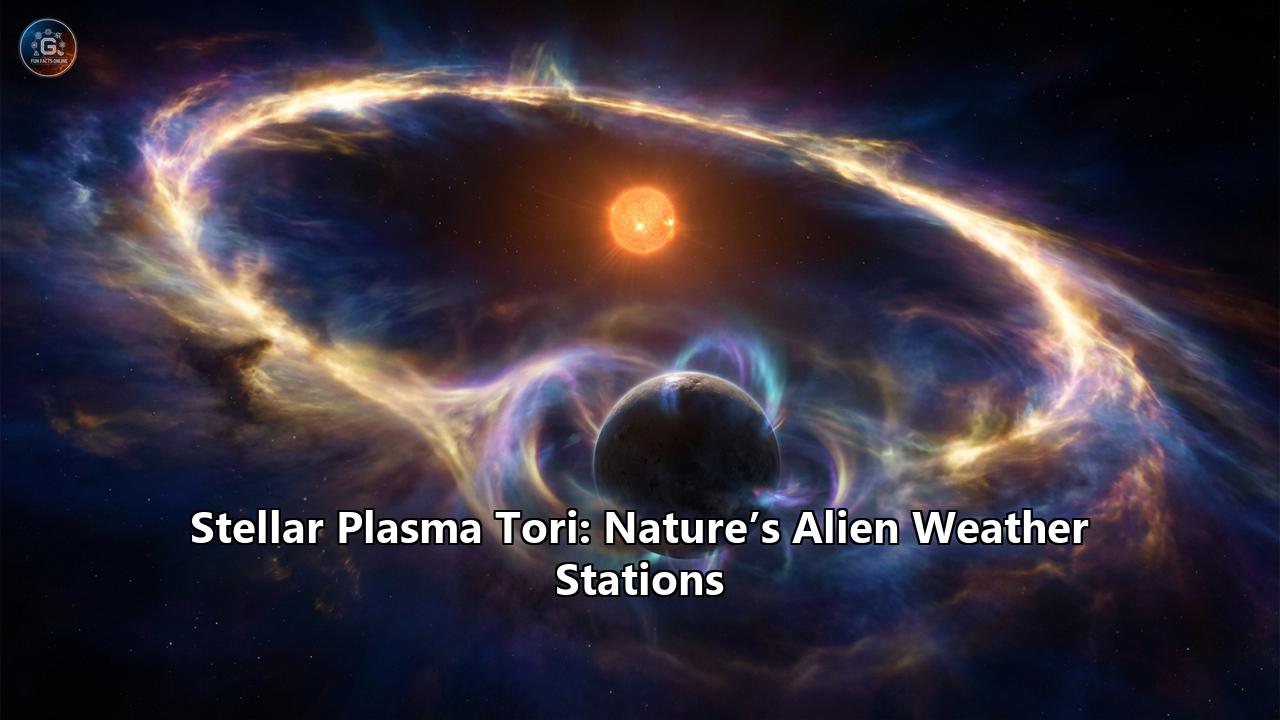
In the dark, silent expanse of the cosmos, where the vacuum is often mistaken for emptiness, there exist colossal structures of glowing, electrified gas that defy the stillness of space. They are not stars, nor are they planets. They are stellar plasma tori—vast, doughnut-shaped rings of superheated ions that encircle celestial bodies, locked in a violent, electromagnetic dance.
To the naked eye, they are often invisible, hidden in the ultraviolet or radio spectrums. But to the sensors of modern astronomy, they shine like neon beacons, pulsing with information. They are the cosmos’s natural instruments—alien weather stations that monitor the invisible storms of magnetic energy, the eruptions of hidden volcanoes, and the breathing of stars. Unlike terrestrial weather stations that measure wind speed or humidity, these cosmic observatories measure the "pressure" of volcanic outgassing, the "temperature" of magnetospheric acceleration, and the "storms" of charged particles moving at relativistic speeds.
From the sulfurous hellscape of Jupiter’s moon Io to the icy plumes of Saturn’s Enceladus, and outward to the relativistic winds of dying pulsars and the newly discovered magnetic cradles of infant stars, plasma tori tell the story of the dynamic universe. They reveal the intricate connection between a parent body (a star or planet) and its satellites, acting as a physical manifestation of the invisible magnetic web that binds them.
This article explores the physics, the majesty, and the scientific significance of stellar plasma tori. We will journey into the heart of Jupiter’s magnetic empire, fly through the diamond dust of Saturn’s rings, and peer into the deep universe to see how these alien weather stations are helping us hunt for volcanic exoplanets and understand the extreme physics of neutron stars.
Part I: The Anatomy of a Plasma Torus
To understand a plasma torus, one must first discard the intuitive understanding of earthly rings. The rings of Saturn, for instance, are made of solid chunks of ice and rock, governed largely by gravity. A plasma torus, however, is a creature of electromagnetism.
1. The Fourth State of MatterPlasma is often called the fourth state of matter. When a gas is heated to extreme temperatures or subjected to intense radiation, its atoms are stripped of their electrons. The result is a soup of positively charged ions and negatively charged free electrons. This electrified fluid responds not just to gravity, but to magnetic and electric fields. In the presence of a strong planetary or stellar magnetic field, this plasma becomes trapped.
2. The Magnetic BottleImagine a planet like Jupiter as a giant bar magnet. Invisible magnetic field lines loop out from the north pole, arc through space, and reconnect at the south pole. Charged particles (plasma) have a difficult time crossing these lines; instead, they spiral around them like beads sliding along a wire. When a source of plasma—such as a moon or a star’s wind—injects material into this magnetic environment, the particles are captured. They spread out along the moon’s orbit, forming a complete ring, or torus.
3. The Weather Station AnalogyWhy call them weather stations? Because a plasma torus is a dynamic, responsive system. It is in a constant state of flux, balancing "sources" (material coming in) and "sinks" (material leaking out).
- The Barometer: The density of the torus measures the "atmospheric pressure" of the source. If a moon’s volcanoes erupt more violently, the torus becomes denser and brighter.
- The Thermometer: The temperature of the ions (often millions of degrees) reveals the energy of the magnetic field accelerating them.
- The Anemometer: The speed at which the torus rotates tells us about the drag forces and the transfer of momentum from the planet to the space environment.
Part II: The Prototype – The Io Plasma Torus
The most studied, complex, and spectacular example of this phenomenon lies in our own solar system: the Io Plasma Torus (IPT). It is the standard by which all other such structures are measured.
1. The Engine: Io’s VolcanoesThe story of the IPT begins with Io, the innermost of Jupiter’s Galilean moons. Caught in a gravitational tug-of-war between Jupiter and the outer moons Europa and Ganymede, Io is kneaded like a ball of dough. This tidal friction generates immense internal heat, making Io the most volcanically active body in the solar system. Its surface is dotted with hundreds of volcanoes that spew plumes of sulfur dioxide (SO2) hundreds of kilometers into space.
2. The Feed Mechanism: Ionization and PickupAs Io orbits Jupiter, it moves through a sea of plasma. The neutral gases (sulfur and oxygen) escaping Io’s atmosphere form a "neutral cloud" that trails the moon. However, this neutrality doesn't last. Solar ultraviolet light and collisions with energetic electrons strip electrons from the sulfur and oxygen atoms. Instantly, the neutral gas becomes plasma.
This moment of ionization is violent. Jupiter’s magnetic field sweeps past Io at a tremendous speed (since Jupiter rotates once every 10 hours, while Io orbits every 42 hours). The magnetic field is moving faster than the moon. When a neutral atom becomes an ion, it is suddenly "sensed" by this magnetic field. It is "picked up" and accelerated instantly from Io’s orbital speed (17 km/s) to the corotation speed of the magnetic field (74 km/s). This instantaneous acceleration adds immense energy to the system, heating the plasma to tens of thousands of degrees.
3. The Structure of the IPTThe resulting structure is a colossal, doughnut-shaped cloud of glowing sulfur and oxygen ions. It is roughly the size of Jupiter itself in cross-section and encircles the planet at Io’s orbital distance.
- The Ribbon: A dense, bright inner region where fresh material is constantly being added.
- The Warm Torus: A larger, more diffuse region of slightly older plasma.
- The UV Glow: To the human eye, the torus would be a faint, ghostly red (due to sulfur) and green (due to oxygen). But in the Ultraviolet (UV) spectrum, it shines with the intensity of a star. In fact, if our eyes could see UV, the Io Plasma Torus would be one of the brightest objects in the night sky, dwarfing the moon in apparent size.
The IPT acts as a direct monitor of Io’s volcanic heartbeat. During the Galileo and Cassini missions, and now with the Juno spacecraft, astronomers have observed the torus brighten and dim.
- Volcanic Outbursts: When a massive volcano like Tvashtar or Pele erupts on Io, the supply of neutral gas increases. Weeks later, the plasma torus brightens in the UV, signalling the injection of fresh mass.
- The Dawn-Dusk Asymmetry: The torus is not a perfect ring. It is often brighter on the "dusk" side of Jupiter due to the complex electric fields generated by the interaction of the solar wind with Jupiter’s magnetosphere. This tells us about the "space weather" coming from the Sun.
Part III: The Frozen Mirror – The Enceladus Torus
If Io is the fiery archetype, the torus around Saturn’s moon Enceladus is its icy, ghostly cousin. It represents a different kind of "weather station"—one that monitors a cryovolcanic environment.
1. The Water WorldEnceladus is a small, icy moon of Saturn. Like Io, it is heated by tidal forces, but instead of molten rock, it harbors a subsurface ocean of liquid water. At its south pole, "tiger stripe" fractures spray geysers of water vapor and ice grains into space.
2. The Neutral TorusUnlike Io’s environment, which is dominated by high-energy plasma, the region around Enceladus is dominated by neutral atoms. The water molecules ejected by Enceladus form a massive, doughnut-shaped cloud of neutral oxygen and hydrogen (OH). This is often called a "neutral torus."
While there is plasma present, the ionization rate is lower than at Jupiter. However, the mechanism is similar: water molecules are broken down by sunlight and electron impact into charged particles, creating a tenuous plasma torus of water-group ions (H2O+, OH+, O+).
3. Reading the RingsThe Enceladus torus is a "snow station." It tells us about the health of the moon's subsurface ocean. Variations in the density of this torus suggest changes in the plume activity. Furthermore, this torus interacts with Saturn’s E-Ring (which is composed of the ice grains themselves). By studying the plasma density here, scientists can estimate how much mass Enceladus is losing—currently estimated at about 250 kilograms of water per second.
Part IV: Extreme Weather – Pulsar Wind Nebulae
Leaving the solar system, we encounter plasma tori on a scale and energy level that defies comprehension. Around pulsars—the rapidly spinning, city-sized remnants of dead stars—we find "relativistic" plasma tori.
1. The Crab NebulaAt the heart of the Crab Nebula lies a pulsar spinning 30 times a second. It generates a magnetic field trillions of times stronger than Earth's. This pulsar emits a wind of electron-positron pairs moving at nearly the speed of light.
Observations by the Chandra X-ray Observatory have revealed a distinct structure: a bright ring (torus) of X-ray emission encircling the pulsar’s equator, often accompanied by jets shooting from the poles.
2. The Physics of the ShockThis torus is formed by a "termination shock." The pulsar wind screams out into the surrounding nebula until it hits the wall of gas ejected during the supernova. At this boundary, the wind slows down, piles up, and releases its kinetic energy as high-energy X-rays.
This torus is a "storm watch" for high-energy astrophysics. Changes in the brightness and shape of the Crab’s torus (known as "wisps" that ripple outward like waves in a pond) allow physicists to study how particles are accelerated to cosmic-ray energies. It is a laboratory for extreme plasma physics that cannot be replicated on Earth.
Part V: The New Frontier – Exoplanetary Weather Stations
The most exciting development in the field of stellar plasma tori is their potential to help us find and understand exoplanets. As we discover planets around other stars, we face a problem: small, rocky planets are hard to see. Their atmospheres are thin, and they don't block much starlight. But if a rocky planet has a moon like Io, or is itself volcanic, it might generate a huge plasma torus that is much easier to detect than the planet itself.
1. The "Exo-Io" HypothesisAstronomers have long theorized that we could detect "Exo-Ios" by looking for the spectral signature of a plasma torus transiting a star. If a star’s light dims in a specific pattern—particularly in UV lines of Sulfur or Oxygen—it could indicate a massive ring of plasma passing in front of the star.
2. The Discovery at TIC 141146667Recent research has identified a potential candidate around the star TIC 141146667, a young, active star. Observations revealed "clumps" of hydrogen gas corotating with the star. While the interpretation is still debated (it could be a prominence or a torus fed by the star’s own wind), it represents the first direct evidence of such torus-like structures in exoplanetary systems.
3. Detecting Volcanism and MagnetospheresWhy is this important?
- Volcanism: A plasma torus is a "smoking gun" for geological activity. Detecting an oxygen/sulfur torus around an exoplanet would prove the planet is geologically alive, a key factor in habitability (carbon cycling).
- Magnetospheres: A torus needs a magnetic field to trap it. If we see a torus around an exoplanet, we have indirectly detected the planet’s magnetic field—another crucial shield for life.
Part VI: The Sound of the Torus
Stellar plasma tori are not silent. They are noisy broadcasters in the radio spectrum.
1. Decametric Radio BurstsIn the 1950s, before we even knew about Io’s volcanoes, astronomers detected strange radio bursts coming from Jupiter. They realized these bursts were synchronized with Io’s orbit. We now know that the Io Plasma Torus acts like an electrical generator. As the torus wobbles, it generates massive electrical currents (millions of amps) that flow along magnetic field lines down to Jupiter’s poles.
These currents generate "cyclotron maser instability" radio waves. If you had a radio receiver on Jupiter, the torus would scream and crackle with the intensity of a billion lightning strikes.
2. The Whistler ModeInside the torus, plasma waves known as "whistlers" propagate. These are electromagnetic waves that travel through the plasma, sounding (when converted to audio) like descending whistles. These waves are crucial for "scattering" electrons and creating the aurorae on the parent planet. By listening to the radio static of a distant star, we might be "hearing" the plasma torus of an unseen planet.
Part VII: Future Forecasts
The study of stellar plasma tori is entering a golden age.
1. JWST and the UV GapWhile the James Webb Space Telescope (JWST) is an infrared instrument, it can detect certain spectral lines associated with warm plasma. However, the true "weather station" readout is in the Ultraviolet. Future missions, like the proposed LUVOIR or specialized UV space telescopes, will be needed to fully scan nearby stars for the tell-tale glow of exo-tori.
2. Understanding Stellar EvolutionPlasma tori around young stars (like T Tauri stars) play a role in braking the star’s rotation. As the star spins, the magnetic field drags the plasma torus, which acts as a brake. Understanding this "magnetic braking" is essential for understanding how stars evolve from rapid spinners to slow, stable stars like our Sun.
Conclusion: The Universal Instrument
Stellar plasma tori are more than just rings of hot gas. They are the sensory organs of a planetary system. They feel the tidal squeeze of gravity, they taste the chemical composition of volcanic interiors, and they see the invisible winds of magnetic energy.
From the sulfurous glow of Io to the relativistic screams of the Crab Pulsar, these structures demonstrate that the universe is connected by invisible webs of electromagnetism. As we gaze out at the stars, searching for other worlds, we may not see the planets themselves at first. Instead, we may see their halos—the glowing, vibrant weather stations that tell us: "This world is alive."
Whether they are signaling a volcanic eruption on a distant moon or the death throes of a neutron star, stellar plasma tori remind us that in space, weather isn't just about rain and clouds—it's about plasma, magnetism, and the raw power of the cosmos.
Reference:
- https://lgbouma.com/posts/2025/07/qa-a-plasma-torus-around-a-young-low-mass-star/
- http://vega.lpl.arizona.edu/iotorus/torus-description.html
- https://arxiv.org/pdf/2506.09116
- https://www.youtube.com/watch?v=ofvyY5WSbyw
- https://fiveable.me/key-terms/intro-astronomy/plasma-torus
- https://www.youtube.com/watch?v=2DBgl5rpFKU
- https://www.youtube.com/watch?v=LIf7iSt0iI4
- https://researchportal.ip-paris.fr/en/publications/mass-unloading-along-the-inner-edge-of-the-enceladus-plasma-torus/
- https://www.youtube.com/watch?v=JNXzp3DxSLc
- https://www.psi.edu/project/the-ins-and-outs-of-the-io-plasma-torus-understanding-mass-and-energy-transport-using-two-decades-of-optical-and-radio-observations/
- https://lasp.colorado.edu/mop/files/2018/07/Chapter-11.pdf
- https://www.researchgate.net/publication/234271989_Saturn's_magnetospheric_plasma_and_the_formation_of_the_Enceladus_water_tori
- https://en.wikipedia.org/wiki/Gas_torus
- https://en.wikipedia.org/wiki/Pulsar_wind_nebula
- https://arxiv.org/pdf/1907.05088
- https://www.researchgate.net/publication/392948411_Constraining_Ongoing_Volcanic_Outgassing_Rates_and_Interior_Compositions_of_Extrasolar_Planets_with_Mass_Measurements_of_Plasma_Tori