
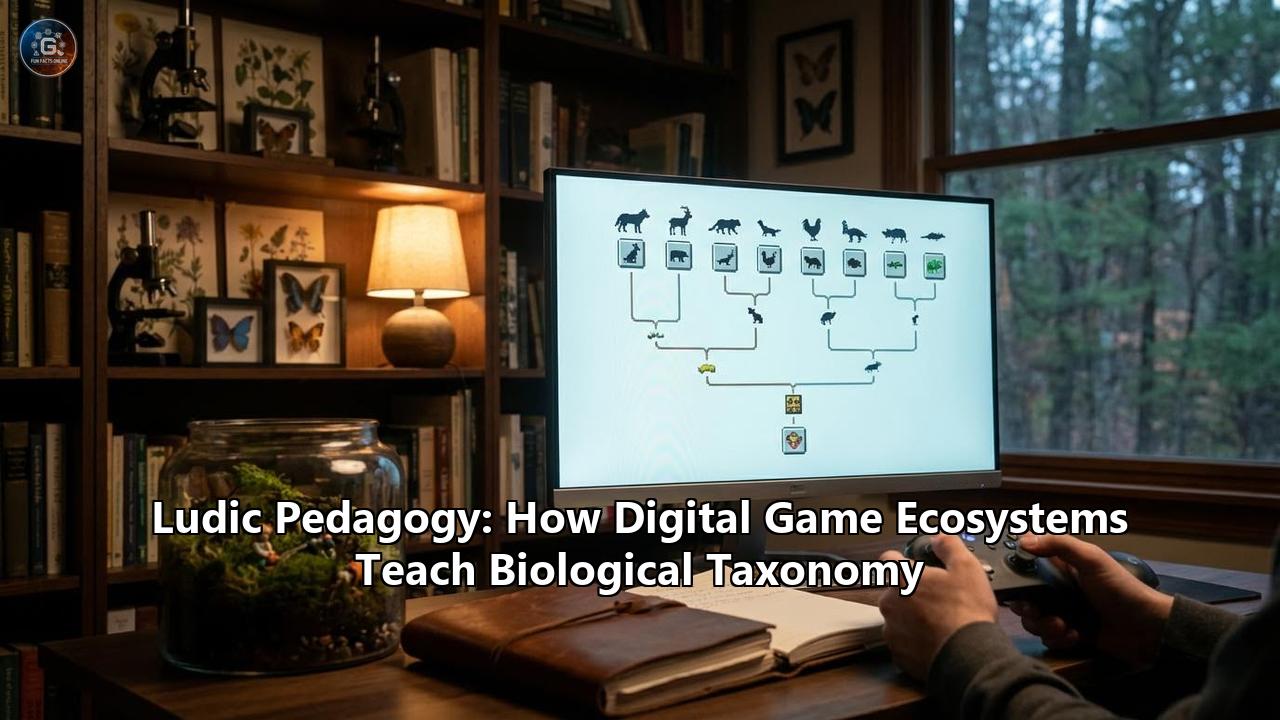
The intricate, branching maps of biological taxonomy—Domain, Kingdom, Phylum, Class, Order, Family, Genus, and Species—often appear to students as a static, insurmountable wall of Latin terminology. For centuries, the Linnaean system and modern cladistics have been taught through dry textbook diagrams and rote memorization. Yet, a quiet revolution in science education is occurring outside the classroom, hidden within the digital architecture of video games. Millions of players are unwittingly mastering the principles of evolutionary biology, phylogenetic mapping, and ecological classification simply by trying to survive, explore, and "catch 'em all."
This phenomenon is the ultimate realization of ludic pedagogy—an educational framework that leverages play, playfulness, and positivity to reintroduce the joy of discovery into learning. By dropping players into complex, simulated ecosystems, modern video games naturally incentivize taxonomic thinking. Gamers are no longer just players; they are virtual field biologists, intuitively grouping organisms by morphological traits, inferring evolutionary lineages, and constructing mental dichotomous keys.
From the meticulously crafted wyverns of Monster Hunter to the procedurally generated alien expanses of No Man's Sky, digital game ecosystems have become some of the most effective, albeit unconventional, teachers of biological taxonomy in the modern era.
The Mechanics of Ludic Pedagogy in Science Education
To understand how games teach complex biological concepts, one must first understand ludic pedagogy. Defined as the meaningful use of playful activities for educational purposes through digital devices, ludic pedagogy is not merely "gamification"—the slapping of points and badges onto traditional quizzes. Instead, it relies on the intrinsic motivation of play.
In traditional education, the high-stakes nature of testing can stifle curiosity. Ludic pedagogy reduces the pressure of these high-stakes outcomes, fostering a more open, curious mindset that enhances creativity and engagement. When a player is asked to memorize the difference between an arthropod and a chordate for a biology exam, the stakes are academic and often stress-inducing. But when a player must identify the morphological weaknesses of a massive, heavily armored insectoid in a video game to craft a new piece of gear, the learning process becomes an organic, rewarding loop.
Video games require the "active sensing of the service system"—a culture of questioning where players constantly analyze their environment. To survive in a digital ecosystem, players must categorize. They must understand which visual cues signify a predator, which signify a docile herbivore, and how different species interact within a food web. This cognitive categorization is the very foundation of biological taxonomy.
Pokémon: The Pre-Darwinian to Modern Cladistics Pipeline
Perhaps the most universally recognized example of covert taxonomic training is the Pokémon franchise. Created by Satoshi Tajiri, a man famously inspired by his childhood hobby of insect collecting, Pokémon is fundamentally a game about field biology. Players traverse diverse biomes, cataloging unknown species into an encyclopedia known as a Pokédex.
While the game uses the term "evolution" to describe what biologists would more accurately call metamorphosis, the underlying structure of the Pokémon universe heavily mimics real-world cladistics. This connection is so profound that in 2012, researchers published a paper in the Annals of Improbable Research detailing a quantitative phylogeny of the original 646 Pokémon families. The researchers operated on the assumption that Pokémon evolved via natural selection independently from familiar Earth animals, applying modern evolutionary theory to a field previously limited to pre-Darwinian methods of inquiry.
In this phylogenetic tree, researchers categorized Pokémon based on shared morphological and behavioral characters, including their elemental Type, Egg Group, and body style. The results mirrored real-world evolutionary phenomena. For instance, the study found that terrestrial life in the Pokémon universe evolved independently three times from water-dwelling ancestors, and that highly specialized clades—such as Fire-types arising from canine-like ancestors, or Grass-types arising from ungulate-like organisms—formed distinct monophyletic groups.
Even the franchise’s anomalies teach valuable taxonomic lessons. The researchers noted that sexually dimorphic taxa (such as Nidoqueen and Nidoking) have historically been identified as completely separate species in the Pokédex. This reflects the very real challenges early human taxonomists faced before the advent of genetic sequencing, where extreme sexual dimorphism in birds and insects often led to males and females being classified as different species. By interacting with these mechanics, players internalize how biologists use shared characteristics to group organisms into nested hierarchies.
Subnautica: Alien Oceans and Applied Taxonomy
If Pokémon introduces players to the concept of cataloging, Subnautica plunges them into the deep end of ecological classification. Set on the fully aquatic alien Planet 4546B, Subnautica tasks players with surviving a vibrant, terrifying ocean ecosystem. The player’s primary tool for understanding this world is not a weapon, but a scanner.
The PDA scanner in Subnautica functions exactly like a field biologist's notebook. When a player scans a "Peeper" or a "Gasopod," the game provides detailed data on the organism's morphology, its role in the trophic pyramid, and its evolutionary adaptations. The game’s ecosystem is so cohesive that the player base has taken it upon themselves to construct massive, highly detailed taxonomic trees of the planet's fauna, applying real-world biological principles to fictional creatures.
Players have categorized the game's lifeforms into recognizable clades. For example, community phylogenies map the split between bilaterians and non-bilaterians. The "Amoeboid" is recognized as a basal metazoan—a primitive mix between a sponge and a comb jelly—while stationary, benthic creatures like anemones and corals are grouped under analogues to Earth's Anthozoa.
Furthermore, players map the planet's chordates, identifying the jawless "Shadow Leviathan" as one of the most basal species in its phylum due to its lack of a distinct skull, akin to Earth's hagfish. The game brilliantly showcases convergent evolution and adaptive radiation. Players learn that the terrifying "Reaper Leviathan" and the docile "Reefback Leviathan" share common ancestors, but diverged wildly based on their ecological niches. By forcing players to read the environment and scan its inhabitants to survive, Subnautica transforms gamers into active taxonomists.
Monster Hunter: Strict Systematics and Anatomical Homology
While Subnautica relies on players to piece together the tree of life, the Monster Hunter franchise takes a highly formalized, academic approach to its fictional biology. Capcom, the developer behind the series, publishes actual "Ecological Tree Diagrams" (phylogenetic trees) in its official lore books, supposedly authored by the in-universe "Royal Paleontology Scriveners".
The taxonomy of Monster Hunter is astoundingly rigorous, utilizing the exact same hierarchical structure used in real-world biology: Order, Suborder, Infraorder, Superfamily, Family, Genus, and Species. Players do not just hunt generic "monsters"; they hunt distinct biological entities that fit neatly into an evolutionary tree.
For example, when a player encounters a Flying Wyvern, a Brute Wyvern, and a Bird Wyvern, the game’s physical design communicates their shared ancestry. A player familiar with the game's taxonomy knows that these creatures share a common tetrapod ancestor, but have undergone different evolutionary pressures. The wings of a Flying Wyvern are anatomically homologous to the forelimbs of a Fanged Wyvern. The series even includes vestigial structures; certain subterranean monsters have small, useless wings, indicating they evolved from flying ancestors before adapting to a fossorial (burrowing) lifestyle.
Players use this taxonomic knowledge as a core gameplay mechanic. If a player knows that a newly discovered monster belongs to the "Neopteron" class (giant insects), they can infer its morphological weaknesses, behavioral patterns, and the types of materials it might drop upon defeat. This is a flawless digital execution of a dichotomous key. Players are rewarded for understanding the phylogenetic relationships of the ecosystem, proving that rigorous scientific classification can be translated into a highly engaging ludic loop.
No Man’s Sky: Procedural Generation and the Limits of Classification
While handcrafted ecosystems teach the rules of taxonomy, No Man's Sky teaches its limitations. Boasting a procedurally generated universe of 18 quintillion planets, the game algorithmically constructs flora, fauna, and entire ecosystems. Because it is impossible for human artists to handcraft quintillions of unique animals, the game relies on a bio-mathematical field called L-systems and procedural rules engines.
When a player lands on a new planet, the game's engine assesses the biome and selects a "base template" or genus for a creature. It then algorithmically stitches together heads, bodies, tails, and color palettes from a vast pool of geometrical descriptors, creating a unique species. The game dictates behaviors, predatory status, and variations in size (such as longer horns on male variants) to ensure the ecosystem makes sense within the crafted rules.
This procedural generation forces players to confront the "species problem"—a real-world debate among biologists regarding how to define a species. When variation is infinite and algorithmically driven, how do you classify organisms? No Man's Sky challenges the morphological species concept. Players quickly learn to group alien creatures not by strict genetic lineage (which does not exist in the code beyond base templates), but by ecological function. A player might recognize a procedurally generated bipedal predator with a mantis-head not because they have seen it before, but because they recognize the algorithmic "rules" that generated its morphology. In this way, No Man's Sky teaches the fluid, sometimes chaotic reality of biological variation, echoing the immense diversity of life on Earth that often defies neat, linear categorization.
The Cognitive Architecture of Interactive Biology
Why is this ludic approach so successful? The answer lies in human cognitive architecture. The human brain is naturally wired to recognize patterns and categorize threats—an evolutionary trait that kept our ancestors alive. Video games hijack this primal instinct. By placing players in environments where identifying a species correctly means the difference between virtual survival and failure, games trigger a level of focus and retention that traditional pedagogical methods struggle to achieve.
When a student reads about taxonomy, it is an abstract concept. But when a player categorizes an organism in a digital game ecosystem, it becomes an "operant resource"—a strategic tool they can use to enact change within their environment. The player learns that taxonomy is not just a list of names; it is a predictive science. If you know an organism's family, you can predict its diet, its habitat, its defense mechanisms, and its evolutionary history.
A New Paradigm for Science Education
The integration of biological taxonomy into digital game ecosystems represents a brilliant, largely accidental triumph of modern media. Developers of games like Pokémon, Subnautica, Monster Hunter, and No Man's Sky did not necessarily set out to create educational software. They sought to create believable, immersive worlds. Yet, in doing so, they had to rely on the rules of the natural world.
Through ludic pedagogy, these games have transformed millions of players into amateur taxonomists. They have proven that learning complex scientific frameworks does not have to be a chore. It can be a grand adventure. As educators continue to look for ways to engage students in STEM fields, they would do well to look at the structural brilliance of these virtual worlds. The next great evolutionary biologist may not find their initial spark in a textbook, but in the pixelated tall grass of the Kanto region, or staring through the visor of a scanner in the abyssal depths of an alien sea.
Reference:
- https://www.reddit.com/r/NoMansSkyTheGame/comments/1rkjo25/how_the_species_are_generated/
- https://prezi.com/p/prrxwuzibrb_/monster-hunter-phylogeny-tree/
- https://nomanssky.fandom.com/wiki/Procedural_generation
- https://www.youtube.com/watch?v=JS8nPCrPITU
- https://monsterhunter.fandom.com/wiki/Ecological_Tree_Diagram_(Phylogenetic_Tree))
- https://www.youtube.com/watch?v=NNJNo9nqc8w
- https://www.reddit.com/r/MonsterHunter/comments/1ji1o3t/mh_taxonomyevolution_tree_11_invertebrates/
- https://nomanssky-archive.fandom.com/wiki/Procedural_generation
- https://kotaku.com/a-look-at-how-no-mans-skys-procedural-generation-works-1787928446