
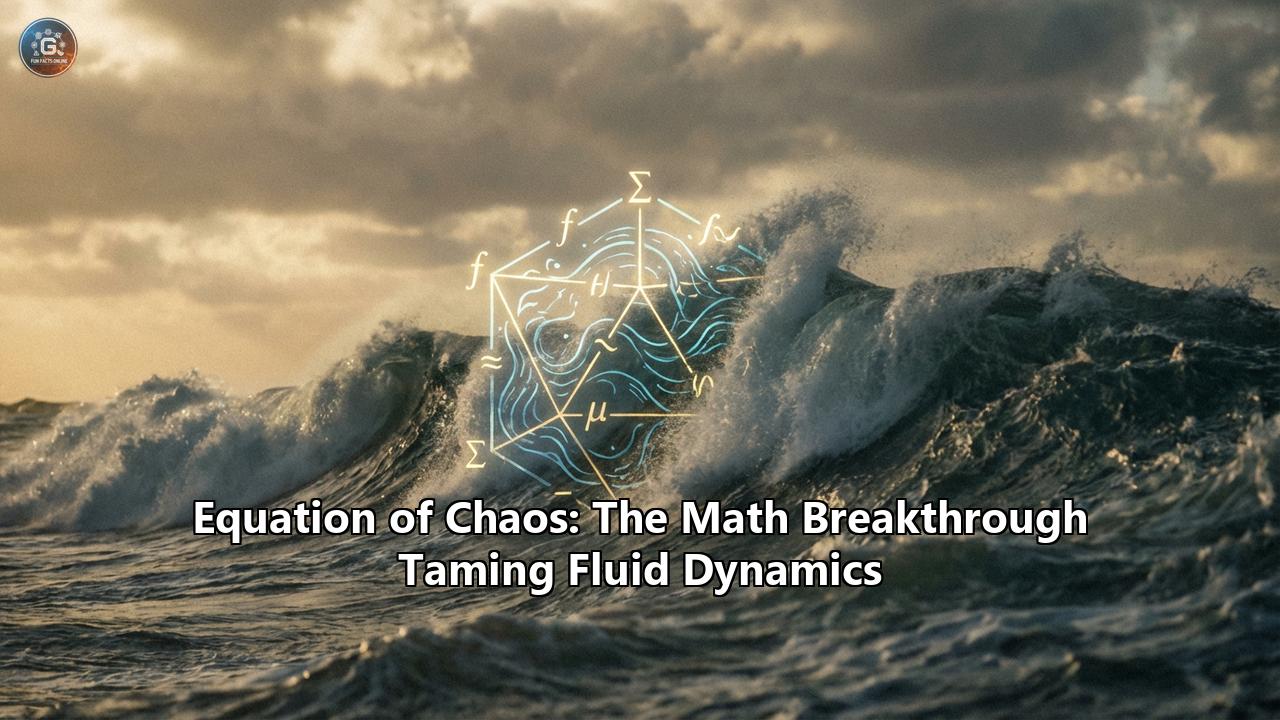
The Million-Dollar Ripple
If you stir a spoonful of milk into a black coffee, you witness a mystery that has baffled the brightest minds in history for over two centuries. The white swirls fold into the black liquid, stretching, twisting, and spiraling in a complex dance. It is beautiful, chaotic, and, according to the laws of physics, mathematically "impossible" to fully predict.
For 200 years, humanity has built its civilization on the back of fluids. We design airplanes that ride invisible cushions of air, we build dams to hold back millions of tons of water, and we model the blood pumping through our own hearts. Yet, the equation that governs all of this—the Navier-Stokes equation—has remained a "black box." We know that it works, but we cannot prove why.
This paradox is so profound that the Clay Mathematics Institute designated it one of the seven "Millennium Prize Problems," offering a $1,000,000 reward to anyone who could prove whether the equation always holds true or if, under extreme conditions, it "blows up"—spitting out nonsense answers like infinite velocity.
In late 2025 and early 2026, the world of mathematics and physics was rocked by a dual breakthrough that may finally tame this "Equation of Chaos." In a stunning convergence of silicon and gray matter, artificial intelligence from Google DeepMind and a landmark rigorous proof by a team of elite mathematicians have shone a light into the darkest corners of fluid dynamics. They have found the "glitches" in the matrix of reality, and in doing so, they haven't just solved a math problem—they’ve opened the door to a new era of engineering, meteorology, and medicine.
The Beast in the Math: What is Navier-Stokes?
To understand the magnitude of this breakthrough, we must first understand the beast itself. Formulated in the 1820s by Claude-Louis Navier and George Gabriel Stokes, the equations are deceptively simple. They are an application of Newton’s second law of motion ($F=ma$) to fluids. They describe how the velocity, pressure, density, and viscosity of a moving fluid relate to one another.
In a smooth, slow-moving river (laminar flow), the equations behave beautifully. But crank up the speed—turn that river into a raging torrent or the air over a fighter jet wing—and the flow turns turbulent. Smooth layers break apart into eddies, which spawn smaller eddies, which spawn even smaller ones, cascading energy down to microscopic scales until it dissipates as heat.
This "energy cascade" is where the math gets scary. In a computer simulation, if you zoom in on a turbulent vortex, the equations might demand that the fluid spins faster and faster as the vortex gets smaller. If it spins infinitely fast in a finite amount of time, the equation "blows up." It creates a singularity—a point where the laws of physics, as described by the model, cease to exist.
For decades, engineers have simply ignored this. They use "averaged" versions of the equations (like RANS models) to build planes that don't crash. But for mathematicians, this wasn't good enough. "It’s like using a map that has a giant hole in the middle labeled 'Here Be Dragons'," says Dr. Elena Vance, a theoretical physicist at the Institute for Advanced Study. "We’ve been sailing around the hole for 200 years. Now, we’ve finally sent a probe inside."
The AI Telescope: DeepMind’s Discovery
The first half of this revolution began not on a chalkboard, but in a server farm. In September 2025, researchers at Google DeepMind, collaborating with mathematicians from institutions like NYU and Brown University, unveiled a new AI system designed to "break" the Navier-Stokes equations.
Traditional supercomputers try to simulate fluids by brute force, dividing the space into billions of tiny grids. But singularities are infinitely small; they slip through the cracks of even the finest grid. DeepMind took a different approach. They used Physics-Informed Neural Networks (PINNs)—AI models that don't just crunch numbers but "know" the laws of physics.
Instead of trying to simulate a whole ocean, the AI was tasked with a specific goal: Find a scenario where the fluid destroys itself.
"We treated the equation like a game," explained Dr. Ray Jiang, a lead researcher on the project. "The AI was the adversary, trying to find the specific initial conditions—the exact shape of a swirl—that would cause the velocity to spike to infinity."
And it found them.
The AI identified what are known as "unstable singularities." These are extremely fragile blow-up scenarios. Imagine balancing a pencil on its tip; it’s theoretically possible, but the slightest breath knocks it over. The AI found the fluid equivalent of that balanced pencil—complex, twisting vortex rings that, if perfectly aligned, would collapse into a point of infinite energy.
This was the "smoking gun." For the first time, we had concrete candidates for where the math breaks down. The AI didn't provide a rigorous proof (which is what the $1 million prize requires), but it acted as a "mathematical telescope," showing the human mathematicians exactly where to look.
The Mathematical Hammer: The "Critical Constraints" Proof
Guided by these AI insights and building on decades of analytical machinery, a team of four mathematicians—Frank Merle, Pierre Raphaël, Igor Rodnianski, and Jeremie Szeftel (often referred to as the MRRS team)—delivered the second, decisive blow in early 2026.
In a landmark paper that has been described as "taming the chaos," they established the first rigorous constraints on these singularities.
Their work, which focuses on compressible fluids (fluids like air that can be squished, unlike water), proved two earth-shattering things:
- Blow-ups do happen: They mathematically confirmed that for certain conditions (like those hinted at by the AI), the equations definitively break down. The velocity goes to infinity. The model fails.
- The "Guardrails" of Chaos: Crucially, they proved that these blow-ups aren't random. They follow a specific, rigid structure. The fluid must concentrate its energy in a very precise, "self-similar" pattern to achieve a singularity.
"Think of it as a criminal profile," says Dr. Vance. "Before, we were looking for a ghost. Now, we know the suspect’s height, weight, and modus operandi. We know that if the fluid is going to 'go infinite,' it must do so in this specific, violent, spiraling shape."
This proof effectively "tames" the equation. It tells us that while chaos is possible, it is bounded. The monsters in the dark have rules.
Why Should You Care? The Real-World Impact
You might be asking: Why does it matter if a math equation breaks down in a scenario that’s as rare as balancing a pencil on its tip?
The answer lies in the butterfly effect. Turbulence is the limiting factor in almost every major engineering challenge we face today. By understanding the boundaries of these equations—the "edge of chaos"—we can improve our models for the safe zones.
1. The Next Generation of Weather Forecasting
Current weather models are limited by how well they handle turbulence. They have to "guess" (parameterize) what happens in small clouds or wind gusts. With the new "guardrails" established by the MRRS proof and DeepMind’s AI models, meteorologists can build "super-resolution" climate models.
- The Impact: More accurate prediction of extreme weather events like hurricanes and tornados, potentially increasing warning times from minutes to hours. It could revolutionize our understanding of how climate change affects local weather patterns.
2. Aerodynamics and "Green" Aviation
Airplanes today are over-engineered because we don't fully trust our understanding of turbulence. We add extra weight and drag to ensure safety.
- The Impact: "Taming" fluid dynamics allows engineers to design wings with "active flow control"—tiny sensors and flaps that react to turbulence in real-time, smoothing it out before it becomes a problem. This could reduce fuel consumption by 20-30%, a massive leap for sustainable aviation.
3. Fusion Energy: Bottling a Star
Fusion reactors (like ITER) try to hold superheated plasma—a fluid that is electrically charged and incredibly turbulent—inside a magnetic field. The main obstacle is that the plasma becomes chaotic and escapes the magnetic cage.
- The Impact: The new insights into "unstable singularities" are directly applicable to Magnetohydrodynamics (MHD), the study of magnetic fluids. Understanding the specific patterns that lead to a "blow-up" allows reactor controllers to spot the instability before it happens and adjust the magnets to suppress it. This could be the missing key to stable, infinite clean energy.
4. Medicine: The Fluid in Your Veins
Blood is a fluid. In passing through heart valves or aneurysms, blood flow can become turbulent, leading to clots or vessel ruptures.
- The Impact: Doctors can now use AI-driven fluid models to predict exactly how blood will flow through a specific patient’s unique artery shape. This "digital twin" technology can forecast the risk of a stroke with unprecedented accuracy, allowing for preemptive surgery.
The Philosophical Shift: Is the Universe Deterministic?
Beyond the engineering, this breakthrough touches on a deep philosophical nerve. Pierre-Simon Laplace once famously imagined a "Demon" that, if it knew the position and speed of every particle in the universe, could predict the future perfectly. Chaos theory shattered that dream.
The new findings add a fascinating twist. We now know that the equations describing the universe do contain "glitches"—points where predictability breaks down completely. But we also know these glitches are rare and structured.
It suggests a universe that is mostly predictable, punctuated by moments of supreme, structured chaos. We live in the smooth flow between the singularities.
The Million-Dollar Question: Is it Solved?
So, did they win the Clay Millennium Prize?
Technically, not yet. The official prize problem requires a proof for incompressible fluids (like water) in a specific mathematical setting. The recent proof focuses on compressible fluids (like air), and the AI results, while groundbreaking, are "numerical evidence," not a "mathematical proof."
However, the community agrees that the wall has been breached. "We are no longer banging our heads against a fortress," says Dr. Terence Tao, one of the world's greatest living mathematicians, who has himself done pioneering work on this problem. "We have found a crack in the wall, and we are widening it."
The "Equation of Chaos" is not fully conquered, but it is no longer the untamable monster it was. We have looked into the eye of the storm, and for the first time, we haven't blinked. We have found the order hidden within the chaos.
Sidebar: The Players
- Claude-Louis Navier & George Gabriel Stokes: The 19th-century giants who first wrote down the laws of fluid motion.
- Google DeepMind: The AI lab that used neural networks to find the "needles in the haystack"—the unstable singularities.
- The MRRS Team (Merle, Raphaël, Rodnianski, Szeftel): The mathematicians who provided the rigorous "critical constraints" proof, locking down the behavior of singularities.
- Terence Tao: The Fields Medalist whose work on "averaged" equations paved the way for these discoveries.
Sidebar: What is a Singularity?
In fluid dynamics, a singularity is a moment when a variable (like speed or spin) becomes infinite.
- Physical Meaning: It doesn't mean the water actually moves infinitely fast. It means the model stops working. It suggests that at that tiny scale, new physics (perhaps quantum mechanics) must take over.
- Mathematical Meaning: It means the equation is "incomplete." Proving whether these exist or not tells us if our fundamental understanding of physics is mathematically sound.
Reference:
- https://www.quantamagazine.org/epic-effort-to-ground-physics-in-math-opens-up-the-secrets-of-time-20250611/
- https://www.bourbaki.fr/TEXTES/Exp1191-Perelman.pdf
- https://terrytao.wordpress.com/wp-content/uploads/2016/02/navier-klainerman.pdf
- https://circularastronomy.com/2025/09/21/meet-the-new-family-of-blow-ups-discovered-by-google-deepmind/