
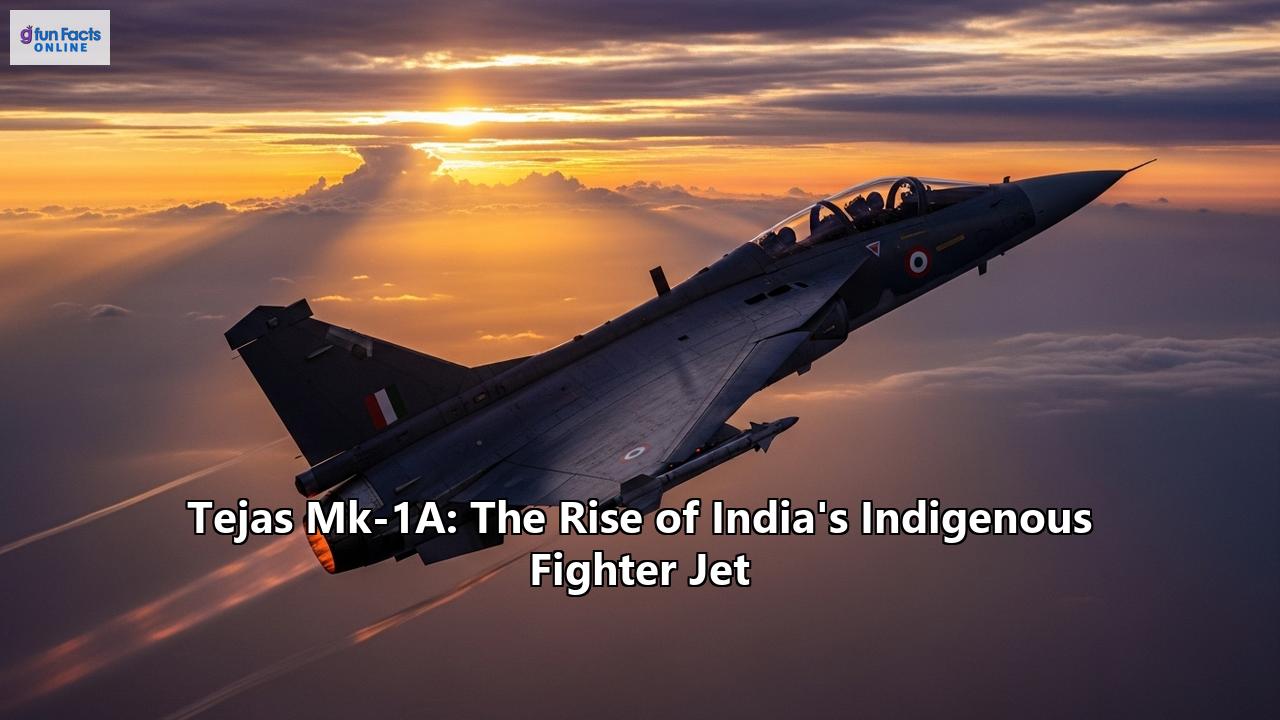
Tejas Mk-1A: The Dawn of India's Indigenous Air Power
A Nation's Ascent in Aerospace: The Tejas SagaFor decades, the narrative of India's military aviation was largely defined by sophisticated, yet foreign-procured, aircraft. From the British Vampires and Hunters to the Russian MiGs and French Mirages, the Indian Air Force (IAF) flew capable machines, but the dream of a world-class, indigenously designed and manufactured fighter jet remained an ambitious, long-held aspiration. The journey to realize this dream has been a marathon, not a sprint—a multi-decade endeavor filled with technological hurdles, geopolitical shifts, and immense perseverance. The culmination of this journey is the HAL Tejas, and its most formidable variant yet, the Tejas Mk-1A, an aircraft that represents not just a piece of military hardware, but the very rise of India as a credible aerospace power.
The story of the Tejas is intrinsically linked to the IAF's long-standing reliance on the Soviet-era MiG-21. By the early 1980s, the IAF recognized that its vast fleet of MiG-21s, the backbone of its air defense, would be approaching obsolescence by the mid-1990s. This looming capability gap, projected to be as high as 40% of the required force structure, created a strategic imperative. In 1983, the Indian government took a momentous step, sanctioning the Light Combat Aircraft (LCA) program with two primary objectives: to develop a replacement for the ageing MiG-21s and, crucially, to build a robust ecosystem for indigenous aerospace development and manufacturing.
The task was monumental. India's last foray into indigenous fighter design, the HAL HF-24 Marut in the 1960s, had provided valuable experience but the industry had not produced anything comparable since. To spearhead this ambitious new project, the Aeronautical Development Agency (ADA) was established in 1984 under the Defence Research and Development Organisation (DRDO) to manage the LCA program, with Hindustan Aeronautics Limited (HAL) as the principal manufacturing partner.
The design was finalized in 1990—a compact, tailless, compound delta-wing aircraft. This configuration was chosen to offer a blend of high-speed supersonic performance and excellent subsonic maneuverability. A key, and perhaps the most challenging, technological decision was to incorporate a "relaxed static stability" design. This means the aircraft is inherently unstable, a characteristic that, when managed by a sophisticated quadruple-redundant digital fly-by-wire system, grants it exceptional agility. On January 4, 2001, a prototype took to the skies for its maiden flight, a landmark event for Indian aviation. Two years later, in 2003, then Prime Minister Atal Bihari Vajpayee officially named the aircraft "Tejas," a Sanskrit word meaning "Radiant."
The path from first flight to operational induction was fraught with challenges, particularly in the development of critical indigenous systems like the multi-mode radar and the Kaveri jet engine. These hurdles led to delays, but the program persevered, leading to the initial operational clearance (IOC) of the Tejas Mk-1. The first Tejas-equipped squadron, No. 45 "Flying Daggers," was formed in 2016, marking the formal entry of an indigenous fighter into the IAF's arsenal. However, this was just the beginning. The Tejas Mk-1 was a stepping stone, a platform that proved the concept. The true game-changer, the variant designed to be the definitive frontline fighter, was yet to come: the Tejas Mk-1A.
The Phoenix Rises: From Mk-1 to Mk-1A
The Tejas Mk-1, while a significant achievement, was viewed by the IAF as a platform with certain operational shortfalls that needed to be addressed. The Mk-1A is the answer to that feedback—a direct evolution designed not just to plug the gaps but to create a significantly more lethal and survivable fighting machine. With over 40 improvements over the original, the Mk-1A is the realization of the LCA program's ultimate initial goal.
The most crucial upgrade in the Tejas Mk-1A is its advanced sensor suite, centered around an Active Electronically Scanned Array (AESA) radar. The initial batches are being fitted with the Israeli Elta EL/M-2052 AESA radar, a powerful system capable of tracking up to 64 targets simultaneously and engaging multiple targets at once. This radar provides superior performance in air-to-air, air-to-ground, and air-to-sea modes, offering long detection ranges and high resistance to electronic jamming. In parallel, India's own indigenous "Uttam" AESA radar is in advanced stages and is slated to be integrated into later production batches, further boosting the aircraft's indigenous content.
Enhancing the Tejas Mk-1A's survivability is an advanced, indigenously developed Unified Electronic Warfare (UEWS) suite. This system includes a radar warner and a self-protection jammer pod, designed to detect, identify, and counter enemy radar and missile threats, significantly improving the pilot's situational awareness and the aircraft's ability to operate in contested airspace. This modern EW capability is a generational leap over the systems on the aircraft it replaces.
The combat potential of the Mk-1A is further amplified by its expanded and more versatile weapons package. A key addition is its compatibility with Beyond Visual Range (BVR) air-to-air missiles. The aircraft has been successfully tested with India's indigenous Astra BVRAAM, which can engage targets at distances exceeding 100 kilometers. This capability allows Tejas pilots to engage enemy aircraft from a safe standoff distance, a critical requirement in modern air combat. The integration of the next-generation Astra Mk2, with a reported range of 140-160 km, is also underway, promising to further enhance its air-to-air lethality. In addition to the Astra, the Mk-1A can carry a mix of other advanced missiles, including the ASRAAM close combat missile, and the Israeli Derby missile.
For ground attack missions, the Tejas can be armed with a variety of munitions, including laser-guided bombs like the GBU-16 Paveway II and the Kh-59 series of air-to-surface missiles. It also carries the indigenous Smart Anti-Airfield Weapon (SAAW), a 125kg class precision-guided bomb. The aircraft is also armed with a GSh-23 twin-barrel 23mm cannon for close-in engagements.
Several other crucial enhancements make the Mk-1A a more practical and effective warplane. The inclusion of an air-to-air refueling probe significantly extends its combat radius and operational flexibility. An Onboard Oxygen Generation System (OBOGS) enhances pilot endurance for longer missions. Maintainability has also been improved, with design changes aimed at reducing turnaround times between sorties, a critical factor for maintaining a high operational tempo during conflict.
Anatomy of a Radiant Warrior: Design, Materials, and Powerplant
The Tejas Mk-1A is the smallest and lightest supersonic combat aircraft in its class, a distinction that is a direct result of its innovative design and extensive use of advanced materials. Its aerodynamic design is dominated by a tailless compound delta wing, which provides excellent flight characteristics across both subsonic and supersonic speeds. This design, inherently unstable to maximize maneuverability, is tamed by a sophisticated digital fly-by-wire flight control system, giving the pilot carefree handling and the ability to push the aircraft to its limits.
One of the most remarkable aspects of the Tejas is its construction. An astonishing 45% of its airframe by weight, and over 90% of its surface area, is made from carbon-fibre composites. This is one of the highest proportions of composite usage in any contemporary fighter jet globally. These advanced materials, used for the wings, fuselage sections, fin, and rudder, provide immense strength and stiffness at a fraction of the weight of traditional aluminum or titanium alloys, reducing the aircraft's overall weight by around 21-25%. This weight reduction is critical for a single-engine fighter, directly contributing to higher agility, better fuel efficiency, and a greater payload capacity. The use of composites also enhances the aircraft's stealth characteristics by reducing its radar cross-section and improves its service life by resisting fatigue and corrosion.
Powering the Tejas Mk-1A is the American General Electric F404-GE-IN20 afterburning turbofan engine. This engine is a specially developed, high-thrust variant of the renowned F404 family, producing 84-90 kN of thrust with afterburner. It provides the Tejas with a thrust-to-weight ratio that enables it to reach a top speed of Mach 1.8 and a service ceiling of over 50,000 feet. The F404 engine is a proven, reliable powerplant that powers numerous fighters worldwide.
The journey to power the Tejas also includes the ambitious, yet challenging, indigenous Kaveri engine project. Initiated by the Gas Turbine Research Establishment (GTRE) in the 1980s, the goal was to develop a domestic engine for the LCA. However, the project encountered significant hurdles, including failing to achieve the required thrust levels and being overweight. Despite not powering the Tejas, the Kaveri program has been an invaluable technology demonstrator, laying the foundation for future Indian efforts in the complex field of jet engine design and manufacturing. The experience gained is now crucial for the development of engines for future indigenous aircraft.
The Naval Chapter: A Stepping Stone from Sea to Sky
In parallel with the development for the Air Force, a naval variant of the Tejas (NLCA) was also developed to operate from India's aircraft carriers. This program, initiated in 2003, was immensely challenging, as carrier-borne aircraft require a host of modifications, including a strengthened undercarriage to withstand the violent forces of arrested landings, a tailhook for engaging arrester wires on the carrier deck, and specialized flight control laws for low-speed carrier approaches.
The NLCA prototypes successfully conducted a series of demanding trials, including ski-jump take-offs and arrested landings at a Shore-Based Test Facility (SBTF) in Goa. In a landmark achievement in January 2020, an NLCA prototype successfully performed an arrested landing and a ski-jump-assisted take-off from the deck of India's aircraft carrier, INS Vikramaditya. This feat made India one of a handful of nations to have mastered the complex technology of operating a fighter aircraft from a carrier.
However, the Indian Navy concluded that the single-engine NLCA, in its current form, was overweight and would face payload limitations when operating from a carrier. Consequently, the NLCA will not serve as a frontline naval fighter. Instead, it has been repurposed as a crucial technology demonstrator. The invaluable experience and technologies proven during the NLCA program—from carrier landing software to the strengthened airframe design—are now directly paving the way for the development of India's next-generation carrier-borne fighter, the Twin Engine Deck-Based Fighter (TEDBF).
Building an Industrial Revolution: Production and the Atmanirbhar Bharat Initiative
The Tejas program is more than just about building a fighter jet; it is about cultivating a national aerospace ecosystem. In line with the Indian government's 'Atmanirbhar Bharat' (Self-Reliant India) initiative, HAL has been orchestrating a major shift in its production strategy by deeply integrating the private sector.
To meet the IAF's large orders—an initial 83 Mk-1A jets followed by a recent approval for 97 more—HAL is ramping up its production capacity from around 16 to a targeted 24 aircraft per year. This is being achieved by establishing new production lines and, most significantly, by outsourcing the manufacturing of major airframe structures to private Indian companies.
Under this modular approach, leading private firms are now responsible for building entire sections of the aircraft. Larsen & Toubro (L&T) is manufacturing the wings, VEM Technologies is producing the center fuselage, Dynamatic Technologies builds the front fuselage, and Alpha Tocol fabricates the rear fuselage. These fully-equipped modules are then delivered to HAL for final assembly, integration of the engine and avionics, and flight testing. This public-private partnership is crucial for accelerating production, reducing bottlenecks at HAL's final assembly line, and building a robust, multi-tiered domestic supply chain. This model not only speeds up the delivery of the Tejas but also builds a resilient industrial base capable of supporting future, more complex projects like the AMCA.
Training the Next Generation of Warriors
The induction of a new generation of aircraft necessitates a modern training apparatus. To facilitate the smooth transition of pilots to the advanced Tejas platform, HAL has developed a twin-seater trainer variant. The IAF has placed an order for 18 of these trainers, the first of which was delivered in October 2023.
These trainers are critical for several reasons. They allow pilots transitioning from the Hawk Advanced Jet Trainer to familiarize themselves with the Tejas's unique flight characteristics, its advanced glass cockpit, and its fly-by-wire controls in a supervised environment. They also enable experienced pilots from other fighter streams, such as the Su-30MKI or Mirage 2000, to convert to the Tejas. The trainer variant retains the full operational capability of the fighter, allowing it to be used in combat roles if required, making it a versatile asset for the IAF. A specialized Lead-In Fighter Trainer (LIFT) variant, which can simulate the flight characteristics of various other fighters, has also been developed and offered for export.
Strategic Deployment and the Future of the Fleet
The IAF is moving swiftly to operationalize its new Tejas Mk-1A squadrons in strategically vital locations. The first squadron is set to be based at Nal Air Force Station in Rajasthan, with a second also planned for the western sector, directly bolstering India's air defense posture along the border with Pakistan. A third squadron is planned for the critical Srinagar airbase in the north, which would be pivotal for monitoring the Line of Actual Control (LAC) with China. This deployment plan underscores the IAF's confidence in the Tejas Mk-1A's capabilities to operate in diverse and challenging environments, from the deserts of Rajasthan to the high altitudes of the Himalayas.
The Tejas Mk-1A, however, is not the final chapter in the LCA story. It is a bridge to an even more capable future. The Aeronautical Development Agency and HAL are already deep into the development of the Tejas Mk2. The Mk2 will be a medium-weight fighter, significantly larger than the Mk-1A, and powered by the more powerful General Electric F414 engine. It will feature canard foreplanes for enhanced agility, an increased internal fuel and weapons payload, an integrated Infrared Search and Track (IRST) system, and a completely redesigned cockpit. The first prototype of the Mk2 is expected to roll out by late 2025 or early 2026.
Beyond the Mk2 lies India's most ambitious aerospace project yet: the Advanced Medium Combat Aircraft (AMCA). The AMCA is envisioned as a fifth-generation stealth fighter, incorporating features like supercruise, advanced sensor fusion, and a networked AI framework for intelligent decision support. The Tejas program, particularly the development of its flight control systems, composite structures, and avionics, has provided the critical foundational technologies and expertise necessary to undertake a project as complex as the AMCA.
A Global Contender: Export Potential and Geopolitical Significance
The Tejas Mk-1A is not just a symbol of India's self-reliance; it is also a credible contender in the global light fighter market. Its blend of modern 4.5-generation capabilities, a relatively low acquisition and operational cost, and the absence of stringent geopolitical strings attached to its sale make it an attractive option for many air forces in Asia, Africa, and South America.
Countries like Malaysia, Argentina, Egypt, and Nigeria have all expressed significant interest in the Tejas. For Malaysia, the Tejas is a contender for its requirement of 18 light combat aircraft. For Argentina, the Tejas offers a capable supersonic fighter free from the British components that have stymied other potential acquisitions due to a UK embargo. Egypt has explored a deal for around 20 jets, potentially including a local Maintenance, Repair, and Overhaul (MRO) facility.
The Tejas Mk-1A is positioned competitively against aircraft like the Pakistani-Chinese JF-17 Thunder and the South Korean KAI FA-50. Compared to the JF-17 Block III, the Tejas Mk-1A boasts a superior thrust-to-weight ratio, a significantly lower radar cross-section due to its extensive use of composites (0.5m² vs 1.5m²), and a more reliable engine. While the FA-50 has achieved greater export success so far, largely due to a higher production rate and a proven service record, the Tejas Mk-1A is technically a more capable 4.5-generation platform compared to the FA-50, which is primarily an advanced trainer with added combat capabilities.
The export of the Tejas is a key pillar of India's strategic policy to act as a net security provider and to build stronger defense partnerships. Each potential sale is not just a commercial transaction but a geopolitical statement, strengthening alliances and extending India's strategic influence.
Conclusion: A New Era in Indian SkiesThe Tejas Mk-1A is the embodiment of India's technological ambition and national will. It is the result of a long, arduous, yet ultimately triumphant journey that has transformed the country's aerospace landscape. From replacing the venerable MiG-21 to becoming a cornerstone of the IAF's modernization plans, the Tejas has silenced its doubters and proven its mettle.
As the production lines at HAL and its private partners accelerate, and as new squadrons stand ready to defend India's skies, the radiant glow of the Tejas signifies more than just the rise of an indigenous fighter jet. It marks the dawn of a new era—an era where India is not just a consumer of high-end military technology, but a creator, an innovator, and a rising power in the global aerospace domain. The Tejas Mk-1A is a powerful statement, a warrior forged in India, for India, and increasingly, for the world.
Reference:
- https://en.wikipedia.org/wiki/HAL_Tejas
- https://www.indiatoday.in/india-today-insight/story/when-14-years-on-iaf-got-its-first-trainer-jet-for-lca-tejas-2446188-2023-10-08
- https://indusresearch.in/the-geopolitics-of-fighter-exports-and-joint-ventures/
- https://www.spansen.com/2022/03/illustration-lca-tejas-aircraft-weapon-loadout.html
- https://www.quora.com/How-would-you-describe-proper-weapons-payload-of-HAL-Tejas
- https://idrw.org/iaf-advances-tejas-mk1a-deployment-with-three-squadrons-planned-by-late-2026/
- https://idrw.org/iafs-tejas-trainer-fleet-taking-shape-sixth-trainer-spotted-at-hal-facility/
- https://swarajyamag.com/insta/india-offers-to-sell-lca-tejas-lift-variant-to-the-us-navy-as-it-floats-global-rfi-to-buy-trainer-jet
- https://www.youtube.com/watch?v=0i99EpPmfqI
- https://www.youtube.com/watch?v=5Z659F5CTfI
- https://www.google.com/search?q=time+in+%E0%A4%A8%E0%A4%BE%E0%A4%97%E0%A4%AA%E0%A5%82%E0%A4%B0+%E0%A4%A1%E0%A4%BF%E0%A4%B5%E0%A5%8D%E0%A4%B9%E0%A4%BF%E0%A4%9C%E0%A4%A8,+IN
- https://defence.in/threads/iaf-to-form-first-tejas-mk1a-squadron-by-end-of-this-year.7936/
- https://www.quora.com/What-kind-of-armaments-can-India-put-on-its-Tejas-fighter-aircrafts
- https://byjus.com/free-ias-prep/lca-tejas/
- https://www.reddit.com/r/indianaviation/comments/1l6654d/tejas_mk1a_vs_jf17_block3/
- https://www.eurasiantimes.com/lca-tejas-why-did-indian-navy-reject-naval-variant-of-tejas-fighter-jet/
- https://myind.net/Home/viewArticle/india-offers-to-sell-lca-tejas-lift-variant-to-the-us-navy
- https://www.youtube.com/watch?app=desktop&v=3WrEl3SF80E
- https://jetlinemarvel.net/comparison-of-the-indian-built-tejas-mk1a-vs-south-korean-fa-50/
- https://www.eurasiantimes.com/tejas-vs-gripen-as-india-looks-to-acquire-114-fighter-jets-why-saab/
- https://idrw.org/jf-17-block-iii-and-tejas-mk1a-compete-for-brazils-f-5-replacement-program/
- https://www.wionews.com/photos/-tejas-mk2-export-potential-which-countries-could-buy-india-s-next-fighter-jet-1754120616347
- https://www.financialexpress.com/business/defence-made-in-india-tejas-nlca-first-step-towards-self-sufficiency-in-having-fighters-off-an-aircraft-carrier-1830602/
- https://thediplomat.com/2018/08/naval-version-of-indias-tejas-light-combat-aircraft-successfully-tests-arrestor-hook-capability/
- https://www.thehindu.com/news/national/naval-variant-of-lca-tejas-successfully-lands-on-carrier/article30541842.ece
- https://www.ajaishukla.com/2021/11/eye-on-export-markets-tejas-debuts-in.html
- https://www.youtube.com/watch?v=ltcG8gDMBpU
- https://www.reddit.com/r/IndianDefense/comments/1m2r3id/detailed_comparison_table_between_jf17_and_tejas/
- https://www.eurasiantimes.com/setback-for-indias-tejas-program-australia-rejects-tejas-lift-trainer-deal/
- https://www.youtube.com/watch?app=desktop&v=byDCh1RLK3k&pp=0gcJCfcAhR29_xXO
- https://fullafterburner.weebly.com/next-gen-weapons/tejas-mk1a-vs-gripen-ng-j-10
- https://iadnews.in/india-offers-lca-tejas-trainer-variant-to-us-navy-report/
- https://defence.in/threads/iaf-expects-to-raise-three-squadrons-of-tejas-mk1a-by-late-2026-as-f404-engine-deliveries-stabilize.15239/
- https://www.quora.com/Is-the-Indian-LCA-Tejas-MK1-a-better-combat-fighter-than-the-Korean-Kai-FA-50
- https://www.quora.com/How-does-the-performance-technology-and-cost-of-Swedens-JAS39-Gripen-compare-to-Indias-HAL-Tejas-MK1A
- https://www.quora.com/How-is-the-Tejas-MK1-in-comparison-to-the-FA-50
- https://idrw.org/tejas-mk1a-export-prospects-defense-analyst-casts-doubt/
- https://idrw.org/tejas-vs-fa-50-a-battle-overshadowed-by-allegations-of-corruption-in-malaysia-and-egypt/