
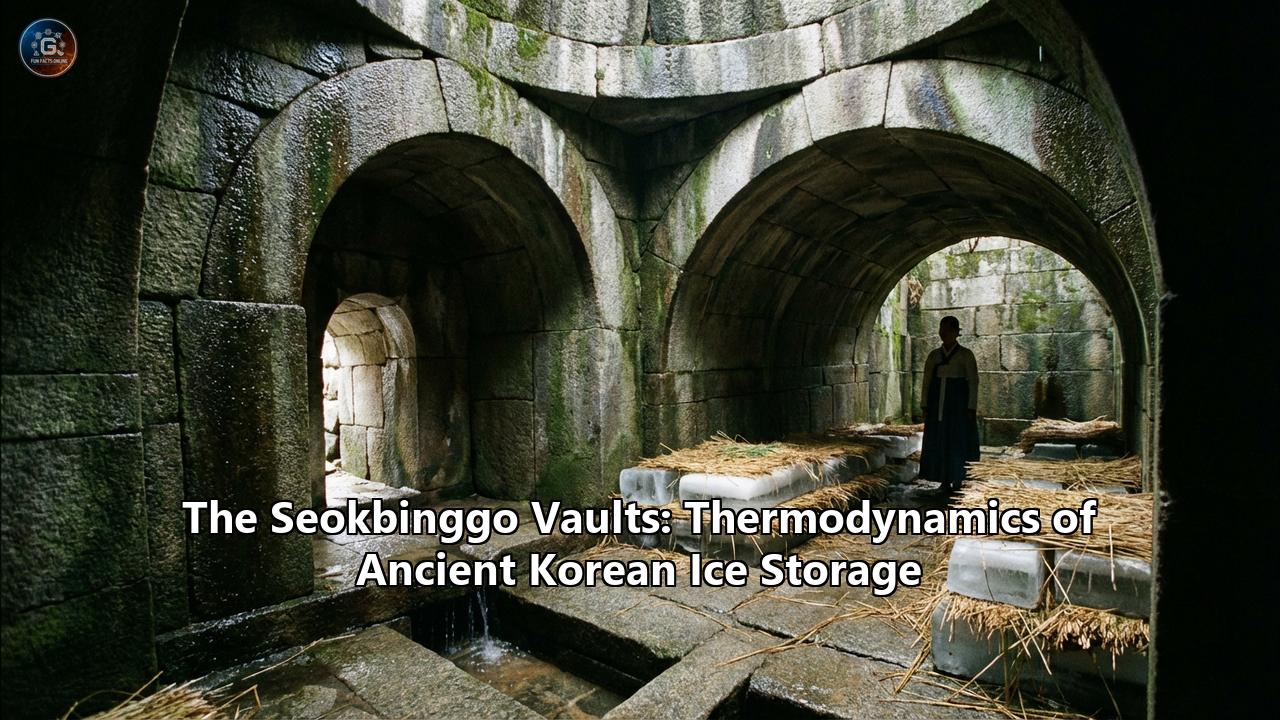
In the sweltering heat of mid-July on the Korean peninsula, when the cicadas cry in a deafening chorus and the humidity clings to the skin like a wet shroud, the idea of ice seems like a fever dream. Yet, three hundred years ago, in the height of the Joseon Dynasty, a royal banquet in the heart of summer would conclude with a delicacy as impossible as it was refreshing: crushed ice, served with fruit, chilled to perfection. This miracle was not born of electricity or chemical refrigerants, but of stone, earth, wind, and a profound understanding of the laws of nature.
They are the Seokbinggo (석빙고)—the Stone Ice Vaults.
Often mistaken for simple burial mounds by the uninitiated, these architectural marvels are scattered across the southern provinces of South Korea, silent sentinels of a lost era of sustainable engineering. To the casual observer, they are mere piles of granite. To the physicist and the architect, they are complex machines that manipulate thermodynamics with a precision that rivals modern technology. This is the story of how ancient Korean engineers tamed the seasons, turning the biting cold of winter into a summer luxury, and the intricate science that made it all possible.
Part I: The Thermodynamics of the Stone Vault
To understand the genius of the Seokbinggo, one must first discard the modern notion of "making things cold." The ancients understood that cold is merely the absence of heat. Therefore, the Seokbinggo was not designed to generate cold, but to battle heat—to fight a war against thermal energy on three different fronts: conduction, convection, and radiation.
The Battle Against Conduction: The Earth as a Blanket
The primary enemy of stored ice is the ground itself. In summer, the surface soil temperature in Korea can soar. The Seokbinggo engineers countered this by utilizing the principle of thermal inertia.
The vaults are invariably semi-subterranean. By burying the structure half-underground, the engineers tapped into the constant temperature of the deep earth. Below a few meters, the soil temperature stabilizes, hovering around the annual average (roughly 15°C or 59°F in this region). This provided a "cool" baseline. But 15°C is still warm enough to melt ice.
This is where the insulation mound comes into play. The granite roof of the vault is not exposed to the air. Instead, it is buried under a massive tumulus of earth, often mixed with clay and lime. This acts as a colossal thermal dampener. Heat from the summer sun must travel through meters of soil before it reaches the stone structure. Because soil is a poor conductor of heat, the "heat wave" travels slowly—so slowly, in fact, that the heat of mid-summer might not penetrate to the vault's ceiling until the weather is already turning cool in autumn. This "thermal lag" effectively shifts the seasons underground.
The Battle Against Convection: The Chimney Effect
While insulation stops heat from entering, it traps internal heat. The ice itself, along with the humans entering to retrieve it, generates heat. Warm air, being less dense than cold air, rises. If trapped, it creates a feedback loop that accelerates melting.
The Seokbinggo’s most defining feature is its ventilation system, a masterclass in fluid dynamics. The ceiling is punctured by three ventilation shafts (typically), which look like small chimneys from the outside.
Here, the Bernoulli Principle and the Stack Effect work in harmony.
- The Stack Effect: Inside the vault, the air near the ice is freezing and dense, sinking to the floor. Any warm air (introduced by opening the door or conduction through walls) rises to the curved ceiling.
- Bernoulli’s Principle: Outside, the wind blows over the curved, grassy mound of the roof. As wind moves over the opening of the ventilation shafts, it creates a pocket of low pressure (just as air moving over an airplane wing generates lift).
- The Result: The low pressure outside "sucks" the stagnant warm air out of the vault through the shafts. This passive ventilation system ensures that hot air never accumulates at the ceiling to radiate heat back down onto the ice.
Crucially, the vents were often capped or designed with hoods to prevent rain and direct sunlight from entering, acting as a one-way valve for heat expulsion.
The "Wing" of the Interior
Modern Computational Fluid Dynamics (CFD) simulations of the Gyeongju Seokbinggo have revealed a startling detail: the interior shape resembles an airfoil. The arched ceiling is not just structural; it creates a smooth path for air circulation. The spacing of the granite arches creates "ribs" that disturb the boundary layer of the air, potentially encouraging the mixing of warm pockets so they can be effectively vented, rather than stagnating in corners.
Part II: The Engineering of Longevity
The thermodynamics would be useless if the structure collapsed or flooded. The construction of a Seokbinggo was a feat of civil engineering that required precise material selection and structural calculation.
The Granite Shear Arches
Korea is a land of granite, a stone known for its hardness and thermal mass. The Seokbinggo walls are built of cut granite blocks. The ceiling is the true marvel: it consists of a series of shear arches.
Unlike a continuous barrel vault (like a tunnel), the Seokbinggo ceiling is made of separate arched ribs spaced at intervals. The gaps between these stone ribs were filled with flat stones and earth. This design is ingenious for two reasons:
- Structural Elasticity: If the ground shifts or settles, a continuous vault might crack along its entire length. Separate arches allow for slight independent movement without catastrophic failure.
- Ventilation Pockets: The spaces between the arches create natural pockets where warm air gets trapped before being vented out, preventing it from circulating back down to the ice.
The Waterproofing Layer
Water is the enemy of ice. If groundwater seeps in, or if condensation drips from the ceiling, the ice melts rapidly (water conducts heat 25 times faster than air).
To combat this, the builders used a layer of lime and clay (known as hoegyeok) between the granite ceiling and the exterior earth mound. This traditional mortar acted as a waterproof sealant, ensuring that summer rains ran off the mound rather than soaking into the vault.
The Slanted Floor and Drainage
Perhaps the most critical, yet invisible, feature is the floor. It is never flat. The floor of every Seokbinggo is sloped, allowing meltwater to flow immediately to a drain.
This is vital because of latent heat. As ice melts, the resulting water is at 0°C. If this water pools around the remaining ice blocks, it increases the surface area for heat transfer and, more dangerously, increases humidity. High humidity acts as a thermal bridge, transferring heat from the walls to the ice. By instantly removing meltwater, the Seokbinggo keeps the interior air dry (or as dry as possible), drastically slowing the melting rate.
Part III: The Architecture of the Specific
While the principles remain the same, each surviving Seokbinggo tells a unique story of adaptation to its local geography.
1. Gyeongju Seokbinggo (Treasure No. 66)
- Location: Wolseong Fortress, Gyeongju.
- Size: Length 18.8m, Width ~6m, Height ~5m.
- The King of Vaults: This is the largest and best-preserved example. Built in 1738 (King Yeongjo’s reign), its sheer scale is breathtaking. The entrance faces north to avoid the hot southern winds of summer. Its ventilation shafts are protected by unique stone caps that are architectural miniatures in themselves. The layout of the ventilation shafts is perfectly spaced to ensure no "dead zones" of stagnant air exist in the long tunnel.
2. Andong Seokbinggo (Treasure No. 305)
- Location: Andong Folk Village (relocated).
- The River Guardian: Originally located on the banks of the Nakdong River, it was moved during the construction of the Andong Dam.
- Unique Feature: The "Dorsal Fin" Arches. The granite arches in Andong are particularly pronounced, protruding significantly from the ceiling line. This creates deep pockets for warm air capture. Its entrance is oriented specifically to face the river, utilizing the cooler river breeze to keep the vestibule temperature down. The ice here was primarily used to preserve the local delicacy, euneo (sweetfish), for presentation to the King.
3. Changnyeong Seokbinggo (Treasure No. 310)
- Location: Changnyeong-eup.
- The Structural Anomaly: Unlike the smooth interior of Gyeongju, the Changnyeong vault shows a more rugged construction style. The arches are constructed perpendicular to the flow of the nearby stream. The entrance is located on the higher ground (south), while the drain is on the lower ground (north), using gravity to its maximum potential. The "rainbow" stones (arch keystones) here are laid intermittently, a specific stylistic choice that also reduced the weight load on the walls.
4. Cheongdo Seokbinggo (Treasure No. 323)
- Location: Hwayang-eup, Cheongdo.
- The Ancient Skeleton: This is the oldest dated Seokbinggo (1713). Sadly, its ceiling has collapsed, leaving only the granite arches standing like the ribs of a great whale skeleton.
- The Lesson: The collapsed state of Cheongdo offers a unique cross-sectional view for archaeologists. We can see exactly how the flat stones spanned the gap between the arches, revealing the "shear arch" construction technique in plain sight. It serves as a visual textbook of Joseon masonry.
Part IV: The Culture of Ice (Binggo)
The Seokbinggo was not a standalone object; it was the physical heart of a complex bureaucratic and cultural system known as the Binggo (Ice Storage Office).
The Politics of Cold
In the Joseon Dynasty, ice was a controlled substance, more valuable than gold in the summer months. The government maintained the Seobinggo (West Ice House) and Dongbinggo (East Ice House) in Seoul.
- Dongbinggo: Dedicated to ritual use. Ice from here was used solely for ancestral rites (hailing the spirits) and royal funerals.
- Seobinggo: The "people's" ice (though "people" meant high-ranking officials). This immense complex, capable of storing over 130,000 blocks of ice, distributed ice to the royal kitchen and officials based on rank.
The Bingpae (Ice Ration Card)
Possessing ice was a status symbol. Officials carried a Bingpae, a wooden tablet carved with their rank and the amount of ice they were allotted. It was a literal "ticket to cool." Corruption involving Bingpae—forging them or trading them on the black market—was a serious crime, highlighting the commodity's value.
The Sohan Hardship
The luxury of summer came at the cost of winter suffering. The harvesting of ice began in the coldest part of winter (Sohan and Daehan, usually January). Laborers were conscripted to cut the frozen Han River (or local rivers like the Nakdong) into precise blocks (typically 12cm thick, 180cm long).
It was brutal, dangerous work. Many suffered frostbite or fell into the freezing water. The Gyeongguk Daejeon (National Code) actually had provisions to provide alcohol and medicine to these ice-cutters to prevent hypothermia, acknowledging the state's debt to their labor.
Straw: The Unsung Insulator
Once the ice was stacked inside the Seokbinggo, it wasn't just left naked. Layers of rice straw were placed between the ice blocks and over the top of the pile. Straw is an excellent insulator because its hollow stalks trap air (similar to double-glazed windows). This prevented the ice blocks from fusing together into a single unmanageable monolith and added one final layer of thermal protection.
Part V: Modern Echoes and Sustainability
In the 21st century, as we grapple with climate change and the immense energy cost of air conditioning (which pumps hot air out into the city, making the "heat island" effect worse), the Seokbinggo offers a lesson in Passive Design.
Modern architects are revisiting the principles of the Seokbinggo:
- Earthships and Bermed Houses: Using the ground as thermal mass is a direct descendant of the Seokbinggo’s semi-subterranean design.
- Solar Chimneys: Modern green buildings use vertical shafts to vent hot air using the stack effect, exactly as the Seokbinggo did 300 years ago.
- Phase Change Materials (PCMs): While we don't use river ice, modern construction uses wax or salt hydrates in walls to absorb heat during the day (melting) and release it at night (solidifying), mimicking the thermal buffer of the ice blocks.
Conclusion
The Seokbinggo is more than a relic; it is a testament to the sophistication of Korean science. Without electricity, without plastics, and without modern theory, the engineers of the Joseon Dynasty observed the wind, the water, and the earth, and built structures that defied the seasons.
Walking into a Seokbinggo today—even just standing at the entrance—you are hit with a blast of damp, cool air that smells of moss and ancient stone. It is the breath of history. It is a reminder that the quest for comfort is timeless, and that sometimes, the most advanced technology is not a microchip, but a perfectly placed stone in the path of the wind.
The vaults stand silent now, no longer filled with river ice, but they remain full of wisdom. In their arched ceilings and slanted floors, we find a harmony with nature that we are only just beginning to relearn. They are the cool, beating heart of Korea's architectural heritage, waiting to whisper their secrets to anyone willing to listen to the wind.
Reference:
- https://www.atlasobscura.com/places/gyeongju-seokbinggo
- https://www.researchgate.net/figure/Seokbinggo-interior-photo-A-and-the-cross-sectional-drawing-B_fig2_360771322
- https://english.khs.go.kr/chaen/search/selectGeneralSearchDetail.do;jsessionid=zXSWPixATno5SamnwHtecyPcIi3f8XoRf1e6vwvL1xLHHTuPlRz2N2Lbgy84QoT3.cha-was01_servlet_engine4?mn=EN_02_02&sCcebKdcd=12&ccebAsno=0003230000000&sCcebCtcd=37&pageIndex=67®ion=&canAsset=&ccebPcd1=&searchWrd=&startNum=&endNum=&stCcebAsdt=&enCcebAsdt=&canceled=&ccebKdcd=&ccebCtcd=
- https://english.khs.go.kr/chaen/search/selectGeneralSearchDetail.do;jsessionid=zXSWPixATno5SamnwHtecyPcIi3f8XoRf1e6vwvL1xLHHTuPlRz2N2Lbgy84QoT3.cha-was01_servlet_engine4?mn=EN_02_02&sCcebKdcd=12&ccebAsno=0003100000000&sCcebCtcd=38&pageIndex=66®ion=&canAsset=&ccebPcd1=&searchWrd=&startNum=&endNum=&stCcebAsdt=&enCcebAsdt=&canceled=&ccebKdcd=&ccebCtcd=
- https://en.namu.wiki/w/%EC%84%9D%EB%B9%99%EA%B3%A0