
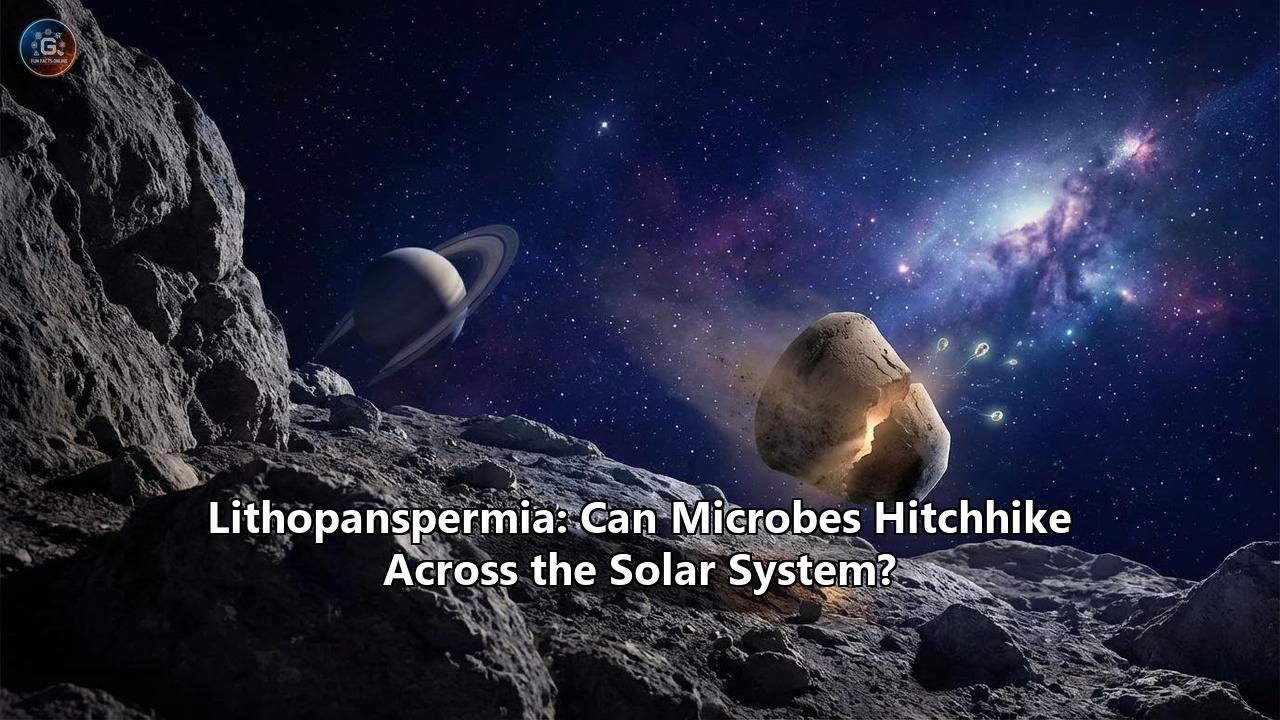
Four billion years ago, the solar system was a shooting gallery. Giant asteroids and cometary debris routinely slammed into the young, cooling planets, throwing up colossal plumes of fire and vaporizing oceans. Picture the scene on early Mars: it was a world with a thick atmosphere, liquid water pooling in vast craters, and perhaps, the microscopic beginnings of life. Suddenly, a multi-ton asteroid strikes the Martian surface at 15 kilometers per second. The kinetic energy released is equivalent to millions of nuclear warheads. Rock is liquefied; the atmosphere is temporarily blown away into the vacuum of space. But at the periphery of the impact zone, something miraculous happens.
Through a quirk of physics known as spallation, fragments of the Martian crust are ejected outward at escape velocity before the shockwave can completely vaporize them. Inside these cold, dark fragments, deeply embedded in the porous basalt, microscopic organisms are suddenly violently thrust into the silent, deadly void of interplanetary space. Millions of years later, one of these rocks is caught in the gravitational pull of a blue-green planet. It plummets through the atmosphere, shedding its fiery outer layers in a brilliant meteor streak, and crashes into a primordial ocean. The rock cracks open. The dormant microbes inside, having survived the violent launch, the frozen eternity of the cosmic void, and the blazing reentry, awaken in the waters of early Earth.
This is the central premise of lithopanspermia—the hypothesis that life is not strictly tethered to the planet of its birth, but can hitchhike across the solar system, and perhaps the galaxy, hidden inside the protective hull of meteorites.
For decades, the idea that life could naturally transfer between planetary bodies was relegated to the fringes of science fiction. Today, however, astrobiologists, physicists, and microbiologists are rigorously testing the boundaries of this theory. Through high-velocity impact experiments, long-term exposure modules on the outside of the International Space Station (ISS), and the stunning discovery of interstellar objects passing through our solar system, lithopanspermia has transitioned from a fantastical thought experiment to a highly plausible, mathematically backed scientific model.
If life can indeed travel across the stars, it forces us to ask a profound question: Did life on Earth actually begin on Earth? Or are we, at our deepest biological roots, the descendants of Martian—or even interstellar—microbial astronauts?
The Cosmic Dandelion: Evolution of an Idea
To understand lithopanspermia, we must first look at its parent concept: panspermia (from the Greek pan meaning "all" and sperma meaning "seed"). The notion that the "seeds of life" exist all over the universe was first pondered by the ancient Greek philosopher Anaxagoras in the 5th century BC. However, the modern scientific framework for the idea was laid down in the late 19th and early 20th centuries by prominent scientists like Lord Kelvin and the Swedish physicist Svante Arrhenius.
Arrhenius proposed that individual bacterial spores could be pushed across the galaxy by the faint radiation pressure of starlight—a concept known as radiopanspermia. While poetic, this idea faced a massive scientific roadblock: the unshielded radiation of space. Ultraviolet (UV) light, galactic cosmic rays, and solar flares are brutally destructive to DNA. A naked microbe drifting through the cosmos would be sterilized long before it reached another world.
Enter lithopanspermia. By proposing that microbes are encased within solid rock—ejected by asteroid impacts—the theory elegantly solves the radiation problem. A few meters, or even a few centimeters, of rock can act as a formidable shield against UV radiation and significantly dampen the effects of cosmic rays.
But replacing the gentle push of starlight with the apocalyptic violence of an asteroid impact introduces an entirely new set of hurdles. For lithopanspermia to work, a microbe must survive a grueling three-act play:
- Act I: Ejection. The extreme shock pressure, heat, and acceleration of being blasted off a planet.
- Act II: Transit. The cold, radiation, vacuum, and vast time scales of deep space.
- Act III: Reentry and Landing. The blistering heat of atmospheric entry and the crushing force of planetary impact.
Over the last two decades, scientists have systematically put the toughest organisms on Earth through simulations of all three acts. The results have been nothing short of astounding.
The Cast of Microscopic Astronauts
Not just any life form can survive the rigors of space travel. The organisms capable of enduring such extremes are known as polyextremophiles—creatures that thrive in environments that would be instantly lethal to humans. To test the lithopanspermia hypothesis, astrobiologists have drafted a "crew" of these robust terrestrial life forms.
Deinococcus radiodurans: Often affectionately dubbed "Conan the Bacterium," this spherical bacterium is a marvel of biological engineering. It is listed in the Guinness Book of World Records as the world’s toughest bacterium. Originally discovered in the 1950s in cans of meat that had spoiled despite being sterilized with massive doses of gamma radiation, D. radiodurans can survive radiation exposures up to 3,000 times the lethal dose for a human. When its DNA is shattered by radiation or extreme desiccation, it simply stitches its genome back together within hours. This extreme resilience makes it a prime candidate for surviving both the transit through space and the radiation environment of other planets. Bacillus subtilis: A common, rod-shaped bacterium found in soils across the globe. What makes B. subtilis invaluable for astrobiology is its ability to form endospores. When conditions become unfavorable, the bacterium strips away its water, shuts down its metabolism, and encases its DNA in a tough, proteinaceous armor. These spores can remain dormant for decades, centuries, and potentially millions of years, patiently waiting for a drop of water to revive them. Chroococcidiopsis: A genus of endolithic (rock-dwelling) cyanobacteria capable of surviving deep in the freezing, hyper-arid deserts of Antarctica. Because they naturally live inside the microscopic pores of rocks, they are already pre-adapted for a lithopanspermic journey. Xanthoria elegans: A stunning, orange-pigmented lichen that thrives in high-alpine and Arctic environments. Lichens are symbiotic partnerships between fungi and algae, and X. elegans has been shown to survive the vacuum of space, shutting down its photosynthesis and reviving seamlessly when returned to Earth-like conditions. Tardigrades: Though not microbes (they are multicellular micro-animals), the "water bear" is famous for entering a state of suspended animation called cryptobiosis. By replacing the water in their cells with specialized proteins, tardigrades can survive the vacuum of space, extreme radiation, and temperatures ranging from near absolute zero to well above the boiling point of water.With our microscopic astronauts selected, we can examine how they fare in the violent ballet of interplanetary transit.
Act I: The Violent Eviction (Surviving the Launch)
The first major objection to lithopanspermia was physical: surely the astronomical pressures generated by a meteorite impact capable of launching debris into space would instantly sterilize any life residing inside the rock.
When a large asteroid hits a planet, the shockwave generates pressures measured in gigapascals (GPa). One gigapascal is roughly equal to 10,000 times the atmospheric pressure at sea level. The escape velocity of Mars is 5.03 kilometers per second; Earth's is 11.2 km/s. Accelerating a rock to these speeds in a fraction of a second involves mind-boggling forces.
However, planetary geologists discovered a loophole: the spallation zone. When a shockwave from an impact reaches the free surface of a planet, it reflects back as a tensile wave. This interaction can cause surface rocks at the periphery of the crater to violently snap off and be launched upward at escape velocities while experiencing only a fraction of the central impact pressure.
To test if microbes could survive this launch, scientists turned to some of the most powerful weapons on Earth: light-gas guns.
At facilities like the Ames Vertical Gun Range in California and the University of Kent in the UK, researchers have simulated the spallation process. In one landmark experiment, scientists seeded granite targets with Bacillus subtilis spores and fired aluminum projectiles at them at a staggering 5.4 kilometers per second. High-speed cameras captured the impact, and the resulting shattered granite fragments (ejecta) were recovered from soft foam catchers.
The peak shock pressure at the exact point of impact was calculated at 57.1 GPa. However, the recovered spall fragments—the pieces launched outward—experienced significantly lower pressures of around 5 to 7 GPa. When the researchers ground up these fragments and placed them in nutrient broths, the Bacillus subtilis spores woke up and began to multiply. The survival rate was roughly 1 in 100,000. While this may sound low, a single kilogram of Earth rock can contain billions of microbes. A 0.001% survival rate is more than enough to successfully seed a new world.
Other shock-recovery experiments have pushed these limits even further. Systematic tests embedding Chroococcidiopsis, Bacillus subtilis, and the lichen Xanthoria elegans between gabbro discs (a Martian analogue rock) exposed them to explosive shockwaves mimicking Martian meteorite ejections. The results showed a "vital launch window" for life: Bacillus spores and the lichen survived shock pressures up to 40-45 GPa, while the cyanobacteria survived up to 10 GPa. Even Deinococcus radiodurans was tested in similar extreme-pressure hypervelocity impact simulations; astonishingly, a large percentage of the cells survived shock pressures up to 2.4 GPa, seamlessly repairing the structural damage caused to their membranes once the pressure subsided.
The conclusion of Act I is clear: the launch is violent, but it is entirely survivable for polyextremophiles hiding in the structural sanctuary of rock pores.
Act II: The Deep Freeze of Transit (Surviving the Void)
Once ejected from the host planet, the life-bearing rock enters the most protracted phase of its journey. Interplanetary space is an unforgiving environment. It is an ultra-high vacuum devoid of liquid water and oxygen. Temperatures fluctuate wildly depending on solar exposure, dropping to -270°C in the shadows. But the ultimate killer is radiation. Solar ultraviolet (UV) radiation will fry exposed DNA in minutes, while highly energetic galactic cosmic rays (heavy ions moving at near light-speed) can penetrate deeply into rock, causing cumulative genetic damage over millions of years.
To test how long life could endure in this environment, space agencies took the experiments out of the laboratory and into low Earth orbit.
One of the most profound experiments in the history of astrobiology is the Japanese Tanpopo (Dandelion) Mission, led by Dr. Akihiko Yamagishi of the Tokyo University of Pharmacy and Life Sciences. The Tanpopo mission was designed specifically to test a variation of the panspermia hypothesis using the Exposed Experiment Handrail Attachment Mechanism (ExHAM) on the exterior of the International Space Station.
Yamagishi and his team were particularly interested in whether microbes could survive without being deeply buried inside rocks. In 2018, using scientific balloons, they had discovered viable Deinococcus bacteria floating 12 kilometers above the Earth's surface in the stratosphere. They hypothesized that clumps of bacteria, acting as their own microscopic shields, could survive the harshness of space—a concept they coined massapanspermia (transfer via microbial aggregates).
For the Tanpopo mission, the team prepared dried pellets of Deinococcus radiodurans of varying thicknesses (from sub-millimeter up to a few millimeters) and placed them in aluminum plates on the outside of the ISS. There, pointing out into the vastness of the cosmos, the bacteria were subjected to raw solar UV radiation, cosmic rays, and wild temperature swings.
After one, two, and three years, the robotic arm of the Japanese Kibo module retrieved panels and brought them back inside. The results were staggering. While the microbes in pellets thinner than 0.5 millimeters were killed by the intense UV radiation, the thicker pellets told a different story. In aggregates 0.5 millimeters or thicker, the cells on the outermost layer died quickly. However, their dead, highly resilient bodies formed an impenetrable sacrificial shield that absorbed the UV radiation, protecting the living cells underneath.
After three years in the absolute harshest environment imaginable, the Deinococcus bacteria in the core of these tiny pellets were still alive. Upon being placed in water back on Earth, they immediately began repairing their accumulated DNA damage and reproducing. By extrapolating the survival curve, Yamagishi’s team calculated that a pellet of Deinococcus just 1 millimeter thick could survive for up to 8 years in outer space. A pellet slightly thicker could survive anywhere from 15 to 45 years.
Eight years is more than enough time for a direct transfer between Earth and Mars during their closest orbital approaches. And this is merely for unshielded bacterial clumps (massapanspermia). If these organisms were safely tucked a few centimeters deep inside a rocky meteorite (lithopanspermia), shielding them entirely from UV radiation and significantly mitigating cosmic rays, models suggest they could remain viable for millions of years.
European experiments tell a similar story. The EXPOSE-E and EXPOSE-R missions by the European Space Agency placed bacterial spores, lichens, and even tardigrades on the outside of the ISS. When shielded by simulated Martian soil or meteorite analogues, the survival rates spiked dramatically. The biofilm mode of growth, common to many bacteria, was found to significantly enhance long-term survival.
Life, it seems, is remarkably well-equipped to wait out the deep freeze of transit.
Act III: The Fiery Descent (Reentry and Impact)
If the rock survives its launch and long slumber in the void, it eventually encounters the gravitational well of a new planet. As it accelerates into the atmosphere, friction compresses the gas in front of the meteorite, generating a superheated plasma that reaches thousands of degrees. This is the fireball stage, where the exterior of the rock undergoes ablation—melting and vaporizing away.
Surely, this fiery descent would incinerate any microbial passengers?
Counterintuitively, the physics of atmospheric reentry act to protect the interior of the rock. The process of ablation is highly efficient at carrying heat away from the meteorite. Because rock is a notoriously poor conductor of heat, the intense thermal energy does not have time to penetrate the interior. As the outer layers vaporize, the rock's core remains largely at the frigid temperature of deep space.
We know this from examining meteorites that have fallen to Earth. Freshly fallen meteorites are often covered in a thin, glass-like fusion crust—usually less than a millimeter thick. Just millimeters beneath this crust, the minerals show no signs of heat alteration. In fact, some freshly recovered meteorites have been reported to be coated in frost shortly after landing, because their deep interiors retained the freezing cold of space. Any endolithic microbes situated a few centimeters inside the rock would barely notice the fiery reentry.
The final hurdle is the physical impact on the new planet's surface. Unlike the titanic asteroid impacts required to eject a rock, the landing is often much gentler. As a meteorite falls through a thick atmosphere like Earth's, atmospheric drag slows it down to terminal velocity. By the time it hits the ground, it is often traveling at merely a few hundred kilometers per hour—a speed at which the survival of shock-resistant microbes is virtually guaranteed. If it lands in water, the deceleration is even more cushioned.
The Martian Connection: Did We Come From Mars?
The theory of lithopanspermia is not merely hypothetical; we have physical proof that planetary transfer occurs naturally. To date, scientists have discovered hundreds of Martian meteorites on Earth.
These meteorites, identified by the unique isotopic signature of trapped gases that perfectly match the Martian atmosphere analyzed by the Viking landers, prove that rocks are regularly exchanged between the planets. The most famous of these is ALH84001, a 4-billion-year-old rock from Mars discovered in the Allan Hills of Antarctica in 1984.
In 1996, NASA scientists announced that ALH84001 contained microscopic structures that resembled fossilized nanobacteria, along with complex organic molecules. While the biological origin of these structures remains a topic of fierce debate—with many scientists arguing they could be produced by abiotic geological processes—the meteorite undeniably proved that a chunk of Mars could be launched into space without melting its interior, drift for millions of years, and land safely on Earth.
This leads to a tantalizing astrobiological hypothesis: Mars-to-Earth Lithopanspermia.
Four billion years ago, the solar system was vastly different. Early Earth was a violent, volatile place, frequently sterilized by massive, ocean-boiling impacts during the Late Heavy Bombardment. Mars, being smaller, cooled down much faster. It had a thick atmosphere, global oceans, and a stable surface far earlier than Earth did. It is entirely possible that life originated on Mars first.
As asteroids bombarded the early Martian surface, millions of life-bearing rocks could have been ejected into space, eventually raining down on early Earth. If true, the implications are mind-bending: the biosphere of Earth may simply be a transplanted Martian ecosystem. When humanity finally sends astronauts to Mars, we may not be visiting an alien world; we might be returning to our ancestral homeland.
The Interstellar Express: 'Oumuamua and the Galactic Dandelion
For a long time, the boundaries of lithopanspermia were thought to be confined to our solar system. The vast distances between stars, spanning light-years, seemed insurmountable for the transfer of biological material. The transit times would stretch from millions to billions of years, giving cosmic radiation ample time to degrade even the hardiest DNA.
Then, in October 2017, the Pan-STARRS telescope in Hawaii detected something unprecedented: an object moving at an extreme hyperbolic trajectory, indicating it was not bound to our Sun's gravity. It was named 1I/’Oumuamua (Hawaiian for "a messenger from afar arriving first"). It was the first confirmed interstellar object to pass through our solar system. Two years later, a second object, the interstellar comet 2I/Borisov, was discovered.
The discovery of 'Oumuamua violently shattered our assumptions about the isolation of solar systems. It proved that rocky and icy debris is constantly being exchanged across the galaxy. It also triggered a massive reevaluation of the likelihood of interstellar panspermia.
If solar systems routinely eject trillions of rocks into the interstellar medium—due to planetary collisions, gravitational interactions with gas giants, or asteroid impacts—how often do they hit other planets?
Astrophysicists Manasvi Lingam and Abraham Loeb from Harvard University utilized the properties of 'Oumuamua to run statistical models of interstellar impacts. Their models calculated that our solar system acts like a massive gravitational "fishing net." They estimated that at any given time, thousands of interstellar objects are passing through our solar system.
More remarkably, Lingam and Loeb found that prior to abiogenesis (the emergence of life on Earth some 3.8 to 4 billion years ago), approximately 400 interstellar objects around 100 meters in size, and roughly 10 objects nearly a kilometer in size, could have directly impacted the early Earth.
"Hence, this opens up the possibility that life could have been transferred to the Earth by means of lithopanspermia," Lingam noted. Because of the extreme cold of the interstellar medium, a rock or icy comet acting as an interstellar transport vehicle would effectively cryopreserve any microbes inside. Furthermore, research by scientists like Steven Desch and Alan Jackson highlighted that if life was buried deep enough inside a large ejecta fragment (e.g., a fragment of an exo-Pluto made of nitrogen ice), it could be sufficiently shielded from the sterilizing background radiation of the galaxy and supernova events.
Calculations by student-scientists exploring the 'Oumuamua data suggest that objects similar in size to 'Oumuamua continuously bring interstellar mass to Earth, calculating rates of billions of grams of foreign material per million years. If even a microscopic fraction of this material originates from a habitable, life-bearing exoplanet, the seeds of life might be continuously raining down across the galaxy. Under this model, life does not need to undergo the complex and highly improbable process of abiogenesis on every individual planet. It only needed to originate once, and from there, it spread across the Milky Way like dandelion fluff on the wind.
The Planetary Protection Dilemma
The reality of lithopanspermia—and the proof that organisms like Deinococcus radiodurans can survive the journey—has triggered intense headaches for modern space agencies. It brings us to the critical field of Planetary Protection.
Planetary Protection is the principle of preventing "forward contamination" (polluting other worlds with Earth microbes) and "backward contamination" (bringing alien microbes back to Earth). When NASA launches rovers like Perseverance to Mars, or the upcoming Europa Clipper to Jupiter's icy moon, the spacecraft are assembled in highly sterile cleanrooms to ensure they don't carry hitchhikers.
However, the Tanpopo mission and the resilience of bacterial spores prove that total sterilization is incredibly difficult. Dr. Yamagishi of the Tanpopo team noted that the survival of cell aggregates in space means that humans must be immensely careful when exploring Mars. The exterior of a spacecraft, previously thought to be completely sterilized by the harsh vacuum and UV radiation of the journey, could easily harbor living colonies of Earth bacteria upon arrival.
If an astronaut, or an inadequately sterilized rover, introduces Earth microbes to the Martian subsurface where liquid water might exist, those microbes could survive and colonize the area. Later, if a scientific instrument detects life in that same spot, we would be faced with a tragic false positive. We would think we had discovered Martian life, only to realize we had simply found our own terrestrial contamination.
"It is very important to search for life on Mars before human missions to Mars," Yamagishi warned, highlighting the urgency of robotic astrobiology before human footprints muddy the cosmic waters.
On the flip side, understanding lithopanspermia gives us an incredible toolkit for the future. Extremophiles are Nature's ultimate bioengineers. As humanity looks toward terraforming Mars or establishing closed-loop bioregenerative life support systems for deep space, these tough-as-nails organisms will be our pioneers. Bacteria like Chroococcidiopsis can extract moisture from rocks and produce oxygen, laying the biological groundwork necessary to transform barren rocks into breathable atmospheres.
Redefining the Tree of Life
The hypothesis of lithopanspermia fundamentally alters how we view our place in the universe. Traditionally, the search for extraterrestrial life has been governed by the Drake Equation, which treats the origin of life on any given planet as an independent, isolated statistical probability.
Lithopanspermia introduces an epidemiological element to the Drake Equation. Life in the universe might behave less like isolated sparks and more like a contagion. If a stellar nursery gives birth to a cluster of stars, and life originates on just one planet orbiting one of those stars, the continuous exchange of lithopanspermic debris could cross-pollinate the entire stellar neighborhood before the stars drift apart. The Milky Way could be teeming with biological networks, sharing a common, ancient genetic heritage that spans thousands of light-years.
When we peer through our microscopes at the humble tardigrade, or the radiation-eating Deinococcus radiodurans, we are not just looking at evolutionary oddities. We might be looking at the biological hardware required for galactic expansion. These extreme survival mechanisms—resistance to gigapascals of shock pressure, immunity to cosmic radiation, the ability to survive for years in a vacuum—seem like massive evolutionary overkill for organisms that have only ever lived on the relatively gentle surface of Earth. Some astrobiologists argue that these traits were not naturally selected by Earth’s environment, but are instead the evolutionary scars of ancient, violent interplanetary voyages.
Whether life originated in the warm, primordial hydrothermal vents of early Earth, in the ancient, vanished oceans of Mars, or on a long-dead exoplanet on the other side of the galaxy, lithopanspermia proves one profound truth: life is incredibly resilient. It is not fragile. It is a robust, dynamic force capable of weathering the apocalypse of a planetary impact, braving the frozen emptiness of the cosmic void, and taking root wherever it finds an anchor.
As we continue to scan the skies for incoming interstellar objects and examine the rocks beneath our feet for signs of cosmic origins, we are forced to reevaluate our definition of "alien." If the cosmic dandelion theory holds true, we are the aliens, and the vast, dark expanse of space is not a barrier to life—it is a highway.
Reference:
- https://pubmed.ncbi.nlm.nih.gov/19778276/
- https://www.research.ed.ac.uk/en/publications/microbial-rock-inhabitants-survive-hypervelocity-impacts-on-mars-/
- https://www.smithsonianmag.com/science-nature/scientists-discover-exposed-bacteria-can-survive-space-years-180975660/
- https://www.tasnimnews.ir/en/news/2020/08/26/2336322/earth-bacteria-can-survive-travel-to-mars-study
- https://kar.kent.ac.uk/67564/1/264PhD%20Thesis%20-%20Luna%20Pasini%20-%20Final%20Version%20for%20Submission.pdf
- https://www.researchgate.net/publication/26835313_Bacterial_Spores_in_Granite_Survive_Hypervelocity_Launch_by_Spallation_Implications_for_Lithopanspermia
- https://www.researchgate.net/publication/229872780_Shock_experiments_in_support_of_the_Lithopanspermia_theory_The_influence_of_host_rock_composition_temperature_and_shock_pressure_on_the_survival_rate_of_endolithic_and_epilithic_microorganisms
- https://astrobiology.com/2026/03/life-forms-can-planet-hop-on-asteroid-debris-and-survive.html
- https://www.eurekalert.org/news-releases/847880
- https://www.researchgate.net/publication/303059678_Investigation_of_the_Interplanetary_Transfer_of_Microbes_in_the_Tanpopo_Mission_at_the_Exposed_Facility_of_the_International_Space_Station
- https://astrobiology.com/2024/01/dna-damage-and-survival-time-course-of-deinococcal-cell-pellets-during-3-years-of-exposure-to-outer-space.html
- https://www.worldatlas.com/space/can-bacteria-survive-in-space.html
- https://pmc.ncbi.nlm.nih.gov/articles/PMC11246395/
- https://pubmed.ncbi.nlm.nih.gov/36475963/
- https://www.researchgate.net/publication/366106373_Some_Pertinent_Issues_for_Interstellar_Panspermia_Raised_after_the_Discovery_of_1I'Oumuamua
- https://journals.gmu.edu/index.php/jssr/article/view/3239
- https://gizmodo.com/interstellar-asteroids-like-oumuamua-could-rewrite-the-1822837006