
It began with a farmer digging a well and ended with a college student staring at a computer screen, weeping.
Between those two events lies a span of 275 years, a volcanic eruption that buried a civilization, and a technological race that has fundamentally altered our relationship with the past. For centuries, the library of the Villa of the Papyri in Herculaneum was a tantalizing paradox: the only surviving library from the ancient world, yet completely inaccessible. Its books were not destroyed by the fires of Mount Vesuvius in 79 AD; they were preserved by them—carbonized into fragile lumps of charcoal that would crumble to dust at the slightest touch.
They were the "unreadable books," a locked room mystery of history. Kings, popes, and scientists tried to open them with knives, mercury, and strange mechanical contraptions, destroying many in the process.
But in the last two years, the lock has been picked. Not by physical hands, but by beams of light brighter than the sun and artificial intelligence capable of seeing what the human eye cannot. As we stand here in December 2025, the impossible has become routine: we are reading the thoughts of an ancient philosopher, fresh from the grave, discussing the nature of pleasure, vice, and the art of living.
This is the story of the "Carbonized Library," the global race to decode it, and the technology that is virtually resurrecting the lost ghosts of antiquity.
Part I: The Library of Charcoal
To understand the magnitude of the recent breakthroughs, we must first understand the catastrophe that created the time capsule.
The Day the Sky Turned Black
On an autumn afternoon in 79 AD, the peak of Mount Vesuvius exploded. While Pompeii was buried under a rain of pumice and ash, its wealthier neighbor, Herculaneum, faced a different fate. A pyroclastic surge—a superheated avalanche of gas and mud moving at hurricane speeds—slammed into the seaside town. It hit with such force that it filled buildings from floor to ceiling in seconds, sealing them in an airtight tomb of volcanic tuff.
Among the buildings buried was a sprawling, opulent estate known today as the Villa of the Papyri. Believed to be the vacation home of Lucius Calpurnius Piso Caesoninus, the father-in-law of Julius Caesar, the villa was a center of Epicurean learning. In its library, shelves were stacked with hundreds of papyrus scrolls—Greek philosophical treatises, poetry, and perhaps lost histories of Rome.
When the pyroclastic surge hit the library, the temperature was approximately 320°C (600°F). It was hot enough to instantly carbonize the organic papyrus, turning it into pure carbon, but the lack of oxygen prevented the scrolls from burning to ash. They were flash-fried, effectively fossilized in their exact shape. The mud hardened into rock, protecting them for 1,700 years.
The "Charcoal" Discovery
In 1750, Swiss engineer Karl Weber, supervising tunneling excavations for the Bourbon King of Naples, broke into the villa. Workmen found what they thought were lumps of charcoal or burnt logs. Some were thrown away or used as torches. It was only when one broke open, revealing regular rows of writing, that the realization struck: they had found a library.
The discovery sparked a frenzy. But the excitement quickly turned to despair. The scrolls were fused shut. Early attempts to open them were disastrous.
- The Knife Method: Attempting to peel the layers simply caused them to flake away like a stale croissant.
- The Mercury Experiment: In the 19th century, chemically treated mercury was injected to separate the layers, but it only ruined the ink.
- The Piaggio Machine: A Vatican priest, Antonio Piaggio, invented a machine that used silk threads to slowly unfurl the scrolls by millimeters a day. It worked, partially, but the outer layers were often destroyed, and the process took decades for a single scroll.
By the 20th century, archaeologists halted all attempts to open them. The risk was too great. The 1,800+ scrolls sat in the National Library of Naples, looking like shriveled burnt baguettes, guarding their secrets. They became the "invisible library," a symbol of knowledge that was physically present but intellectually unreachable.
Part II: The Digital Resurrection
The turning point came not from archaeology, but from computer science and particle physics.
The Visionary: Brent Seales
Dr. Brent Seales, a computer scientist at the University of Kentucky, spent two decades obsessed with a single question: Can we read a book without opening it?
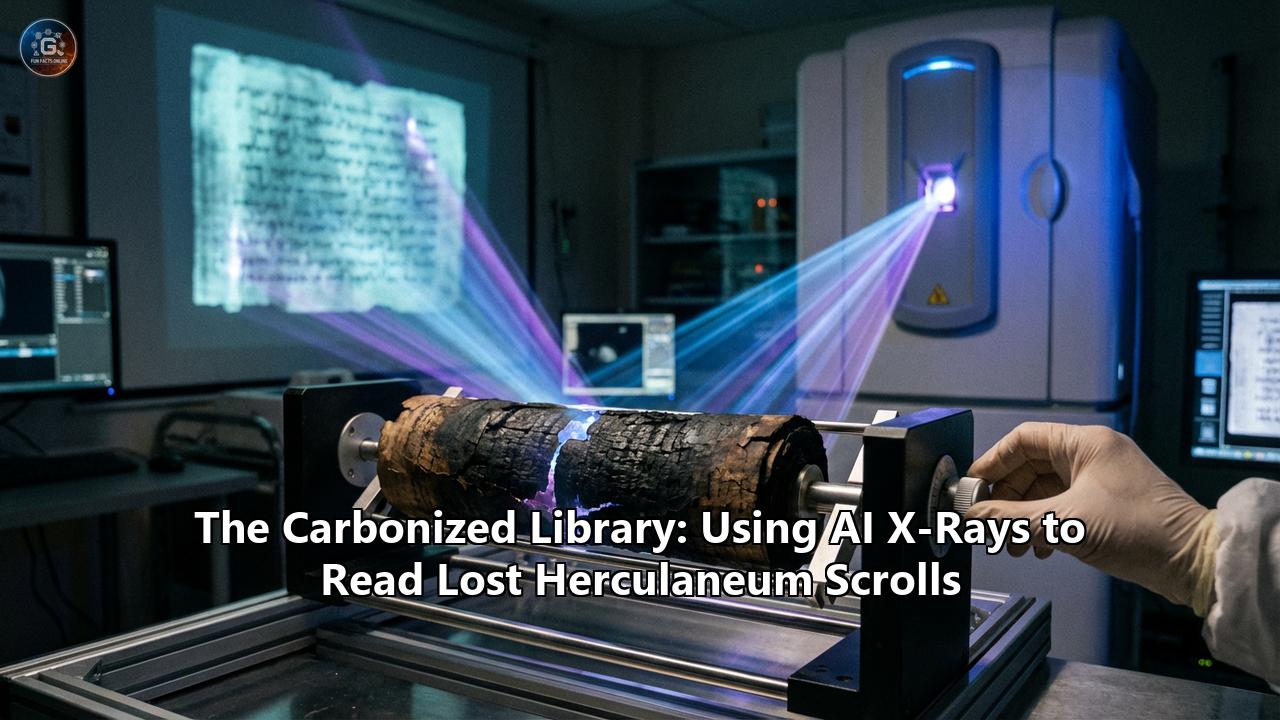
His team developed a technique called Virtual Unwrapping. The concept is similar to a medical CT scan but infinitely more complex.
- Scanning: The scroll is placed in a micro-CT scanner, which uses X-rays to create a 3D volumetric model of the object.
- Segmentation: Algorithms identify the single, continuous sheet of papyrus winding through the complex, crushed interior. This is the hardest part—imagine trying to trace a single sheet of lasagna in a crushed block of pasta.
- Flattening: The curved, warped surface is mathematically "flattened" into a 2D plane.
- Texturing: The intensity of the X-ray absorption at each point is mapped onto the 2D plane, hopefully revealing the ink.
In 2016, Seales proved the concept by virtually unwrapping the En-Gedi scroll, a charred lump from Israel. It turned out to be an early copy of the Book of Leviticus. But the Herculaneum scrolls posed a harder problem. The ink used in En-Gedi contained metal (lead), which glows brightly on X-rays. The Herculaneum scrolls were written with carbon-based ink (soot and gum arabic) on carbonized papyrus.
Carbon on carbon. To a standard X-ray, the ink and the paper look exactly the same. They have the same density. For years, the scans came back looking like blank sheets of noise.
The Particle Accelerator Solution
To see the invisible ink, the team turned to Diamond Light Source, a synchrotron in the UK. This machine accelerates electrons to near light speed, producing X-rays 100 billion times brighter than the sun.
In 2019 and 2023, Seales and his team scanned two intact scrolls (known as PHerc. Paris. 4 and PHerc. Paris. 3) at incredible resolutions (4-8 micrometers). The phase-contrast imaging technique allowed them to see minute differences in the texture of the papyrus where the ink sat. The ink didn't absorb X-rays differently, but it sat on top of the fibers, creating a microscopic ridge.
But the human eye still couldn't see it clearly. The data was a jumbled mess of 3D voxels. They needed something that could recognize patterns humans missed. They needed AI.
Part III: The Vesuvius Challenge
In March 2023, the problem was crowd-sourced. Nat Friedman (former CEO of GitHub), Daniel Gross, and Brent Seales launched the Vesuvius Challenge.
They released the high-resolution 3D scans of the scrolls to the public and offered a simple proposition: $1,000,000 in prizes to anyone who could read the text.
"We have the scans. We have the method. We need the code," Friedman announced.
The challenge electrified the global tech community. It wasn't just a coding contest; it was a treasure hunt. The "Master Plan" was simple:
- Detect the ink.
- Segment the layers.
- Read the philosophy.
The "Crackle" Breakthrough
The first breakthrough came from a realization about the ink. Casey Handmer, a theoretical physicist and entrepreneur, spent hours staring at the raw scan slices. He noticed a strange texture—a "crackle" pattern. The dried ink had cracked differently than the papyrus fibers over 2,000 years.
He didn't use a neural network; he used his eyes. He labeled these crackles and shared his findings. This was the "Rosetta Stone" for the AI models.
The Race for "Purple"
In October 2023, a 21-year-old computer science student from the University of Nebraska, Luke Farritor, trained a machine learning model on Handmer's "crackle" data. One night, at a party, he checked his phone. His code had finished running. On the screen was a glowing shape in the black-and-white static.
Three Greek letters: Π (Pi), Ο (Omicron), Ρ (Rho).
Then the whole word: ΠΟΡΦΥΡΑϹ (porphyras).
"Purple."It was the first word read from an unopened Herculaneum scroll in history. Farritor won the "First Letters Prize" ($40,000). He had proven the concept.
The Grand Prize Winners (Feb 2024)
The race accelerated. Youssef Nader, an Egyptian biorobotics PhD student in Berlin, developed a more powerful model using a modified ResNet/TimeSformer architecture. Julian Schilliger, a robotics student from ETH Zurich, built "Volume Cartographer" tools to automate the nightmare of 3D segmentation.
Realizing their complementary skills, Nader, Farritor, and Schilliger formed a super-team. They combined their models, working sleepless nights as the December 31st deadline approached.
On February 5, 2024, the Vesuvius Challenge announced the result. The team had successfully deciphered 4 passages of 140 characters each. They won the $700,000 Grand Prize.
They hadn't just found a word; they had found a book. The text was a philosophical treatise on pleasure, music, and food. The "unreadable" was now read.
Part IV: The Discoveries of 2025
If 2024 was the year of proof, 2025 was the year of production. The goal shifted from "can we read it?" to "what does it say?"
The "On Vices" Discovery (May 2025)
In May 2025, the Vesuvius Challenge awarded its First Title Prize of $60,000. Two independent teams—Sean Johnson (from the internal Vesuvius team) and the duo of Marcel Roth and Micha Nowak (University of Würzburg)—cracked the code of scroll PHerc. 172.
Deep inside the carbonized spirals, the AI painted a clear column of text that served as the title page (or subscriptio, which appears at the end of a scroll).
Title: On Vices and Their Opposite Virtues and In Whom They Are and About What (Περὶ κακιῶν καὶ τῶν ἀντικειμένων ἀρετῶν...) Author: Philodemus.This was a massive confirmation. Philodemus of Gadara was the "house philosopher" of the Villa. We knew he wrote on vices (fragments of Book 10 "On Arrogance" and Book 9 "On Household Management" existed), but this scroll appeared to be Book 1—the foundational text of the series.
"Disgust" and the Therapy of Arguments
The text deciphered throughout 2025 has given us an intimate look at Epicurean psychotherapy. The AI models picked out keywords like διατροπή (diatrope), meaning "disgust" or "shame," and φοβ (phob), meaning "fear."
Scholars like Federica Nicolardi (University of Naples) and Richard Ovenden (Bodleian Librarian) have begun to piece together the argument. Philodemus isn't just writing abstract theory; he is writing a manual for mental health.
In one striking passage deciphered in late 2024 and refined in 2025, Philodemus attacks the Stoic view that truth is enough. He argues that a philosopher must use "frank speech" (parrhesia) to shock a student out of their bad habits, sometimes using harsh criticism to induce a healthy sense of shame—medicinal "disgust" at one's own vices.
The Pleasure of Scarcity
Another passage, clarified by the 2024 Grand Prize winners and expanded in 2025, tackles the Epicurean definition of pleasure. The author writes:
"As too in the case of food, we do not right away believe that things that are scarce are absolutely more pleasant than those which are abundant."
This is a direct rebuttal to the idea that luxury equals happiness. Philodemus argues that the pleasure of bread and water, when one is hungry, is equal to the pleasure of a banquet. The "scarcity value" is a mental illusion. It is a 2,000-year-old blog post on the psychology of consumerism.
Part V: The Technology of 2025
How did we get from "purple" to full titles? The technology stack has evolved rapidly in the last 12 months.
1. Automated Segmentation (The "Auto-Seg" Prize)
The bottleneck in 2024 was human labor. Mapping the layers of papyrus took hundreds of hours of manual clicking. In 2025, the community focused on the First Automated Segmentation Prize.
Winners like Hendrik Schilling and Paul Henderson developed algorithms that "grow" the surface mesh automatically. The AI acts like a virtual snake, sliding between the layers of the scroll, distinguishing the gap between papyrus sheets even when they are pressed tight as sedimentary rock.
This reduced the time to segment a scroll segment from weeks to days.
2. Beyond the Crackle (Ink Detection 2.0)
The "crackle" pattern found by Handmer worked for PHerc. Paris. 4, but not for all scrolls. Some were preserved differently. In July 2025, the Vesuvius team, led by Stephen Parsons, began exploring new ink signatures.
They found that some scrolls have "plumper" ink, while others have ink that caused a chemical degradation in the fibers visible only in certain X-ray spectra. The new models are "multimodal," looking for a combination of texture, chemical density, and geometric deformation.
3. The Scaling Pipeline
By late 2025, the project had moved from a "contest" to an industrial pipeline.
- Scanning: A new scanning protocol at Diamond Light Source was established to scan scrolls 10x faster.
- The Render Farm: A massive cloud computing cluster now runs the "unwrapping" algorithms 24/7, processing terabytes of data from the scans.
Part VI: The Future - "UnLost" and the Master Plan
As of December 25, 2025, the mood in the archaeological and tech communities is euphoric. The "impossible" is now an engineering problem.
The "UnLost" Project
In late 2025, it was announced that Brent Seales, along with partners in Germany and Italy, had secured a massive €13.5 million ERC Synergy Grant for a project titled "UnLost."
This grant funds the scaling of the technology to the rest of the collection. The goal is no longer just to read one scroll, but to read the 300+ intact scrolls sitting in Naples.
The Master Plan: Stage 4
Nat Friedman's "Master Plan" has entered its final conceptual phase.
- Stage 1: Prove it works (Done).
- Stage 2: Read a whole scroll (In progress - "High confidence" for completion by early 2026).
- Stage 3: Scan everything (The 300 scrolls in Naples).
- Stage 4: Dig.
This is the ultimate prize. Archaeologists believe the Villa of the Papyri has a second library. The scrolls found so far are mostly Greek and mostly Epicurean—likely the specialized working library of Philodemus. But a Roman senator like Piso would have had a main library containing Latin literature.
That library has never been found. It is likely still buried in the unexcavated lower levels of the Villa.
If the technology proves we can read what we find, the political will to restart excavations (halted for decades due to cost and preservation concerns) will be unstoppable.
What Are We Looking For?
The potential finds are staggering.
- Lost books of Livy: We are missing 107 of the 142 books of his History of Rome.
- Sappho: Most of her poetry is lost.
- Early Christian Texts: The eruption was in 79 AD. It is chronologically possible (though unlikely in an Epicurean villa) that early Christian writings or references to the movement exist.
- Aristotle: Lost dialogues.
- Ennius: The father of Latin poetry, whose work exists only in fragments.
Conclusion: The Un-Burning of the Library
The deciphering of the Herculaneum scrolls is more than a technological triumph; it is a victory of hope over entropy. For 2,000 years, Vesuvius seemed to have the final word. It silenced the voices of Herculaneum, turning their wisdom into ash.
But the ash was a preservative, not a destroyer. It waited for us. It waited for us to build the synchrotron, to invent the computer, to develop the neural network.
In an interview in late 2025, Dr. Brent Seales summed it up: "We used to look at these black lumps and see a tragedy. Now we look at them and see a hard drive. We just needed to build the drive reader."
The library is open. The ghosts are speaking. And for the first time in two millennia, we are finally able to listen.
Reference:
- https://research.uky.edu/news/grand-prize-discovery-made-2000-year-old-herculaneum-scrolls
- https://www.factinate.com/things/researchers-ai-read-ancient-scroll-vesuvius
- https://www.infoq.com/news/2024/03/vesuvius-challenge-ai/
- https://economictimes.indiatimes.com/magazines/panache/ai-decodes-2000-year-old-burned-still-rolled-scroll-reveals-title-and-author-after-centuries/articleshow/120973222.cms?from=mdr
- https://www.zmescience.com/science/news-science/ai-reveals-title-and-author-of-scroll-burned-by-vesuvius-that-no-one-could-read-for-2000-years/
- https://scrollprize.org/
- https://net.kidzsearch.com/ai-decodes-first-full-passages-of-2000-year-old-burned-herculaneum-scrolls/
- https://www.finebooksmagazine.com/news/title-work-deciphered-sealed-herculaneum-scroll-digital-unwrapping
- https://www.theguardian.com/science/2025/may/06/x-ray-reveals-ancient-greek-author-of-charred-first-century-bc-vesuvius-scroll
- https://www.warpnews.org/innovation/they-have-succeeded-in-reading-the-title-in-the-rolled-2000-year-old-papyrus-scroll-wins-60-000/
- https://www.theguardian.com/science/2023/oct/12/researchers-use-ai-to-read-word-on-ancient-scroll-burned-by-vesuvius
- https://thecolgatemaroonnews.com/58303/news/dr-brent-seales-on-recent-triumphs-virtually-unwrapping-the-herculaneum-scrolls/
- https://www.sustainability-times.com/research/ai-reads-the-unreadable-2000-year-old-greek-scroll-decoded-without-being-opened-in-historic-technological-breakthrough/
- https://uknowledge.uky.edu/cs_etds/138/
- https://biz.chosun.com/en/en-science/2025/05/07/Z3AOUIIT3ZCX5MLTJM256BAOBI/
- https://www.youtube.com/watch?v=0Bxeef33uKI
- https://greekreporter.com/2025/02/05/greek-letters-burned-herculaneum-scroll/