
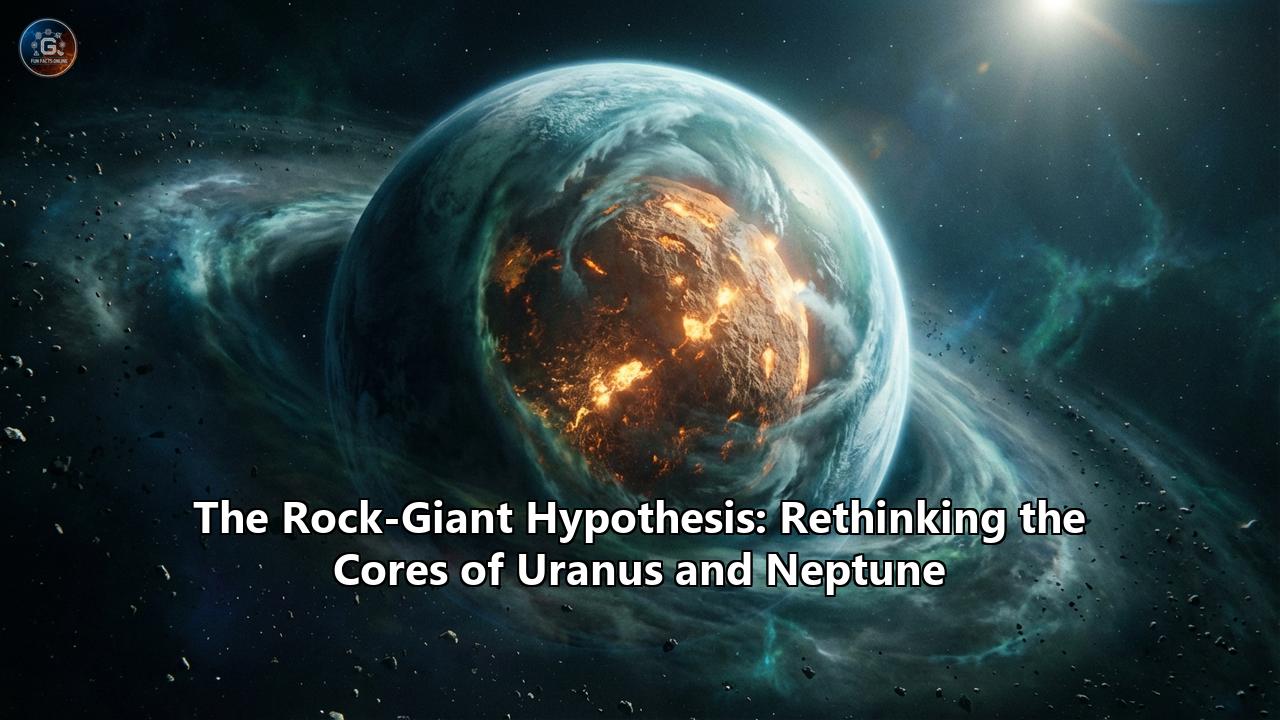
For nearly forty years, a specific image of the outer solar system has been etched into the collective consciousness of the scientific community and the public alike. We are taught that beyond the asteroid belt lie the Gas Giants, Jupiter and Saturn—colossal worlds of hydrogen and helium. Beyond them, in the frozen twilight of the solar system, orbit the "Ice Giants," Uranus and Neptune. This classification has been the bedrock of planetary science since the Voyager 2 flybys of the late 1980s. The standard model paints these worlds as vast, slushy reservoirs of water, ammonia, and methane ices wrapped in thin hydrogen envelopes.
But in the quiet corridors of astrophysics departments and the high-performance computing centers of Zurich and Bristol, a revolution is brewing. A new wave of research, driven by advanced simulations and a re-evaluation of old data, suggests that our fundamental classification of these planets may be wrong. They may not be Ice Giants at all.
Welcome to the Rock-Giant Hypothesis. This radical new framework proposes that Uranus and Neptune are not dominated by water, but by rock—vast, hot, silicate interiors that have been masquerading as ice for decades. This shift is not merely a matter of semantics; it threatens to upend our understanding of how the solar system formed, how magnetic fields are generated, and how we interpret the thousands of exoplanets currently being discovered around distant stars.
Part I: The Illusion of Ice
The Birth of a Paradigm
To understand why the Rock-Giant Hypothesis is so disruptive, we must first understand how the "Ice Giant" label came to be. When Voyager 2 swept past Uranus in 1986 and Neptune in 1989, it returned gravitational data that allowed scientists to calculate the planets' densities. Uranus (1.27 g/cm³) and Neptune (1.64 g/cm³) were denser than Saturn, yet far less dense than Earth.
Planetary scientists of the 20th century worked with a limited palette of materials:
- Gas: Hydrogen and helium (low density).
- Ice: Water, methane, and ammonia (medium density).
- Rock/Iron: Silicates and metals (high density).
To match the observed mass and radius of Uranus and Neptune, the simplest mathematical solution was a mixture that was roughly 60-70% "ice" by mass, with a smaller rocky core and a hydrogen envelope. It was a solution born of convenience and chemical abundance; oxygen is the third most common element in the universe, so water (H2O) should be abundant in the outer solar system. Thus, the "Ice Giant" was born.
The Density Degeneracy Problem
The crack in this foundation lies in a phenomenon known as "density degeneracy." At the immense pressures found deep inside a planet—millions of times the atmospheric pressure of Earth—matter behaves in counter-intuitive ways.
In the standard model, we assume a distinct layering: a rocky core, an icy mantle, and a gaseous atmosphere. However, recent work by researchers like Luca Morf and Ravit Helled at the University of Zurich has highlighted a critical flaw in this assumption. At pressures exceeding 100 gigapascals (GPa), the density of a mixture of rock (silicates) and hydrogen gas can be virtually identical to the density of high-pressure ice.
Imagine two planetary interiors:
- Model A (Ice Giant): A thick layer of water ice compressed to a super-dense state.
- Model B (Rock Giant): A skeleton of silicate rock permeated by hydrogen and helium gas.
To a passing spacecraft measuring gravity, these two interiors look exactly the same. Voyager 2 didn't "see" ice; it saw a mass distribution that could be ice. For decades, we chose Model A because we assumed ices were more common in the outer solar nebula. The Rock-Giant Hypothesis asks a dangerous question: What if we chose wrong?
Part II: The Evidence for Rock
The shift toward the Rock-Giant model is not driven by contrarianism, but by observational paradoxes that the Ice Giant model has failed to solve.
The Case of the Missing Carbon Monoxide
One of the most compelling arguments comes from the atmosphere. If Uranus and Neptune were truly formed primarily from water ice, their formation would have involved the accretion of cometary materials rich in oxygen. As these ices churned and mixed over billions of years, chemical equilibrium dictates that some of that oxygen should react with carbon to form carbon monoxide (CO).
Professor Nicholas Teanby and his colleagues have pointed out a glaring inconsistency: the atmospheres of Uranus and Neptune are remarkably depleted in carbon monoxide. If the interior were a vast ocean of supercritical water mixed with the atmosphere, we should see roughly 100 times more CO than we do.
The Ice Giant model tries to explain this away by arguing that the planets are "unmixed"—that the water is trapped in a lower layer that never interacts with the atmosphere. But this creates thermodynamic problems. A planet that doesn't mix its interior struggles to cool down, yet Neptune emits significant internal heat.
The Rock-Giant Hypothesis offers a cleaner solution. If the planet is dominated by dry rock rather than water ice, the oxygen budget is locked up in silicate minerals (SiO2, MgO) deep in the solid or molten rock, unavailable to form CO in the upper atmosphere. The "missing" oxygen isn't missing; it's just bound in rock, exactly as it is on Earth.
The Magnetic Mess
Perhaps the greatest mystery of Uranus and Neptune is their magnetic fields. Unlike Earth, Jupiter, and Saturn, whose magnetic fields are aligned roughly with their rotation axes and centered in the core, the fields of Uranus and Neptune are a mess. They are offset from the planet's center by thousands of kilometers and tilted wildly (60 degrees in Uranus's case).
The standard Ice Giant model explains this by proposing a "shallow dynamo"—a conducting fluid layer of ionic water moving sluggishly near the surface. But simulations have always struggled to make this work perfectly. Pure water is hard to make electrically conductive enough to generate the observed fields without extreme temperatures that would melt the planet.
Recent studies into the electrical conductivity of silicates at extreme pressures have provided a lifeline for the Rock-Giant view. We used to think of rock as an electrical insulator. However, new ab initio molecular dynamics simulations show that at the pressures inside Uranus and Neptune, silicate magma becomes a semiconductor, and eventually a liquid metal.
A Rock-Giant model posits that the magnetic field is generated not by slushy water, but by conductive silicate fluids or a "soup" of magnesium oxide and hydrogen. This "ionic rock" dynamo could naturally produce the complex, multipolar, off-center magnetic fields that Voyager 2 observed. It turns out that a messy magnetic field may be the signature of a liquid rock interior, not an icy one.
Part III: Building a Rock Giant in the Freezer
The most significant hurdle for the Rock-Giant Hypothesis is the question of origin. How do you build a planet made of rock in a region of the solar system defined by ice?
The Refractory Planetesimal Theory
The standard story of solar system formation says that beyond the "Frost Line" (roughly 3 AU from the Sun, where Jupiter sits), ices condense into solids. Therefore, any planet forming there should be mostly ice.
However, new formation models suggest we may have overestimated the purity of the outer solar nebula.
- Refractory Accumulation: As the protoplanetary disk evolved, drag forces could have concentrated dust grains (silicates and carbon-rich "tars") more efficiently than ice. "Refractory" refers to materials with high melting points—rocks and metals.
- The Carbon-Rich Reality: The objects in the Kuiper Belt (like Pluto and Arrokoth) are not pure water ice. They are covered in dark, reddish organic tholins and rock. If Uranus and Neptune formed by accreting billions of these "dirty" planetesimals, they would naturally acquire a massive budget of rock and organic carbon, rather than just water.
The Pebble Accretion Revolution
A modern theory known as Pebble Accretion supports this view. In this scenario, planets grow rapidly by sweeping up millimeter-sized "pebbles" of dust and ice. Detailed hydrodynamical simulations show that if the gas disk survives long enough, a growing core can capture massive amounts of silicate dust that drifts inward from the outer edges of the solar system.
This mechanism allows a planet to build a massive rocky core (perhaps 70-80% of its total mass) even in the outer solar system, provided it accretes the material before the gas disk dissipates. The result is a world that is not a ball of ice, but a massive "Super-Earth" that managed to hold onto a thick blanket of hydrogen and helium.
Part IV: The Third Option – The Methane World
While the Rock-Giant versus Ice-Giant battle heats up, a third combatant has entered the ring: the Methane-Giant Hypothesis.
Recent work by researchers in Israel and the US suggests that the interiors might not be rock or water, but methane (CH4). Methane is less dense than water but denser than hydrogen. A planet dominated by methane could solve the "missing CO" problem (since methane has no oxygen) and fits the density data.
Furthermore, at high pressures, methane decomposes into diamonds and hydrogen. This leads to the famous "diamond rain" hypothesis, where solid diamonds precipitate toward the core, releasing gravitational energy. While the Rock-Giant hypothesis focuses on silicates, the Methane model suggests these worlds are massive organic factories. It is possible the truth is a hybrid: a Rock-Giant coated in a thick layer of polymerized methane and diamond, with very little water to be found.
Part V: Implications for the Galaxy
The identity crisis of Uranus and Neptune matters far beyond our own solar system. The most common type of planet known in the galaxy is the "Sub-Neptune" or "Mini-Neptune"—planets larger than Earth but smaller than Neptune.
If Uranus and Neptune are truly Rock Giants, it implies that rocky super-worlds are the norm in the universe, not the exception. It suggests that the transition from a terrestrial planet (like Earth) to a gas giant (like Jupiter) is not a cliff, but a smooth gradient.
- Earth: 100% Rock/Metal.
- Super-Earth: 90% Rock, 10% Gas.
- Uranus (Rock Giant Model): 70% Rock, 30% Gas.
- Jupiter: 5% Rock, 95% Gas.
This continuum would mean that many of the "Mini-Neptunes" we see in habitable zones around other stars might actually be "Super-Earths" with bloated atmospheres. They could have solid surfaces deep beneath their clouds, rather than being bottomless oceans of magma or ice. This significantly increases the real estate available for potential subsurface habitability in the galaxy.
Part VI: The Future – We Must Go Back
The Rock-Giant Hypothesis has exposed a humiliating truth: we do not know what half of the planets in our own solar system are made of. We are modeling complex exoplanetary systems based on a template (the "Ice Giant") that might be a fiction.
The only way to resolve the debate between Rock, Ice, and Methane is to return. A dedicated Uranus Orbiter and Probe (UOP), listed as a top priority in the latest Planetary Science Decadal Survey, is essential.
To distinguish between the models, a future mission would need:
- Deep Gravity Measurements: By orbiting close to the planet, a spacecraft can map the mass distribution. A rock-dominated interior has a different gravitational "fingerprint" than an ice-dominated one.
- Seismology: Ideally, measuring the vibrations of the planet (Doppler imaging) could reveal the stiffness of the core. Rock rings differently than ice.
- Noble Gas Abundances: A probe dropped into the atmosphere measuring Argon, Krypton, and Xenon can tell us if the planet formed from ices (which trap these gases) or rocks (which don't).
Conclusion: A New View of the Blue Worlds
The Rock-Giant Hypothesis is more than just a new model; it is a reminder of the fragility of scientific knowledge. For decades, we looked at the pale blue dots of Uranus and Neptune and saw what we expected to see—frozen copies of the comets that wander our skies.
But the universe is rarely so compliant. The new data suggests these worlds are dark, hot, silicate monsters, wrapped in crushing layers of hydrogen, generating magnetic fields through the churning of liquid rock rather than salty water. They are not merely "Ice Giants" relegated to the freezer of the solar system; they are the missing link between the Earth and the Stars, the archetype of the most common planetary family in the galaxy.
Until we return to verify the truth, Uranus and Neptune remain the ultimate Rorschach test of planetary science—mirrors reflecting our changing understanding of how worlds are built. The Ice Giant is dead; long live the Rock Giant.
Reference:
- https://en.wikipedia.org/wiki/Formation_and_evolution_of_the_Solar_System
- https://www.cambridge.org/core/books/abs/ultracondensed-matter-by-dynamic-compression/unusual-magnetic-fields-of-uranus-and-neptune-metallic-fluid-h/E8201D0173985DCCCC29A73869CCC008
- https://vcresearch.berkeley.edu/news/clue-what-lies-beneath-bland-surfaces-uranus-and-neptune
- https://www.astronomy.com/science/uranus-and-neptune-have-weird-magnetic-fields-this-might-be-why/