
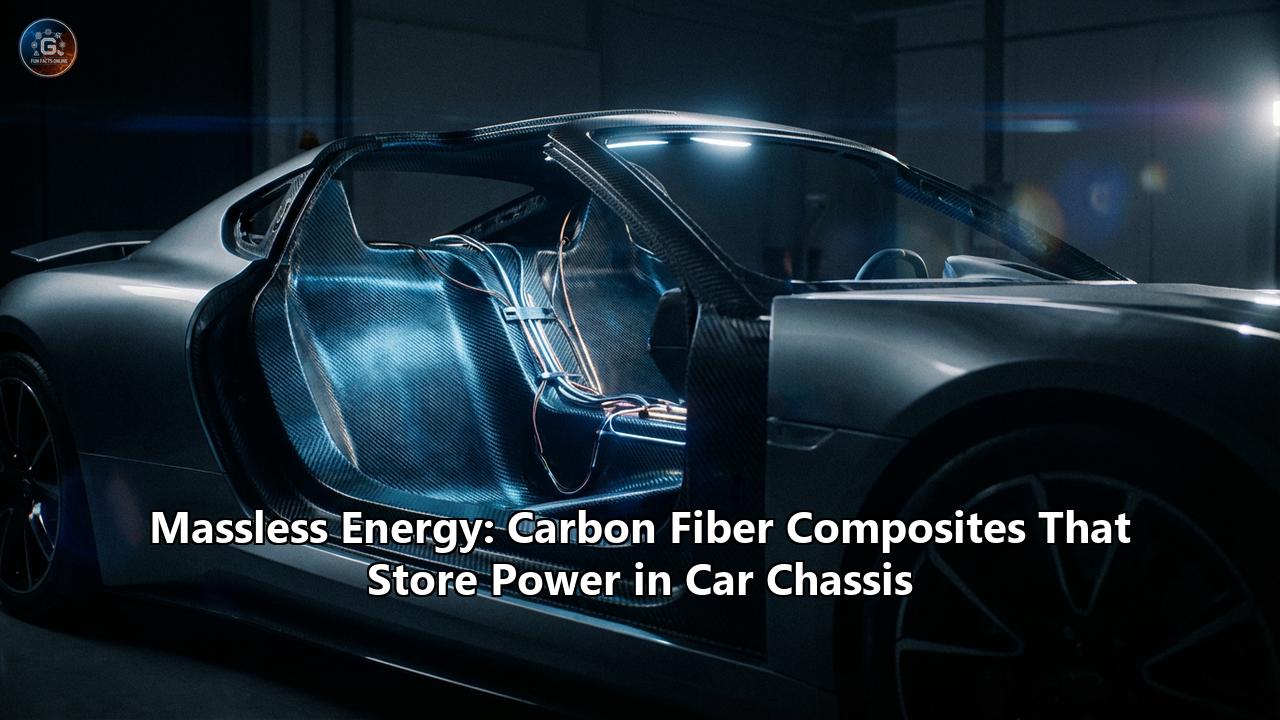
The concept of "massless energy" sounds like science fiction—a term ripped from the pages of a theoretical physics journal or a Star Trek script. But in the laboratories of Gothenburg, London, and Stockholm, it is becoming a tangible, structural reality. It is a technology that promises to break the "tyranny of the rocket equation" that has plagued electric vehicle (EV) design for decades.
This is the story of Structural Battery Composites (SBCs)—carbon fiber materials that serve as both the skeleton of a vehicle and its fuel tank. By turning the chassis itself into a battery, engineers are on the verge of creating vehicles where the energy storage adds effectively zero extra weight. This is the dawn of the massless energy revolution.
Part I: The Tyranny of Dead Weight
To understand why structural batteries are revolutionary, we must first understand the fundamental flaw of modern electric vehicles.
In a traditional internal combustion engine car, the fuel tank is relatively light. A steel or plastic tank holding 50 liters of gasoline weighs very little, and the fuel itself disappears as you drive, making the car lighter and more efficient over time.
In an electric vehicle, the paradigm is reversed. To get more range, you need a bigger battery. But a bigger battery adds immense weight. A Tesla Model S battery pack, for instance, weighs roughly 540 kg (1,200 lbs). That is half a ton of "dead weight" that the car must carry around every single mile, regardless of whether it is fully charged or nearly empty. This mass requires a heavier chassis to support it, bigger brakes to stop it, and a more powerful motor to accelerate it. This creates a vicious cycle: to go further, you add weight, which reduces efficiency, which requires even more battery, which adds even more weight.
Elon Musk and battery engineers call this "parasitic mass." Every kilogram of structure—the steel frame, the aluminum body panels, the crash beams—is a parasite. It contributes nothing to the vehicle's motion; it only consumes energy.
Enter Massless Energy Storage.The idea, pioneered by researchers like Professor Leif Asp at Chalmers University of Technology and Professor Emile Greenhalgh at Imperial College London, is elegant in its simplicity: What if the parasite became the host?
If you could make the car’s hood, doors, roof, and chassis out of the battery itself, you would eliminate the need for a separate battery pack. The weight of the energy storage would effectively vanish because the material is already there performing a structural function.
Mathematically, this is described as "effective energy density." Even if a structural battery has a lower raw energy density (e.g., 30 Wh/kg) than a state-of-the-art Lithium-ion cell (250 Wh/kg), its effective density at the system level is massive. If you replace a 10kg aluminum roof with a 10kg structural battery roof, the added weight for that energy storage is zero. You have achieved infinite effective energy density relative to the added mass.
Part II: The Anatomy of a Structural Battery
A structural battery is not just a battery glued to a piece of metal. It is a complete reimagining of material science where every atom must moonlight in a second job. The material must be stiff enough to survive a crash but porous enough to let ions flow.
1. The Negative Electrode: Carbon Fiber's Secret Life
Carbon fiber is famous for being light and strong—used in Formula 1 cars, Boeing Dreamliners, and high-end tennis rackets. But carbon fiber is, at its core, just graphite—layers of carbon atoms. And graphite is exactly what the negative electrode (anode) of a standard Lithium-ion battery is made of.
Researchers discovered that certain types of carbon fiber—specifically those with a "turbostratic" microstructure (intermediate stiffness)—are perfect for this dual role. They are strong enough to bear loads but their atomic layers are slightly disordered, creating "parking spots" where lithium ions can slot in during charging.
In a structural battery, the carbon fibers are the negative electrode. They carry the electrical current and they carry the mechanical load. There is no copper current collector, no graphite slurry, no binder. Just the fibers themselves.
2. The Positive Electrode: The Coating Challenge
The positive electrode (cathode) is trickier. You can't just make a cathode out of pure carbon fiber. You need a lithium source. The current breakthrough involves coating carbon fibers with Lithium Iron Phosphate (LFP).
Using a process called Electrophoretic Deposition (EPD), researchers coat individual carbon fibers with a thin layer of LFP particles. This creates a "fuzzy" fiber that is still strong but is now chemically active. This LFP-coated fiber acts as the positive terminal. When the battery discharges, lithium ions leave the carbon fiber anode, swim through the electrolyte, and embed themselves in the LFP coating on the cathode fibers.
3. The Electrolyte: The "Holy Grail" of Stiffness
This is the hardest part. In a normal battery, the electrolyte is a liquid—literally a pool of solvent that ions swim through. You cannot build a car chassis out of liquid. You need a solid.
But solids generally don't let ions move. It's like trying to swim through concrete.
The solution is a bicontinuous structural electrolyte. Imagine a microscopic sponge made of rigid epoxy (glue). This epoxy skeleton provides the stiffness and strength. Now, imagine the holes in that sponge are filled with a liquid electrolyte that conducts ions.
The chemistry is a delicate dance. If the pores are too big, the material is weak and the car collapses. If the pores are too small, the ions can't move and the battery doesn't work. The latest generation of Structural Battery Electrolytes (SBE) achieves a stiffness of roughly 70 Gigapascals (GPa)—which is as stiff as aluminum—while still maintaining an ionic conductivity high enough to power a vehicle.
Part III: Manufacturing the Impossible
Making these batteries is not like stamping out steel parts. It is "Dark Arts" manufacturing—a mix of textile weaving, chemical engineering, and vacuum physics.
The Laminate Stack:It starts like a high-tech sandwich.
- Bottom Layer: A sheet of aligned carbon fibers (Negative Electrode).
- Middle Layer: An ultra-thin separator (fiberglass or cellulose) that prevents short circuits but lets ions pass.
- Top Layer: A sheet of LFP-coated carbon fibers (Positive Electrode).
This dry sandwich is placed in a vacuum bag. All the air is sucked out. Then, the liquid electrolyte precursor—a mix of epoxy monomers and lithium salts—is infused into the stack.
The Curing Crisis:This is where it gets difficult. The composite must be "cured" (baked) to harden the epoxy. But heat kills batteries. Standard aerospace composites are cured at 120°C to 180°C. If you heat a lithium electrolyte to that temperature, it might degrade or evaporate.
Researchers have had to develop low-temperature curing cycles and specific "reaction-induced phase separation" techniques. As the epoxy cures and hardens, it chemically separates from the liquid electrolyte, forming that crucial microscopic sponge structure automatically. It is self-assembling nanotechnology at the scale of a car door.
Part IV: The "Smart" Chassis – A Nervous System for Cars
A structural battery offers a superpower that no normal material has: Proprioception.
Humans know where their limbs are and if they are hurt because we have a nervous system. Cars currently do not. If a chassis has a microscopic crack, you don't know until it fails.
But a structural battery is an electrical device. Its resistance and impedance (how hard it is for electricity to flow) depend entirely on its physical integrity. If a structural battery door panel gets dented in a parking lot, the carbon fibers might break or delaminate. This immediately changes the electrical resistance of that specific part of the battery.
By using Electrochemical Impedance Spectroscopy (EIS), the car's computer can constantly "ping" the chassis.
- Ping: "Right door panel, how are you?"
- Response: "My resistance just spiked by 5%. I have sustained structural damage."
This turns the entire vehicle into a smart sensor. A car made of structural batteries could detect crash damage, metal fatigue, or manufacturing defects in real-time, essentially feeling pain.
Part V: Commercial Frontiers – From Lab to Fab
This is no longer just academic theory. The race to commercialize is on.
Sinonus AB:Spun out of Chalmers University in Sweden, Sinonus is the first company dedicated entirely to commercializing this carbon fiber battery tech. Their CEO, Markus Zetterström, has outlined a pragmatic roadmap. They aren't starting with cars. They are starting with the "low-hanging fruit":
- IoT Devices: Smart home sensors, trackers, and wearables where replacing a AAA battery with a structural lid makes the device smaller and lighter.
- Drones: In a drone, weight is everything. A structural battery wing could increase flight time by 20-50%.
- Volvo: Working closely with Chalmers, Volvo has investigated using plenum covers and trunk lids as energy storage.
- Tesla & BYD: While not using true structural composites (where the fiber is the battery), they are pioneering "Cell-to-Chassis" technology. The BYD Blade Battery and Tesla's 4680 structural pack glue standard battery cells into the frame to provide stiffness. This is a stepping stone. True structural composites are the next leap—removing the cell cans entirely.
The Swedish EV maker Polestar has hinted at using structural power composites in their "Project 0" initiative to create a climate-neutral car by 2030, recognizing that shedding weight is the fastest way to reduce the carbon footprint of the vehicle's production and operation.
Part VI: The Sustainability Paradox
Every revolution has a cost. For structural batteries, the elephant in the room is recycling.
We barely know how to recycle standard lithium-ion batteries. We barely know how to recycle standard carbon fiber composites (which are usually ground up or landfilled).
A structural battery combines these two hard-to-recycle materials into a single, inseparable block. You have lithium, phosphorus, epoxy resin, and carbon fiber all cured into a solid rock.
- Pyrometallurgy (Burning): If you burn it to get the cobalt or lithium, you destroy the expensive carbon fiber.
- Acid Leaching: If you dissolve it in acid, you create toxic waste sludge.
This is the "Sustainability Paradox."
- The Good: A lighter car uses less energy to drive, reducing CO2 emissions over its life.
- The Bad: The car is harder to make and harder to kill.
Researchers are now investigating bio-based resins derived from lignin (wood pulp) that can be dissolved with specific enzymes at the end of life, allowing the carbon fibers and lithium to be recovered intact. This is the "de-bond on demand" technology that will be required before mass adoption can happen.
Conclusion: The Invisible Revolution
We are moving toward an era of Invisible Energy.
For the last century, "energy" was a distinct object—a tank of gas, a lump of coal, a cylinder of lithium. In the future, energy will be a property of the material itself.
Your laptop will not have a battery inside it; the casing will be the battery. Your electric plane will not carry fuel in the wings; the wings will be the fuel. Your car will not have a battery pack; it will be the battery.
Massless energy storage represents the ultimate convergence of function. It is the moment where physics, chemistry, and mechanical engineering stop being separate departments and fuse into a single discipline. When a car chassis can store power, sense its own health, and carry the weight of passengers all at once, we stop building machines and start building organisms.
The "weightless" battery is heavy on potential. And it is coming faster than we think.
Reference:
- https://www.researchgate.net/publication/372654025_Climate_impact_and_energy_use_of_structural_battery_composites_in_electrical_vehicles-a_comparative_prospective_life_cycle_assessment
- https://www.youtube.com/watch?v=tMvbg4XvM7Y
- https://theinnovator.news/structural-battery-composites-could-alter-the-way-planes-and-cars-are-powered/
- https://www.mdpi.com/2071-1050/11/20/5679