
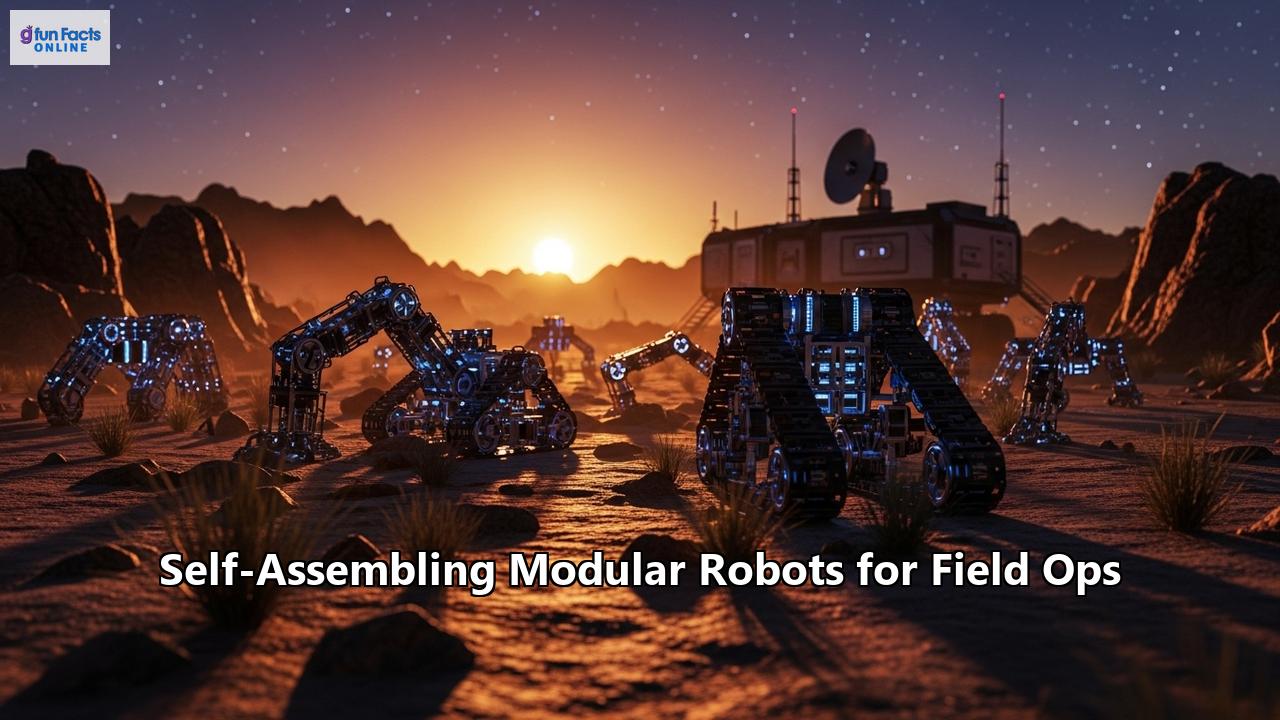
The Dawn of Adaptive Machines: Self-Assembling Modular Robots in the Field
Imagine a disaster zone, rubble strewn across a landscape where survivors may lie trapped. Instead of a single, monolithic rescue robot, a swarm of small, independent modules is deployed. These modules, communicating and collaborating, assess the terrain. Some link together to form a long, snake-like robot, capable of slithering through narrow crevices. Others assemble into a stable, six-legged walker to traverse unstable debris. This is not a scene from a science fiction blockbuster; it is the near-future promise of self-assembling modular robots, a technology poised to revolutionize field operations across a multitude of sectors.
These are not your typical, single-purpose machines. Self-reconfiguring modular robots are composed of multiple, often identical, units that can autonomously change their shape and function by rearranging their connections. This chameleon-like ability to adapt their morphology on the fly unlocks a new paradigm in robotics, offering unprecedented versatility, robustness, and efficiency for tasks in unpredictable and dynamic environments.
The Building Blocks of a Revolution: Understanding the Architecture
At the heart of this transformative technology lies the concept of modularity. By breaking down complex robotic systems into simpler, interchangeable modules, engineers can create robots that are scalable, easily repaired, and capable of a vast range of tasks. These systems are generally classified into three main architectural types, each with its own set of advantages and disadvantages.
Lattice-Based Systems: The Power of the Grid
Lattice-based modular robots consist of modules that connect to each other at specific points within a virtual grid, much like atoms forming a crystal lattice. This structured approach simplifies the mechanical design of the modules and the computational challenges of planning their reconfiguration. The predictability of the lattice makes it easier to develop algorithms that can be scaled to complex, three-dimensional structures. One of the long-term visions for this architecture is the creation of "programmable matter," where a collection of modules could form any desired object, from a simple tool to a piece of furniture, and then reconfigure into something else entirely.
However, the rigid nature of the lattice can be a drawback. While excellent for creating static structures, it can be difficult for these robots to generate the dynamic and fluid movements required for locomotion or intricate manipulation.
Chain-Based Systems: Flexibility in Motion
In contrast to the rigid grid of lattice systems, chain-based modular robots connect modules in series, forming snake-like or limb-like structures. This configuration is exceptionally well-suited for locomotion and manipulation. Think of a robotic snake that can navigate through pipes or a multi-legged robot that can walk over rough terrain; these are prime examples of chain-based systems. Researchers have even proposed a sub-classification of chain robots based on their topology: 1D, 2D, or 3D chains, each suited for different types of tasks.
The primary challenge for chain-based systems lies in the complexity of self-reconfiguration. Planning the sequence of movements for a long chain of modules to transform from one shape to another is a computationally intensive task.
Hybrid and Mobile Systems: The Best of Both Worlds?
Seeking to combine the strengths of both architectures, researchers have developed hybrid systems. These robots, like the M-TRAN, can form both chains and lattices, offering a greater degree of versatility. Another emerging category is mobile-type robots. In these systems, individual modules have their own independent means of locomotion and can move through the environment to connect with other modules and form larger structures. This approach offers a high degree of flexibility in how robots can assemble and reconfigure.
The design of the individual modules themselves is a critical aspect of these systems. Each module is a self-contained robot, typically equipped with its own power source, processor, sensors, and actuators. A key innovation in many modern systems is the use of genderless connectors, often employing magnets or mechanical latches, which allow any two modules to connect to each other. This simplifies the self-assembly process significantly.
The Intelligence Behind the Assembly: Algorithms and Control
The physical form of a modular robot is only half the story. The true power of these systems lies in the sophisticated algorithms that govern their behavior. The overarching goal is to achieve autonomous self-reconfiguration, enabling a robot to change its shape to best suit the task at hand without human intervention.
This is a monumental challenge. The robot must be able to perceive its own state, understand the desired goal configuration, and then plan and execute a sequence of actions to transform itself. This process can be broadly broken down into several key areas:
- Self-Reconfiguration Planning: This is the problem of determining the sequence of moves required to get from a starting configuration to a goal configuration. Researchers are exploring a variety of approaches to solve this complex puzzle. Some methods, like the Hierarchical Substructure Decomposition (HSD), break down the problem into a series of simpler, pre-computed reconfigurations between smaller substructures. Other approaches treat the problem as a flow through a network, using algorithms to find the most efficient way to move modules to their target locations.
- Distributed Control: For large swarms of modules, centralized control becomes a bottleneck. Distributed control, where each module makes its own decisions based on local information and communication with its neighbors, is a more scalable and robust solution. This is where concepts from swarm intelligence come into play, with robots following simple rules that lead to complex, emergent collective behavior.
- The Role of AI and Machine Learning: Artificial intelligence and machine learning are becoming increasingly important in this field. Deep learning models are being used to select the most efficient self-reconfiguration algorithm for a given task. Reinforcement learning, a technique where robots learn through trial and error, is being used to develop control software for robot swarms. Researchers at Caltech have developed a machine learning-based approach called GLAS (Global-to-Local Safe Autonomy Synthesis) that helps swarms of robots navigate cluttered environments without colliding. This data-driven approach allows robots to learn on the fly, making them more adaptable to unknown spaces.
Powering the Swarm: The Enduring Challenge of Energy
For self-assembling modular robots to be truly effective in the field, they need to be able to operate for extended periods without human intervention. This makes power management one of the most critical challenges in their design. The problem is twofold: providing enough energy to power the entire swarm and efficiently distributing that power among the modules.
Traditional battery technology remains a primary power source, with lithium-ion batteries being a common choice due to their high energy density. However, for field operations, simply relying on batteries that need to be manually replaced or recharged is not a viable long-term solution. This has led to research into several innovative approaches:
- Wireless Charging: The ability for robots to autonomously recharge themselves is a key goal. This could involve returning to a central charging station or, more advanced concepts like in-motion wireless charging, where robots can receive power as they move through their environment.
- Energy Harvesting: For long-duration missions, the ability to harvest energy from the environment is a game-changer. This could include solar power, vibration-based energy harvesting, or even thermal energy harvesting.
- Efficient Power Management Systems: Sophisticated power management systems are crucial for optimizing energy use. This can involve using low-power components, implementing power-saving modes like sleep or standby, and using energy-efficient algorithms. Modular power solutions are also being developed that allow for the easy scaling of power to meet the changing demands of a reconfiguring robot.
Staying Connected: The Lifeline of Communication
Effective communication is the lifeblood of a self-assembling robotic system. Modules need to be able to share information with each other to coordinate their actions, understand the overall state of the swarm, and report back to human operators. As with power, the challenge is to create a communication system that is robust, scalable, and efficient.
A variety of wireless communication protocols are being explored for this purpose, each with its own strengths and weaknesses:
- Wi-Fi: Offers high data rates, making it suitable for transmitting large amounts of data, such as video feeds. However, its range can be limited, especially in cluttered environments.
- Bluetooth: Ideal for short-range communication between modules and is very power-efficient.
- Zigbee and Z-Wave: These low-power protocols are well-suited for creating mesh networks, where modules can relay signals to each other, extending the overall range of the network.
- LoRa (Long Range): As its name suggests, LoRa offers a very long range with low power consumption, making it ideal for applications like environmental monitoring over large areas.
- 5G and Beyond: The advent of 5G promises ultra-reliable, low-latency communication, which will be critical for the real-time control of large, dynamic robot swarms.
In addition to these standard protocols, researchers are also developing specialized communication systems for modular robots. One novel approach is a hybrid system that uses inter-module buses that can connect on-demand to form arbitrary network topologies. This allows for both local communication between neighboring modules and global communication across the entire system.
Built to Last: Robustness and Fault Tolerance in the Field
Field operations are, by their very nature, unpredictable and often harsh. Robots deployed in these environments will inevitably face challenges, from rough terrain to component failures. For self-assembling modular robots to be truly useful, they must be robust and fault-tolerant. This is another area where the modular design offers a significant advantage.
- Redundancy: The inherent redundancy of a modular system means that the failure of a single module does not necessarily lead to the failure of the entire robot. The system can continue to function, albeit at a reduced capacity.
- Self-Repair: Taking this concept a step further, researchers are developing robots that can autonomously detect, eject, and replace failed modules. This process of self-repair could be a game-changing feature, especially for long-duration missions in remote or hazardous locations where human intervention is impossible.
- Adaptive Control: When a module fails, the robot's dynamics change. Fault-tolerant control systems can detect these failures and adjust the robot's behavior to compensate. For example, a legged robot might change its gait to continue walking even after one of its leg modules has failed.
Robots in Action: Applications Across the Spectrum
The potential applications for self-assembling modular robots in field operations are vast and varied. Here are some of the key areas where this technology is expected to make a significant impact:
Search and Rescue: A New Breed of First Responders
In the chaotic aftermath of a natural disaster, time is of the essence. Getting to survivors quickly can be the difference between life and death. Self-assembling modular robots offer a powerful new tool for search and rescue teams. They can be deployed into areas that are too dangerous for human responders, such as collapsed buildings or unstable terrain.
- Case Study: Responding to Earthquakes and Fires: Researchers have developed multi-linked, snake-like robots that can navigate through the rubble of a collapsed building. These robots can be equipped with cameras and sensors to locate survivors and assess the structural integrity of the site. For fires, fire-resistant robots are being developed that can enter burning buildings to extinguish flames and search for occupants. The Tokyo Fire Department already has a dozen different types of robots in its arsenal. In disaster scenarios, a combination of aerial and ground robots can be particularly effective. An aerial drone could carry a smaller ground robot into a damaged building and then provide aerial surveillance while the ground robot searches for survivors.
Construction: Building the Future, One Module at a Time
The construction industry is another area that is ripe for disruption by autonomous systems. Self-assembling robots have the potential to automate many of the repetitive and dangerous tasks on a construction site, leading to increased efficiency, improved safety, and lower costs.
- Automated Masonry and Drywalling: Robots like the SAM100 can lay bricks at a much faster rate than human masons. Other robots have been developed that can autonomously install drywall, a labor-intensive and often tedious task. The Hadrian X, a truck-mounted bricklaying robot, can build the walls of a full-sized house in just two days.
- Earthmoving and Site Preparation: Autonomous bulldozers and excavators are already being used to dig trenches, excavate foundations, and grade building pads. These machines can operate 24/7, significantly speeding up the initial phases of a construction project.
- Prefabrication and Assembly: In factory settings, robots are used to assemble prefabricated building components with high precision. The use of modular construction, combined with robotic assembly, has the potential to revolutionize the way we build, making construction faster, cheaper, and more sustainable.
Space Exploration: The Next Frontier for Autonomous Systems
For long-duration space missions, such as the exploration of the Moon and Mars, the ability to build and maintain infrastructure in-situ is critical. Sending everything from Earth is prohibitively expensive. This is where self-assembling modular robots come in. NASA has a keen interest in this technology and is funding several research projects in this area.
- In-Situ Resource Utilization (ISRU): The concept of ISRU involves using local resources, such as lunar regolith, to create everything from building materials to rocket fuel. Modular robotic systems are being designed to perform tasks like excavation, material processing, and 3D printing of structures using these local resources.
- In-Space Assembly: For large structures like space telescopes or habitats, launching them fully assembled is not feasible. Instead, they will need to be assembled in orbit. NASA's Assemblers project is developing a modular, reconfigurable robotic manipulator for just this purpose. These robots will be able to autonomously assemble structures, detect and correct errors, and even reconfigure themselves for different tasks.
- Planetary Exploration: On the surface of other worlds, modular robots could reconfigure themselves to adapt to the terrain, transforming from a wheeled rover to a legged walker as needed. This adaptability would be invaluable for exploring the diverse and often challenging landscapes of the Moon and Mars.
Environmental Monitoring: A Swarm of Sentinels
Protecting our planet requires a deep understanding of our environment, and that means collecting vast amounts of data. Swarm robotics, a concept closely related to self-assembling modular systems, offers a powerful new way to monitor our planet's health. A large number of simple, sensor-equipped robots can be deployed to cover vast areas, providing real-time data on everything from air and water quality to ecosystem health.
- Air and Water Quality Monitoring: Swarms of drones can be used to monitor air pollution in cities, while aquatic robots can patrol rivers and oceans to detect and track pollutants. This can help to identify the sources of pollution and inform remediation efforts.
- Ecosystem Health: Robots can be used to monitor the health of forests, track wildlife populations, and assess the impacts of climate change. For example, four-legged robots are being developed to navigate through forests and gather data on the health of trees.
- Disaster Prediction: By monitoring environmental conditions, robot swarms could also help to predict natural disasters. For example, ocean-going robots could be used to monitor for signs of tsunamis.
The Road Ahead: Future Trends, Challenges, and Ethical Considerations
The field of self-assembling modular robotics is still in its early stages, but the pace of innovation is rapid. Looking to the future, several key trends are emerging:
- Swarm Intelligence and AI: The integration of advanced AI and swarm intelligence will be critical for coordinating the behavior of large, complex robotic systems. We can expect to see more sophisticated learning-based approaches that allow robots to adapt and learn in real-time.
- Miniaturization: As modules become smaller and more capable, the resolution and flexibility of modular robots will increase. This could open up new applications in areas like medicine and material science.
- Soft Robotics: The development of soft, flexible robots will enable modular systems that can interact more safely with humans and delicate objects.
Despite the immense potential, there are still significant challenges to overcome. Power and communication will continue to be key research areas. Furthermore, the widespread deployment of autonomous robots in the field raises important socio-economic and ethical questions.
- Economic Impact: The automation of tasks currently performed by humans will inevitably lead to job displacement. It is crucial that we develop strategies to mitigate this impact, such as retraining programs and the creation of new jobs in areas like robot design, manufacturing, and maintenance. However, robotics also has the potential to boost productivity and create new economic opportunities.
- Ethical Considerations: The deployment of autonomous robots in public spaces raises concerns about safety, privacy, and accountability. How do we ensure that these robots operate safely around humans? Who is responsible when an autonomous robot causes an accident? How do we protect the privacy of individuals when robots are constantly collecting data from their environment? Developing robust ethical frameworks and regulations will be essential to ensure that these technologies are developed and deployed in a responsible manner.
In conclusion, self-assembling modular robots represent a profound shift in our approach to robotics. By moving away from rigid, single-purpose machines and embracing the principles of modularity, adaptability, and collective intelligence, we are on the cusp of creating a new generation of robots that can tackle some of the most challenging problems we face. From saving lives in disaster zones to building new worlds in space, the future of field operations is being assembled, one module at a time.
Reference:
- https://www.numberanalytics.com/blog/ethics-in-robotics-and-autonomous-systems
- https://ntrs.nasa.gov/citations/20210012148
- https://prism.sustainability-directory.com/scenario/ethical-frameworks-for-autonomous-delivery-robots/
- https://roboticsbiz.com/economic-impacts-of-robotics-and-autonomous-systems-ras/
- https://howtorobot.com/expert-insight/how-robots-are-transforming-prefabricated-construction-manufacturing
- https://www.frontiersin.org/journals/robotics-and-ai/articles/10.3389/frobt.2023.1149080/full
- https://alife-robotics.co.jp/members2024/icarob/data/html/data/OS/OS10-1.pdf
- https://www.youtube.com/watch?v=zBvvbOLq3t0
- https://cosmosmagazine.com/technology/for-robots-the-future-is-modular/
- https://www.niac.usra.edu/files/studies/final_report/354Farritor.pdf
- https://www.numberanalytics.com/blog/future-robotics-modular-systems
- https://library.fiveable.me/swarm-intelligence-and-robotics/unit-11/modular-robotics/study-guide/fXaBh1e3plrnIeGT
- https://www.numberanalytics.com/blog/advanced-modular-robotics
- https://www.frontiersin.org/journals/robotics-and-ai/articles/10.3389/frobt.2023.1134841/full
- https://www.eas.caltech.edu/news/machine-learning-helps-robot-swarms-coordinate-1
- https://www.caltech.edu/about/news/machine-learning-helps-robot-swarms-coordinate
- https://dig8italx.com/robotics-enviro-monitoring/
- https://activities.esa.int/4000134534
- https://www.numberanalytics.com/blog/robotics-in-disaster-response
- https://evolutionoftheprogress.com/swarm-robotics-for-environmental-monitoring/
- https://www.imnovation-hub.com/digital-transformation/robots-construction-applications/
- https://www.automate.org/news/ethical-considerations-in-the-development-and-deployment-of-robots-116
- https://medium.com/@ohermans1/unleashing-the-power-of-swarm-robotics-revolutionizing-environmental-monitoring-9ec4e400cb3d
- https://ntrs.nasa.gov/citations/20050157088
- https://www.tandfonline.com/doi/full/10.1080/25741292.2021.1905342
- https://blog.geetauniversity.edu.in/swarm-robotics-and-ai-coordination-algorithms/
- https://www.researchgate.net/publication/303381736_Application_of_Swarm_Robotics_Systems_to_Marine_Environmental_Monitoring
- https://www.youtube.com/watch?v=05SuBLowwKM
- https://www.mdpi.com/2075-5309/15/16/2965
- https://aiforgood.itu.int/disaster-robots-revolutionizing-emergency-response-with-autonomous-robots/
- https://www.uk-ras.org.uk/wp-content/uploads/2021/01/UKRASWP_ExtremeEnvironments2017_online.pdf
- https://www.youtube.com/watch?v=xGGfTgHp6Ik
- https://community.element14.com/technologies/industrial-automation-space/b/blog/posts/autonomous-robots-used-on-construction-sites---and-more
- https://library.fiveable.me/swarm-intelligence-and-robotics/unit-9/environmental-monitoring/study-guide/rUrBo6FkSCgQ6aSs
- https://uppcsmagazine.com/the-rise-of-robots-economic-impact-and-social-transformation/
- https://library.fiveable.me/swarm-intelligence-and-robotics/unit-12/future-directions-swarm-robotics-research/study-guide/OyRlxxkSCnhhoi3b
- https://www.mdpi.com/2218-6581/13/2/33
- https://assets.publishing.service.gov.uk/media/6193996bd3bf7f055b293381/ras-final-report-nov-2021.pdf
- https://www.numberanalytics.com/blog/ethical-considerations-for-service-robots