
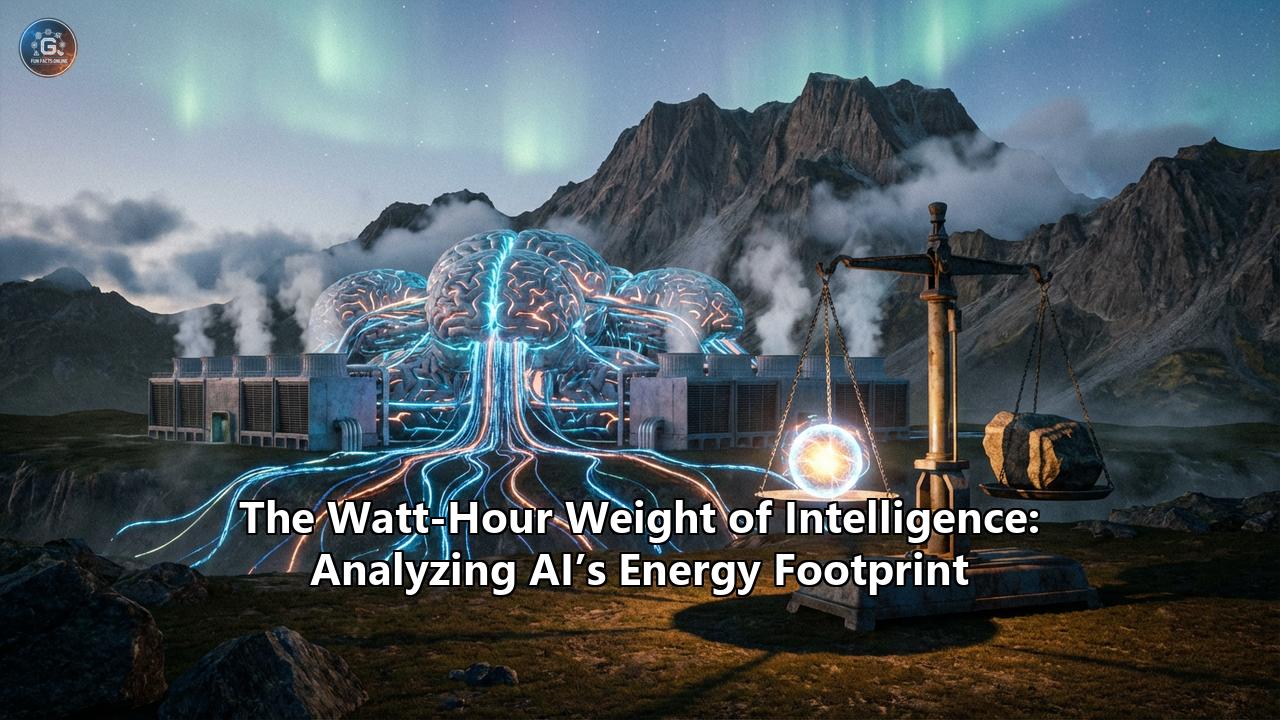
The concept of "the cloud" has always been a convenient lie—a fluffy, ethereal metaphor that suggests our data lives in the sky, weightless and cost-free. But as we step firmly into the era of generative artificial intelligence, that metaphor is evaporating. In its place stands a monolithic physical reality: millions of tons of copper, silicon, and steel, humming in windowless warehouses, consuming rivers of water and oceans of electricity.
We have begun to measure intelligence not just in IQ or floating-point operations per second (FLOPS), but in joules. Every query sent to a Large Language Model (LLM) carries a specific "watt-hour weight"—a physical cost paid in coal burned, wind turbines spun, and water evaporated. As AI transitions from a niche research curiosity to a global utility embedded in phones, cars, and browsers, we are forcing a confrontation between the infinite ambition of silicon intelligence and the finite physics of our energy grids.
This is the story of that confrontation. It is an analysis of how we are turning electricity into thought, the staggering inefficiencies of our current methods, and the desperate, brilliant race to reinvent the computer before the lights go out.
Part I: The Scale of the Beast
From Training to Inference: The Shift in the Energy EquationFor the first decade of the deep learning boom, the environmental narrative focused almost exclusively on training. Training a massive model like GPT-4 or Gemini Ultra is a Herculean event. It involves tens of thousands of GPUs running at full throttle for months, crunching through petabytes of text. The carbon footprint of a single training run has been compared to the lifetime emissions of multiple cars, or a trans-Atlantic flight. It is a spectacle of energy consumption.
However, as we move through 2024 and into 2025, the equation has fundamentally shifted. Training is a one-time "tuition fee" for the model. Inference—the act of using the model to answer a question, summarize an email, or generate an image—is the daily rent.
Consider the math of mass adoption. When a model is trained, it consumes a massive, fixed block of energy. But once deployed, if it has 100 million active users asking ten queries a day, the energy cost of those billions of tiny inference calculations quickly dwarfs the original training cost. Recent data from major tech firms suggests a ratio shift: inference now accounts for 60% to 70% of total AI energy load, a figure projected to rise as "AI agents" begin operating autonomously in the background of our operating systems.
The "Watt-Hour Per Query" MetricTo understand this impact, we must look at the granular metric of energy per query. A standard Google search is incredibly efficient, estimated to consume about 0.3 watt-hours of energy. It’s a simple database lookup.
A generative AI query is different. It is not retrieving a pre-existing answer; it is calculating one, probability by probability, token by token. Estimates for a standard LLM query range from 3 watt-hours to as high as 9 watt-hours for complex reasoning tasks. This means a conversation with a chatbot can be 10 to 30 times more energy-intensive than a traditional search.
If we were to replace every Google search with an LLM interaction overnight, global electricity demand for computing would not just tick up; it would spike violently. This is why the metric of "Tokens per Watt" has become the new "Miles per Gallon" for the semiconductor industry. It is no longer enough to be smart; chips must be lean.
Part II: The Physics of Thought
Heaters That Do MathTo understand why AI is so power-hungry, we have to look at the transistor. For seventy years, the digital transistor has been the building block of our world. It is a switch that is either on (1) or off (0). To represent the nuanced, probabilistic weights of a neural network—which are essentially massive grids of floating-point numbers—we have to chain together thousands of these binary switches.
This approach suffers from what is known as the Von Neumann Bottleneck. In a classic computer, memory (where data lives) and logic (where work happens) are separated. To multiply two numbers, the chip must fetch data from memory, move it to the processor, do the math, and send it back. For an LLM with 175 billion parameters, generating a single word requires moving gigabytes of data back and forth across the chip, billions of times.
This movement is where the energy goes. It generates heat. In fact, modern GPUs are essentially high-performance heaters that perform mathematics as a side effect. We pump electricity in, shuttle electrons back and forth to simulate "thinking," and then pump more electricity in to cool the fans that blow the waste heat away.
The Biological ContrastCompare this to the human brain. The brain is an analog, electrochemical machine. It operates on about 20 watts of power—barely enough to dim a lightbulb. Yet, on that budget, it runs a general intelligence capable of writing poetry, navigating complex 3D environments, and feeling emotions, all simultaneously.
The brain does not separate memory and processing; a synapse is both a storage unit and a calculator. It does not run at a gigahertz clock speed; it is slow, asynchronous, and incredibly sparse (neurons only fire when they need to).
The gap between silicon and biology is the "efficiency chasm." Closing it is not just an engineering challenge; it is a necessity. If we tried to build a brain-scale AI using today's GPU architecture, it would require a dedicated nuclear power plant. To scale AI further, we have to abandon the architectures that got us here.
Part III: The Hardware Revolution
The industry knows the wall is coming. This realization has triggered a cambrian explosion of exotic hardware architectures, each trying to bypass the limits of digital silicon.
1. Analog AI: Computing in MemoryCompanies like Mythic and researchers at IBM are revisiting an old idea: Analog computing. Instead of representing numbers as 0s and 1s, analog chips use the physical properties of electricity itself—voltage and resistance—to do the math.
In an analog AI chip, the "weight" of a neural network parameter is encoded as the resistance of a memory cell. When you pass a current through it, Ohm’s Law ($V = IR$) performs the multiplication instantly, right where the data sits. There is no data movement. No Von Neumann bottleneck.
These "Compute-in-Memory" (CIM) chips can theoretically achieve efficiencies 10x to 100x greater than digital chips. They are less precise—analog signals are "noisy"—but neural networks are surprisingly resilient to noise. They don't need perfect math; they just need "good enough" math, delivered continuously.
2. Photonic Computing: Thinking at the Speed of LightIf moving electrons through copper wires creates too much heat, why not use photons (light) instead? Lightmatter and other startups are building photonic processors that perform matrix multiplications using beams of light.
In these chips, data is encoded into the intensity of light beams. These beams interact through interferometers—optical devices that split and merge light. The interference pattern effectively performs the math. Light moves faster than electricity, generates almost no heat during transmission, and offers massive bandwidth.
Lightmatter’s "Passage" interconnect, for example, allows chips to talk to each other using wafer-scale optical highways, breaking the bandwidth limits that currently choke multi-chip clusters. The promise is a future where the "heat" of computation is largely eliminated, leaving only the energy cost of the lasers themselves.
3. Wafer-Scale Engines: The Size of a Dinner Plate Cerebras Systems took a different approach: Brute force engineering. A standard chip is the size of a postage stamp because manufacturing defects make large chips risky. Cerebras solved this by printing a single, massive chip the size of a dinner plate—the Wafer Scale Engine (WSE).The WSE-3 contains 4 trillion transistors and 900,000 AI cores on a single slice of silicon. Because everything is on one giant chip, data never has to leave the silicon to go to slow, external memory. It stays on the wafer, moving at lightning speeds between cores. This architecture drastically reduces the "data movement tax," allowing for massive model training and inference with a fraction of the power-per-operation of a traditional GPU cluster.
4. Neuromorphic Computing: Spiking Like a BrainInspired by biology, Intel’s Loihi and other neuromorphic chips abandon the steady "tick-tock" of the global clock. They use Spiking Neural Networks (SNNs), where digital neurons only transmit data when a threshold is reached—a "spike."
If nothing is happening in a part of the network, it consumes zero power. This "event-driven" architecture is radically efficient for tasks that involve processing sensory data over time, like video or audio, potentially offering 1,000x efficiency gains for specific edge-AI applications.
Part IV: The Societal Gridlock
While engineers labor in labs, the real world is already feeling the weight of the watt-hour. The "cloud" is landing in our backyards, and it is heavy.
Northern Virginia: The Choke PointLoudoun County, Virginia, is known as "Data Center Alley." Roughly 70% of the world's internet traffic flows through the fiber optics beneath its soil. But the physical grid is buckling.
In 2024 and 2025, utility provider Dominion Energy began warning of a "power pause." The demand from new data centers—driven specifically by AI clusters which are far more power-dense than traditional storage servers—was outpacing the ability to build transmission lines.
The societal impact is tangible. Residents face the threat of rising electricity rates to pay for the new substations required by tech giants. Diesel generators, used as backup power for data centers, have become a point of contention regarding local air quality. The digital economy is colliding with analog zoning laws.
Ireland: The Island ServerIreland successfully courted tech giants for decades with low taxes, becoming the data center capital of Europe. Today, data centers consume over 21% of Ireland’s total generated electricity, a figure that could top 30% by 2027.
This success has become a liability. The Irish grid operator, EirGrid, has had to place de facto moratoriums on new connections in the Dublin area. The country is facing a stark choice: build more gas power plants to feed the servers (threatening its climate goals) or turn away the industry that fueled its economic boom.
Singapore: The Tropical TestbedSingapore, land-scarce and energy-import-dependent, imposed a moratorium on new data centers back in 2019. They lifted it in 2022 but with strict new caveats: new facilities must meet a Power Usage Effectiveness (PUE) of 1.3 or lower. This policy has turned the city-state into a laboratory for green data center technologies, forcing operators to innovate with tropical-climate cooling solutions and high-efficiency hardware to gain entry.
Part V: The Policy Landscape
Governments are waking up to the reality that AI dominance requires energy dominance.
The EU AI Act and "Green AI"Europe, always the pioneer in regulation, has included specific environmental reporting requirements in its AI Act. Providers of General Purpose AI (GPAI) models are increasingly required to disclose the energy consumption of their training and inference cycles.
This "transparency mandate" is a powerful lever. It forces companies to treat energy efficiency as a public metric of quality, not just a hidden operational cost. If a model is labeled "F" for energy efficiency, enterprise customers with their own Net Zero goals may look elsewhere.
The US Approach: Security and SupplyIn the United States, the conversation is framed around national security. The proposed "Artificial Intelligence Environmental Impacts Act" seeks to standardize how we measure AI's footprint. Meanwhile, the Department of Energy is pouring billions into grid modernization.
There is a growing geopolitical realization: Compute is Energy. You cannot be an AI superpower without being an energy superpower. This is driving a renewed interest in nuclear power—specifically Small Modular Reactors (SMRs)—to provide carbon-free, baseload power dedicated to AI campuses. Tech giants are effectively becoming utility companies, signing Power Purchase Agreements (PPAs) for nuclear and geothermal energy decades into the future.
Part VI: The Economic Paradox
The Ghost of William Stanley JevonsAs chips get more efficient, a dangerous economic paradox looms. In the 19th century, economist William Stanley Jevons observed that as steam engines became more efficient with coal, coal consumption didn't drop—it skyrocketed. Making energy cheaper made it profitable to use steam engines everywhere.
This is Jevons Paradox, and it haunts the future of AI.
If DeepSeek, Groq, or Mythic succeeds in making AI inference 100x cheaper and more energy-efficient, we won't necessarily use less energy. We might just put AI in everything.
- Your toaster will have an LLM to optimize browning.
- Video games will generate infinite, unique dialogue for every NPC.
- Ads will be generated in real-time, pixel-by-pixel, for your specific psychological profile.
Efficiency does not guarantee conservation; it often fuels ubiquity. The "Watt-Hour Weight" of a single thought might drop, but the total weight of the world's machine thinking could exponentially increase.
Conclusion: The Hybrid Future
We stand at a crossroads. One path leads to a brute-force future where we pave the planet with solar panels just to keep our silicon chatbots talking. The other leads to a revolution in how we compute—a shift from the rigid, hot logic of the 20th century to the fluid, cool, analog/photonic physics of the 21st.
The ultimate solution will likely be Hybrid Intelligence.
- Digital chips for precision and control.
- Analog/Photonic chips for the heavy lifting of matrix math.
- Neuromorphic chips for sensory processing at the edge.
- Biological inspiration for the algorithms themselves.
The "Watt-Hour Weight" of intelligence is the defining constraint of the next decade. It is the metric that will decide which companies survive, which nations lead, and ultimately, whether our artificial minds can coexist sustainably with our natural world. We have taught the sand to think; now we must teach it to breathe.
Reference:
- https://plusclouds.com/us/blogs/how-much-energy-do-artificial-intelligence-models-consume-what-is-the-jevons-paradox
- https://physics.stackexchange.com/questions/670731/how-practical-is-the-landauer-limit-to-actual-computing-including-distant-futur
- https://medium.com/@Elongated_musk/heat-not-halting-problems-why-thermodynamics-may-decide-ai-safety-6963bfcd3c7c
- https://data.oireachtas.ie/ie/oireachtas/libraryResearch/2024/2024-07-23_spotlight-data-centres-and-energy_en.pdf
- https://www.akcp.com/index.php/2022/02/24/singapore-lifting-the-ban-for-new-data-centers-whats-the-catch/
- https://thegreenblueprints.com/singapore-lifts-data-center-moratorium-green-mandates/
- https://fedscoop.com/democratic-lawmakers-propose-legislation-to-study-ais-environmental-impacts/
- https://greensoftware.foundation/articles/the-eu-ai-act-insights-from-the-green-ai-committee/
- https://www.potomacofficersclub.com/news/democrat-lawmakers-have-introduced-a-bill-to-study-ais-effects-on-the-environment/
- https://www.itpro.com/server-storage/data-centres/367441/why-singapore-stopped-building-data-centres
- https://www.markey.senate.gov/news/press-releases/markey-heinrich-eshoo-beyer-introduce-legislation-to-investigate-measure-environmental-impacts-of-artificial-intelligence
- https://eu.boell.org/en/2024/04/08/eu-ai-act-missed-opportunity
- https://illuminem.com/illuminemvoices/jevons-paradox-and-the-future-of-ai-infrastructure-a-misapplied-economic-theory
- https://publicservicesalliance.org/2025/01/29/jevons-paradox-and-efficiencies-of-ai-processes/