
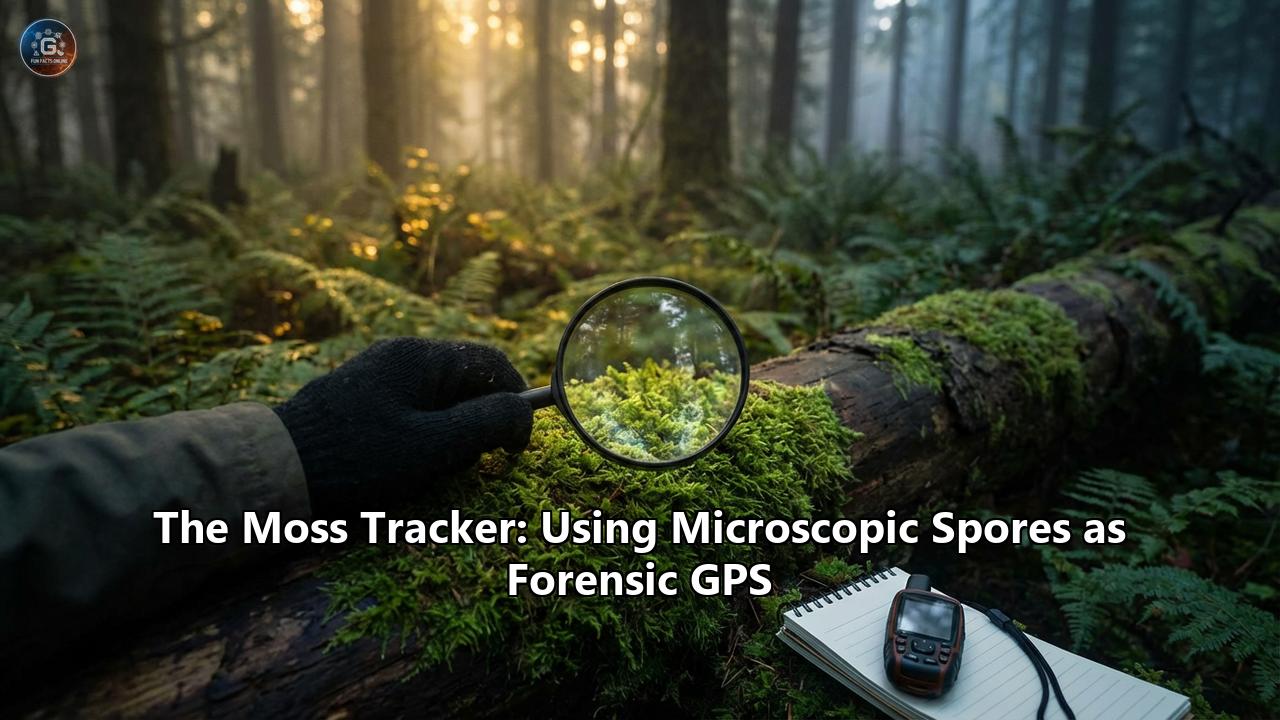
The forest floor is never truly silent. To the untrained ear, it may seem devoid of testimony, a chaotic scatter of leaves, mud, and decay. But to the forensic ecologist, the ground is screaming with information. Every step taken by a perpetrator, every brush against a tree branch, every momentary pause in a ditch leaves a microscopic signature—a biological barcode that can link a suspect to a crime scene with devastating precision. This is the world of the "Moss Tracker," where the silent witnesses are not people, but the invisible legions of spores, pollen grains, and microscopic plant fragments that coat our world.
In the annals of criminal justice, we have long relied on fingerprints, ballistics, and, more recently, DNA. These are the "macro" clues, the ones we can easily conceptualize. But there exists a parallel dimension of forensic science, one that operates on the scale of micrometers. It is a discipline that combines botany, ecology, palynology (the study of dust, pollen, and spores), and geology to create a "Forensic GPS." This system does not rely on satellites, but on the unique, localized assemblages of plant life that define every square meter of the Earth’s surface.
This article explores the fascinating, high-stakes, and scientifically rigorous world of forensic botany and palynology. We will delve into the biology of the invisible, the methodology of the hunt, the landmark cases that proved the science, and the future of using nature to solve the worst of human crimes.
Part I: The Science of the Invisible
To understand how a speck of dust can convict a murderer, one must first understand the biological engineering of the plant world. The primary actors in this forensic drama are pollen grains and spores.
The Indestructible witness: SporopolleninPollen and spores are the reproductive units of the plant kingdom. Pollen is produced by seed plants (angiosperms and gymnosperms) to transfer male genetic material to the female part of a flower. Spores are the reproductive units of cryptogams—plants that do not produce seeds, such as ferns, mosses, and fungi.
What makes them invaluable to forensics is not just their function, but their construction. The outer wall of a pollen grain or spore is made of a substance called sporopollenin. This complex biopolymer is one of the most chemically inert and durable organic substances known to science. It is nature's ultimate armor. Sporopollenin is resistant to strong acids, bases, high temperatures, and decay.
While a human body may decompose in weeks, and a fingerprint may wash away in a rainstorm, pollen grains can persist for millions of years. Paleobotanists regularly analyze pollen from the Jurassic period that is as pristine as the day it was released. In a forensic context, this means that evidence deposited on a piece of clothing, a shoe, or inside a car boot does not degrade. It waits. A jacket worn during a murder in 1990 and stored in a plastic bag will still carry the exact pollen signature of the crime scene when analyzed thirty years later.
The Fingerprint of PlaceIf durability is the first pillar of forensic palynology, diversity is the second. There are roughly 400,000 known plant species in the world. Each species produces pollen or spores with a unique morphology. Under a scanning electron microscope (SEM), these grains look like alien spacecraft. Some are spiked spheres (like the sunflower family), others are smooth ovals, some have air bladders (like pine pollen) that look like Mickey Mouse ears, and others are intricate, geometric lattices.
A forensic palynologist can look at a single grain and identify the plant it came from—often down to the genus, and sometimes the species.
However, the true power lies not in the single grain, but in the assemblage.
Imagine a crime scene in a woodland. This specific patch of earth is not just "a forest." It is a complex ecological community. It has an oak tree canopy (releasing Quercus pollen), an understory of hazel (Corylus), a ground cover of specific ferns (Pteridium), a patch of stinging nettles (Urtica) near the path, and a specific species of moss growing on the rotting log where the body was found.
The air and soil at this specific coordinate contain a mix of pollen and spores that reflects this exact community. A hundred meters away, the canopy might change to beech, the nettles might disappear, and a different moss might dominate. The "pollen profile" or "assemblage" shifts.
When a criminal walks through this scene, they become a pollinator of sorts. They pick up this specific cocktail of microscopic particles on their shoes, their trousers, their hair, and even inside their nasal cavities. This is the Forensic GPS. If the suspect’s shoes carry a mix of 40% Oak, 20% Hazel, 15% Nettle, and 5% of a rare moss species found at the crime scene, and that specific mix exists nowhere else in the region, the probability of them having been there becomes overwhelmingly high.
The Moss Connection: Bryophytes as Super-StickiesWhile pollen travels on the wind, moss spores and fragments are often heavier and stickier. Bryophytes (mosses, liverworts, and hornworts) are particularly damning evidence. Unlike trees, which disperse pollen over kilometers, many mosses have very localized dispersal. If a suspect has fragments of a specific moss on their clothing, it suggests direct contact.
Furthermore, mosses are incredibly resilient. They can desiccate (dry out) completely and appear dead, only to rehydrate and spring back to life when water is added. In the lab, a forensic botanist can take a brown, withered scrap from a suspect’s shoe, hydrate it, and watch the leaves unfurl to reveal their distinct cellular structure. DNA can be extracted from these tiny fragments even years later.
Because mosses grow in very specific micro-habitats—some like acidic soil, some like limestone walls, some only grow on the bark of specific trees—they offer a higher resolution of location than wind-blown pollen. Finding a specific moss assemblage is like finding a receipt with the GPS coordinates of the purchase.
Part II: The Methodology – From Mud to Microscope
The journey from a muddy boot to a courtroom conviction is a meticulous process, governed by strict protocols to prevent contamination and ensure scientific validity.
Step 1: The CollectionIn a typical investigation, the forensic ecologist is one of the first experts summoned to the scene, or conversely, brought in years later when a cold case is reopened.
At a fresh crime scene, the priority is to establish a Control Profile. The scientist will take soil and vegetation samples from the immediate area where the crime occurred (the deposition site). They will also take samples from the surrounding area—5 meters away, 10 meters away, 50 meters away—to understand how the vegetation changes. This establishes the "uniqueness" of the crime scene spot.
They also collect "alibi samples." If a suspect claims, "I wasn't in the woods, I was playing football at the local park," the scientist goes to the football park and samples the soil and vegetation there. This allows them to compare the suspect’s clothing against both the crime scene and the alibi location.
Step 2: The HarvestThe evidence from the suspect—shoes, clothing, car mats, shovels—is brought to the lab. The extraction of the "invisible witness" is a delicate art.
- Tape Lifts: Special adhesive tape is pressed onto clothing to lift surface debris.
- Washings: Dirty items are washed in filtered water or solvents to dislodge embedded particles.
- The Nasal Flush: In cases of homicide, the victim's nasal cavities are often flushed. The pollen inhaled in the last breaths can pinpoint the location of death, distinct from the location where the body was dumped.
- Soil Sectioning: If a lump of mud is found on a shoe, it is not just mashed up. It is dissected layer by layer. The bottom layer (closest to the shoe tread) represents the oldest mud (perhaps from the suspect's garden). The outer layer represents the most recent contact (the crime scene). A time-line of movement can be built from a single clod of dirt.
Once the material is collected, the organic chaos must be reduced to clean pollen grains. The samples undergo acetolysis. This involves boiling the sample in a mixture of acetic anhydride and sulfuric acid. This aggressive chemical bath digests everything—cellulose, lipids, proteins, bacteria, leaf matter—except the sporopollenin.
What remains is a clean residue containing only the pollen and spores. This residue is mounted on microscope slides.
Step 4: The CountThis is the grueling part. The palynologist sits at a high-powered light microscope (usually 400x to 1000x magnification) and counts. They don't just count a few; they count hundreds, sometimes thousands of grains per slide to ensure statistical significance.
They identify each grain: "One Pinus, one Poaceae (grass), one Taraxacum (dandelion), one Sphagnum spore..."
Step 5: The InterpretationThis is where science meets detective work. A raw list of pollen types is useless without ecological context.
The scientist must ask:
- Is this pollen consistent with the season? (Finding spring pollen in a sample from a crime committed in autumn implies the item wasn't washed since spring).
- Is this an insect-pollinated plant? (Insect-carried pollen is heavy and sticky; it doesn't fly in the wind. Finding it on a suspect implies direct contact with the plant).
- Is this an exotic species? (Finding pollen from a Cedar of Lebanon or a Monkey Puzzle tree is rare and creates a very specific link to a garden or park).
The final product is a report that compares the Crime Scene Assemblage with the Suspect Assemblage. If they match, and if that match is ecologically rare, the trap shuts.
Part III: The Pioneers and the Protocols
Forensic botany is not new, but it has only recently gained the recognition it deserves, largely due to a few tenacious pioneers.
The "Sherlock Holmes" of Spores: Professor Patricia WiltshireNo article on this subject is complete without discussing Professor Patricia Wiltshire. A British forensic ecologist, she is arguably the world's leading authority on the subject. She has worked on over 300 high-profile criminal cases.
Wiltshire is known for her rigorous approach. She doesn't just look at pollen; she looks at the "total profile"—the soil, the fungi, the moss, and the pollen together. She famously refers to the environment as a "particulate landscape." To her, a jumper is not a piece of clothing; it is a landscape that has moved through other landscapes, collecting souvenirs from each.
Her methodology emphasizes that nature is chaotic but patterned. She often reconstructs crime scenes mentally, visualizing the height of the vegetation, the direction of the wind, and the interaction between the perpetrator and the plants. Did they kneel? If so, the knees of the jeans will have a different pollen profile (ground-level flora) than the shoulders (canopy flora).
Locard’s Exchange Principle: The Botanical CorollaryEdmond Locard, the father of forensics, stated: "Every contact leaves a trace." In the world of botany, this is amplified. You can wipe fingerprints off a gun. You can bleach blood out of a shirt. But you cannot scrub every microscopic spore out of the weave of a fabric or the stitching of a shoe.
Plants are the ultimate adherents to Locard’s principle. They are designed to disperse. They want to travel. When a criminal moves through a forest, the forest is biologically engineered to tag them. Burrs stick to wool; sticky sap adheres to denim; microscopic hooks on spores latch onto synthetic fibers. The criminal is not just leaving traces; they are being actively colonized by the crime scene.
Part IV: Landmark Cases – When Nature Took the Stand
The true power of the Moss Tracker is best illustrated through the cases where it provided the key to the lock.
Case Study 1: The Soham Murders (2002)
The disappearance of two ten-year-old girls, Holly Wells and Jessica Chapman, in Soham, England, gripped the world. For weeks, there were no leads. Eventually, the school caretaker, Ian Huntley, became a suspect, but there was little physical evidence linking him to the remote ditch where the bodies were eventually found.
Enter Patricia Wiltshire.
The bodies had been dumped in a ditch overgrown with stinging nettles (Urtica dioica). To the average person, a nettle is a weed. To Wiltshire, it was a witness.
When she examined the shoes and the car of Ian Huntley, she found high concentrations of nettle pollen. But nettles are common; finding nettle pollen is not proof of guilt. However, Wiltshire went deeper. She analyzed the type of nettle pollen. She found that the pollen on Huntley’s items included "clumps" of immature pollen grains.
This was crucial. Nettle pollen is usually released explosively into the wind as single, dry grains. Clumps of immature pollen only exist if the plant has been violently thrashed or trampled, forcing the pollen sacs to burst prematurely. The presence of these clumps on Huntley’s car and shoes indicated he hadn't just walked near nettles; he had driven through them and trampled them violently—exactly the action required to dump bodies in an overgrown ditch.
Furthermore, she analyzed the soil on the car's underside. It contained a specific mix of brick dust, concrete particles, and a unique assemblage of ditch vegetation (including specific mosses) that perfectly matched the track leading to the deposition site.
The botanical evidence was so precise that it helped destroy Huntley’s alibi. He claimed he had never been to the ditch. The moss and the nettles proved he was a liar. He was convicted.
Case Study 2: The Cold Case of Christopher Laverack
In 1976, 9-year-old Christopher Laverack was murdered in Hull, England. His body was found in a local river, wrapped in a carpet bag and weighted down with a heavy ornamental brick. The case went cold for decades.
Thirty years later, the police reopened the file. They still had the clothing Christopher was wearing and the brick. They turned to palynology.
The pollen analysis of the boy's clothing revealed a garden assemblage: privet (Ligustrum), cypress (Cupressus), and other ornamental garden plants. It did not match the river bank where he was found. This suggested he was killed in a domestic garden and then moved.
The focus turned to the brick. It was a dense, concrete block. Analysis of the crevices in the brick revealed the same garden pollen assemblage, but also something more specific: spores from a specific fungus that grows on rotting timber, and pollen from a specific type of cedar.
Investigators looked at the boy’s uncle, Melvyn Read (who had since died). They examined the garden of the house Read lived in back in 1976. Despite 30 years passing, the "fingerprint of place" remained. The garden had a privet hedge. It had the specific cedar tree. It had the ornamental cypress. The pollen profile of the uncle's garden was a statistical match to the pollen on the murdered boy’s clothes and the murder weapon.
Although Read was dead, the botanical evidence allowed the police to posthumously identify him as the killer, providing closure to the family after three decades. The plants had held the memory of the murder for a generation.
Case Study 3: The "Baby Doe" – Geographic Profiling
In 2015, the body of a toddler was found washed up on a shore in Boston Harbor, Massachusetts. She was known only as "Baby Doe." With no missing persons report matching her description, police were stumped. Who was she? Where did she come from?
Forensic palynologists from the U.S. Customs and Border Protection were brought in. They analyzed the pollen found on the child’s hair and clothing.
They found a high concentration of Cedar (Cedrus) and Pine (Pinus) pollen, along with soot particles indicative of an urban environment. Crucially, the specific species of Cedar and the accompanying weeds were not native to the immediate coastal area where she was found.
The pollen pointed to a specific residential environment in the New England area, likely a neighborhood with ornamental landscaping rather than a wild forest. This "pollen geolocation" helped investigators narrow their search radius. Combined with isotope analysis (which analyzes drinking water signatures in teeth/bone), the evidence pointed away from international trafficking or distant states and focused the investigation locally.
Eventually, a tip came in identifying her as Bella Bond. The botanical evidence was consistent with the area of Boston where she had lived, helping to corroborate the narrative of her life and death.
Part V: The Moss Tracker in Action – A Step-by-Step Scenario
To fully appreciate the complexity, let’s construct a theoretical scenario based on standard forensic ecology procedures.
The Crime: A body is found buried in a shallow grave in a peat bog in Scotland. A suspect is arrested in London, 400 miles away. He denies ever being in Scotland. He has a pair of hiking boots in his garage that he claims he hasn't worn in years. The Investigation:- The Scene Analysis: The forensic ecologist visits the grave. They note the dominant vegetation: Sphagnum moss (multiple species), Heather (Calluna vulgaris), and Bog Asphodel. They take control samples. They also note a rare liverwort growing on the damp rocks nearby.
- The Boot Analysis: The suspect’s boots are seized. They look clean to the naked eye. The ecologist uses a fine needle to scrape debris from the stitching of the sole and the tongue of the boot.
- The "Exotic" Find: Under the microscope, the ecologist finds Sphagnum leaves. But Sphagnum grows in many places. However, they also find pollen from the Bog Asphodel (which is insect-pollinated and shouldn't be there unless the boot walked through it) and, the "smoking gun," a fragment of the rare liverwort found at the grave site.
- The Negative Match: Crucially, the ecologist checks the pollen against the flora of London parks. London parks have Plane tree (Platanus) and Lime tree (Tilia) pollen, and high levels of traffic pollution particulates. The boots have none of this in the upper mud layers. This proves the boots have not been worn in London recently.
- The Seasonality: The Bog Asphodel pollen found on the boots is fresh. This plant flowers in July. The suspect claims he hasn't been to Scotland in years. The presence of July-flowering pollen proves the boots were in a bog environment this July.
- The Conclusion: The boots were in a peat bog, in July, in a location containing that specific rare liverwort. The probability of this combination existing in a London garage is zero. The suspect's alibi is shattered.
Part VI: Beyond Murder – Other Applications
While homicide captures the headlines, the Moss Tracker is used in a variety of other high-stakes fields.
1. Narcotics TraffickingCocaine and Heroin are plant products. They come from plants that grow in specific regions. A shipment of cocaine seized in New York can be analyzed for pollen.
If the cocaine contains pollen from tropical weeds native to the Chapare region of Bolivia, intelligence agencies know the origin. If it contains pollen from plants native to Colombia, the supply chain is different.
Furthermore, as the drugs move, they pick up pollen from the packaging locations. If a shipment of cannabis contains pollen from a specific species of pine that only grows in a certain valley in Morocco, the route is traced. This is "Forensic Intelligence."
2. Counterfeit PharmaceuticalsFake malaria pills kill thousands of people. Palynologists analyze the starch and pollen inside the fake pills. If they find pollen from trees that only grow in southeast China, it points to the location of the illegal factory. This helps law enforcement target the manufacturing source rather than just the street dealers.
3. War Crimes and Mass GravesIn the aftermath of the Bosnian War, forensic palynology played a key role. Perpetrators often dug up mass graves and moved bodies to secondary locations to hide the evidence of genocide.
Investigators found that the bodies in the secondary graves were coated in pollen and soil types (specific clay minerals and rock types) that did not match the new burial site. The pollen matched the geology and flora of the original execution sites. This provided scientific proof of the movement of bodies and the cover-up operation, serving as crucial evidence in international war crimes tribunals.
4. Art ForgeryIs a painting a genuine Renaissance masterpiece or a 19th-century fake?
Palynologists can take a tiny scraping from the varnish or the canvas. If a painting supposedly painted in Italy in 1500 contains pollen from a plant that was only introduced to Europe from America in 1700 (like Maize or certain weeds), it is a fake. The air trapped in the drying paint captured the atmosphere of the time it was created.
Part VII: The Limitations and Legal Challenges
Despite its power, forensic palynology is not a magic bullet. It faces significant hurdles in the legal system.
The "Expert Shortage"There are very few highly trained forensic palynologists in the world—perhaps fewer than 50 who are fully qualified to testify in court. It takes years of training to learn to identify thousands of pollen types visually. While DNA analysis is largely automated, palynology is still a manual, labor-intensive art. This creates a bottleneck in investigations.
The Probability ProblemDNA gives a statistic: "1 in a billion chance." Palynology is often more qualitative. It relies on the expert saying, "In my opinion, this assemblage is extremely rare." Defense attorneys often attack this subjectivity. They argue, "Could this pollen have blown in from a garden five miles away?"
To combat this, modern forensic ecology is becoming more statistical, building databases of "pollen rain" to calculate precise likelihood ratios.
ContaminationBecause pollen is everywhere, contamination is a constant risk. If a police officer walks through the crime scene and then enters the room where the suspect is being interviewed, they can transfer pollen to the suspect. Strict anti-contamination suits (bunny suits) and protocols are essential.
SeasonalityPollen is seasonal. If a crime occurs in winter, there is less fresh pollen in the air. The evidence might rely more on "background" pollen in the soil, which is less precise than a fresh, seasonal flush.
Part VIII: The Future – DNA Barcoding and AI
The future of the Moss Tracker is high-tech. The discipline is currently undergoing a revolution.
1. eDNA and MetabarcodingInstead of looking at pollen grains under a microscope, scientists are beginning to sequence the DNA of the pollen. This is called environmental DNA (eDNA) or metabarcoding.
A soil sample is run through a sequencer, which reads the DNA of every plant fragment, bacteria, and fungus in the mix. This generates a massive list of species, far more than a human could count. It creates a digital biological fingerprint of a location with unparalleled resolution.
This method removes the "subjectivity" of the human eye and provides hard data that holds up better in court.
2. Automated Pollen Recognition (AI)Counting pollen is slow and causes eye strain. New AI systems are being trained to recognize pollen grains. A microscope scans the slide, and a neural network identifies the grains in seconds. This will speed up investigations and allow for the analysis of thousands of samples, creating a global "pollen map."
3. Drones and Remote SensingIn the future, drones equipped with sticky filters could fly over areas to sample the "air column" and create real-time pollen maps of cities and forests. If a crime occurs, police could consult the "pollen weather report" for that day to see exactly what biological tag was in the air.
Part IX: Conclusion – The unblinking Eye of Nature
The concept of the Moss Tracker reminds us of a profound truth: we are not separate from nature. We move through it, and it moves with us. We inhale its dust, we tread on its soil, and we carry its genetic code on our clothes.
For the criminal, this is a terrifying reality. They may wear gloves to hide fingerprints. They may bleach the scene to destroy DNA. They may burn the weapon. But they cannot stop the wind from blowing. They cannot stop the moss from shedding its spores. They cannot stop the microscopic rain of the forest from settling on their shoulders.
Forensic botany has turned the environment itself into a witness stand. It has given a voice to the silent ditch, the muddy path, and the garden hedge. In the pursuit of justice, these microscopic specks—durable, diverse, and ubiquitous—are proving to be the most reliable trackers on Earth. The criminal may run, but as long as they step on the earth, the earth will remember them.
Extended Technical Appendix: The Biology of the "Trace"
To fully grasp the "Moss Tracker" concept, it is valuable to understand the specific biological mechanisms that make this science possible. This section delves deeper into the botanical nuances that forensic experts exploit.
The Aerodynamics of GuiltNot all pollen is created equal. Plants have evolved different strategies to move their genetic material, and these strategies dictate the forensic value of the pollen.
- Anemophilous (Wind-Pollinated) Plants:
Examples: Pine, Oak, Grasses, Nettles, Cannabis.
Forensic Value: These plants produce massive amounts of lightweight pollen. A single cannabis plant can produce millions of grains. Because they travel far, they act as a "background signature" for a region. If a suspect has a high concentration of Pine pollen, it tells you they were in a coniferous region, but not necessarily which forest. However, the absence of this background pollen can be significant. If a body is found in a pine forest, but the suspect's clothes have zero pine pollen, it suggests they were never there.
- Entomophilous (Insect-Pollinated) Plants:
Examples: Roses, Lilies, Dandelions, most garden flowers.
Forensic Value: These are the gold standard. This pollen is heavy, sticky, and produced in small quantities. It does not fly in the wind. It relies on a bee or a beetle to carry it. Therefore, if this pollen is found on a suspect, it implies direct contact. The suspect must have brushed against the plant. Finding rare orchid pollen on a shirt is practically a GPS coordinate, as the orchid might only grow in a few specific locations.
- Hydrophilous (Water-Pollinated) Plants:
Examples: Sea-grasses, some pond weeds.
Forensic Value: Useful in drowning cases. If a suspect claims the victim drowned in a swimming pool, but the lungs contain pollen from a freshwater pond weed, the story is a lie.
The Bryophyte Advantage: Why Moss Matters MostWhile pollen is the "star" of palynology, bryophytes (mosses) are the unsung heroes of specific geolocation.
- The "Clumping" Factor: Unlike pollen, which separates into single grains, moss often travels as tiny clumps of leaves or protonema (the early growth stage). A clump contains more biological information than a single cell. It allows for DNA extraction and morphological matching of leaf cell patterns.
- The Habitat Specificity: Mosses are incredibly fussy.
Sphagnum moss requires acidic, waterlogged peat bogs.
Grimmia moss loves dry, exposed siliceous rocks and roofs.
Tortula muralis is the "wall screw-moss" found on urban concrete.
Schistostega pennata (Goblin Gold) grows only in dark, damp caves or rabbit holes and reflects light.
Finding a mix of Tortula (urban) and Sphagnum (bog) on a pair of trousers tells a story of a journey from the city to the wild—a common trajectory in abduction cases.
The Soil Profile: The Matrix of EvidenceForensic botanists rarely work with just the plant; they work with the soil it grows in. Soil is a "matrix" containing:
- Minerals: Sand, silt, clay (geology).
- Organic Matter: Decaying leaves (humus).
- Microbiota: Diatoms (microscopic algae), testate amoebae.
- Palynomorphs: The pollen and spores.
When a shoe treads on soil, it picks up this entire matrix. The "layering" effect on a shoe sole is critical.
- Layer 1 (Deepest in the tread): The mud from the suspect's own driveway (The "Home" signature).
- Layer 2: Mud from a gas station en route.
- Layer 3 (Surface): Mud from the crime scene.
A skilled forensic soil scientist can peel these layers apart. In one case, a layered mud sample on a wheel arch proved a vehicle had traveled from a limestone area (calcareous soil) to a granite area (acidic soil) and back again, destroying the suspect's claim that the car had not moved.
The Psychology of the Suspect and the Plant
Forensic Ecology also involves a degree of psychological reconstruction. The botanist asks: "How did the suspect interact with the vegetation?"
- The Drag: Dragging a body creates a "swathe" of destruction. It crushes plants, forcing sap and chlorophyll into the clothing of both the victim and the perpetrator. It also forces pollen deep into the weave of the fabric.
- The Hiding: Perpetrators often cover bodies with branches or leaves. This "botanical shroud" links the perpetrator to the specific tree they cut. If they used a knife to cut a birch branch, the saw marks on the wood can be matched to the knife, and the birch pollen on their gloves links them to the action.
- The Waiting: Kidnappers or snipers often lie in wait. This prolonged contact with the ground transfers a massive load of local fungal spores and soil bacteria to their clothing. The "buttock print" in the soil can be analyzed for compression and vegetation damage to estimate how long they waited—was it minutes (grass springs back) or hours (grass is chlorotic and dying)?
Case Study Deep Dive: The "Woodchipper" Murder (Helle Crafts Case)
Although famous for other forensic reasons (teeth, bone fragments), the Helle Crafts case (1986, Connecticut) had a botanical element. Richard Crafts disposed of his wife's body using a woodchipper near a river.
While the bone fragments proved death, the botanical evidence helped confirm the location*. Leaves and wood chips found mixed with the remains were identified as local species consistent with the riverbank, helping to confirm that the pile of debris was indeed the primary deposition site and not material dumped from elsewhere. It illustrated that even when a body is mechanically destroyed, the botanical context remains.
The Global Database Project
One of the most ambitious current projects in this field is the creation of global pollen databases.
The aim is to create a "Google Earth" for pollen.
- Step 1: Satellite imagery identifies vegetation cover (e.g., this is a pine forest, this is a wheat field).
- Step 2: Ground sampling verifies the pollen load in these areas.
- Step 3: AI models predict the pollen assemblage for any coordinate on the planet based on wind, season, and vegetation data.
If successful, a detective could theoretically upload a photo of a pollen slide from a suspect’s jacket, and the system would output a heat-map of the world (or the city) showing the "hotspots" where that specific mix exists. This would transform forensic palynology from a reactive science (checking a specific location) to a proactive one (finding the location from scratch).
Final Thoughts: The Justice of Nature
In a world increasingly dominated by technology, it is ironic that one of our most sophisticated forensic tools is also our most primal. It is the dust of the earth.
The "Moss Tracker" teaches us that nothing vanishes without a trace. We are constantly exchanging matter with our environment. We are painting our biographies onto the world in footprints and skin cells, and the world is painting its biography onto us in pollen and spores.
For the victim of a violent crime, buried in a lonely wood, this is a final hope. The trees stand witness. The moss keeps watch. And eventually, a scientist with a microscope will listen to their story. The silence of the forest is an illusion; it is speaking the truth, if we only know how to listen.
Reference:
- https://www.positive.news/society/justice/meet-the-forensic-ecologist-who-uses-nature-to-solve-crimes/
- https://www.asteetrace.org/palynology
- https://www.youtube.com/watch?v=5Fuw4_ZW1_g
- https://resources.environment.yale.edu/envy/stories/the-science-of-pollen/
- https://newsharbour.co.uk/patricia-wiltshire/
- https://www.researchgate.net/publication/365150345_Forensic_Palynology
- https://www.youtube.com/watch?v=jdWLZhTh8Wg
- https://www.biotechniques.com/analytical-chemistry/a-silent-witness-how-analysis-of-pollen-can-solve-crimes/
- https://www.ojp.gov/events/forensic-palynology-and-search-geolocation-using-pollen-fingerprints-generate-investigative
- https://www.cabidigitallibrary.org/doi/10.1079/soilsciencecases.2024.0004
- https://www.youtube.com/watch?v=wcCFiz4726g
- https://m.researching.cn/articles/OJfa1a3fa938076ef0
- https://www.lyellcollection.org/doi/10.1144/sp492-2021-81
- https://www.southampton.ac.uk/geography/about/staff/pewle15.page
- https://en.wikipedia.org/wiki/Patricia_Wiltshire
- https://pubmed.ncbi.nlm.nih.gov/31400618/
- https://www.cellmarkforensics.co.uk/services/specialist-forensic-service/soil-botany-pollen/
- https://portlandpress.com/emergtoplifesci/article/5/3/475/228415/Forensic-botany-time-to-embrace-natural-history
- https://www.researchgate.net/publication/6504346_Forensic_botany_Usability_of_bryophyte_material_in_forensic_studies
- https://en.wikipedia.org/wiki/Forensic_palynology
- https://www.studysmarter.co.uk/explanations/law/forensic-science/forensic-bryology/